
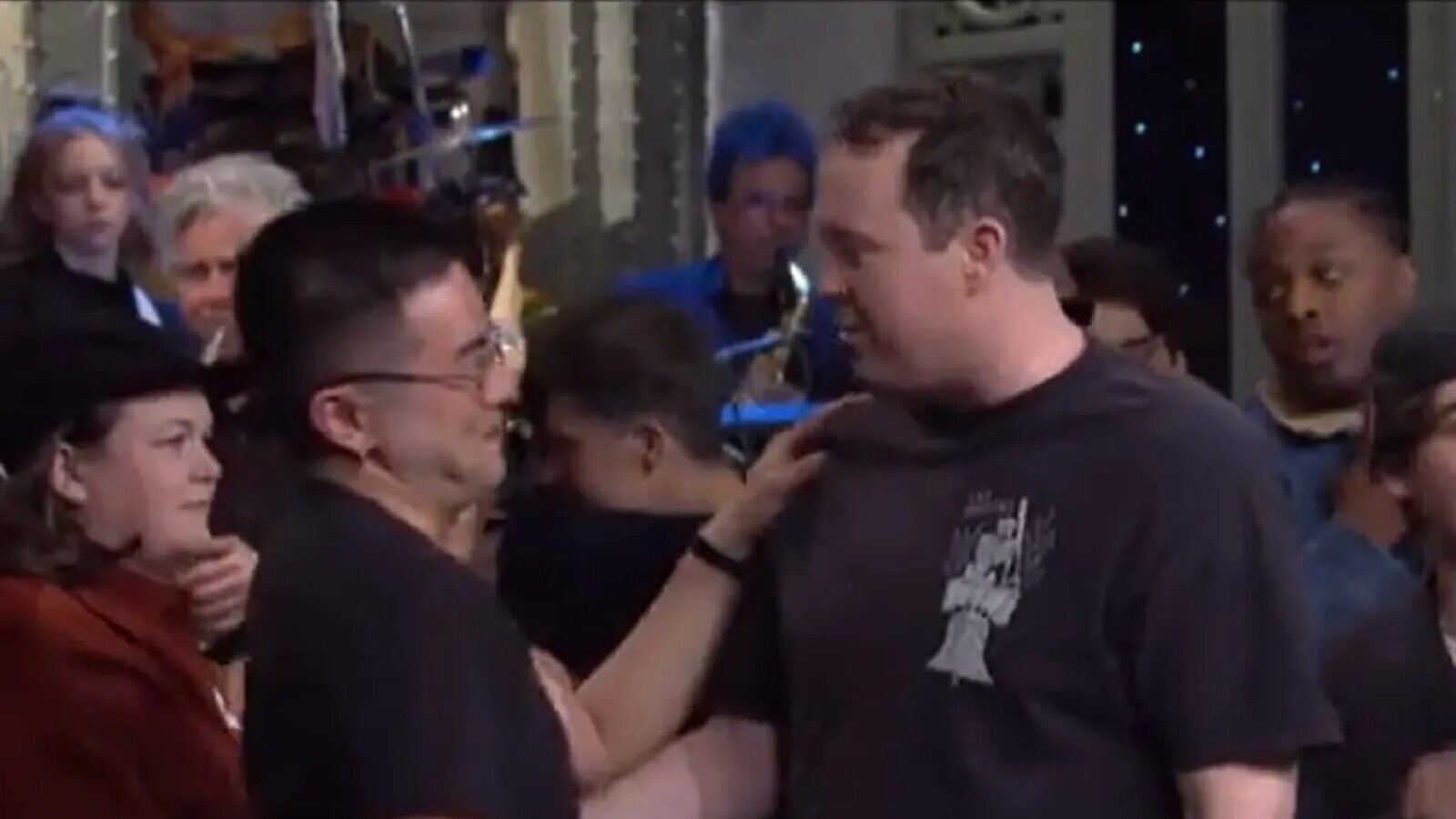
Comedy drama is best when it stays onstage. Unfortunately, the latest mini-firestorm around Bowen Yang, Shane Gillis, and Saturday Night Live proved once again that the internet prefers its sketches served with comment-section seasoning. The story began when a person described in reports as an SNL background actor, Michelle Best, accused Yang of helping get Gillis fired from the show in 2019. Yang did not write a long essay. He did not issue a corporate statement. He simply replied with the kind of sharp, compact comeback that makes social media gasp, screenshot, and whisper, “Well, that landed.”
The headline practically writes itself: Bowen Yang roasts Saturday Night Live extra who says he got Shane Gillis fired. But the bigger story is not just one Instagram clapback. It is about how one of TV’s most famous comedy institutions became a stage for an old argument about accountability, cancel culture, representation, and who gets blamed when a public scandal becomes too convenient for nuance.
What Happened Between Bowen Yang, Michelle Best, and Shane Gillis?
The dispute resurfaced around Shane Gillis’ return to Saturday Night Live as host. Under an Instagram post promoting Gillis, Michelle Best praised him and suggested that Bowen Yang had played a role in Gillis being removed from the cast years earlier. Reports noted that Best’s comment framed Gillis as unfairly pushed out and used insulting language toward Yang.
Yang’s response was direct: he denied having anything to do with Gillis’ firing and added a stinging reminder that he had written the sketch in which Best appeared as a background actor. In comedy terms, that is not just a rebuttal. That is a two-piece combo with a callback. He rejected the accusation, defended his own role, and turned the comment back on its author without writing a single overcooked notes-app monologue.
For anyone catching up, Shane Gillis was announced as a new SNL cast member in September 2019 alongside Bowen Yang and Chloe Fineman. Almost immediately afterward, clips from Gillis’ podcast surfaced featuring offensive remarks, including racist and homophobic language. Within days, SNL announced that Gillis would not join the cast. Yang, who had just made history as the show’s first Chinese American cast member, was suddenly pulled into a national conversation he did not create.
Why Bowen Yang’s Response Hit So Hard
Yang’s comeback worked because it was funny, factual, and wonderfully economical. The best roast does not need a marching band. It needs timing. Yang’s reply essentially said: no, I did not get him fired; also, let’s not pretend you were running the room when I was writing the material you appeared in.
That last part is what made the moment travel. A background actor claiming behind-the-scenes knowledge about a major casting controversy is already bold. Doing so to a cast member who was actually in the writers’ room is bold with extra glitter. Yang’s response reminded readers that proximity is not the same as authority. Being in the building does not mean you know who pulled the fire alarm.
The Power of a Clean Clapback
Yang has built much of his public persona on wit that feels polished but not frozen. On SNL, his best characters often work because they mix absurd confidence with emotional precision. Whether playing a chaotic iceberg, a theatrical public figure, or a self-aware pop-culture creature, Yang understands the magic of saying just enough. His response to Best followed the same formula: short setup, sharper punchline, clean exit.
It also helped that Yang did not sound defensive in a sweaty way. He sounded tired of a rumor that had overstayed its lease. That tone matters. In internet conflict, the person who seems calm usually wins the room. Yang did not need to prove he was not the villain of someone else’s theory. He simply punctured the theory and moved on.
The Shane Gillis Firing: A Quick Timeline
To understand why the accusation against Yang gained attention, it helps to revisit the timeline. In September 2019, Saturday Night Live announced three new cast members: Bowen Yang, Chloe Fineman, and Shane Gillis. Soon after, old podcast clips of Gillis circulated widely. The clips included derogatory comments about Asian people, gay people, and others. The backlash was swift, and SNL announced that Gillis would not move forward as a cast member.
Gillis later continued his stand-up career and built a large fan base. In February 2024, he returned to SNL as host, joking in his monologue about having been fired from the show. In March 2025, he returned again as host with Tate McRae as musical guest. That return reignited the 2019 conversation, because the internet keeps old controversies in a drawer labeled “open during engagement dips.”
Reports later noted that Lorne Michaels said he was unhappy with the firing and suggested that the decision came from higher-level NBC leadership. That detail matters because it undermines the simple theory that Yang personally orchestrated Gillis’ exit. The actual situation appears to have involved network judgment, public pressure, vetting failures, and a fast-moving media stormnot one newly promoted cast member quietly moving chess pieces in Studio 8H.
Bowen Yang Was Dragged Into a Culture War He Did Not Start
One reason Yang’s response resonated is that he has repeatedly described the 2019 situation as something that happened around him, not because of him. Yang was a new cast member, a writer-turned-performer, and a milestone hire for Asian American representation on SNL. Then, within hours, his debut became entangled with Gillis’ controversy.
That is an uncomfortable position. Yang did not make the comments. He did not release the clips. He did not hire Gillis. He did not fire Gillis. Yet because Yang is Asian American and openly gay, some commentators treated him as a symbolic opposite to Gillis. The narrative became too neat: one comedian represented offensive old comedy, the other represented modern inclusion. Real life, inconveniently, is not a sketch with name tags.
In later interviews, Yang suggested that both he and Gillis were used by larger media narratives. That is a more mature reading than the usual online scoreboard. It acknowledges that two comedians can be placed into opposing roles by people who want a simple fight. The internet loves heroes and villains because it is bad at processing co-workers, institutions, timing, and context all at once.
Why the “Bowen Yang Got Shane Gillis Fired” Claim Does Not Hold Up
The claim falls apart for several reasons. First, Gillis’ firing followed widely circulated clips that created public backlash. Second, SNL released its own decision through official channels. Third, Lorne Michaels later indicated that the call was not simply a cast-level decision. Fourth, Yang himself has denied involvement. Finally, the idea that a newly promoted cast member could force a network-level decision within days gives him a level of power that even longtime SNL stars would probably love to have.
That is the funny part hiding under the mess. If Bowen Yang truly had the power to control NBC hiring and firing decisions in 2019, he would not just be a cast member. He would be the Wizard of 30 Rock, pulling levers behind a velvet curtain while interns bring him iced coffee and Emmy nominations.
Social Media Loves a Convenient Villain
The reason the rumor survives is not because it is well-supported. It survives because it is emotionally useful to certain audiences. For people who view Gillis’ firing as an example of “cancel culture,” Yang becomes an easy character to blame. He is visible, successful, Asian American, queer, and associated with the show’s changing identity. That makes him a magnet for projections that have little to do with what actually happened.
But blaming Yang turns a complicated institutional decision into a personal grudge story. It removes Gillis’ own words from the center of the controversy and replaces them with a fantasy about sabotage. That may be more dramatic, but it is not more accurate.
How Shane Gillis’ Return Changed the Conversation
Gillis’ return to Saturday Night Live as host complicated the entire narrative. If SNL had permanently banished him, the old culture-war script would remain easier to maintain. Instead, the show invited him back. Gillis performed monologues, appeared in sketches, and turned his firing into part of his public mythology.
For his fans, the return looked like vindication. For critics, it raised questions about whether accountability in entertainment is temporary when a comedian becomes commercially valuable enough. For casual viewers, it was probably just another Saturday night where someone made jokes while a musical guest waited backstage in great lighting.
Yang’s response to Best arrived in that atmosphere. Gillis was no longer an exiled figure outside the building. He was hosting the show. That made the accusation against Yang feel even stranger. If Gillis and SNL had reached a place where he could return as host, why keep blaming Yang for an old decision that the show itself had clearly moved beyond?
The Comedy Industry’s Bigger Lesson
This incident shows how comedy is still wrestling with old boundaries and new audiences. Stand-up comedy has always involved risk, provocation, and failure. Sketch comedy, especially on a mainstream network, involves different pressures: advertisers, corporate standards, live broadcast rules, social responsibility, and public perception. When those worlds collide, the result can be messy.
Gillis came from a stand-up and podcast ecosystem where comics often test boundaries in loose, conversational formats. SNL operates inside a legacy television machine that cannot treat every offensive remark as an experiment. Yang represents another modern reality: performers from historically underrepresented groups are often expected to answer for controversies they did not cause. That expectation is exhausting, unfair, and, frankly, bad writing.
Accountability Is Not the Same as Erasure
One of the most useful ways to read the situation is to separate accountability from erasure. Gillis lost the SNL cast job in 2019, but his career did not disappear. He continued touring, built a major fan base, worked with Netflix, and returned to host the very show that once cut ties with him. Yang, meanwhile, built a standout SNL career, earned major recognition, appeared in film and television projects, and became one of the show’s defining modern performers.
Both careers continued. That does not erase the original controversy. It does, however, challenge the idea that one person’s career can be summed up by a single firing or that another person should be blamed forever for a decision he says he did not make.
Why Bowen Yang’s Roast Became a Perfect Internet Moment
The reason this story spread is simple: it had all the ingredients. Famous show? Check. Old controversy? Check. Accusation in an Instagram comment? Check. A celebrity response that was both denial and dunk? Absolutely check.
Yang’s roast worked because it restored scale. A background actor made a sweeping claim about a network-level firing. Yang answered with a reminder of who was actually writing the sketch. In a culture where everyone wants to sound like an insider, his reply was a tiny comedy masterclass in status correction.
It also revealed something about how audiences consume entertainment news. People are not only interested in what happened; they want to know who embarrassed whom. They want the clapback, the quote, the screenshot, the moment where someone says the thing everyone else was thinking but with better punctuation.
Experiences Related to the Bowen Yang and Shane Gillis Conversation
Anyone who has worked in a creative environment can recognize a smaller version of this drama. Maybe not the NBC-and-national-headlines version, thankfully. But many workplaces have moments where someone outside the decision-making circle confidently explains what “really happened.” The person may have been in the room once. They may have heard a story from a friend of a friend. Suddenly, they are narrating the entire corporate thriller like they directed it.
That is why Yang’s response felt satisfying beyond celebrity gossip. It spoke to the experience of being blamed for a decision that had more layers than people want to admit. In any office, writers’ room, theater company, classroom, or group project, it is easy for a rumor to flatten reality. One person becomes the villain because the true explanation involves too many meetings, too much timing, and too many people with actual authority.
There is also a lesson here for anyone who posts publicly: confidence is not evidence. Social media rewards boldness, but boldness can quickly become self-own territory when the person you accuse shows up with receipts. Best’s comment may have been meant as support for Gillis, but it ended up giving Yang the perfect platform to deny the claim and remind everyone of his professional role. That is the risk of turning speculation into accusation in a public comment section. The main character may answer.
For fans, the experience is different but equally familiar. Many people develop strong feelings about comedians, shows, and controversies from a distance. They pick sides based on clips, headlines, and the communities they follow. A Gillis fan may see his firing as unfair punishment. A Yang fan may see the blame directed at Yang as scapegoating. An SNL fan may see the whole thing as another chapter in the show’s long history of making controversial decisions and then folding the controversy back into the show.
The healthier experience is to hold more than one thought at a time. Gillis can be a successful comedian and still have faced consequences for offensive remarks. Yang can be a sharp comic and still not be responsible for another performer’s firing. SNL can be a legendary institution and still make messy hiring decisions. Comedy can push boundaries and still receive criticism when those boundaries cut into real communities. None of these ideas cancel the others out.
For writers and content creators, this story is also a reminder that tone matters. Yang did not respond with a lecture. He responded with precision. That is often more effective. When the facts are on your side, you do not need to bury them under twenty paragraphs of fury. A clean line can do more than a thunderstorm. The roast worked because it was short enough to travel and specific enough to stick.
Finally, there is a personal lesson in refusing roles that other people assign to you. Yang was cast by the media and online commenters into a symbolic role in Gillis’ firing. Years later, he is still pushing back against that script. That is relatable. Many people spend years trying to correct a version of themselves invented by others. The best response is not always to explain endlessly. Sometimes it is to say, plainly, “That is not what happened,” add one perfect punchline, and get back to work.
Conclusion: The Roast Was Funny, but the Context Matters
Bowen Yang’s roast of the Saturday Night Live extra who claimed he got Shane Gillis fired was a compact, memorable internet moment. It was funny because it was sharp. It mattered because it corrected a lazy narrative. The real story is not that Yang secretly controlled Gillis’ fate. The real story is that a complicated 2019 controversy keeps getting repackaged into simple blame games.
Yang’s response cut through that noise. Gillis’ career continued. Yang’s career grew. SNL moved forward, awkwardly and publicly, the way it often does. And the internet received what it always wants: a fresh screenshot, a clean burn, and another excuse to debate whether comedy is too sensitive, not sensitive enough, or simply addicted to making its messiest arguments in the comments.












