
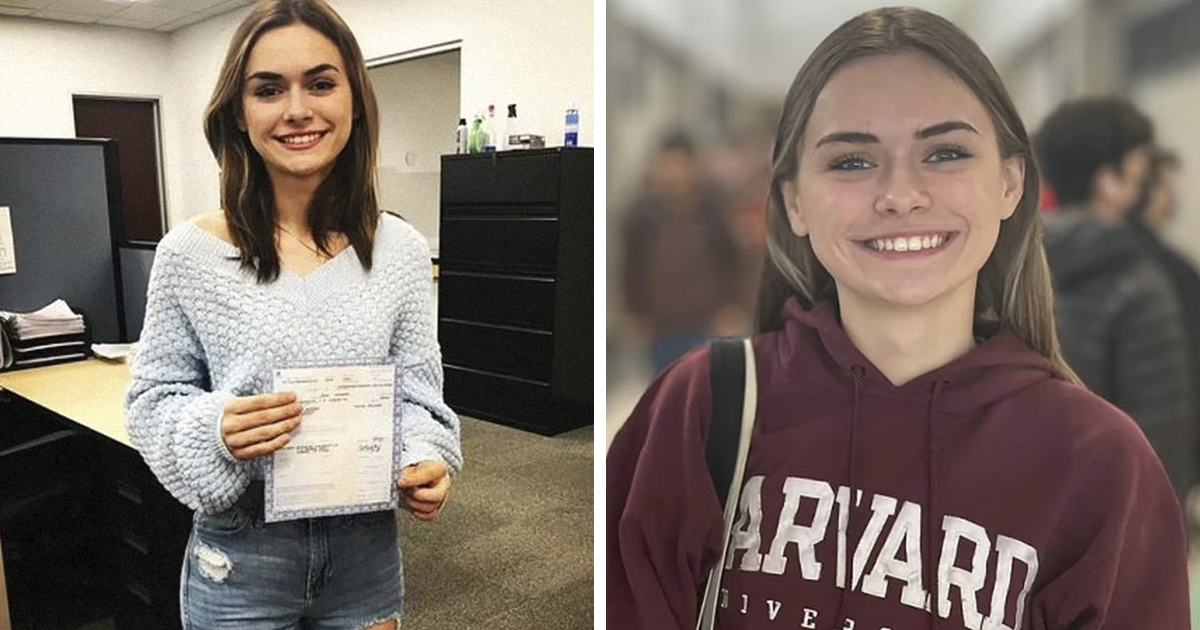
Some college application essays begin with a favorite quotation, a childhood hobby, or a carefully polished story about winning the big game. Aurora Sky Castner began hers with four unforgettable words: “I was born in prison.” It was not a dramatic metaphor. It was the first fact of her lifeand the starting point of a journey that eventually carried her from a Texas county jail to Harvard College.
Who Is Aurora Sky Castner?
Aurora Sky Castner, commonly known as Sky Castner, was born in the Galveston County Jail in Texas while her mother was incarcerated. Shortly after her birth, Castner’s father collected her from the jail and raised her as a single parent in Montgomery County.
Her childhood did not follow a predictable path. She and her father moved frequently, and her biological mother was largely absent from her life. Castner reportedly spoke with her mother only once, when she was 14. Yet the uncertainty surrounding her early years did not prevent her from developing a fierce attachment to learning.
By elementary school, she was already known as an enthusiastic reader. Books offered structure, possibility, and perhaps the comforting idea that an opening chapter does not dictate the ending. That lesson would become the unofficial theme of the Sky Castner story.
A Bright Student With a Competitive Streak
Castner did not drift casually toward academic success. She pursued it with intention. She later explained that earning all A’s gave her a sense of satisfaction and accomplishment. Grades mattered to hernot merely as numbers on a report card, but as proof that disciplined effort could produce something stable.
At Reaves Elementary School in Conroe, educators noticed both her intelligence and her need for additional adult support. They referred her to Conroe Independent School District’s Project Mentor, a program that connects students with community volunteers who can provide consistent encouragement and guidance.
That referral would become one of the pivotal moments in her life. It is also an excellent reminder that educators rarely know how far a thoughtful introduction may travel. Sometimes a referral form is merely paperwork. Sometimes it quietly helps redirect an entire future.
The Mentor Who Became Family
When Castner was eight years old, Project Mentor paired her with Mona Hamby. Before their first meeting, Hamby received a short description of the child she would mentor. Castner’s hero was Rosa Parks, she loved reading, and her favorite food was reportedly tacos from Dairy Queen. It was an endearingly specific résumé.
Hamby initially expected to meet Castner for school lunches and ordinary mentoring activities. She soon understood that the young student needed something deeper and more consistent. Their relationship expanded beyond weekly conversations into a decade-long bond.
Hamby helped Castner obtain glasses, accompanied her for her first professional haircut, and introduced her to experiences outside the environment in which she had grown up. Other members of the community contributed dental and orthodontic care and helped her attend summer camp.
These details may sound small beside the word “Harvard,” but they are not small to a child. Being able to see the classroom board, smile without embarrassment, attend camp, or walk into a salon with a trusted adult can change how a young person participates in the world.
Importantly, Hamby did not manufacture Castner’s intelligence or ambition. Castner brought the talent, effort, curiosity, and competitive drive. Her mentor helped remove obstacles, widen the map, and provide the steady reassurance that someone was paying attention.
Turning Harvard From a Fantasy Into a Plan
Castner reportedly dreamed about Harvard from a young age, but distant dreams become more powerful when they acquire physical details. In March 2022, Hamby and her husband took her to visit the university’s campus in Cambridge, Massachusetts.
The trip made Harvard feel less like a famous name printed on sweatshirts and more like a place where Castner could actually live, study, and belong. Hamby later observed that her enthusiasm for the school intensified after the visit.
Castner continued challenging herself at Conroe High School, where she attended the Academy for Health and Science Professions. The specialized program emphasized demanding coursework in science, mathematics, and related fields. Meanwhile, her legal ambitions led her to consider subjects such as psychology and philosophy, both of which can strengthen the analytical foundation needed for a future law degree.
When application season arrived, Boston University professor James Wallace assisted her in shaping her personal essay. Castner said he helped her tell her story in the best possible way. That wording matters. A good admissions adviser does not replace an applicant’s voice with something shinier. The adviser helps the applicant make the existing voice clearer.
“I Was Born in Prison”
Castner’s Harvard application reportedly opened with the sentence, “I was born in prison.” It was direct, startling, and impossible to confuse with the opening of anybody else’s essay.
However, the sentence worked because it introduced a complete story rather than serving as a piece of emotional decoration. Her application was supported by years of excellent grades, advanced coursework, focused preparation, mentorship, and intellectual curiosity. Harvard admissions officers were not evaluating only an unusual birthplace. They were evaluating what Castner had done with the life that followed it.
Her approach also demonstrated ownership. She could have hidden the circumstances of her birth, fearing that they might trigger judgment or pity. Instead, she presented the truth on her own terms. She made it context, not a verdict.
That distinction is crucial. Personal hardship should never become a performance applicants feel forced to sell. Castner’s story was effective because the difficult beginning belonged naturally to the larger account of her growth.
Graduating Near the Top of Her Class
In May 2023, Castner graduated summa cum laude from Conroe High School. She ranked third in the graduating class, an achievement that reflected years of consistency rather than one spectacular semester.
Her decorated graduation cap announced that she was “Harvard 2027 Bound.” After being admitted through Harvard’s early-action process, she prepared to leave Texas and begin college in Cambridge.
Graduation photographs showed the usual mixture of excitement, nerves, laughter, adjusted tassels, and adults trying unsuccessfully not to cry. The celebration was deeply personal, but its meaning extended to the people who had accompanied Castner along the way: her father, Hamby, teachers, counselors, health professionals, and community supporters.
An Important Clarification About Studying Law at Harvard
Many headlines described Castner as being accepted to “study law at Harvard.” That phrase is understandable shorthand, but it is technically inaccurate.
Castner was admitted to Harvard College, the university’s undergraduate schoolnot directly to Harvard Law School. Harvard College does not offer a formal pre-law major. Undergraduate students who are interested in legal careers may study psychology, government, history, economics, philosophy, science, literature, or virtually any other concentration before applying separately to law school.
A student seeking a Juris Doctor degree from Harvard Law School must first complete a bachelor’s degree and then participate in the law school admissions process. Admission to Harvard College does not guarantee later admission to Harvard Law School.
Therefore, the most accurate version of Castner’s goal is that she entered Harvard College with an interest in pursuing law as a future career. The clarification does not make her accomplishment less impressive. Getting into Harvard College is not exactly the academic equivalent of finding a coupon in a cereal box.
What Sky Castner Is Doing at Harvard
More recent public profiles identify Castner as a Harvard College undergraduate concentrating in psychology. Her reported campus activities suggest that her interests have grown beyond the original viral headline while remaining connected to questions of equity, service, and human behavior.
She has been publicly listed as a project leader with Harvard Undergraduate Global Research and Consulting Group, an organization that provides pro bono research and consulting assistance to nonprofits and social-impact ventures. Another profile describes her involvement with equity-focused clean-energy work and Harvard’s innovation community.
Castner has also been identified as a co-founder of Aurora & Lei Press, a Harvard-based nonprofit publishing initiative focused on multilingual access to information in fields such as law, health, entrepreneurship, aging, and education.
These activities reflect a meaningful evolution. Her story is no longer simply about a teenager who was accepted to Harvard. It is becoming the story of a college student testing different ways to turn education into useful work.
Why the Sky Castner Story Resonates
Castner’s journey attracts attention because the contrast is dramatic: a birth inside a jail and an education at one of the world’s most selective universities. Yet reducing her life to those two locations would miss the most instructive partthe long middle.
That middle contained years of reading, studying, adjusting to change, accepting help, visiting new places, completing assignments, and continuing after ordinary disappointments. Resilience usually looks less like a movie montage and more like doing homework when nobody is playing inspirational music in the background.
Her circumstances also connect to a much larger American story. Millions of children in the United States have experienced the incarceration of a parent. Research has associated parental incarceration with financial stress, family instability, stigma, emotional strain, and educational difficulty. These outcomes are risks, however, not destinies.
Castner’s achievements should not be used to suggest that every child can overcome structural disadvantages through determination alone. Her story demonstrates something more useful: ability can flourish when personal effort meets reliable relationships and practical opportunity.
Resilience Was Only Part of the Equation
Inspirational profiles often place one extraordinary student alone beneath a spotlight. Everyone else disappears, and “resilience” receives all the credit. Castner’s journey offers a more honest picture.
Her father assumed responsibility for raising her. Teachers recognized her strengths. A school district maintained a mentoring program. Hamby sustained the relationship for years. Community members addressed health needs. A professor helped her present her experiences clearly. Castner then used those resources with exceptional discipline.
None of these contributions cancels another. Support did not diminish her achievement, and her achievement did not make support unnecessary.
The result was not a lone superhero story. It was an example of what can happen when a talented young person repeatedly encounters adults who answer, “Yes, let’s figure that out,” instead of, “That is probably not for someone like you.”
Lessons for Schools, Mentors, and Communities
Notice Potential Before It Becomes Obvious
Castner’s teachers recognized her love of reading and academic promise while she was still in elementary school. Schools should not wait until a student wins awards before offering enrichment, mentorship, or advanced opportunities.
Make Mentoring Consistent
Research on youth mentoring repeatedly emphasizes that trust develops through time and reliability. Hamby remained present for approximately a decade. The duration of that bond was likely as significant as any individual outing or piece of advice.
Address Practical Barriers
A student may possess exceptional ability while still needing glasses, dental treatment, transportation, application guidance, or suitable clothing. Dreams require logistics. Motivational posters are pleasant, but they rarely schedule an orthodontist.
Let Young People Own Their Stories
Supporters helped Castner communicate her experiences without defining her entirely by them. Students should be able to discuss hardship with dignity, complexity, and control rather than being turned into inspirational mascots.
Expand a Student’s Sense of Belonging
The Harvard campus visit allowed Castner to imagine herself in a place she had previously known only from a distance. College tours, professional shadowing, cultural programs, and introductions to new environments can turn an abstract possibility into a concrete plan.
A Beginning Is Not a Biography
Aurora Sky Castner’s life began in the Galveston County Jail, but her birthplace did not contain instructions for the rest of her future. Through academic focus, a committed father, long-term mentorship, community support, and her own willingness to aim high, she reached Harvard College and began building a broader path in psychology, social impact, publishing, and public service.
The most inspiring part of her story is not that she somehow erased the past. She did something more powerful: she incorporated it into a larger identity without allowing it to become the only identity available to her.
Her journey is evidence that circumstances matter, opportunities matter, and people matter. It also reminds us that a young person’s potential may be present long before the surrounding world has provided the tools to reveal it.
Related Experiences: What Journeys Like Castner’s Can Feel Like
Although no two lives are identical, Castner’s reported experiences reflect challenges familiar to many students from unstable, low-income, single-parent, or justice-affected families. Understanding those experiences helps move the conversation beyond a feel-good headline.
The Experience of Feeling Different
Children whose families have encountered incarceration may learn early that certain personal facts produce uncomfortable reactions. They may avoid discussing a parent, invent explanations, or constantly evaluate whether a new friend can be trusted. Even when the child has done nothing wrong, stigma can behave like an unwanted backpack carried from classroom to classroom.
Castner’s decision to begin her application with the truth reversed that dynamic. Instead of waiting for someone else to discover or define the circumstances, she controlled the introduction. Students in similar situations often describe that kind of honesty as frightening but freeing.
The Experience of Receiving Ordinary Things That Feel Extraordinary
A mentor helping a child choose glasses or arranging a haircut may appear unrelated to university admission. For the student, however, these moments can communicate safety, attention, and worth. The lasting memory is not simply the object or appointment. It is the realization that an adult noticed a need and returned to help meet it.
Long-term mentors also provide access to unwritten knowledge: how to ask questions, communicate with teachers, prepare for an interview, travel to an unfamiliar city, or recover after an awkward mistake. Families with more resources often transfer this information naturally. Other students must acquire it through teachers, counselors, coaches, employers, or volunteers.
The Experience of Visiting a Place You Never Expected to Enter
Walking through an elite campus can produce excitement and intimidation at the same time. A student may admire the libraries while wondering whether everyone else received a secret instruction manual. Campus visits help because they replace a glossy image with classrooms, sidewalks, dining halls, and ordinary people carrying overloaded backpacks.
For Castner, seeing Harvard in person reportedly intensified her commitment. For many first-generation applicants, physical exposure creates a subtle but decisive shift from “People go there” to “I could go there.”
The Experience of Writing About Pain Without Being Reduced to It
Application essays present a difficult balance. Students want admissions officers to understand the obstacles they have faced, but they do not want their suffering to become their most marketable quality. The strongest narratives usually connect hardship to choices, interests, relationships, and intellectual development.
Castner’s opening line attracted attention, but the rest of her record gave it meaning. Her experience illustrates why applicants should never feel pressured to exaggerate trauma. An admissions essay is not a contest to determine who had the worst childhood. It is an opportunity to show how a person thinks, acts, learns, and hopes to contribute.
The Experience of Arriving After the Celebration Ends
Acceptance day makes excellent news. College life is longer and more complicated. Once students arrive, they must manage demanding classes, new social expectations, homesickness, finances, and the unsettling discovery that nearly everyone was impressive in high school.
Success therefore changes shape. It becomes asking for tutoring, joining organizations, revising career plans, building friendships, and learning that uncertainty is not evidence of failure. Castner’s more recent activities in psychology, consulting, equity work, and publishing suggest that her Harvard experience is not a fixed script. It is an ongoing process of exploration.
That may be the most relatable lesson of all. Reaching a dream school does not finish a person’s story. It simply provides a new setting, harder questions, andjudging by college dining hallsa mysterious number of ways to prepare pasta.











