
Note: This article is written for web publication and synthesizes verified production history, filmmaker interviews, official film records, and critical data. Direct source links are omitted by request.
Introduction: A Tiny Island, a Giant Imagination
Moonrise Kingdom looks like someone tucked a love story inside a vintage field guide, shook in a thunderstorm, and labeled the whole thing “important childhood evidence.” Directed by Wes Anderson and co-written with Roman Coppola, the 2012 coming-of-age comedy-drama follows two lonely 12-year-olds, Sam Shakusky and Suzy Bishop, as they run away together across the fictional New England island of New Penzance in the summer of 1965. On paper, that sounds simple. On screen, it becomes a carefully built miniature universe of Khaki Scouts, binoculars, record players, church pageants, stern adults, hand-sewn patches, and feelings too large for small people to carry politely.
Behind the scenes, Moonrise Kingdom was not merely “another Wes Anderson movie.” It was a major creative turning point. The film combined Anderson’s precise visual language with a wilder emotional center, using real Rhode Island locations, Super 16mm cinematography, deeply researched production design, handmade costumes, and a soundtrack shaped by Benjamin Britten, Hank Williams, Françoise Hardy, and Alexandre Desplat. The result was a movie that feels nostalgic without becoming dusty, funny without winking too hard, and romantic without pretending childhood is tidy. Spoiler: childhood is not tidy. It is more like a suitcase packed by Suzy Bishopbooks, binoculars, secrets, and probably one item nobody’s parents approved.
The Story Behind Moonrise Kingdom
At its core, Moonrise Kingdom is about two kids who feel misunderstood by almost everyone except each other. Sam, played by Jared Gilman, is an orphan and a Khaki Scout whose emotional survival kit includes maps, watercolors, and surprising confidence. Suzy, played by Kara Hayward, is a sharp, dreamy, frustrated girl who reads fantasy novels, wears heavy blue eye shadow, and looks at the world through binoculars as if she is investigating a crime committed by adulthood.
The adults orbiting them are just as lost, though they have better shoes and worse excuses. Bruce Willis plays Captain Sharp, a lonely island police officer with more tenderness than his uniform initially suggests. Edward Norton plays Scout Master Ward, a well-meaning leader whose seriousness about camp procedure is both adorable and mildly alarming. Bill Murray and Frances McDormand play Suzy’s parents, Walt and Laura Bishop, whose marriage seems to be held together by legal training, bad communication, and the heroic endurance of bathrobes. Tilda Swinton appears as a character literally named Social Services, which is exactly the sort of institutional joke Anderson can deliver with a straight face and a clipboard.
Why Rhode Island Became New Penzance
Although New Penzance is fictional, the world of Moonrise Kingdom was rooted in very real places. The production shot in Rhode Island, using coastal landscapes, wooded areas, historic buildings, and carefully chosen interiors to create an island that feels both authentic and storybook-like. Locations included Narragansett Bay, Prudence Island, Camp Yawgoog, Trinity Church in Newport, and the Conanicut Light in Jamestown, which served as the exterior of the Bishop family home.
This choice mattered. Anderson’s films often look designed down to the molecule, but Moonrise Kingdom needed weather, mud, rocks, coves, trees, and old New England architecture. The natural Rhode Island setting gave the movie texture. It prevented the film from becoming a dollhouse sealed behind glass. The island feels windblown and damp. It has beaches where children can declare their independence and forests where adults can lose control of the situation with impressive speed.
The Bishop House: Real Outside, Built Inside
One of the smartest behind-the-scenes details involves the Bishop home. The exterior came from Conanicut Light, a former lighthouse in Jamestown, but the interiors were built inside an empty retail space in Middletown, Rhode Island. That contrast is very Wes Anderson: find a real shell, then construct an interior so precisely arranged that the camera can move through it like a diagram of family dysfunction.
The Bishop house is more than a home; it is a visual map of emotional distance. Rooms are stacked and framed so the audience can see how close the family members are physically and how far apart they are emotionally. The house is full of warm colors and charming details, yet it feels oddly lonely. That is the quiet magic of the production design: it lets the setting tell the truth even when the characters cannot.
Production Design: Nostalgia With a Ruler
The production design of Moonrise Kingdom, led by Adam Stockhausen, does not simply recreate 1965. It invents a memory of 1965: slightly heightened, color-coded, and organized with almost suspicious neatness. The Khaki Scout camp, the church pageant, the Bishop home, the police station, and the cove all feel like artifacts from a world where every object has been chosen by someone who owns both a compass and a glue gun.
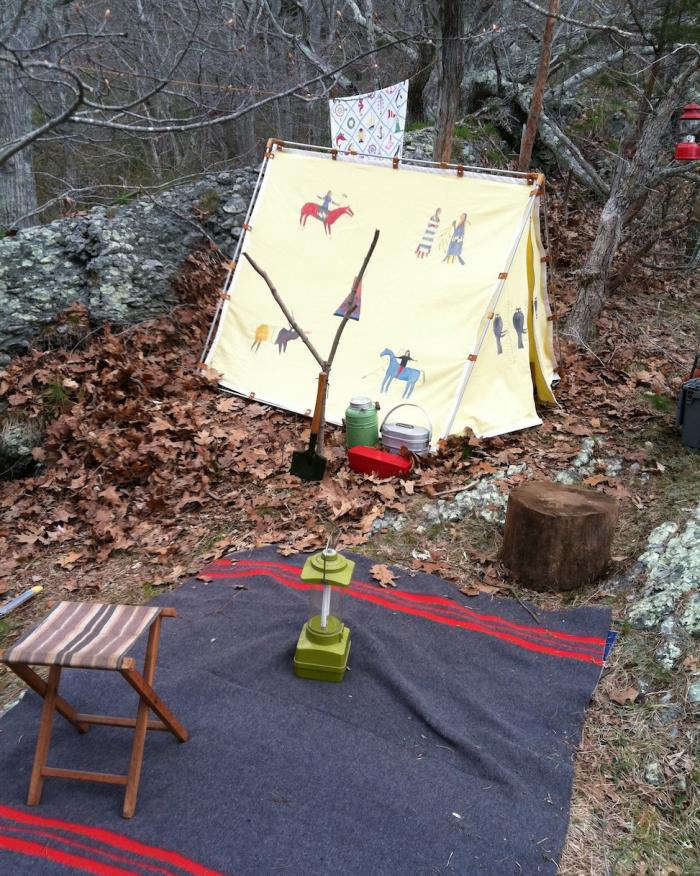
That precision is essential to the film’s humor. A normal tent is just camping equipment. In Moonrise Kingdom, a tent becomes a personality statement. A scout badge is not only decoration; it is character development the size of a nickel. A record player is not just a prop; it is a portable emotional weather system. The movie’s art direction turns ordinary childhood objects into symbols of escape, order, rebellion, and longing.
The Church Pageant as Story Engine
The church pageant is one of the film’s most important visual and emotional anchors. Sam and Suzy first meet during a performance of Benjamin Britten’s Noye’s Fludde, and the story later circles back to the church during the storm. That structure makes the pageant more than a cute set piece. It becomes a miniature version of the entire movie: children and adults performing roles together while a flood approaches.
The pageant costumes, animal masks, stage lighting, and church setting create a theatrical frame around the film’s central themes. Sam and Suzy are not just running away; they are trying to write themselves into a better story. In Anderson’s world, that story naturally includes handmade costumes, dramatic music, and at least one adult who is not emotionally prepared for the situation.
Cinematography: Why Super 16mm Matters
Cinematographer Robert D. Yeoman, a longtime Anderson collaborator, shot Moonrise Kingdom on Super 16mm, a choice that gave the film a grainy, tactile quality. Instead of feeling slick and polished, the images have warmth and texture. The format supports the movie’s atmosphere: a little faded, a little handmade, like an old family photograph found inside a library book.
The visual style is unmistakably Anderson: symmetrical compositions, lateral camera moves, snap zooms, careful blocking, and frames that seem arranged with tweezers. But Moonrise Kingdom feels more open and windswept than some of his earlier films. The camera often observes characters as tiny figures inside a larger landscape, which is exactly how childhood can feel. To a 12-year-old, a beach can be a kingdom, a storm can be destiny, and a stolen canoe can be a perfectly reasonable transportation plan.
Symmetry With Emotion
Anderson’s symmetry is sometimes misunderstood as merely decorative. In Moonrise Kingdom, it serves the story. The balanced frames create a sense of order, while the characters inside them are emotionally off balance. Sam and Suzy look composed, but they are fleeing rejection. The adults stand in neat arrangements, but their lives are messy. The contrast is funny, beautiful, and quietly heartbreaking.
Costume Design: Tiny Uniforms, Big Personalities
Kasia Walicka-Maimone’s costume design is one of the film’s secret weapons. The clothes are instantly readable: Sam’s Khaki Scout uniform, Suzy’s pink dress, Captain Sharp’s police outfit, Scout Master Ward’s precise scouting attire, and Social Services’ severe blue ensemble. Each costume tells the audience who the character thinks they areor who the world has decided they must be.
The Khaki Scout uniforms are especially important. They are not generic costumes pulled from a warehouse and sent to set with a hopeful shrug. The details were custom-made, including patches, buttons, piping, and insignia. That level of care gives the scouts’ world a believable internal logic. It also makes Sam’s rebellion funnier. He is not rejecting order because he does not understand it. He understands it perfectly. He simply has a more urgent mission: love, escape, and possibly surviving in the wilderness with questionable snacks.
Suzy Bishop’s Look
Suzy’s costume is one of the most memorable images in the film. Her salmon-pink dress, knee socks, saddle shoes, blue eye shadow, and binoculars create a character who is both childlike and theatrical. She looks as if she dressed herself for a role only she understands. That is exactly the point. Suzy is not trying to be fashionable; she is trying to be seen. The binoculars reverse the usual gaze: she watches the world before it can fully judge her.
The Music: Britten, Hank Williams, and a Portable Record Player
Music is not background decoration in Moonrise Kingdom. It is part of the film’s skeleton. Benjamin Britten’s Noye’s Fludde is central to the story, both as a church performance and as a thematic echo of the coming storm. The film also uses Britten’s The Young Person’s Guide to the Orchestra, which fits Anderson’s fascination with systems, parts, and how many tiny pieces can create one grand emotional machine.
The soundtrack also includes Hank Williams, whose songs deepen the loneliness around Captain Sharp, and Françoise Hardy’s “Le Temps de l’Amour,” which turns Sam and Suzy’s beach dance into one of the most famous scenes in Anderson’s filmography. That moment is awkward, sweet, funny, and oddly brave. It captures the feeling of being young and trying on adulthood like a costume that is still several sizes too large.
Why the Soundtrack Works
The music works because it does not flatten the film into simple whimsy. Britten brings grandeur and spiritual weight. Hank Williams brings ache. Hardy brings adolescent cool, or at least the 12-year-old version of cool, which is mostly confidence plus a portable record player. Alexandre Desplat’s score ties the pieces together with delicate orchestral intelligence. The result is a soundtrack that feels curated but not cold, sophisticated but still emotionally available.
Working With Young Actors
Moonrise Kingdom introduced Jared Gilman and Kara Hayward in their first major film roles. Casting two newcomers at the center of a highly stylized ensemble was a risk, but it became one of the film’s great strengths. Sam and Suzy do not behave like polished movie children. They are serious, strange, guarded, and occasionally unintentionally hilarious. Their directness gives the film its heartbeat.
Anderson is known for creating controlled cinematic worlds, but young actors can bring unpredictability, which is exactly what this story needed. Sam and Suzy must feel like children with private inner lives, not adult screenwriters trapped in smaller bodies. Their performances capture the intensity of first love, when every glance feels historic and every plan feels legally binding.
The Adult Ensemble: Deadpan Panic at Its Finest
The adult cast gives Moonrise Kingdom much of its comic rhythm. Bruce Willis plays Captain Sharp with quiet sadness, offering one of the most tender performances in the film. Edward Norton’s Scout Master Ward is sincere to the point of comedy, but never cruelly mocked. Bill Murray and Frances McDormand portray domestic disappointment with dry precision. Tilda Swinton turns bureaucracy into a human weather warning. Jason Schwartzman’s Cousin Ben appears like a small-business owner operating from inside a scout camp fever dream.
What makes the ensemble work is that every adult is ridiculous and vulnerable at the same time. They chase the children, but they are also chasing lost versions of themselves: lost love, lost purpose, lost courage, lost order. Sam and Suzy run away because childhood hurts. The adults search for them because adulthood has not exactly been a picnic either.
Release, Reception, and Awards
Moonrise Kingdom opened the 65th Festival de Cannes on May 16, 2012, a prestigious launch that positioned the film as a major international event. It later opened in the United States in limited release and became a box office success relative to its scale. With a reported budget of $16 million, it earned more than $68 million worldwide, proving that a carefully made, idiosyncratic film about runaway children, scout discipline, and emotional flooding could still find a large audience.
Critics responded strongly. Review aggregators recorded widespread acclaim, and the film earned an Academy Award nomination for Best Original Screenplay for Wes Anderson and Roman Coppola. The American Film Institute also recognized it as one of the outstanding films of 2012. More importantly, the movie became one of Anderson’s signature works: a film frequently cited for its balance of visual control and emotional openness.
Why Moonrise Kingdom Still Feels Fresh
Years after its release, Moonrise Kingdom still resonates because it understands something painfully true: children often feel emotions before they have the language to explain them, while adults often have the language and still manage to say the wrong thing. The film turns that gap into comedy, adventure, and melancholy.
The behind-the-scenes craft is a major reason the movie endures. Rhode Island gives it place. Super 16mm gives it texture. Production design gives it a world. Costumes give it identity. Music gives it emotional architecture. The actors give it life. Anderson’s direction pulls all of those pieces into a miniature epic where a cove can become a kingdom and two misunderstood kids can briefly rule it.
Behind-the-Scenes Lessons From Moonrise Kingdom
1. Specificity Makes Fantasy Believable
The film is fictional, but its details are concrete. The badges, maps, books, uniforms, houses, church programs, and weather reports make New Penzance feel real. That is a useful lesson for filmmakers, writers, designers, and anyone trying to build a creative world: imagination becomes stronger when it has physical evidence.
2. Style Should Serve Emotion
The movie is beautiful, but beauty is not the endpoint. The symmetry, colors, costumes, and music all support the emotional story of two children trying to be understood. Without that emotional center, the style would be a very fancy empty lunchbox. With it, every design choice feels meaningful.
3. Comedy and Sadness Can Share a Tent
Moonrise Kingdom is funny because it takes its characters seriously. Sam’s survival skills, Suzy’s books, Scout Master Ward’s procedures, and Captain Sharp’s loneliness are all treated with care. The humor comes from the collision between formal behavior and messy feeling. That is why the film can make viewers laugh and then quietly ambush them with tenderness.
Extended Experience: What Watching Moonrise Kingdom Feels Like
Watching Moonrise Kingdom feels like opening a box of old postcards from a place you never visited but somehow miss. There is a strange familiarity to it: the smell of damp canvas, the scratch of a wool uniform, the awkward silence after someone says something too honest, the drama of packing a suitcase as if leaving home will solve the entire problem of being human. The film captures childhood not as adults often describe itsimple, innocent, carefreebut as children actually experience it: intense, confusing, ceremonial, and full of private rules.
One of the most relatable experiences in the movie is the desire to be taken seriously. Sam and Suzy are funny because they are small people acting with enormous formality, but the joke never cancels their dignity. Anyone who remembers being young can recognize that feeling. You make a plan. You gather supplies. You decide the adults do not understand. You may only be walking into the woods behind your house, but emotionally you are crossing the Alps. Sam and Suzy’s escape is exaggerated, of course, but the feeling underneath it is real: the desire to find one person who sees you clearly.
The movie also captures the comedy of adult panic. The adults in Moonrise Kingdom are not villains. They are tired, lonely, distracted, and scared. That makes the film richer. When they search for the children, they are also forced to confront their own failures. Parents, teachers, officers, and officials all discover that their systems are not as secure as they imagined. A child can vanish through the cracks with a map, a record player, and a romantic agenda. That is alarming. It is also, cinematically speaking, excellent.
For viewers who love filmmaking, the experience becomes even more rewarding on repeat watches. The first viewing may focus on Sam and Suzy’s adventure. The second reveals the production design: the way rooms are arranged, how colors repeat, how props explain characters before dialogue does. The third viewing might reveal the sound design and music cues. The fourth may send you into a dangerous online search for vintage binoculars. Please proceed responsibly. Not everyone can pull off Suzy Bishop’s look at the grocery store, though confidence does help.
What makes the film special is that it never treats imagination as childish in a dismissive way. Instead, imagination becomes a survival tool. Sam paints because he needs to interpret the world. Suzy reads because books give shape to feelings she cannot explain. The scouts follow rituals because rituals make chaos manageable. Anderson’s behind-the-scenes craft mirrors that idea. The movie itself is a carefully organized shelter against emotional disorder.
In the end, the experience of Moonrise Kingdom is both cozy and stormy. It is a film about first love, but also about loneliness, chosen family, and the odd bravery of being sincere. It invites viewers to remember the age when every object had magical importance: a pin, a patch, a book, a song, a secret path. It reminds us that childhood was not small just because we were. Sometimes the kingdom was only a cove. Sometimes the moon was only rising. But when you were twelve, that was enough to change everything.
Conclusion
Moonrise Kingdom remains one of Wes Anderson’s most beloved films because its behind-the-scenes craftsmanship and emotional storytelling are inseparable. The Rhode Island locations give the fictional island a real coastline. The Super 16mm cinematography gives the images warmth and grain. The production design turns everyday objects into story clues. The costumes make each character instantly memorable. The music gives the film its pulse, from Britten’s theatrical grandeur to Hank Williams’ lonely ache and Françoise Hardy’s beachside cool.
Most of all, the film works because it treats childhood feeling as serious business. Sam and Suzy may be young, but their longing is not small. Their world may be meticulously arranged, but their emotions are wild. That tension is the secret behind Moonrise Kingdom: it is a handmade adventure about the messy, funny, frightening moment when two children decide they deserve to be understood. And honestly, they are not wrong.












