
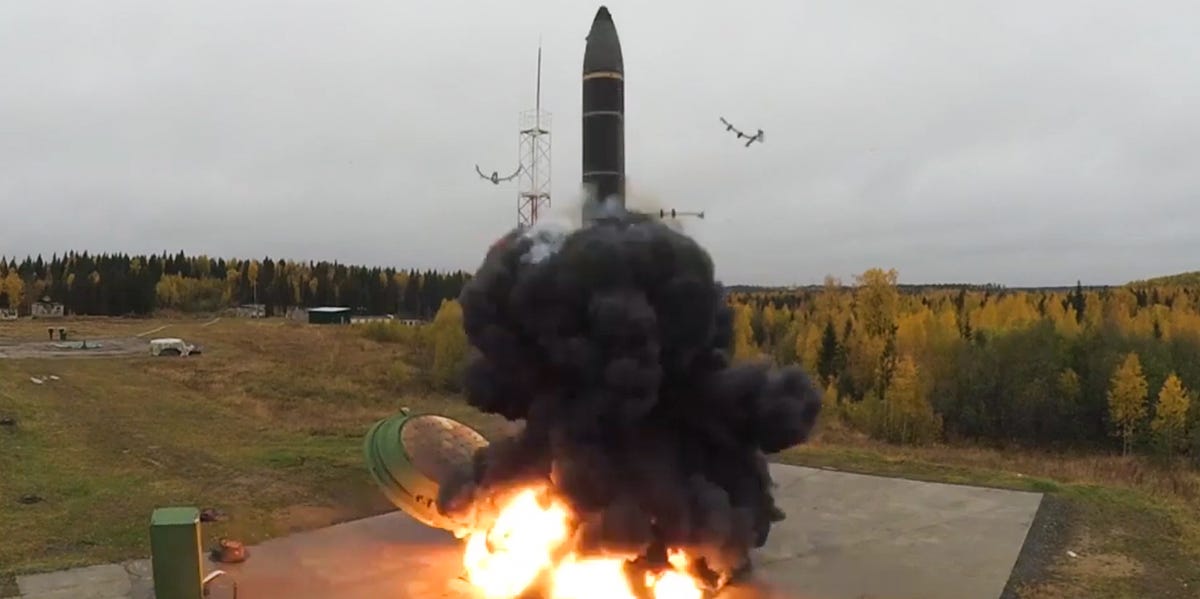
When Russia warns that any incoming ballistic missile may be treated as nuclear, it is not just another dramatic headline from the global security soap opera. It is a statement about speed, uncertainty, early-warning systems, and the terrifyingly short decision window that comes with ballistic missile warfare. In plain English: once a missile is in the air, nobody gets to pause the movie, zoom in, and politely ask, “Excuse me, is that warhead conventional or nuclear?”
This is why the phrase “Russia warns any incoming missile is nuclear” matters. It sits at the intersection of nuclear deterrence, ballistic missile defense, launch-on-warning strategy, and the war in Ukraine. It also explains why long-range missile strikes, even when conventionally armed, can raise anxiety far beyond the battlefield. A ballistic missile is not simply a fast weapon. It is a political message traveling at several times the speed of sound, and the people receiving that message may have only minutes to interpret it.
What Russia’s Warning Actually Means
Russia’s warning is based on a grim technical reality: early-warning systems can detect a missile launch and estimate its trajectory, but they cannot reliably determine whether the missile carries a conventional explosive, a nuclear warhead, or something else while it is still flying. That uncertainty creates a nightmare scenario for any nuclear-armed state. If leaders wait too long, they risk losing command centers, missile silos, radar sites, or political leadership. If they respond too quickly, they risk mistaking a limited conventional strike for the beginning of nuclear war. Not exactly the kind of decision anyone wants to make before finishing a cup of coffee.
The warning gained global attention in 2020 when Russian military officials argued that any ballistic missile launched toward Russian territory would be perceived as carrying a nuclear warhead. In 2024, Russia revised its nuclear doctrine again, widening the circumstances under which it says nuclear weapons could be used. The updated doctrine includes possible nuclear use after reliable information about ballistic missiles targeting Russia or its allies, as well as certain massive aerospace attacks involving aircraft, drones, cruise missiles, or hypersonic systems.
Why Ballistic Missiles Are So Dangerous
A ballistic missile follows a high-speed arc: launch, boost, midcourse flight, and terminal descent. During the boost phase, the rocket engines fire and push the missile upward. In the midcourse phase, the missile or warhead travels through space or near-space. In the terminal phase, the warhead plunges toward its target at extreme speed. By then, everyone involved is having a very bad day.
Unlike slower aircraft or cruise missiles, ballistic missiles compress decision-making time. Intercontinental ballistic missiles can cross continents in roughly half an hour. Shorter-range ballistic missiles may give defenders only a handful of minutes. That speed is the reason ballistic missile warning systems are tied so closely to nuclear command and control. They are designed to identify a launch quickly enough for leaders to decide whether to retaliate before their own forces are destroyed.
Conventional or Nuclear? That Is the Terrifying Question
Modern missiles can be dual-capable, meaning the same or similar delivery system may be able to carry either a conventional or nuclear payload. Russia, the United States, China, and other military powers have all studied or deployed systems that blur traditional lines between strategic and tactical weapons. That ambiguity may be useful for deterrence, but it is awful for crisis stability. When a radar screen shows an incoming missile, the defending side cannot calmly inspect the payload like a suspicious suitcase at airport security.
This is why Russian officials emphasize uncertainty. Their argument is simple: because they cannot know the warhead type in time, they may treat the launch itself as the threat. Critics say this kind of language is meant to frighten NATO and discourage support for Ukraine. Both things can be true at once: the technical problem is real, and the political messaging is intentional.
Russia’s 2024 Nuclear Doctrine: A Lower Threshold?
Russia’s revised nuclear doctrine did not say Moscow will automatically launch nuclear weapons after every missile alert. It did, however, expand the range of scenarios in which nuclear weapons might be considered. The doctrine says Russia may use nuclear weapons in response to nuclear or other weapons of mass destruction, aggression with conventional weapons that threatens sovereignty or territorial integrity, attacks on critical command-and-control systems, and reliable information about incoming ballistic missiles.
The biggest political change is how the doctrine treats attacks by non-nuclear states supported by nuclear powers. Under the revised language, aggression against Russia by a non-nuclear state with the support or participation of a nuclear power may be treated as a joint attack. That wording is widely understood as a warning to NATO countries supplying weapons, intelligence, or other support to Ukraine.
In practice, doctrine is not an autopilot button. Nuclear use would still depend on the Russian president, military assessments, political calculations, and the specific crisis. But doctrine matters because it signals intent. It tells adversaries where the red lines might be, even if those lines are painted with fog, smoke, and a large bucket of strategic ambiguity.
The Ukraine War and the Missile Signaling Problem
The war in Ukraine has turned missile signaling into a daily reality. Russia has used ballistic missiles, cruise missiles, drones, and hypersonic weapons to strike Ukrainian cities, infrastructure, and military targets. Ukraine has sought longer-range capabilities to hit Russian logistics, air bases, command nodes, and energy infrastructure supporting the war effort. Every expansion in range creates a new escalation debate.
When Western-supplied missiles are used against targets inside Russia, Moscow argues that NATO is becoming more directly involved. Western governments generally respond that Ukraine is defending itself against invasion and that Russia can end the escalation by ending the war. This argument is morally straightforward but strategically complicated. Nuclear-armed states often care less about legal neatness than about perceived threats to regime security, military assets, and national prestige.
The Oreshnik Example
Russia’s use of the Oreshnik intermediate-range ballistic missile against Ukraine in 2024 added another layer to the drama. The missile was presented by Moscow as a warning to the West, not merely as a battlefield tool. Its reported connection to the RS-26 Rubezh family and its nuclear-capable design made the message obvious: Russia wanted Western leaders to think about escalation, not just impact craters.
That is the uncomfortable part of missile politics. A weapon does not need to carry a nuclear warhead to carry a nuclear message. Sometimes the payload is explosives. Sometimes the payload is fear.
Launch-on-Warning: The World’s Worst Countdown Clock
Launch-on-warning is a nuclear posture in which a country may launch retaliatory weapons after detecting an incoming attack but before enemy warheads arrive. The logic is grim but understandable: if a state waits until it is hit, it may lose the ability to respond. The danger is equally obvious: false alarms, sensor errors, cyber interference, or misread intentions could push leaders toward catastrophe.
History offers several close calls. During the Cold War, both the United States and the Soviet Union experienced false alarms caused by technical glitches, training confusion, or unusual sensor readings. Humanity survived not because the system was perfect, but because people hesitated, questioned, and refused to let machines write the final chapter. That is comforting until you realize “we survived because someone paused” is not exactly a robust global safety strategy.
Why Missile Defense Does Not Solve Everything
Missile defense systems can help, but they are not magic force fields. Different systems are designed for different phases of flight. Some intercept in the midcourse phase, some in the terminal phase, and some are intended for shorter-range regional threats. A large-scale attack by a major nuclear power would be far harder to defeat than a limited launch by a smaller missile state.
This is why U.S. homeland missile defense has historically focused on limited threats, not stopping a massive Russian or Chinese nuclear strike. Against a sophisticated nuclear arsenal with decoys, multiple warheads, maneuvering vehicles, submarine-launched missiles, and overlapping attack routes, missile defense becomes extremely difficult. In other words, missile defense can reduce risk, but it cannot replace deterrence, diplomacy, or arms control.
Russia’s Nuclear Arsenal and the Deterrence Equation
Russia remains one of the world’s two largest nuclear powers. Public estimates from arms-control researchers place Russia’s total nuclear inventory in the thousands, including deployed strategic warheads, non-strategic nuclear weapons, and retired warheads awaiting dismantlement. Russia’s strategic forces include land-based intercontinental ballistic missiles, submarine-launched ballistic missiles, and nuclear-capable bombers.
The size and diversity of that arsenal shape how Moscow talks about missile threats. Russia wants adversaries to believe that any attack on its strategic command, nuclear forces, or homeland could trigger overwhelming consequences. At the same time, the United States and NATO try to avoid being coerced by nuclear threats, because rewarding every nuclear warning would teach the world’s worst lesson: buy nukes, make threats, get concessions.
Is Russia Bluffing?
That is the billion-dollar question, although “billion” feels low in this case. Analysts disagree on how credible Russia’s nuclear threats are. Some argue Moscow uses nuclear rhetoric mainly for coercion: to slow Western aid to Ukraine, divide NATO, and frighten publics in democratic countries. Others warn that repeated threats can create a trap. If leaders draw red lines too often and then watch them get crossed, they may eventually feel pressure to act simply to preserve credibility.
The most responsible answer is that Russia’s threats are neither empty nor automatic. Nuclear use remains unlikely because it would invite enormous diplomatic, military, economic, and possibly nuclear consequences. But “unlikely” is not the same as “impossible.” The danger is not just a deliberate first strike. It is miscalculation, panic, false warning, or a conventional strike that one side interprets as preparation for something larger.
How the West Responds
Western governments have generally tried to balance support for Ukraine with escalation management. That means providing weapons, intelligence, air defense systems, and economic support while avoiding direct NATO-Russia combat. It also means communicating privately and publicly that nuclear use would bring severe consequences.
At the same time, NATO cannot allow Russia to turn nuclear warnings into a veto over Ukraine’s defense. If every Russian nuclear statement froze Western policy, deterrence would run in reverse. Moscow would learn that nuclear saber-rattling works. Other nuclear powers would notice. The world would become a much louder, scarier place, with more leaders discovering the strategic value of shouting “nuclear” every time they dislike something.
What This Means for Ordinary People
For most readers, ballistic missiles and nuclear doctrine feel remote, like something discussed in windowless rooms by people who own too many acronyms. But the consequences are not remote. Missile warnings influence defense budgets, alliance politics, energy markets, civil defense planning, and the daily lives of people in Ukraine who hear air raid alerts instead of alarm clocks.
The lesson is not to panic. Panic is rarely useful unless you are being chased by a bear, and even then it has mixed reviews. The lesson is to understand why careful language, reliable communication channels, arms-control talks, and crisis hotlines matter. Nuclear risk is not reduced by pretending missiles are harmless. It is reduced by making sure leaders have time, information, and incentives not to make the worst decision in human history.
Experiences and Real-World Reflections: Living Under the Shadow of Missile Warnings
People who study nuclear deterrence often describe the subject in charts, doctrines, and force structures. People who live near war describe it differently: the sound of sirens, the glow of phones in dark shelters, the habit of checking alerts before checking the weather, and the strange normality of making breakfast while wondering whether the next missile will be intercepted. That human experience is essential to understanding why Russia’s warning about incoming ballistic missiles feels so serious.
In Ukraine, civilians have learned the emotional vocabulary of modern missile war. A drone alert is frightening. A cruise missile alert is worse. A ballistic missile warning is different because it often means very little time. People may have minutes, not hours, to move away from windows, reach a corridor, descend into a shelter, or wake a child who has already learned too much about geopolitics for someone who still owns stuffed animals. The experience is not abstract. It is practical, immediate, and exhausting.
For military personnel and air-defense crews, the pressure is also intense. Operators must distinguish between drones, decoys, cruise missiles, ballistic missiles, and mixed salvos designed to overwhelm defenses. Their decisions happen under severe time pressure. A radar track is not a newspaper article. It does not come with a headline, editor’s note, and helpful summary. It is data, speed, altitude, trajectory, probability, and consequence.
For policymakers, the experience is quieter but no less stressful. Every decision to supply longer-range weapons, approve strikes, or adjust air-defense deployments is weighed against escalation risk. Officials must ask not only “Can this help Ukraine defend itself?” but also “How will Russia interpret it?” and “What happens if a conventional strike is mistaken for something strategic?” This is the mental tax of nuclear politics: even defensive choices must be measured against worst-case scenarios.
Analysts who track Russian nuclear signaling often describe a recurring pattern. Moscow issues a warning. Western capitals debate whether the warning is serious. Support for Ukraine slows, continues, or changes form. Russia then adjusts its rhetoric again. Over time, this creates what might be called threat fatigue. People hear the word “nuclear” so often that they either panic or tune it out. Both reactions are dangerous. Panic rewards coercion. Indifference ignores risk.
The most useful mindset is disciplined seriousness. Treat the warning as meaningful, but do not treat it as destiny. A ballistic missile alert is dangerous because it compresses time and clouds certainty. A nuclear doctrine is dangerous because it shapes expectations. But human choices still matter. Communication matters. Restraint matters. Verification matters. So does public understanding. Citizens do not need to become missile engineers, but they should understand why dual-capable missiles, launch-on-warning policies, and nuclear ambiguity make international crises more fragile.
The experience of living with missile risk teaches one final lesson: deterrence is not just about weapons. It is about nerves. The side that panics first may make mistakes. The side that ignores risk may make different mistakes. The safest path is steady, informed, and unsentimental. Ballistic missiles are terrifying machines, but the greater danger is a political system that treats compressed time and incomplete information as acceptable conditions for civilization-ending decisions.
Conclusion
Russia’s warning that any incoming ballistic missile could be viewed as nuclear is not just bluster, and it is not a simple prediction of automatic nuclear war. It is a dangerous mix of technical reality and strategic messaging. Ballistic missiles move too fast for certainty. Dual-capable systems blur the line between conventional and nuclear conflict. Revised doctrine gives Moscow more room to threaten escalation. The war in Ukraine gives those threats a real-world stage.
The best response is not hysteria. It is clarity. The world needs strong deterrence, careful crisis communication, modern early-warning safeguards, missile-defense realism, and renewed arms-control thinking. Because when missiles fly, assumptions travel with them. And in nuclear strategy, a bad assumption can be more dangerous than the missile itself.
Note: This article is written for public education and strategic analysis. It does not provide operational instructions, targeting guidance, or technical assistance for weapon development or use.












