
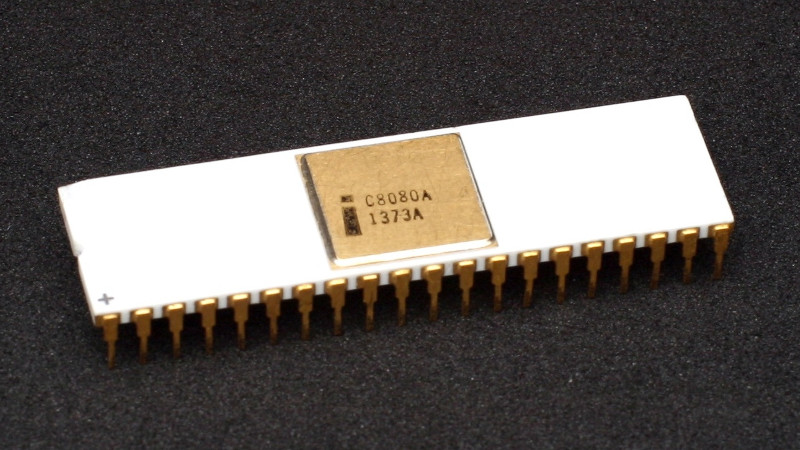
Before computers became thin aluminum slabs, cloud dashboards, AI assistants, and pocket rectangles that complain when we walk too slowly, there was a humbler kind of magic: an 8-bit microprocessor, a front panel full of switches, blinking lights, and a room full of people who were absolutely convinced that typing hexadecimal by hand was a normal weekend activity. Welcome back to the Intel 8080, one of the chips that turned computing from a locked-room corporate resource into something curious people could own, program, break, repair, and brag about.
The Intel 8080 was not the first microprocessor. It was not the prettiest. It did not arrive with a glossy touchscreen, a friendly startup chime, or a box that said “revolutionary” in minimalist typography. Yet for many hobbyists, engineers, students, early software developers, and future tech giants, the Intel 8080 was where personal computing started to feel personal. It powered machines like the MITS Altair 8800, helped create the market for microcomputer software, gave CP/M a hardware foundation, and influenced processor designs that still echo through modern computing.
What Was the Intel 8080?
Introduced in 1974, the Intel 8080 was an 8-bit general-purpose microprocessor designed at a time when “general-purpose” was a bold idea. Earlier chips such as the Intel 4004 and 8008 proved that useful computing logic could live on a single chip, but the 8080 made that idea more practical, more flexible, and more attractive to engineers building real systems.
Technically, the Intel 8080 was a single-chip CPU built using n-channel silicon-gate MOS technology. It used an 8-bit data bus and a 16-bit address bus, which meant it could address up to 64 KB of memory. That number looks adorable now, like a kitten wearing a pocket protector, but in the mid-1970s it was enough to build serious small computers, industrial controllers, cash registers, terminals, instruments, and hobbyist machines.
The chip came in a 40-pin package, a major improvement over the 18-pin Intel 8008. Those extra pins mattered. They made it easier to connect memory, input/output devices, clocks, control signals, and supporting hardware. In other words, the 8080 was not merely faster than its predecessor; it was easier to design around. For early computer builders, that was the difference between “possible” and “please pass the aspirin.”
Why the 8080 Felt Like a Breakthrough
The Intel 8080 arrived when computers were still widely associated with universities, laboratories, government agencies, banks, and companies with budgets large enough to make a purchasing department sweat. The idea that an individual could own a meaningful computer was still strange. Then the 8080 helped shrink the computer from a room-sized institutional machine into a box that a motivated hobbyist could put on a desk.
Its performance was dramatically better than the Intel 8008, and its architecture gave programmers more room to build useful software. It had seven 8-bit registers, including the accumulator, plus register pairs that could be used for 16-bit operations. It had a 16-bit program counter and stack pointer. It supported subroutines, interrupts, arithmetic, logic, jumps, calls, returns, and I/O instructions. Compared with modern CPUs, it was tiny. Compared with what came before, it was a door swinging open.
The Altair 8800: The 8080 Gets Its Big Stage
If the Intel 8080 was the engine, the MITS Altair 8800 was the noisy garage-built vehicle that made everyone look up. Featured in the January 1975 issue of Popular Electronics, the Altair 8800 became one of the most famous early microcomputers. It was sold as a kit, priced under $500, and built around the Intel 8080. That price still represented real money, but compared with commercial computers costing tens of thousands of dollars, it felt almost democratic.
The original Altair was not exactly user-friendly. It did not ship with a monitor, keyboard, mouse, graphical desktop, app store, or cheerful onboarding wizard. Users entered programs using front-panel toggle switches and read results from blinking LEDs. That sounds painful because it was. Still, to early computer hobbyists, those lights were not a limitation; they were proof that the machine was alive.
The Altair 8800 gave the Intel 8080 cultural momentum. Orders poured in faster than MITS could comfortably fulfill. Hobbyists formed clubs, exchanged code, argued about memory boards, and dreamed up uses for a computer that most people still thought belonged in a corporate basement. The 8080 had found its audience: people who did not want to wait for the future to be delivered fully assembled.
How the 8080 Helped Launch the Software Business
The 8080 did more than power hardware. It helped make software feel like a product. The most famous example is Altair BASIC, written by Bill Gates, Paul Allen, and Monte Davidoff for the Altair 8800. The story has become computing folklore: Gates and Allen saw the Altair on the cover of Popular Electronics, realized that affordable microcomputers would need software, and moved quickly to create a BASIC interpreter for the machine.
BASIC mattered because it gave non-specialists a way to program. Assembly language was powerful but unforgiving. BASIC was friendlier, or at least friendly enough that a person could write a small program without feeling personally attacked by the hardware. Altair BASIC became Microsoft’s first major product, and the software industry took another step toward becoming an industry of its own rather than an accessory to hardware.
This is one reason the Intel 8080 deserves more attention than its raw specifications suggest. A chip is not only transistors and pins; it is an ecosystem. The 8080 created enough performance, address space, and market excitement for people to write languages, operating systems, utilities, games, development tools, and business applications. That is when a processor becomes a platform.
CP/M and the Rise of the Microcomputer Standard
Another major part of the Intel 8080 story is CP/M, the Control Program for Microcomputers created by Gary Kildall of Digital Research. CP/M became the dominant operating system for many 8080- and later Z80-based microcomputers in the late 1970s and early 1980s. It gave small computers a more organized way to use disk drives, run programs, manage files, and support business software.
CP/M helped normalize the idea that different machines could run a common operating system and a shared software library. That may sound obvious today, but in the 1970s the microcomputer world was a jungle of incompatible boards, buses, monitors, terminals, storage systems, and “it works on my machine” energy. CP/M provided a center of gravity.
The Intel 8080 was central to that early CP/M ecosystem. Many programs were written for 8080 assembly language or for processors compatible with it. Even after the Zilog Z80 became popular, the 8080 instruction set remained a foundation. The Z80 extended and improved on the 8080, but its compatibility meant existing 8080 software could often keep running. That backward compatibility helped preserve software investment and encouraged adoption.
The 8080 Instruction Set: Small, Sharp, and Educational
Learning the Intel 8080 instruction set is like learning to cook in a tiny kitchen. You do not have endless counter space. You cannot hide behind luxury appliances. Every register matters. Every byte matters. Every instruction teaches you something about how computers really work.
The 8080’s programming model includes an accumulator, general-purpose registers, register pairs, condition flags, a stack pointer, and a program counter. Programmers used instructions such as MOV, MVI, LXI, ADD, SUB, JMP, CALL, and RET. These mnemonics may look ancient, but they reveal core computing concepts with admirable bluntness. Data moves. Arithmetic happens. Flags change. Control flow jumps. The machine does exactly what you told it to do, not what you hoped you meant.
That is why the 8080 remains valuable for education. Modern computers bury complexity under layers of operating systems, runtimes, frameworks, virtual machines, browsers, containers, and package managers. The 8080 lets learners see the bones. It explains memory addressing, stacks, binary arithmetic, I/O, interrupts, machine code, and the painful beauty of debugging one byte at a time.
From the 8080 to the Z80 and x86
The Intel 8080 did not stop influencing computing when newer chips arrived. Federico Faggin, who played a major role in Intel’s early microprocessors, later co-founded Zilog. Zilog’s Z80, introduced in 1976, became one of the most successful 8-bit processors ever. It was designed to be largely compatible with 8080 software while adding new registers, instructions, and hardware conveniences.
The Z80 powered a remarkable range of systems, from CP/M computers to home computers, embedded devices, game machines, musical instruments, and arcade hardware. Its long commercial life shows how strong the 8080 software base had become. When a processor architecture inspires a compatible successor that remains relevant for decades, that architecture has done something right.
The 8080 also influenced Intel’s later designs, including the 8085 and the 8086. The 8086 became the starting point for the x86 family, which shaped personal computing for generations. Modern x86 processors are vastly different from the 8080 in performance, complexity, memory model, and internal design, but the family resemblance is not imaginary. The 8080 is part of the ancestral tree.
Why Vintage Computing Fans Still Love the 8080
Vintage computing is not just nostalgia, although nostalgia certainly gets a comfortable chair and a cup of coffee. The Intel 8080 attracts enthusiasts because it is understandable. A motivated person can read the manuals, study the bus signals, write an emulator, build a single-board computer, or toggle in a tiny program and actually grasp what is happening.
That feeling is increasingly rare. Today’s processors contain billions of transistors, speculative execution, caches, branch predictors, multiple cores, security features, power-management systems, and enough microarchitectural wizardry to make a wizard ask for documentation. The 8080, by contrast, is small enough to reason about. It invites participation.
Emulators, replica kits, FPGA recreations, restored Altair systems, CP/M disk images, and online assemblers keep the 8080 world alive. People still write tiny programs for it. They still debate instruction timing. They still compare it with the 6502 and Z80 as if the fate of civilization depends on which one handled addressing modes with more elegance. This is part of the charm. Old chips create new conversations.
Specific Examples of What the Intel 8080 Enabled
1. Hobbyist Personal Computers
The Altair 8800 showed that individuals would buy, assemble, and program microcomputers. That market signal helped inspire other machines and companies. The personal computer revolution did not happen overnight, but the 8080-powered Altair was one of the sparks that made the dry wood catch fire.
2. Early Business Software
With CP/M and disk-based systems, 8080-compatible machines became useful for word processing, accounting, inventory, database work, and office tasks. They were not just toys for people who enjoyed solder fumes. They became practical tools.
3. Programming Languages for Microcomputers
Altair BASIC proved that microcomputers needed accessible software. It helped establish the idea that software could be written, sold, licensed, copied, argued about, and improved as a standalone product.
4. Hardware Expansion Culture
Early 8080 systems encouraged add-on boards, memory expansion, serial interfaces, disk controllers, and bus standards such as the S-100 bus. That expansion culture later became a defining feature of personal computing: buy the base machine, then customize it until your desk looks like a small electrical substation.
What the Intel 8080 Teaches Modern Technologists
The first lesson is that constraints create clarity. The Intel 8080 forced programmers to think carefully about memory, registers, timing, and code size. Waste had consequences. A careless routine could consume precious bytes. A clever routine felt like winning a chess game against physics.
The second lesson is that platforms matter. The 8080 became important not only because of its silicon, but because of the machines, manuals, magazines, clubs, operating systems, languages, and people around it. Technology succeeds when an ecosystem forms around it.
The third lesson is that accessibility changes history. The Altair 8800 was primitive, but it was reachable. It invited amateurs into a field that had been dominated by institutions. Some of those amateurs became founders, engineers, authors, teachers, and lifelong enthusiasts. Give people a tool they can understand and modify, and they may build a world around it.
Experiences Related to the Intel 8080: Going Back to the Beginning
Spending time with the Intel 8080 today feels less like using an old processor and more like visiting the workshop where personal computing learned to walk. Fire up an 8080 emulator, load a monitor program, and suddenly the modern computer around you fades into the background. You are left with memory addresses, registers, opcodes, and the strange satisfaction of making a tiny machine obey.
The first experience most people notice is how physical early computing feels, even in simulation. On a modern laptop, running software can feel weightless. Click an icon, wait half a second, and complain that the animation was not buttery enough. With an 8080-style system, every action has texture. Loading a program means thinking about where it lives in memory. Printing text means understanding the output routine. A loop is not an abstract programming concept; it is a handful of bytes turning around and around like a tiny mechanical crank.
Writing a simple 8080 program is humbling in the best way. Suppose you want to add two numbers. In a modern language, you might write one clean line and move on. On the 8080, you load a value into a register, add another value, check flags if necessary, store the result, and remember that the machine has no interest in your feelings. If the answer is wrong, the bug is probably yours. The processor is innocent, or at least it has a very good lawyer.
Another memorable experience is learning how much personality a limited machine can have. The Altair’s front panel, for example, turned computing into a visible ritual. Switches entered data. Lights showed status. The machine did not hide its work behind a polished interface. It blinked at you. It made you part of the process. Even people using emulators today often understand why those lights became iconic. They were not decorative; they were the conversation.
Exploring CP/M on an 8080-compatible setup adds another layer of appreciation. Suddenly the machine is not just executing tiny experiments; it is running an operating system. You can list files, run programs, edit text, assemble code, and feel the outline of modern computing appear in miniature. The commands are terse, the storage is small, and the environment is strict, but the basic pattern is familiar. You are using a computer as a personal tool.
The biggest experience the Intel 8080 offers is perspective. It reminds us that computing did not become powerful all at once. It grew through practical compromises, clever engineering, enthusiastic communities, and a lot of trial and error. The 8080 was not perfect, and that is part of its appeal. It was good enough to let people begin. And in technology, “good enough to begin” is often the most revolutionary specification of all.
Conclusion: The Little 8-Bit Chip With a Long Shadow
The Intel 8080 deserves its place in microprocessor history because it helped transform computing from a specialist resource into a personal adventure. It powered the Altair 8800, supported the rise of CP/M, encouraged the early software business, influenced the Z80, and pointed toward the x86 era. More importantly, it gave curious people a way into computing.
Looking back at the 8080 is not just an exercise in nostalgia. It is a reminder that revolutions often begin with imperfect tools used by determined people. The Intel 8080 was small, limited, and demanding. It was also flexible, influential, and wonderfully teachable. For most of us who care about the roots of personal computing, this is where the lights started blinking.
Note: Historical prices and specifications varied by system configuration, production revision, and source. The article presents widely accepted figures and context for general educational and editorial use.












