
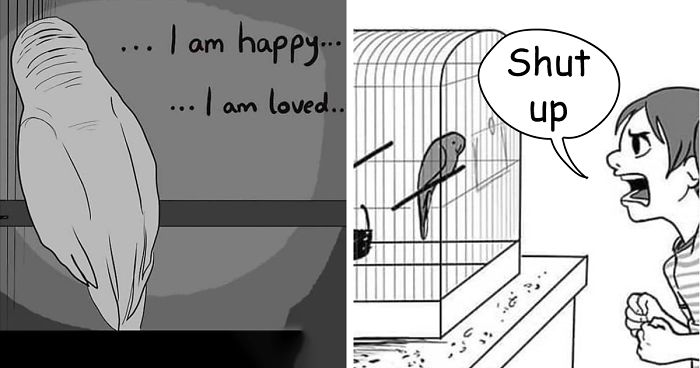
Some comics make you chuckle. Some make you think. And then there are Jenny-Jinya’s animal comics, which sneak into your heart wearing tiny emotional boots, sit down on your feelings, and politely ask, “Were you using these tears?” The German artist, whose real name is Jenny Hefczyc, has become widely known online for her Loving Reaper comicsshort, heartbreaking stories where animals meet a gentle version of Death after lives touched by neglect, cruelty, abandonment, or simple human misunderstanding.
Her work has covered dogs, cats, circus animals, wildlife, and “small pets” that people often buy before doing enough research. This time, the tearjerker centers on parrotsespecially small birds such as budgies and parakeets, often treated like colorful decorations instead of intelligent, social, demanding living beings. The result is exactly what fans expect from a Jenny-Jinya comic: minimal art, quiet dialogue, emotional restraint, and a final emotional punch that arrives with the force of a piano dropped from a cartoon cloud.
But the reason this comic hurts is not simply because it is sad. It hurts because it is true. Behind the illustrated sorrow is a real animal-welfare issue: many birds are purchased as “easy pets,” only to be ignored, confined, rehomed, or surrendered when their natural behaviors become inconvenient. Jenny-Jinya’s genius is that she turns that uncomfortable truth into a story people cannot scroll past.
Who Is Jenny-Jinya, the Artist Behind the Loving Reaper Comics?
Jenny-Jinya is best known for creating Loving Reaper, a webcomic series built around a compassionate Grim Reaper who helps animals cross over after suffering in the human world. Unlike the usual pop-culture version of Deathspooky robe, dramatic scythe, suspiciously bad public relationsJenny’s Reaper is gentle, patient, and heartbreakingly kind. He is not there to punish animals. He is there because someone has to be with them when people were not.
The series gained attention through comics such as “Good Boy” and “Black Cat,” both of which used simple storytelling to expose painful realities: loyal dogs left behind, black cats harmed by superstition, animals punished for problems humans created. Over time, the project grew into a larger animal-welfare platform, with stories about adoption, neglect, wildlife exploitation, and the quiet suffering of creatures we like to call “cute” until they require work.
What separates Jenny-Jinya’s animal comics from ordinary sad webcomics is their moral clarity. The comics do not scream at the reader. They do not lecture with a megaphone. They simply place an animal in front of us and let us see the world from that animal’s small, confused, trusting point of view. That is often more powerful than a thousand statistics.
Why This Parrot Comic Feels Like Her Saddest One Yet
The parrot-focused comic is especially devastating because parrots are easy to misunderstand. They are bright, clever, funny, and expressive. On social media, they dance, whistle, mimic voices, and look like feathery comedians who accept payment in sunflower seeds. That charming image hides a much more complicated reality: parrots are not toys, decorations, or “starter pets.” They are intelligent birds with deep social needs, strong instincts, loud voices, and long lifespans.
In the comic, Jenny-Jinya highlights how many people treat small birds as low-maintenance pets. A child wants one. A parent says yes. A cage appears. At first, everyone is excited. Then the bird makes noise, sheds feathers, scatters seed, needs attention, and behaves likebrace yourselfa bird. The novelty fades. The cage stays closed. The room grows quiet in the worst possible way.
That emotional setup is simple, but it works because it mirrors real life. Budgies, parakeets, cockatiels, and larger parrots are often purchased because they are beautiful, affordable, or considered easier than a dog or cat. Yet birds need enrichment, safe space, proper nutrition, veterinary care, social interaction, and opportunities to express natural behaviors such as flying, climbing, foraging, chewing, vocalizing, and bonding. When those needs are ignored, boredom and stress can lead to feather plucking, screaming, aggression, withdrawal, or poor health.
Jenny-Jinya’s comic does not need to show every detail of bird care. It only has to show the emotional consequence of neglect. A parrot in a cage is not automatically abused, but a parrot treated like a room accessory is being denied the life it was built to live.
The Power of Death as a Kind Character
One of the boldest choices in the Loving Reaper comics is making Death the most compassionate figure in the room. In many stories, Death is the villain. In Jenny-Jinya’s world, Death is often the only character who listens. That reversal changes everything.
For animals who have been abandoned, mistreated, or forgotten, the Reaper becomes a witness. He validates their pain. He answers their questions. He gives them the comfort humans failed to provide. This is why readers cry: not because the comic is manipulative, but because it offers tenderness after injustice. It says, “This animal mattered,” and for many readers, that sentence lands hard.
The parrot comic uses this same emotional architecture. The bird’s suffering is not presented as entertainment. It is presented as a failure of responsibility. The Reaper’s presence does not erase the tragedy; it exposes it. He is gentle precisely because the world was not.
Animal Comics as Advocacy: Why They Work So Well
Animal welfare campaigns often struggle with a difficult balance. If the message is too graphic, people look away. If it is too soft, people fail to act. Jenny-Jinya’s comics occupy a rare middle ground: they are emotionally intense but visually accessible. The art is clean, the panels are easy to follow, and the dialogue is short enough to read in a minute. Then, before the reader can emotionally prepare, the story quietly removes the floor.
This format is perfect for the internet. A long report about parrot neglect may be important, but many people will not read it during a coffee break. A comic, however, can travel quickly across Instagram, Facebook, Reddit, Webtoon, and fan communities. It can make someone pause mid-scroll. It can reach animal lovers, casual readers, parents, young people, and even those who did not wake up planning to rethink pet ownership.
The best advocacy art does not merely say, “Care about this.” It creates the feeling of caring before the reader has time to resist. That is why these emotional animal comics have become so widely shared. They transform abstract suffering into one face, one voice, one small life.
The Real Problem With “Easy Pets”
The parrot comic also opens a bigger conversation about the phrase “easy pet.” In truth, no animal is easy if we are doing care properly. Some animals require less space than others. Some cost less to feed. Some do not need daily walks in the rain while you question every life choice that led to dog ownership. But “small” does not mean “simple.”
Birds are a perfect example. A budgie may fit in your hand, but that does not mean its needs are tiny. Birds are sensitive to household toxins, temperature changes, diet problems, loneliness, unsafe toys, and stress. Many species are social by nature and can suffer when isolated. Some parrots can live for decades, making them a long-term responsibility rather than a cute weekend decision.
Parents may buy birds for children thinking it will teach responsibility. That can be truebut only if adults remain fully involved. A child can help change water, offer food, clean under supervision, and learn empathy. But the adult must be the real guardian. Animals should never be placed in the risky position of depending entirely on a child’s attention span, because even wonderful children sometimes forget homework exists while holding the homework.
What Jenny-Jinya’s Comic Teaches About Responsible Pet Ownership
The message is not “never love birds.” It is “love them honestly.” Responsible bird care begins before purchase or adoption. A future guardian should research the species, understand lifespan, noise level, diet, enrichment needs, cage size, daily interaction, safe flight time, and access to an avian veterinarian. They should consider adoption or rescue whenever possible, especially because many birds are surrendered after owners realize they are more demanding than expected.
Birds need more than food and water. They need stimulation. They need space to move. They need toys that encourage natural behaviors. They need clean environments and safe materials. They need protection from fumes, unsafe foods, open windows, ceiling fans, candles, nonstick cookware fumes, and other household hazards many new bird owners never think about until it is too late.
Most importantly, they need to be seen as birds. Not tiny humans with wings. Not decorative objects. Not background noise. Birds are intelligent animals with their own instincts, fears, preferences, and ways of communicating. A responsible owner learns to respect that difference.
Why Readers Keep Coming Back Even Though the Comics Hurt
At first glance, it seems strange that people keep reading comics that make them cry. Usually, humans avoid pain. We skip sad movies when we are fragile. We pretend onions are responsible for tears. We say, “I’m fine,” while looking like a Victorian ghost. Yet Jenny-Jinya’s audience keeps returning because her sadness serves a purpose.
Her comics offer grief with meaning. The reader is not crying just because an animal dies. The reader is crying because the story reveals a preventable wound. That difference matters. Sadness becomes awareness. Awareness becomes conversation. Conversation can become better choices: adopting instead of buying, researching before bringing home a pet, donating to shelters, sharing rescue resources, or simply treating animals with more patience.
There is also comfort in the Reaper character. He gives readers a way to imagine that animals who suffered were not alone in the end. For anyone who has lost a pet, that idea can be devastating and healing at the same time. It is emotional acupuncture: sharp, oddly helpful, and not something you want to explain to strangers on public transportation.
Specific Examples of Themes in Jenny-Jinya’s Animal Comics
Abandonment
Many Loving Reaper stories focus on animals left behind when they become inconvenient. Dogs wait for owners who never return. Cats are dismissed because of superstition. Senior pets sit in shelters while younger animals are chosen first. These stories ask readers to confront how casually humans can break an animal’s trust.
Neglect Through Ignorance
The parrot comic belongs strongly in this category. Not every neglectful owner begins as cruel. Some begin as uninformed. They buy the cage before reading about the animal. They assume quiet equals content. They confuse survival with wellbeing. Jenny-Jinya shows that ignorance can still cause real harm.
Exploitation
Other comics explore animals used for entertainment, profit, or spectacle. Circus animals, wildlife, and pets made into internet props all raise the same question: when humans call something “cute,” who benefitsand who pays the price?
Compassion After Harm
Even in the saddest stories, Jenny-Jinya rarely ends with pure darkness. The Reaper’s kindness gives each animal dignity. That does not undo the damage, but it prevents the story from becoming hopeless. The point is not despair. The point is responsibility.
Experiences Related to Jenny-Jinya’s Tearjerker Animal Comics
Anyone who has ever loved an animal understands why Jenny-Jinya’s work hits so hard. You do not have to own a parrot to feel the ache of the parrot comic. You only need to remember a moment when an animal trusted you completely. Maybe it was a dog sleeping with its head on your shoe, as if your foot were a luxury resort. Maybe it was a cat blinking slowly from across the room, pretending not to love you while absolutely loving you. Maybe it was a bird cocking its head at your voice, curious and alert, trying to understand the strange giant who controls the snack supply.
These small experiences are what make the comic personal. A reader may start by thinking, “This is about someone else’s mistake.” Then the story quietly asks, “Have you ever misunderstood an animal’s needs? Have you ever assumed affection was enough? Have you ever loved something without learning how to care for it properly?” That question can sting. It should. Good art sometimes arrives with a tiny flashlight and points it directly at the dusty corners of our conscience.
For bird owners, the comic may feel especially close to home. Many know how lively, opinionated, and emotionally present birds can be. A budgie is not a living ornament. A parrot is not a feathered voice recorder. Birds can recognize routines, respond to people, show preferences, demand interaction, and become distressed when neglected. Owners who have spent time earning a bird’s trust understand that the bond is not automatic. It is built through patience, consistency, and respect. The first time a nervous bird steps onto your finger, it can feel like receiving a tiny royal title: Congratulations, you are now Trusted Perch.
For readers who have made mistakes with pets in the past, Jenny-Jinya’s comics can bring guilt. But guilt does not have to be useless. It can become education. A person who once bought a pet without research can become the person who tells others to slow down. A parent who once treated a small animal as a child’s hobby can become the adult who says, “This is a family responsibility.” A former impulse buyer can become a rescue advocate. Growth is not as cute as a baby parrot video, but it is much better for the parrot.
The most powerful experience connected to this topic is the shift from sympathy to responsibility. Sympathy says, “That poor animal.” Responsibility says, “What can I do differently?” Jenny-Jinya’s comic pushes readers toward the second response. It asks people to research before adopting, support shelters, avoid treating animals as gifts, and teach children that pets are not practice objects for empathythey are living beings already deserving it.
That is why the tearjerker works. It is not sadness for sadness’s sake. It is a beautifully drawn emotional alarm clock. It wakes readers up, possibly with tears, possibly with a guilty sniffle, and hopefully with a stronger commitment to the animals who depend on human choices.
Conclusion
Artist Who Made People Cry With Her Animal Comics Is Back With Another Tearjerker, And It Might Be Her Saddest One Yet is more than a viral headline. It is a reminder of why Jenny-Jinya’s Loving Reaper comics continue to matter. Her parrot-focused story turns a common blind spot into an emotional lesson: animals do not suffer only when people are openly cruel. They also suffer when people are careless, uninformed, bored, or unwilling to meet the needs of the pets they chose.
The sadness in Jenny-Jinya’s work is not empty. It has direction. It points toward better research, kinder choices, more responsible adoption, and deeper respect for animals whose lives are shaped by human decisions. Her comics may make readers cry, but those tears are not the end of the story. Ideally, they are the beginning of a better one.
Note: This article is original, fully rewritten SEO content based on publicly available information about Jenny-Jinya’s Loving Reaper comics and established animal-welfare guidance on responsible bird and pet care.













