
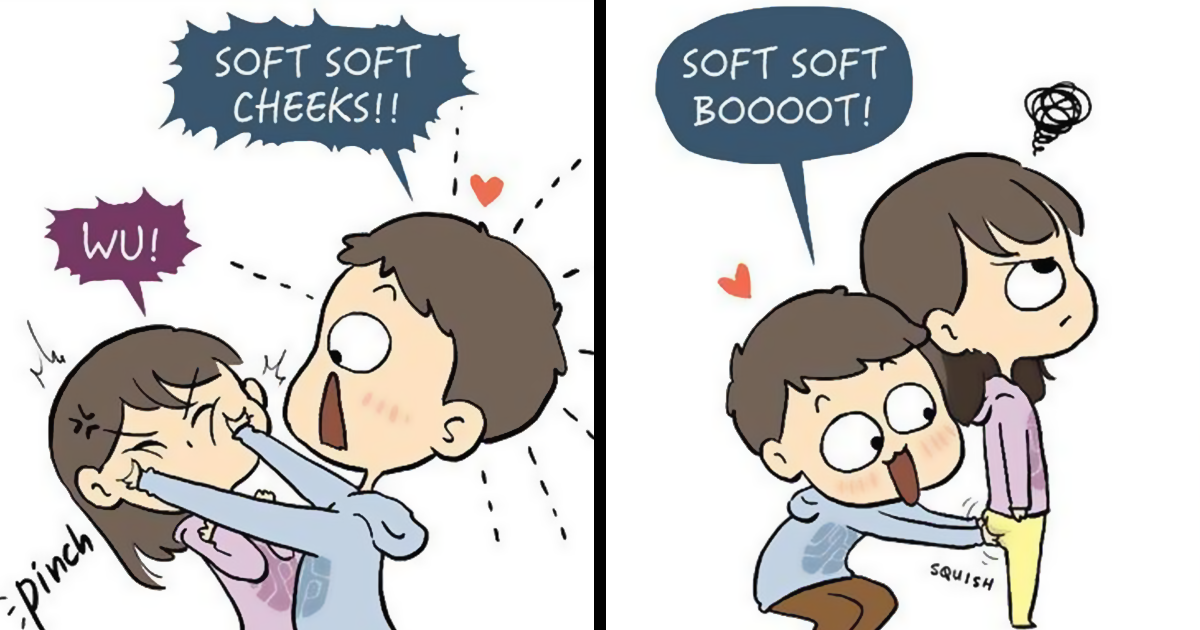
Romance is often advertised with candlelight, dramatic airport reunions, and suspiciously wrinkle-free bedsheets. Real relationships, however, are more likely to involve stolen snacks, blanket negotiations, unanswered questions from three hours ago, and one partner insisting they are “not tired” while falling asleep mid-sentence.
That wonderfully ordinary version of love is the territory explored by The Potato Couple, a relationship comic series created by Malaysian couple Jason and Ymei. Their sweet, playful illustrations turn small domestic moments into visual punchlines that feel instantly familiar. The 35 newer comics continue that formula, capturing the affectionate nonsense that develops when two people know each other almost too well.
These are not stories about perfect partners living in a permanent honeymoon montage. They are about comfort, teasing, food, sleep, emotional support, misunderstandings, and the unofficial marital law stating that anything on your partner’s plate looks better than the identical item on yours.
From Long-Distance Drawings to The Potato Couple
Jason and Ymei’s comic project began with personal drawings created during their long-distance relationship. Those early illustrations eventually developed into J&Y Productions and the series now widely known as The Potato Couple. By 2023, the project had reached its tenth anniversary and attracted an international audience numbering in the hundreds of thousands.
The name arrived when the couple prepared to publish their first book in 2015. They wanted something simple, memorable, and relatable. A potato, in their playful explanation, is mildly sweet and full of carbohydratesmaking it an excellent symbol for love that is warm, energetic, and not so sugary that readers need to schedule a dentist appointment afterward.
It is a silly name, but it suits the project. Potatoes are comforting, adaptable, and rarely pretentious. Nobody expects a potato to deliver a twelve-minute speech about its emotional journey. It simply shows up, makes the meal better, and occasionally becomes fries. The comics work in much the same way: uncomplicated on the surface, deeply comforting underneath.
A Creative Partnership Built on Observation
According to Jason, roughly 80 percent of the stories come from real life, although moments are sometimes exaggerated to improve the joke or clarify the message. The couple keeps notes nearby so that an argument, affectionate gesture, awkward misunderstanding, or sudden “aha” moment can be evaluated as possible comic material later.
That habit explains why the finished panels feel so natural. The creators are not beginning with a generic idea such as “marriage is funny.” They are watching for the precise moment when everyday life becomes funny: the facial expression after someone says they are not hungry and then reaches across the table, the dramatic response to a minor inconvenience, or the peaceful feeling of finally being reunited after a long day.
Why the 35 New Relationship Comics Feel So Familiar
The strongest relationship comics create two reactions almost simultaneously. First comes the laugh. Then comes the quieter realization: “Wait, we do that too.”
The new collection succeeds because it focuses on behavior that rarely appears in traditional romantic storytelling. There are no billionaire weddings, magical prophecies, or misunderstandings that could be solved only after six seasons. The stakes are smaller and more recognizable. Who gets the comfortable side of the bed? Why does one person need three pillows? Is sharing dessert a loving gesture or an act of culinary theft?
Love Is Hidden in the Tiny Reactions
Long-term affection is often expressed through responses so small that outsiders might miss them. One partner arrives home, and the other visibly relaxes. Someone makes a strange noise, and the other person understands exactly what it means. A bad mood is met with a snack, a hug, or the strategic decision to remain silent until coffee has been administered.
Relationship researchers often describe these everyday attempts to connect as emotional “bids.” A comment, touch, joke, sigh, or random observation can be an invitation for attention. Consistently acknowledging those invitations helps partners build trust and closeness over time.
The Potato Couple comics turn such bids into visible stories. A request for food may actually mean “take care of me.” Playful annoyance may carry the message “I am comfortable enough to be ridiculous around you.” A reunion hug may communicate more than a paragraph of romantic dialogue ever could.
Exaggeration Makes the Truth Easier to See
Cartoon characters can stretch, shrink, explode, melt, or transform into emotional weather systems. That freedom allows the artist to illustrate feelings more accurately than a realistic photograph sometimes can.
A mildly irritated person might become a fire-breathing creature. A sleepy partner may appear to weigh as much as a refrigerator. A hug can become a full-body collision. None of this is literally true, but emotionally, it can be extremely accurate.
This is one reason comics are especially effective for autobiographical storytelling. The medium combines visual rhythm, character expression, and selective detail, allowing artists to compress an entire domestic episode into a few carefully arranged panels. The Library of Congress recognizes autobiography as an important subject within modern webcomics, while its broader comic-art collection highlights how panels and character development can attract devoted audiences across formats.
The Secret Ingredient Is Affection, Not Just Comedy
Plenty of jokes can be made about married life. The important question is whether both people are laughing.
The Potato Couple generally avoids the old-fashioned “my spouse ruined my life” style of relationship humor. Instead, the comedy comes from mutual quirks, mismatched habits, and affectionate exaggeration. Even when one character is annoyed, the relationship itself does not feel like the target.
That distinction matters. Positive humor can help partners feel closer, especially when the joke reduces tension or celebrates a shared experience. Shared laughter has also been associated with greater positive emotion, perceived similarity, and relationship satisfaction. Humor used as disguised hostility, however, can produce the opposite effect.
The Joke Usually Protects the Relationship
In effective couple comedy, the punchline rarely says, “My partner is terrible.” It says, “Human beings are strange, and somehow these two strange people have agreed to share a bathroom.”
Jason and Ymei’s illustrated characters may tease each other, compete for food, or react dramatically to harmless situations, but the emotional foundation remains warm. Their comic versions are teammates, even when they are briefly opposing attorneys in the Supreme Court of Blanket Distribution.
This approach has parallels in other popular autobiographical relationship comics. Yehuda and Maya Devir have built visual stories around the chaos of marriage and family life, while Bonnie Pang’s IT Guy & Art Girl turns differences in personality and profession into affectionate humor. These series differ visually, but all transform private routines into public recognition.
What the Comics Reveal About Modern Relationships
At first glance, a comic about stealing fries may not appear to offer deep social commentary. Look closer, however, and these panels reveal several truths about contemporary couplehood.
Comfort Is Its Own Kind of Romance
Early romance is often shaped by presentation. People carefully choose outfits, prepare clever replies, and pretend they have never made a strange sound while standing up. Long-term intimacy gradually replaces that polished performance with comfort.
The characters in The Potato Couple are lovable because they have entered the phase where each person has seen the other at their least cinematic. Their affection survives messy hair, odd sleeping positions, unflattering expressions, and highly questionable snack decisions.
That does not mean romance has disappeared. It has simply changed clothing. Sometimes romance wears sweatpants and asks whether there is any ice cream left.
Partners Develop a Private Language
Couples often collect repeated jokes, gestures, nicknames, and references until they have created a miniature culture understood by approximately two people. A single look may summarize an entire argument. One oddly pronounced word can remain funny for ten years. A story nobody else finds interesting becomes an essential part of the relationship archive.
The comics invite readers into Jason and Ymei’s private language while leaving enough space for couples to recognize their own. The circumstances may differ, but the emotional grammar is familiar.
Ordinary Life Is Worth Documenting
Social media frequently treats life as a collection of major announcements: weddings, vacations, promotions, babies, new homes, and perfectly arranged breakfasts that definitely became cold during the photo session.
Relationship comics offer a refreshing alternative. They suggest that a Tuesday-night conversation can be memorable. A ridiculous argument can become a cherished story. A tiny act of care may deserve to be recorded even if it receives no applause.
That attention to ordinary life connects The Potato Couple with a much longer tradition of autobiographical comics. Artists have repeatedly used sequential art to give emotional weight to domestic routines, personal anxieties, family dynamics, and experiences that might otherwise seem too small for conventional storytelling.
Why Relationship Webcomics Are So Shareable
A successful relationship comic requires very little explanation. Readers can understand the situation in seconds, making the format ideal for scrolling, sharing, and sending to a partner with the caption, “This is literally you.”
That message often means one of three things:
- “I feel seen.”
- “You have been exposed.”
- “Please stop stealing my food.”
The accessibility of webcomics also helps them cross cultural and linguistic boundaries. Facial expressions, body language, domestic routines, and visual exaggeration can communicate even when readers come from different backgrounds.
Relatability has become a major creative force in online illustration. Comics such as Nathan Pyle’s Strange Planet became widely popular by presenting familiar behavior from an unexpected perspective. The Potato Couple uses a different visual universe, but the emotional mechanism is similar: readers laugh because a simple image makes ordinary behavior suddenly visible.
The Creative Challenges Behind Apparently Simple Comics
Short comics may look effortless, but simplicity is usually the result of difficult choices. The artist must identify the essential moment, remove unnecessary details, establish the situation, pace the panels, and deliver the punchline before the reader loses interest.
Jason has identified creative blocks and changing social media algorithms as persistent challenges. His response to creative fatigue includes resting, traveling, studying other content, and allowing ideas to return naturally. He has also joked that he cannot always explain why one post becomes popular while another carefully prepared post does not. That statement may be the most relatable comic premise of all, especially to anyone who has ever posted online.
The couple’s note-taking practice provides a useful lesson for creators. Inspiration is not always a lightning bolt. Sometimes it is a half-finished sentence typed into a phone while your partner is doing something inexplicably funny near the refrigerator.
Observation Comes Before Illustration
The appeal of the finished artwork depends on attention. A creator must notice how people pause, react, avoid eye contact, lean closer, or become dramatically offended by minor events. Comedians working with autobiographical material describe a similar process: they study behavior, identify emotional patterns, and often involve their partners in deciding which private experiences can become public jokes.
That collaborative sensitivity is especially important when real relationships become content. A funny story should not come at the cost of trust. The strongest material usually lets the audience laugh with the couple rather than at one partner’s humiliation.
More Than Cute Pictures
Jason has said that readers have sent messages describing meaningful emotional reactions to the comics, including people who felt encouraged during difficult periods. While a cheerful webcomic is not a substitute for professional support, such responses show how powerful recognition can be. Seeing a familiar emotion represented can make a reader feel less isolated.
The series does not offer a twelve-step program for building the perfect relationship. It offers something humbler: warmth. A few panels remind readers that affection can be awkward, arguments can become funny stories, and the person who annoys you by stealing your snack may also be the person whose presence makes home feel complete.
In a digital environment often dominated by outrage, comparison, and aggressively optimized perfection, these comics create a small, soft corner of the internet. Jason has expressed the hope that readers will find warmth in the work and share it with others who need it.
A Couple’s Experience of Reading the 35 New Comics Together
Imagine two partners sitting on the couch after dinner. One is scrolling through the collection while the other is pretending not to look. Within a few panels, the first person laughs and turns the phone around.
“This is you,” they say.
“That is absolutely not me,” the second person replies, already recognizing themselves with uncomfortable accuracy.
That exchange is part of the experience. Relationship comics are not only consumed; they are used. Couples send them as affectionate accusations, conversation starters, apologies, reminders, and evidence in ongoing domestic investigations.
The First Stage: Recognition
The initial pleasure comes from identifying a familiar habit. Perhaps one character needs constant attention while the other is trying to work. Maybe someone steals a bite after confidently declining food. Perhaps the comic captures the difference between how a couple imagines sleeping together and the actual nighttime arrangement, which resembles a wrestling match conducted under a comforter.
Recognition produces a special kind of laughter because the reader is not only enjoying a joke. The reader is watching private behavior become universal. Something that seemed unique to one household has apparently been happening in kitchens, bedrooms, and living rooms around the world.
The Second Stage: Competitive Identification
Soon, each partner begins assigning characters.
“You are clearly the dramatic one.”
“I am reacting normally. You are the one who behaves like a confused raccoon.”
This debate may continue far longer than the comic itself. That is not necessarily a problem. The panels provide a low-pressure way to discuss habits that might sound more critical in direct conversation. A playful image can soften the opening, allowing the couple to laugh before addressing the real issue.
Of course, comic-based diplomacy has limits. Sending seventeen panels about dirty dishes at 2 a.m. is no longer subtle communication. At that point, someone should probably wash a plate.
The Third Stage: Remembering Shared Moments
As the couple continues scrolling, the comics may trigger memories. A panel about travel recalls the vacation when both people became lost but refused to admit it. A food joke brings back the anniversary dinner when one partner ordered the better meal. A comforting scene recalls a difficult week when a quiet hug mattered more than advice.
These memories form the couple’s shared narrativethe evolving story they tell about who they are together. Relationship researchers emphasize the importance of friendship, affection, shared meaning, and regular moments of connection. A comic cannot create those qualities by itself, but it can help partners notice that they already exist.
The Final Stage: Seeing Ordinary Love Differently
After reading all 35 comics, viewers may return to their own routines with slightly sharper eyes. The next silly disagreement might look less like evidence of incompatibility and more like a future story. The next spontaneous hug may feel worth remembering. Even a stolen French fry could become part of the relationship mythology, although repeated offenses should still be prosecuted.
This is the collection’s most appealing effect. It does not make ordinary relationships look more glamorous. It makes ordinary relationships look more valuable.
Love is not always a grand performance. Sometimes it is bringing water without being asked. Sometimes it is understanding a strange facial expression. Sometimes it is sitting together in comfortable silence. And sometimes it is turning your spouse into a potato-shaped cartoon so hundreds of thousands of strangers can recognize themselves in your marriage.
Conclusion
The 35 new Potato Couple comics demonstrate why Jason and Ymei’s work continues to connect with readers. Their success comes not from inventing an ideal romance but from observing the real one in front of themcomplete with teasing, tenderness, snack disputes, tired conversations, emotional support, and wonderfully unnecessary drama.
By combining personal experience with visual exaggeration, the creators turn private memories into relatable relationship comics. Each panel suggests that a good love story does not need constant excitement. It needs attention, kindness, shared humor, and perhaps an emergency supply of food that both partners agree not to steal.
That last condition may be unrealistic, but love is about hope.












