
America has a retirement problem, and like every great national mystery, everyone has a favorite suspect. Some point at pensions and say, “Aha! Those generous promises are bankrupting the system.” Others point at the disappearance of pensions and argue the opposite: “No, the crisis started when we took stable retirement income away from ordinary workers.” Somewhere in the middle sits the confused 62-year-old trying to calculate whether a 401(k), Social Security, home equity, and a half-used warehouse-club membership can somehow become a dignified retirement plan.
So, are pensions to blame for the retirement crisis? The honest answer is: not exactly. Traditional pensions are not the villain in a black cape. In many ways, they were one of the strongest tools workers had for predictable retirement income. But poorly funded pension promises, shrinking private-sector pension coverage, rising longevity, uneven access to retirement plans, and the shift toward individual savings accounts have all helped create the current retirement squeeze.
The better question is not whether pensions caused the retirement crisis. It is whether America replaced pensions with something equally reliable. For millions of workers, the answer is a nervous laugh followed by checking a 401(k) balance during lunch.
What Is the Retirement Crisis?
The retirement crisis refers to the growing gap between what Americans need for financial security in retirement and what many households have actually saved. It is not one single problem. It is a tangled mess of low savings, inconsistent workplace plan access, longer lifespans, expensive health care, housing costs, debt, and uncertainty about future Social Security benefits.
Many older Americans still rely heavily on Social Security, but Social Security was never designed to be a full retirement paycheck. It is a foundation, not the whole house. When private savings are thin and pensions are absent, that foundation starts carrying too much weight. Add inflation, medical costs, and the possibility of living 25 or 30 years after leaving full-time work, and retirement planning begins to feel less like budgeting and more like trying to land a plane using a grocery receipt.
Data from major retirement research organizations consistently shows a divided picture. Higher-income households often have retirement accounts, home equity, and investment assets. Lower- and middle-income workers are more likely to have limited savings, no employer plan, irregular work histories, or jobs that do not provide meaningful retirement benefits. The result is a system where some people retire with spreadsheets, advisors, and tax strategies, while others retire with hope, Social Security, and a calculator that has seen too much.
How Traditional Pensions Used to Work
A traditional pension, also called a defined benefit plan, promises workers a set monthly payment in retirement. The benefit is usually based on salary, years of service, and age at retirement. The employer is responsible for funding and managing the plan. Workers do not have to decide which funds to buy, rebalance a portfolio, or guess how long they will live. The pension does the heavy lifting.
That structure has real advantages. A pension provides lifetime income, which protects retirees from outliving their money. It pools risk across many workers. It reduces the burden of individual investment decisions. It also turns retirement from a personal guessing game into a more predictable stage of life.
For workers who spent decades with one employer, pensions could be powerful. A teacher, factory worker, utility employee, or public servant could plan around a known monthly benefit. Combined with Social Security and modest savings, that pension often created a stable retirement. It was not always glamorous, but it was dependable. Dependability may not trend on social media, but retirees tend to be big fans of checks that arrive every month.
Why Private-Sector Pensions Declined
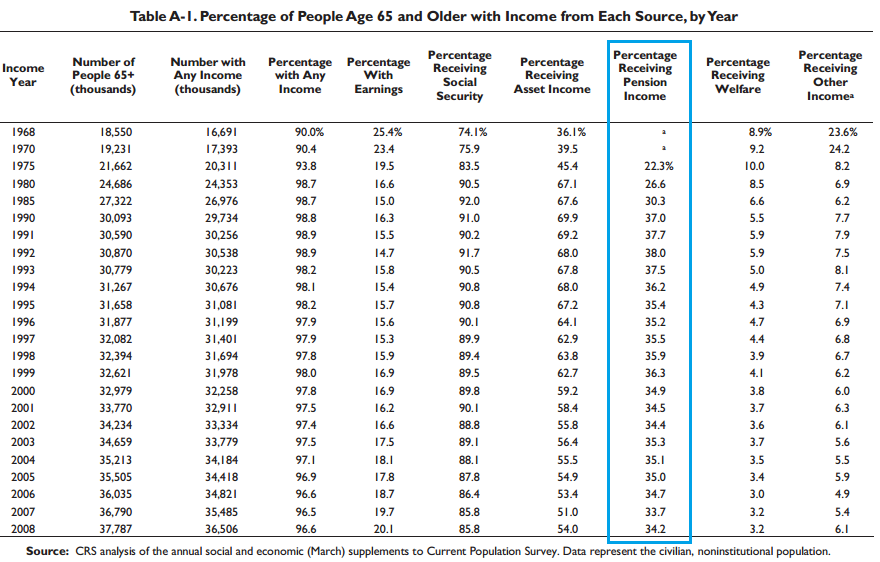
The decline of private-sector pensions is one of the biggest changes in American retirement history. Over several decades, employers moved away from defined benefit plans and toward defined contribution plans, such as 401(k)s. In a 401(k), workers contribute money from their paychecks, often with an employer match, and the final retirement balance depends on contributions, investment returns, fees, withdrawals, and timing.
Employers had several reasons for making the switch. Traditional pensions can be expensive, complex, and risky for companies. Employers must estimate future obligations, manage investments, and contribute enough to fund promised benefits. If workers live longer or markets underperform, the employer may have to contribute more. A 401(k), by contrast, shifts much of that risk to employees.
For companies, the change made financial sense. For workers, it was a mixed bag. A 401(k) can work well for people who have steady income, start early, receive employer matches, invest consistently, avoid high fees, and do not cash out when changing jobs. That is a lot of “ifs.” The 401(k) system can be excellent for disciplined savers with stable careers, but it is less forgiving for people who face layoffs, caregiving breaks, medical bills, low wages, or employers that do not offer a plan.
Are Pensions Too Expensive?
Some critics argue that pensions are a major cause of fiscal stress, especially in the public sector. They point to underfunded state and local pension plans, rising contribution requirements, and political promises that were easier to make than to pay for. In some cases, those criticisms are fair. A pension promise without proper funding is not generosity; it is a bill handed to the future with a smiley face sticker on it.
Public pensions can become a burden when governments skip contributions, use unrealistic investment assumptions, enhance benefits without paying for them, or rely too heavily on risky returns. When pension systems are underfunded, taxpayers, workers, and future public services may all feel the pressure. That is why pension governance matters. Sound funding rules, honest accounting, reasonable benefit formulas, and disciplined contributions are not boring details. They are the seat belts of retirement policy.
Still, it would be misleading to blame pensions as a category. Well-funded pensions can be efficient and sustainable. The problem is not that lifetime retirement income exists. The problem is when promises are made without adequate funding or when pension debates ignore the broader cost of retirement insecurity. If fewer workers have pensions and many do not save enough, society may still pay through increased reliance on safety-net programs, delayed retirement, family financial strain, and reduced consumer spending among older adults.
The Real Issue: Risk Shifted From Employers to Workers
The biggest retirement change is not simply that pensions became less common. It is that risk moved from institutions to individuals. Under a traditional pension, employers and pension funds manage investment risk and longevity risk. Under a 401(k), workers must decide how much to save, where to invest, how to react during market crashes, when to retire, and how quickly to withdraw money.
That is a lot to ask from people who are also raising children, paying rent, managing debt, caring for parents, and trying to understand why eggs sometimes cost like luxury goods. Retirement planning requires financial literacy, emotional discipline, and enough income left over after today’s bills. Many households are not failing because they are careless. They are failing because the system assumes everyone has extra cash, stable employment, and the personality of a spreadsheet.
This risk shift helps explain why the retirement crisis is uneven. Workers with higher wages benefit most from tax-advantaged accounts because they have more money to contribute and more tax liability to reduce. Workers with low wages may need every dollar for immediate expenses. Even when they have access to a plan, participation can be difficult without automatic enrollment, employer contributions, and emergency savings.
Social Security Is Essential, but It Cannot Do Everything
Social Security remains the most important retirement income source for many Americans. It is especially valuable because it provides inflation-adjusted lifetime benefits. Unlike a personal account, it does not disappear because of a market downturn or a retiree living longer than expected.
But Social Security faces long-term financing challenges. Current projections show that without legislative action, trust fund reserves could be depleted in the 2030s, after which incoming revenue would cover only a portion of scheduled benefits. That does not mean Social Security will vanish. It means policymakers need to address the gap through some combination of revenue increases, benefit adjustments, or broader reforms.
This uncertainty makes pensions and private savings even more important. If Social Security benefits are reduced in the future, retirees without pensions or meaningful savings will be most vulnerable. But if Social Security is strengthened, it can help stabilize the entire retirement system. In plain English: Social Security is the floor. Pensions and savings are the furniture. Nobody wants to spend retirement sitting on the floor.
Do 401(k)s Solve the Problem?
401(k) plans are not bad. In fact, well-designed 401(k)s can be very effective. Automatic enrollment, automatic escalation, low-cost index funds, target-date funds, and employer matches have improved outcomes for many workers. When people are automatically enrolled, participation rises sharply. When contributions increase gradually over time, workers save more without feeling a sudden budget shock.
The weakness is that 401(k)s are not universal, and balances vary dramatically. Some workers have generous plans and strong matches. Others have no workplace plan at all. Some small businesses cannot afford to offer retirement benefits. Gig workers, part-time workers, and job changers often fall through the cracks. Even workers with plans may contribute too little, borrow from accounts, cash out when changing jobs, or retire during a market downturn.
Another challenge is turning savings into income. Accumulating money is one problem; spending it wisely over retirement is another. A retiree with a 401(k) balance must decide how much to withdraw each year while considering inflation, taxes, health care, market returns, and lifespan. That is not a simple household chore. It is basically actuarial science wearing a cardigan.
Public Pensions: Problem, Solution, or Both?
Public pensions occupy a complicated place in the retirement debate. For many teachers, firefighters, police officers, nurses, and government workers, pensions provide retirement security that private-sector workers increasingly lack. These plans can help attract and retain employees in public service, especially when salaries are lower than private-sector alternatives.
At the same time, public pensions can create budget pressure if they are underfunded. Some states and cities have managed their plans responsibly. Others have struggled with legacy costs, optimistic assumptions, or years of skipped payments. The variation is important. Saying “public pensions are broken” is too broad. Saying “all public pensions are perfectly fine” is also too cheerful. The truth is more annoying, which is how truth often behaves.
The best public pension systems are transparent, funded consistently, and designed with realistic assumptions. They balance worker security with taxpayer affordability. The worst systems delay hard choices until the bill becomes enormous. Pensions are not automatically a crisis. Bad pension management can be.
Why Blaming Pensions Misses the Bigger Picture
Blaming pensions for the retirement crisis misses several deeper issues. First, many workers no longer have access to any traditional pension. Second, many private-sector workers still lack access to employer-sponsored retirement plans. Third, wages for many households have not left enough room for consistent saving. Fourth, retirement has become longer and more expensive. Fifth, health care and long-term care costs can destroy even careful plans.
In other words, the retirement crisis is not caused by one greedy benefit system. It is caused by a retirement structure that expects individuals to carry more responsibility while giving them uneven tools. A high-income worker with a generous 401(k), employer match, financial advisor, and paid-off home is playing a different game from a low-wage worker with no plan, rising rent, and credit card debt. Both may live in the same economy, but they are not using the same retirement map.
Pensions actually highlight what people need most: predictable income. The problem is that America reduced access to traditional pensions without creating an equally strong universal replacement. The 401(k) system expanded, but it did not cover everyone. Social Security remained crucial, but it was not increased enough to replace the lost pension layer. The result is a three-legged stool where one leg is shorter, one leg is under repair, and the third leg depends on whether your employer offered a match.
What a Better Retirement System Could Look Like
A stronger retirement system would not simply bring back old pensions exactly as they were. The labor market has changed. Workers switch jobs more often, careers are less linear, and many people work outside traditional full-time employment. A modern solution needs portability, automatic participation, low fees, lifetime income options, and broad coverage.
1. Expand Access to Workplace Retirement Plans
Every worker should have a simple way to save through payroll deduction. State auto-IRA programs, small-business retirement credits, pooled employer plans, and federal reforms can help close the access gap. The easier saving becomes, the more likely people are to do it.
2. Use Automatic Enrollment and Automatic Escalation
Automatic enrollment works because it turns inertia into an ally. Instead of requiring workers to sign up, the plan includes them unless they opt out. Automatic escalation gradually increases contribution rates over time. These features are not magic, but they are close enough to deserve a cape.
3. Strengthen Social Security
Social Security is the backbone of retirement income for millions. Policymakers should address its financing sooner rather than later. Waiting makes the choices harder and the adjustments sharper. A stable Social Security system would reduce anxiety and protect retirees who have little other income.
4. Add Lifetime Income Options
Retirees need help turning savings into reliable income. Plans can offer annuity-like options, managed payout funds, or other income tools that reduce the risk of outliving assets. Workers should not need a Ph.D. in finance to spend their own savings safely.
5. Improve Pension Funding Discipline
Where pensions exist, they should be funded responsibly. That means realistic assumptions, regular contributions, transparency, and governance that resists political shortcuts. Pension promises should be treated like real obligations, not decorative language in a benefits brochure.
So, Are Pensions to Blame?
Pensions are not the main cause of the retirement crisis. If anything, the disappearance of pensions from much of the private sector has made retirement less secure for many workers. Traditional pensions had flaws, especially when poorly funded, but they solved a problem that 401(k)s often struggle with: providing reliable lifetime income.
The retirement crisis is better understood as a crisis of coverage, adequacy, and risk. Too many workers lack access to plans. Too many accounts are too small. Too much responsibility sits on individuals. Too much uncertainty surrounds Social Security. And too many policy debates treat retirement like a personal hobby instead of a core part of economic security.
Pensions are not innocent in every case. Underfunded plans can create serious public finance problems. But blaming pensions alone is like blaming the umbrella for the rain. The larger storm includes wage inequality, benefit erosion, longer lifespans, health care costs, and a retirement system that works best for people who already have advantages.
Experience-Based Reflections: What the Pension Debate Feels Like in Real Life
When people talk about pensions, the conversation often sounds technical: funded ratios, actuarial assumptions, contribution rates, discount rates, and liabilities. Those terms matter, but they can hide the human side of retirement. At the kitchen-table level, the pension debate is really about one question: “Will I be okay when I can no longer work the same way?”
Imagine two workers who earned similar salaries over their careers. One has a traditional pension. The other has a 401(k). The pension worker may not be rich, but they can estimate monthly income with confidence. They know what arrives next month and the month after that. The 401(k) worker may have a decent balance, but the balance moves with markets. A bad year right before retirement can feel personal, even if it is just the market doing market things. That uncertainty changes behavior. People may delay retirement, reduce spending too much, or worry constantly about running out of money.
This is where pensions offer an emotional benefit that spreadsheets rarely capture. Predictable income reduces stress. It helps retirees make decisions. It can support local economies because retirees with steady income continue spending on groceries, repairs, gifts, restaurants, and services. A pension check may look boring, but boring is underrated when the alternative is watching market news with the intensity of a sports fan in overtime.
At the same time, workers without pensions often feel the unfairness. A private-sector employee may see public workers retire with lifetime benefits while they must self-fund retirement through a 401(k), if they have one at all. That frustration is understandable. But the answer should not be to make everyone less secure. A better response is to ask why reliable retirement income became rare outside government jobs and how more workers can gain access to dependable savings and income tools.
Small business owners face another side of the problem. Many want to offer retirement benefits but worry about cost, administration, compliance, and employee turnover. For them, a traditional pension may be unrealistic. But simple payroll-based plans, tax credits, pooled plans, and automatic enrollment can make a difference. Retirement security should not depend entirely on whether someone works for a giant corporation, a state agency, or a tiny business with one heroic office printer and a coffee machine from 2009.
For younger workers, pensions can seem like a rumor from another planet. Many have student debt, high housing costs, changing jobs, and side gigs. Telling them to save more is not wrong, but it is incomplete. Saving requires income, access, and stability. A worker juggling rent, insurance, groceries, and family obligations may know perfectly well that retirement matters. Knowledge is not the missing ingredient; money often is.
The most practical lesson is that retirement security needs both personal action and system design. Individuals should save early when possible, capture employer matches, avoid unnecessary cash-outs, and increase contributions gradually. But public policy and employers must also create structures that make good outcomes easier. A retirement system that depends on millions of people making perfect financial choices for 40 years is not a system; it is a national group project with no project manager.
In the end, pensions are not the enemy. The real enemy is retirement uncertainty without adequate tools. A strong retirement future may include fewer old-style pensions, more modern pooled-income designs, stronger 401(k)s, broader automatic savings, and a protected Social Security system. The goal should not be nostalgia. The goal should be dignity. Americans do not need every retirement plan to look like it did in 1975. They need a system that lets people stop working someday without feeling like they are stepping off a financial cliff.
Conclusion
Pensions are not the simple villain behind the retirement crisis. Poorly funded pension promises can create real problems, especially for public budgets, but traditional pensions also provided something many workers desperately need: predictable lifetime income. The deeper crisis is that stable retirement income has become less available while individual workers are expected to manage more risk on their own.
The future of retirement should combine the best features of several systems: the reliability of pensions, the portability of defined contribution plans, the universality of Social Security, and the behavioral power of automatic enrollment. Blaming pensions may make for a punchy headline, but it does not solve the problem. Building a retirement system that actually works for modern workers would be far more usefuland frankly, much better for everyone’s blood pressure.












