
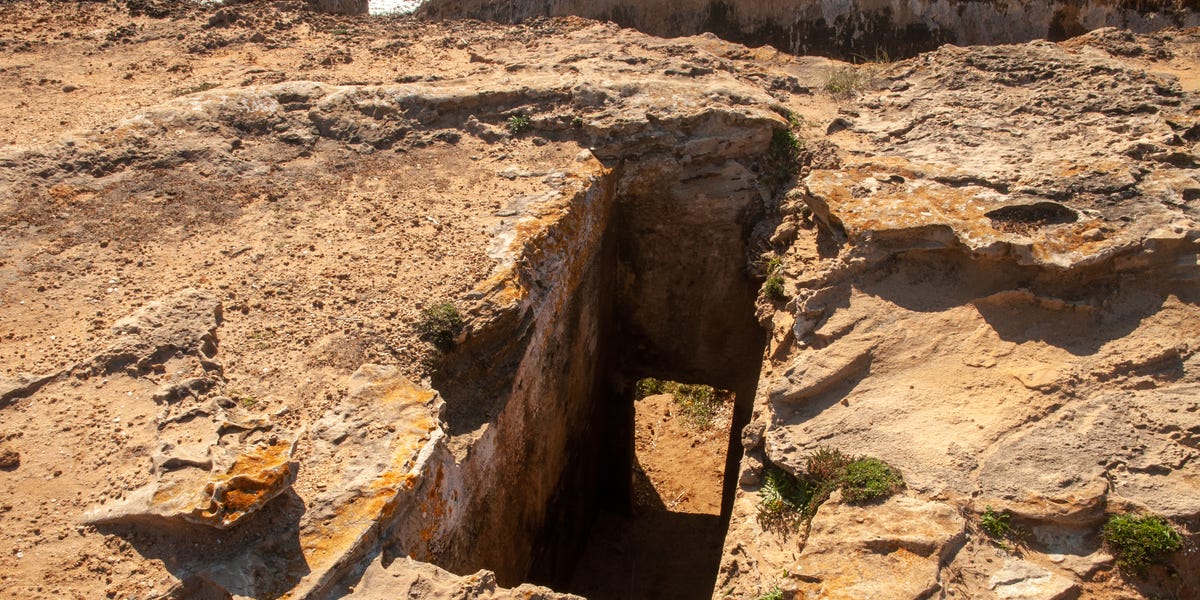
Some archaeological discoveries begin with gold, skeletons, dramatic inscriptions, and enough mystery to make a movie trailer write itself. This one began with construction work, pottery fragments, a stone circleand then the ancient-world equivalent of opening a beautifully wrapped gift box and finding absolutely nothing inside.
A Roman Tomb With One Very Strange Problem: No Body
Near the village of Wolkertshofen in Upper Bavaria, Germany, archaeologists uncovered what appears to be the foundation of a monumental Roman burial mound, or tumulus. The site was not discovered during a glamorous treasure hunt. It surfaced during work connected to a stormwater retention basin, which is a polite modern way of saying: “We were managing rainwater, and suddenly Rome showed up.”
The structure is striking. Archaeologists found a carefully built circular stone foundation about 12 meters wide, or roughly 39 to 40 feet across. On the southern side was a square extension measuring about two meters by two meters, likely the base for a statue, stele, or commemorative marker. Everything about the construction suggested importance: the shape, the craftsmanship, the roadside location, and the sheer “look at me” confidence of the monument.
But inside the circle, there were no bones. No urn. No ashes. No grave goods. No sword, jewelry, coins, ceremonial vessels, or dramatic “curse tablet” waiting to ruin someone’s afternoon. The tomb was empty.
That absence is exactly what makes the Wolkertshofen Roman tomb so fascinating. In archaeology, nothing is often something. A missing body can be evidence, tooespecially when the monument was clearly built with care, money, planning, and public visibility.
Where Was This Empty Roman Tomb Found?
The discovery took place near Wolkertshofen, close to Nassenfels in the Eichstätt district of Upper Bavaria. In Roman times, this area belonged to the province of Raetia, a frontier region that included parts of modern southern Germany, Switzerland, Austria, and the Tyrol. It was not the marble-and-mosaics heart of Rome, but it was deeply connected to the empire through roads, farms, military movement, trade, and cultural exchange.
The location matters because the Roman tomb was positioned beside an ancient road leading from Nassenfels toward the Altmühl Valley. Roman roads were not casual country lanes. They were the empire’s circulatory system, carrying soldiers, merchants, officials, news, taxes, goods, gossip, and probably more complaints about road repairs than any inscription bothered to preserve.
Nearby, archaeologists also note the presence of a villa rustica, a Roman rural estate. That detail strengthens the idea that the tomb was linked to a wealthy family or local elite. A large memorial beside a road was not only a private act of mourning; it was public messaging. It told travelers: someone important belonged here, and their family had the resources to make sure nobody missed it.
What Is a Tumulus?
A tumulus is a burial mound, often built over or around a grave. The form is ancient and widespread, appearing in many cultures long before Rome spread across Europe. In the Roman world, tumuli had a long tradition in Italy and Central Europe, and they began appearing in the empire’s northwestern provinces from the first century CE onward.
The Wolkertshofen structure was not the mound itself but the stone ring that would have supported or defined it. Think of it as the architectural skeleton of a monument that once rose higher in the landscape. The earthen mound is gone, but the stone foundation remained buried long enough to confuse, delight, and slightly torment modern archaeologists.
In Raetia, a Roman-period tumulus of this size and construction quality is extremely rare. Burial mounds in the region were more commonly associated with earlier Bronze Age and Iron Age traditions. That makes the Wolkertshofen tomb especially valuable because it sits at a cultural crossroads: Roman engineering, provincial identity, local memory, and possibly older Celtic funerary traditions all meeting in one empty circle of stone.
So Why Build a Tomb With Nobody Inside?
The leading interpretation is that the Wolkertshofen monument was a cenotaph. A cenotaph is an empty tomb or memorial built to honor someone whose remains are buried elsewhere, lost, unrecovered, or intentionally placed in another location. The word comes from Greek roots meaning “empty tomb,” which is refreshingly direct. Ancient people did not always overcomplicate the branding.
There are several reasons a Roman family might build a cenotaph. The deceased may have died far from home, perhaps during travel, military service, trade, or administrative work. Their body may have been buried in another family plot. Their remains may have been unavailable. Or the monument may have served a symbolic purpose larger than burial itself: preserving memory, asserting family prestige, and keeping the dead socially present among the living.
That last point is crucial. In Roman culture, memory was not passive. Families actively maintained it through inscriptions, monuments, portraits, funerary rites, meals, offerings, and public display. A tomb did not simply say “someone died.” It said, “This person mattered, this family matters, and yes, we selected excellent road frontage.”
The Roadside Location Was Not Random
Modern people may prefer quiet cemeteries tucked behind trees, but Romans often placed tombs and funerary monuments along roads outside settlements. This made the dead part of daily life. Travelers passing by could see names, statues, inscriptions, reliefs, and family symbols. In a world without billboards, a tomb could function as a memorial, status symbol, identity statement, and stone résumé.
The Wolkertshofen tomb’s location beside a Roman traffic route suggests it was designed for visibility. It was meant to be seen from the road, possibly from a distance. The square extension on the south side may have supported a statue or stele that made the monument even more readable to passersby. If the circular mound was the stage, the statue or marker was the spotlight.
This public-facing design helps explain why archaeologists do not interpret the empty interior as a failure. The monument may never have needed a body inside to do its job. Its job was remembrance. Its job was prestige. Its job was to make absence visible.
What the Empty Tomb Reveals About Roman Bavaria
The discovery gives researchers another piece of the puzzle in understanding Roman life in Bavaria. The area around Wolkertshofen was already known for a long history of human occupation, with evidence from the Neolithic, Bronze Age, Iron Age, Roman Imperial period, and early Middle Ages. That means this was not an empty backwater suddenly interrupted by one Roman monument. It was a long-used landscape where communities lived, farmed, buried their dead, adapted customs, and reused meaningful places.
The tomb also shows how provincial Roman culture was never simply a copy-and-paste version of Rome. People living in Raetia absorbed Roman forms, materials, technologies, and social habits, but they also existed within older local traditions. The tumulus form may represent that blend. The stone construction points toward Mediterranean and Roman models; the mound tradition echoes pre-Roman practices in Central Europe.
In other words, the Wolkertshofen monument may be a quiet argument in stone: Roman, local, elite, traditional, innovative, and symbolic all at once. That is the sort of identity mix archaeologists love, because it refuses to sit neatly in one labeled box. Ancient people, inconveniently for textbook writers, were complicated.
Could Tomb Robbers Have Taken Everything?
Whenever archaeologists find an empty tomb, the obvious question arrives wearing muddy boots: was it robbed?
Looting is common in ancient burial contexts. Many tombs across the Roman world were disturbed in antiquity or later centuries. Valuable grave goods were tempting, and stone monuments could be reused as building material. However, the Wolkertshofen tomb’s emptiness appears more meaningful than a simple case of robbery. Archaeologists found no skeletons and no grave goods, and the monument’s roadside position near a Roman estate supports the cenotaph interpretation.
If robbers had emptied the tomb, researchers might expect signs of disturbance or at least some leftover burial evidence. Instead, the structure seems to have been intentionally symbolic. It was likely built not as a container for remains, but as a monument to someone whose body was elsewhere.
That distinction matters. A robbed tomb says, “Something was here and someone took it.” A cenotaph says, “Someone was never here, but memory was.” The Wolkertshofen find appears to belong to the second category, which is arguably stranger and more emotionally interesting.
Why Archaeologists Are Excited About an Empty Space
To non-archaeologists, an empty tomb may sound like a letdown. No skeleton? No treasure? No dramatic Latin inscription calling down doom upon intruders? Come on, history, put in a little effort.
But archaeologists are not disappointed by absence when absence answers a question. The missing burial helps researchers understand Roman memory practices, social display, and cultural blending in Raetia. The monument’s size, shape, position, and emptiness create a more nuanced story than a typical grave might.
The tomb tells us that Roman provincial families could invest heavily in commemoration even without placing remains inside the monument. It shows that status could be performed through architecture. It suggests that the dead could remain socially powerful even when physically absent. It also hints at the emotional world of families who may have needed a local place to mourn someone buried far away.
That is the human core of the discovery. Beneath the archaeological vocabularytumulus, cenotaph, Raetia, villa rusticathere may be a family trying to solve an old problem: how do you keep someone present when they are gone?
Specific Examples That Help Explain the Find
Roman Roadside Tombs
Across the Roman world, tombs often lined roads outside city gates and settlements. These monuments turned travel routes into corridors of memory. A passerby might encounter inscriptions asking them to pause, read a name, or remember the dead. The Wolkertshofen tomb fits this pattern because it stood along an important Roman road rather than being hidden away.
Funerary Monuments as Status Symbols
Roman funerary art was deeply tied to identity and rank. Wealthy families, freed people, officials, landowners, and ambitious households used tombs to communicate who they were. A monument did not need to be subtle. In fact, subtlety was not exactly the Roman empire’s favorite hobby. The Wolkertshofen tumulus, with its large circular foundation and possible statue base, seems designed to make a statement.
Cenotaphs in the Ancient World
Cenotaphs were known in ancient Mediterranean culture. They honored people whose bodies were elsewhere, allowing families or communities to create a fixed site for remembrance. The Wolkertshofen monument likely belongs to this tradition. It was not empty because nobody cared. It was empty because the body and the memorial did not have to occupy the same place.
What Questions Remain?
The Wolkertshofen tomb still has mysteries. Who was honored there? Was the person a landowner connected to the nearby villa rustica? A family member who died away from home? A local elite figure who wanted Roman-style commemoration with regional flavor? Was there once an inscription on the stele or statue base? Did travelers know the name of the person remembered there?
Those answers may be difficult to recover. Organic materials decay. Inscriptions disappear. Stones are reused. Earth moves. Farmers plow. Construction happens. Time, as usual, refuses to keep tidy paperwork.
Future analysis of the site, surrounding features, soil, construction materials, and nearby Roman remains may help clarify the monument’s date and context. Even without a name, the tomb already speaks. It tells us that in Roman Bavaria, memory could be monumental, public, and expensiveeven when the person being remembered was not physically there.
Experiences Related to the Topic: Standing Before an Empty Tomb
There is a particular feeling that comes from standing near an ancient ruin and realizing the most important part of it is missing. Not missing in the frustrating sense, like losing your keys five minutes before leaving the house, but missing in a way that becomes the whole story. An empty Roman tomb asks visitors, readers, and researchers to slow down. It refuses the easy drama of treasure and forces attention onto memory, landscape, and intention.
Imagine walking along a rural road in Bavaria and seeing a mound rise beside the route nearly two thousand years ago. Perhaps there was a statue, a carved marker, or a painted surface catching the light. Carts moved past. Travelers looked over. Local people knew the family. Some may have paused, some may have ignored it, and some may have whispered the name of the dead. The monument did what monuments do best: it interrupted ordinary life with a reminder that someone wanted to be remembered.
That experience feels surprisingly modern. People still build memorials where bodies are not present. Roadside crosses, plaques for disaster victims, war memorials, missing-person monuments, and symbolic graves all serve a similar purpose. They give grief an address. They turn loss into a place. They allow memory to gather, even when the person cannot.
The Wolkertshofen tomb also changes how we think about archaeological excitement. Popular imagination loves the moment when a tomb opens and reveals golden masks, jeweled daggers, or a skeleton posed like it has been waiting centuries for dramatic lighting. But real archaeology is often quieter and more thoughtful. Sometimes the greatest discovery is a pattern of stones. Sometimes the most important artifact is the absence of artifacts. Sometimes the “wow” moment is not “Look what they found,” but “Look what they deliberately did not put here.”
For anyone fascinated by ancient history, that is a valuable lesson. A site does not need glitter to matter. The empty tomb in Bavaria reminds us that archaeology is not only about objects; it is about choices. Someone chose the road. Someone chose the circle. Someone chose the stonework. Someone chose the statue base. Someone chose to build a tomb where no one would be buried, because the monument itself was the message.
And there is something moving about that. The person commemorated at Wolkertshofen may never be identified. Their name may be gone. Their body may have rested far away or vanished entirely from the archaeological record. Yet the family’s effort survived in stone. That is the strange power of the empty Roman tomb: it contains no body, but it is not empty of meaning.
Conclusion: The Empty Tomb That Was Full of Clues
The massive Roman tomb discovered near Wolkertshofen is not remarkable because archaeologists found treasure inside. It is remarkable because they found nothing insideand that nothing changes the story.
The 12-meter circular stone foundation, the possible statue base, the Roman road, the nearby villa rustica, and the absence of remains all point toward a cenotaph: a symbolic tomb built to honor someone buried elsewhere. In ancient Raetia, where such Roman tumuli are rare, this discovery offers a powerful glimpse into how provincial communities blended Roman customs with local traditions.
More than a strange archaeological headline, the Wolkertshofen tomb is a reminder that monuments do not always preserve bodies. Sometimes they preserve longing, status, identity, and the stubborn human desire to be remembered after the last traveler has passed.












