
Note: This article is based on current public information about AmiBlitz, AmiBlitz3, AmigaOS, Aminet packages, modern Amiga emulation, PiStorm/Emu68 acceleration, and active retro-computing community development.
Why Amiga Programming Still Has a Pulse in 2025
In 2025, programming for the Amiga sounds, at first, like choosing to commute by steam train because the whistle has better vibes. And yet, the Amiga refuses to become just another beige museum piece. It still has active developers, new operating system updates, modern emulator workflows, hardware accelerators, community tutorials, fresh code examples, and a stubbornly cheerful group of people who look at a Motorola 68k machine and think, “Yes, I can still ship something fun on this.”
That is where AmiBlitz comes in. AmiBlitz, especially in its modern AmiBlitz3 form, is a BASIC compiler and integrated development environment for 68k Amiga systems. It continues the tradition of Blitz Basic, a language that helped many Amiga users move beyond simple tinkering into actual game and application development. Unlike the slow, line-numbered BASIC stereotype that haunts old computer jokes like a ghost wearing a pocket protector, Blitz Basic was compiled. That mattered. It let hobbyists write fast Amiga software without immediately wrestling every copper list, blitter operation, and register-level detail by hand.
Today, AmiBlitz occupies a sweet spot between nostalgia and practicality. It is approachable enough for returning Amiga fans, powerful enough for real utilities and games, and close enough to the machine to remind you that the Amiga was never just a computer. It was a tiny multimedia stage with a keyboard attached.
What Is AmiBlitz?
AmiBlitz is the modern continuation of the Blitz Basic idea on the Amiga. AmiBlitz3 is a complete package that includes a compiler, an IDE, documentation, includes, examples, libraries, and tools intended for 68k Amiga development. It targets classic Amiga environments rather than pretending the platform has somehow become a cloud-native Kubernetes cluster. Thank goodness. Nobody wants to debug YAML on an A1200.
The current AmiBlitz3 package is aimed at Amiga systems with enough resources to run the IDE comfortably. The development environment itself expects more than a stock floppy-only machine: hard drive space, extra RAM, a 68020-class processor, and a suitable Workbench setup. The compiled output, however, is a separate story. Developers can build programs while thinking carefully about what hardware they want their finished software to support.
That distinction is important. A modern AmiBlitz workflow may happen on an accelerated Amiga, a PiStorm-powered system, or an emulator like WinUAE or FS-UAE. The final program can still be designed with real Amiga hardware in mind. In other words, you can write with 2025 convenience and still respect 1990 constraints. It is like cooking with a modern oven but serving the meal on a very opinionated ceramic plate from 1987.
Why AmiBlitz Matters for Amiga Development
1. It Keeps Classic Amiga Coding Approachable
Many Amiga developers love assembly language, and for good reason. Assembly gives maximum control over the hardware. It also gives maximum opportunity to spend an entire evening discovering that one tiny assumption has thrown your sprite routine into the emotional equivalent of a washing machine full of bricks.
AmiBlitz gives programmers another path. It lets them write structured, readable code while still producing compiled Amiga programs. That makes it useful for hobbyists, returning developers, retro game creators, utility authors, and learners who want to understand Amiga programming without beginning at the deepest end of the swimming pool wearing lead boots.
2. It Connects to the Real Amiga Ecosystem
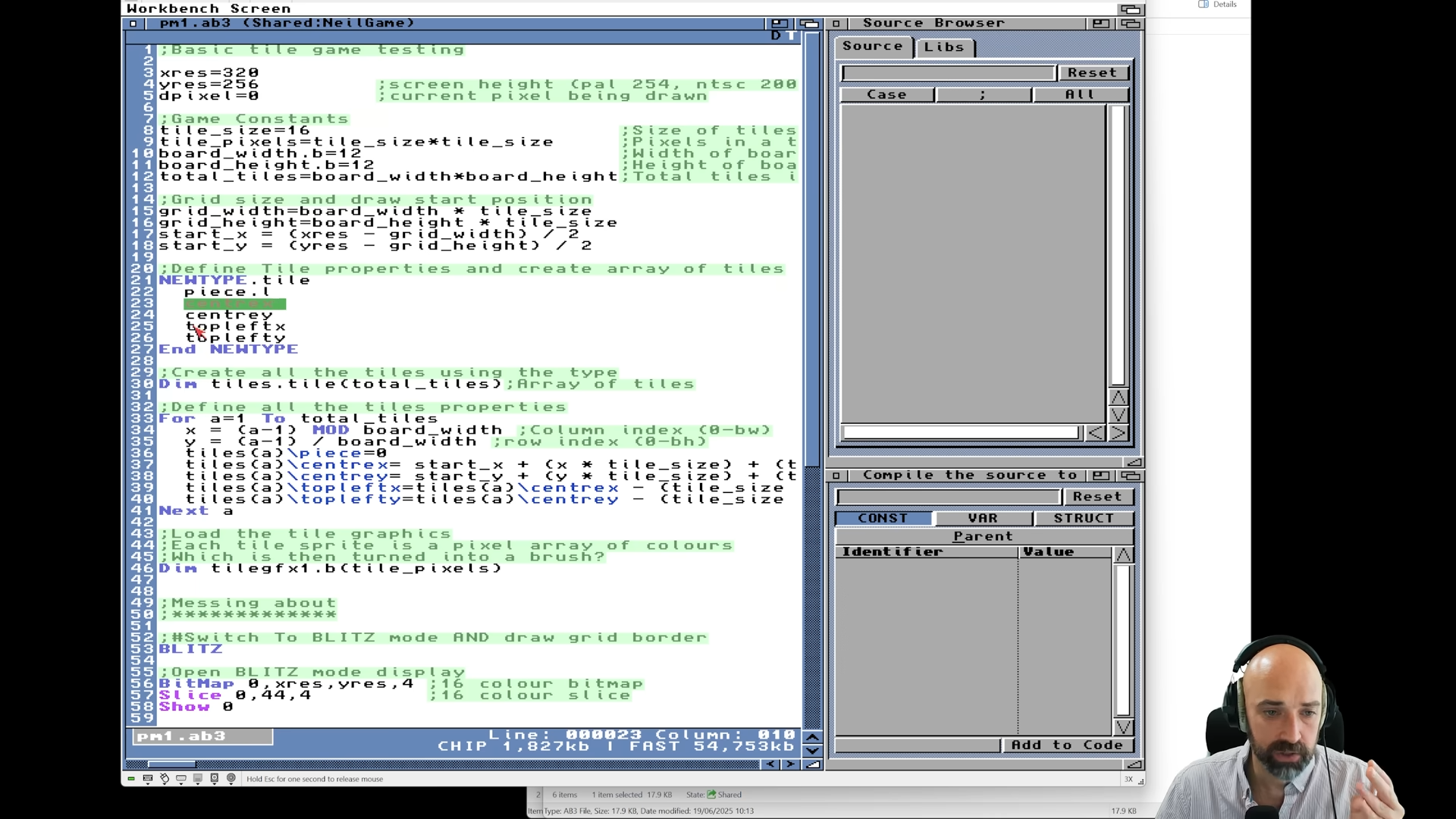
AmiBlitz is not just a toy language floating above the platform. It can interact with Amiga concepts that matter: screens, windows, libraries, Workbench behavior, graphics, input, files, and user interface systems such as MUI. Recent AmiBlitz example packages include practical demonstrations like opening screens, creating windows, plotting graphics, checking CPU and FPU information, building MUI interfaces, handling interface events, locating a program’s startup directory, and writing files.
That practical example base is one reason AmiBlitz remains valuable. Retro development is much easier when you can begin with working samples rather than a blank editor and a distant memory of how you once configured assigns at 2 a.m.
3. It Has a Living Community
Amiga programming in 2025 is not mainstream, but it is alive. AmiBlitz continues to appear in discussions about game development, application development, retro tools, and no-code or low-code experiments. Community packages on Aminet, video tutorials, GitHub activity, Discord discussions, and retro-computing articles all point to the same conclusion: AmiBlitz is not a fossil. It is more like a vintage synthesizer that still works, still sounds cool, and still occasionally makes everyone in the room say, “Wait, that came from that?”
The 2025 Development Landscape: Real Hardware, Emulators, and Accelerators
Real Amiga Hardware
Developing directly on original Amiga hardware is still the most romantic option. It is also the most likely to involve compact flash adapters, old power supplies, mysterious expansion boards, and the ancient ritual of asking whether the problem is the software, the cable, the RAM, or the universe having a sense of humor.
For AmiBlitz, real hardware can be wonderful when properly expanded. A stock Amiga 500 is historically important, but it is not the ideal place to run a modern IDE. An Amiga 1200, Amiga 3000, Amiga 4000, or upgraded 68k machine gives the developer far more breathing room. Add RAM, storage, and a faster CPU, and AmiBlitz becomes much more comfortable.
WinUAE and FS-UAE
Modern emulators have changed the Amiga programming experience dramatically. WinUAE on Windows and FS-UAE across Windows, macOS, and Linux allow developers to build, test, save states, transfer files, and iterate quickly. That is a huge advantage when compared with the old cycle of editing on a slow hard drive, rebooting after crashes, and praying to the gods of floppy alignment.
For AmiBlitz development, emulation offers a practical workflow: configure an Amiga environment, install AmiBlitz3, mount host folders for file exchange, and test across different machine profiles. A developer can target a plain A1200-style configuration, an expanded 68030 machine, or a more powerful setup depending on the software’s goals. Testing across profiles helps avoid writing a program that runs beautifully only on the author’s turbocharged Franken-Amiga and nowhere else.
PiStorm and Emu68
PiStorm and Emu68 have also become important parts of the modern Amiga conversation. PiStorm is an open-source accelerator approach that uses a Raspberry Pi to provide fast 68k-style performance, while Emu68 uses bare-metal JIT translation for speed. For developers, this can make the Amiga feel startlingly responsive without abandoning the classic environment.
That speed is useful when compiling, browsing documentation, running an IDE, or testing larger projects. Still, developers should be careful. If a game or utility is meant for a broader Amiga audience, it should be tested on slower or more standard configurations too. Performance is wonderful, but compatibility is the Amiga scene’s love language.
What Can You Build With AmiBlitz in 2025?
Games
Games are the obvious attraction. Blitz Basic has a strong historical connection with Amiga game development, including well-known examples from the 1990s. AmiBlitz keeps that spirit alive for modern homebrew creators. A developer can build arcade games, platformers, puzzle games, shooters, strategy experiments, and small prototypes without dropping straight into assembly.
For example, a simple AmiBlitz game might begin with a custom screen, a player sprite, joystick input, collision detection, and a tile-based background. From there, the developer can add sound effects, score tracking, enemy behavior, and level progression. The biggest challenge is not usually the language; it is designing within Amiga limits. Color depth, chip RAM, CPU speed, screen modes, and disk loading still matter. The Amiga is generous with charm but strict with resources.
Workbench Utilities
AmiBlitz is also useful for Workbench utilities. Small tools are a perfect fit: file helpers, launchers, configuration tools, data converters, disk utilities, productivity aids, and graphical front ends for existing command-line programs. Because AmiBlitz can work with Amiga libraries and user interface concepts, it is not limited to full-screen games.
This is one area where modern retro development feels especially rewarding. A useful Workbench tool does not need to compete with modern software. It only needs to make life better inside the Amiga environment. A clean MUI-based utility that solves one annoying problem can earn more love than a giant unfinished game engine that promises seven galaxies and delivers one bouncing square.
Demos and Experiments
AmiBlitz can also serve as a playground for visual experiments, audio tools, graphics tests, fractals, educational programs, and demo-style routines. Developers can use it to learn Amiga graphics behavior, input handling, timing, file access, and system interaction. It is a friendly way to move from “I remember the Amiga” to “I made the Amiga do something new.”
A Practical AmiBlitz Workflow for 2025
Step 1: Choose Your Development Environment
The easiest starting point is usually emulation. Install a legal Amiga environment, configure a hard drive directory, and set up a Workbench installation that can comfortably run AmiBlitz3. Developers who own Amiga Forever or official AmigaOS media can use those resources to build a legitimate setup. Once that foundation is ready, install AmiBlitz3 and confirm that the IDE launches correctly.
Step 2: Start With Examples
Do not begin by writing a full game engine. That road leads to sadness, cold coffee, and a folder named “NewGameFinalFinalActuallyFinal2.” Start with examples. Open a screen. Draw a line. Create a window. Read joystick input. Write a small file. Compile and run. Each tiny success teaches the development loop.
Step 3: Build a Small Complete Project
The best first AmiBlitz project is not “a massive RPG with weather systems and emotional chickens.” It is a small complete program. Try a sprite demo, a calculator, a tile viewer, a music disk menu, a file renamer, or a single-screen arcade game. Finishing a small project teaches more than endlessly planning a huge one.
Step 4: Test on Multiple Configurations
If you develop on a fast emulator or PiStorm system, test on slower setups too. A program that assumes unlimited CPU power may disappoint users on real classic machines. Check memory usage, screen mode compatibility, file paths, library requirements, and behavior after a cold boot. Amiga users are patient people, but they can detect sloppy assigns from three rooms away.
Step 5: Package It Like a Good Citizen
When your program is ready, include a clear readme, version number, requirements, installation steps, known issues, and contact details. Use standard Amiga archive formats when appropriate. A good release package makes your work easier to test, preserve, mirror, and discuss. In the retro world, documentation is not boring. It is future archaeology with better formatting.
AmiBlitz vs. Assembly, C, AMOS, and Modern Game Tools
AmiBlitz vs. Assembly
Assembly gives unmatched control and can squeeze performance out of the Amiga like juice from a very complicated orange. AmiBlitz trades some of that control for speed of development. For many projects, that trade is worth it. You can still optimize key routines, think carefully about data, and use Amiga-specific techniques without writing every line at register level.
AmiBlitz vs. C
C remains a serious choice for Amiga system programming, portable tools, and developers already comfortable with lower-level code. AmiBlitz is often friendlier for fast prototyping and classic Amiga-style application building. The best choice depends on the developer’s experience and the project’s goals. C may feel more universal, while AmiBlitz feels more Amiga-native in spirit.
AmiBlitz vs. AMOS
AMOS is beloved for game creation and accessibility. AmiBlitz, however, has a different personality. It is compiled, closer to broader Amiga application development, and often discussed as a more flexible option for projects that go beyond simple game experiments. AMOS may be the cheerful game-making workshop; AmiBlitz is the workshop with sharper tools and a slightly more serious toolbox.
AmiBlitz and New Visual Tools
One interesting trend is the attempt to connect modern visual development ideas with native Amiga output. Projects such as no-code or visual game-building tools have explored generating AmiBlitz code and compiling it to Amiga executables. Whether these tools become mainstream in the Amiga community or remain niche experiments, they show that AmiBlitz still has enough relevance to act as a backend for new workflows.
Common Challenges When Programming the Amiga With AmiBlitz
Memory Is Still a Boss Fight
Modern developers are used to machines with oceans of memory. The Amiga gives you a pond, sometimes a large pond, but still a pond. Chip RAM matters. Fast RAM matters. Asset size matters. If a game uses too many large images, sound samples, or buffers, it may run only on expanded systems. That is fine if intentional, but painful if discovered five minutes before release.
File Paths and Assigns Can Bite
Amiga path handling is powerful but different from modern Windows, macOS, or Linux habits. Assigns, volumes, devices, and relative paths require discipline. A program should not assume that every user has the same drawer layout as the developer. That way lies chaos, bug reports, and someone politely saying, “It works on your machine because your machine is cursed.”
Documentation Requires Patience
AmiBlitz includes documentation and examples, but like much of the Amiga world, information can be spread across old guides, forum posts, archive readmes, source comments, and community wisdom. The trick is to collect examples, annotate discoveries, and build your own notes. Every Amiga developer eventually becomes part programmer, part librarian, and part detective with a fondness for LHA archives.
Compatibility Needs Deliberate Testing
Amiga models differ. OCS, ECS, and AGA machines have different graphics capabilities. CPU upgrades change timing. Emulators may behave differently from real hardware. Libraries may not exist on every installation. A responsible AmiBlitz developer tests assumptions early and states requirements clearly.
Why 2025 Is a Surprisingly Good Time to Learn AmiBlitz
The funny thing about retro development is that the tools sometimes become easier to use decades after the commercial market has moved on. In the 1990s, an Amiga developer might have been limited by expensive hardware, scarce manuals, slow distribution, and local knowledge. In 2025, the same developer has emulator snapshots, searchable archives, GitHub repositories, community videos, Discord groups, Aminet mirrors, compact flash storage, PiStorm acceleration, and decades of accumulated Amiga lore.
AmiBlitz benefits directly from that environment. It is old enough to feel authentic and current enough to remain useful. It lets beginners make visible progress while giving experienced users room to produce polished work. It also encourages a healthy design mindset: small programs, tight constraints, efficient assets, clear packaging, and respect for the target machine.
For SEO searchers wondering whether Amiga programming is still practical, the answer is yes, with context. You are not choosing AmiBlitz to build the next billion-user mobile app. You are choosing it to create software for a classic platform with personality, history, and a community that appreciates craft. That is a different definition of success, and honestly, a refreshing one.
Experience Notes: What It Feels Like to Program With AmiBlitz in 2025
Working with AmiBlitz in 2025 feels like stepping into a workshop where every tool has a story. The first experience is usually surprise. You expect the process to feel ancient, slow, and painfully fragile. Sometimes it is. Then the compiler runs, a window opens, a sprite moves, or a tiny utility behaves exactly as intended, and suddenly the whole thing becomes addictive. The Amiga has a talent for making small wins feel theatrical.
The best way to approach AmiBlitz is to treat it as both a programming environment and a time machine. On one side, you are writing real code, solving real problems, and making real software. On the other side, you are learning the habits of a machine designed when multimedia computing was still exciting enough to make people gasp in computer shops. That changes how you think. You stop assuming infinite resources. You start asking better questions: Can this graphic be smaller? Does this screen mode make sense? Do I need that sample in memory all the time? Can the interface be simpler?
The experience is especially satisfying when using a modern emulator setup. You can edit, compile, test, break things, restore a working state, and try again. That fast loop makes learning AmiBlitz much less intimidating. At the same time, testing on real hardware adds a different kind of pleasure. Hearing the machine click, watching Workbench load, and seeing your own program run on an actual Amiga gives the project a physical presence that modern development often lacks.
There is also a strong community feeling around AmiBlitz. Retro programmers tend to appreciate details. If you release a tool with a proper readme, sensible requirements, and a clean archive, people notice. If you share a small example that helps someone understand MUI, screen handling, or file output, it may become part of the next person’s learning path. The ecosystem is small enough that contributions feel visible.
The biggest lesson from AmiBlitz programming is that constraints can be creative rather than annoying. A limited palette pushes stronger art direction. Limited memory encourages cleaner data. Slower CPUs reward simpler mechanics. Instead of drowning in engine features, plug-ins, and endless updates, you focus on the core idea. Does it run? Is it fun? Is it useful? Does it feel like it belongs on the Amiga?
That is why AmiBlitz still matters. It is not merely nostalgia with syntax highlighting. It is a practical bridge between classic Amiga design and modern retro creativity. In 2025, that bridge is still open, still weird, still charming, and still worth crossing.
Conclusion: AmiBlitz Makes Amiga Programming Feel Alive Again
Amiga programming in 2025 is not about chasing mainstream trends. It is about building for a machine that continues to inspire loyalty because it rewards curiosity. AmiBlitz gives developers a friendly, compiled, Amiga-aware way to create games, utilities, demos, and experiments without requiring every project to begin in assembly language.
With AmiBlitz3, modern emulators, active archives, current examples, and hardware acceleration options, the Amiga development scene has more practical support than outsiders might expect. The platform is old, yes. But old does not mean finished. Sometimes old means refined, beloved, and just stubborn enough to keep blinking its drive light at the future.
For anyone who wants to learn retro programming, build a small Amiga game, create a Workbench utility, or understand why people still talk about this machine with suspiciously shiny eyes, AmiBlitz is one of the best places to start. Bring patience, make backups, read the examples, test on realistic hardware, and do not be surprised when your “quick weekend experiment” becomes a folder full of sprites, notes, and increasingly ambitious ideas.











