
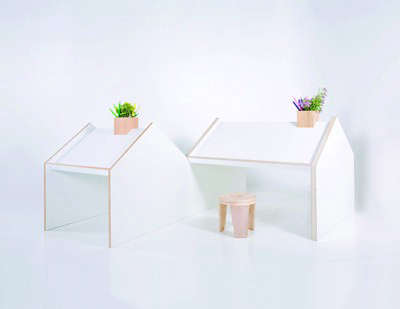
The Alberto Marcos Deskhouse is what happens when a child’s first drawing of a house grows up, gets a design degree, and decides to become useful. At first glance, it looks almost ridiculously simple: a white house-shaped form with a pitched roof and a tiny chimney. But look again. That “roof” is a work surface. That “house” is a hideaway. That chimney is not just there to look adorable; it stores pencils, crayons, and other creative weapons of mass imagination.
Designed by Alberto Marcos for the Spanish children’s furniture brand Ninetonine, the Deskhouse is part furniture, part play architecture, and part visual joke in the best possible way. It takes the universal symbol of homethe square body, triangular roof, and proud little chimneyand turns it into a child-sized creative station. In a market full of plastic tables that look as if they were designed during a very long lunch break, the Deskhouse stands out because it treats children’s furniture as real design, not as a temporary object waiting to be outgrown, stained, and banished to the garage.
This article explores what the Alberto Marcos Deskhouse is, why it became a memorable piece of kids furniture design, how it supports drawing and imaginative play, and what families should know before creating a similar creative corner at home. Spoiler: it is not magic furniture. It will not make children clean up glitter voluntarily. Nothing can do that. But it does show how smart design can make reading, drawing, pretending, and sharing feel like one continuous adventure.
What Is the Alberto Marcos Deskhouse?
The Alberto Marcos Deskhouse is a children’s desk and playhouse hybrid created for Ninetonine. Its basic idea is charmingly direct: use the shape of a small house to create a functional drawing desk that also works as a cozy place to crawl under, hide, read, or pretend. The design has been described as a two-sided drawing desk, a playhouse, and a creative table for children who would rather not separate “work” from “play”which, frankly, makes children sound more emotionally advanced than most adults with calendars.
Its form is based on the “first house” many children draw: a square or rectangular body, a triangular roof, a chimney, maybe a garden path, and perhaps a sun in the corner wearing sunglasses for no known reason. Marcos translated that familiar drawing into a three-dimensional object. The result is instantly readable. Children know what it is before anyone explains it. Adults understand the design concept before the coffee kicks in. That kind of clarity is hard to fake.
Older product listings and design coverage describe the Deskhouse as a small table for reading, drawing, writing, and sharing. Depending on version and listing, materials have been described as white melamine, MDF or board construction, wood veneer, and oak details. The small version was listed at roughly 63.4 cm long, 77 cm wide, and 75 cm high. Historic listings also mentioned European pricing and U.S. availability at the time of publication, but those figures should be treated as archival information rather than current shopping guidance.
Why the Deskhouse Design Works
It turns a symbol into a tool
The genius of the Deskhouse is not that it looks like a house. Lots of things look like houses, including birdhouses, gingerbread cookies, and certain suspiciously expensive candles. The genius is that the house shape does actual work. The pitched roof creates slanted drawing surfaces. The open structure underneath becomes a small retreat. The chimney becomes a storage box. Every cute detail has a job, which is exactly what separates good design from decorative furniture wearing a tiny costume.
The white surface keeps the object visually light, while the wood accents add warmth. In a child’s room, that matters. Bright primary-colored furniture can be fun, but it can also turn a bedroom into a toy store that lost its manager. The Deskhouse has a calmer personality. It can sit in a modern nursery, playroom, Montessori-inspired corner, or family living space without shouting, “I was assembled during a sugar rush.”
It respects children’s imagination
Many children’s products are designed as if kids need everything explained with decals, buttons, slogans, and enough cartoon animals to staff a zoo. The Alberto Marcos Deskhouse takes the opposite approach. It gives children a recognizable shape and lets them finish the story. Today it is a schoolhouse. Tomorrow it is a bakery. Later it is a cave, a castle, a veterinary clinic, a spaceship garage, or a secret headquarters where crayons go to discuss unionizing.
This open-ended quality is important because children do not always play in straight lines. A desk becomes a counter. A table becomes a tunnel. A box becomes a submarine. The Deskhouse leans into that natural flexibility. It does not force one use; it invites many. That is why it remains interesting as a design object even years after its first wave of media attention.
A Desk, a Playhouse, and a Storage Trick Walk Into a Room
Functionally, the Deskhouse is built around three core uses: creative work, imaginative play, and simple organization. The sloped roof surfaces provide a place for drawing, coloring, reading, or placing paper. The interior space underneath offers a child-sized hiding place. The chimney works as a pencil or crayon holder, keeping art supplies close instead of scattered across the floor like confetti after a parade nobody approved.
That combination matters because children often move quickly between modes. One minute they are drawing a cat. The next minute the cat is a map. Then the map belongs to a pirate. Then the pirate needs a house. Then the house needs a chimney. Suddenly the child is under the desk negotiating with a stuffed giraffe. Good children’s furniture should not panic during this sequence. The Deskhouse does not panic. It was built for exactly this level of creative chaos.
For parents, the built-in storage is a small but meaningful win. A dedicated spot for pencils and crayons can make cleanup easier and create a ritual: draw, store, return, repeat. No, it will not guarantee that every marker cap survives. But it does give supplies a “home,” which is a surprisingly powerful concept for young children learning responsibility and routine.
How the Deskhouse Fits Into Child Development
The Deskhouse is not only a nice-looking object; it connects to broader ideas about play-based learning. Early childhood experts consistently emphasize that play supports problem solving, language, social development, creativity, and executive function. Children learn through doing, pretending, repeating, testing, and sometimes announcing that a blanket is now a volcano and everyone must evacuate immediately.
A furniture piece like the Alberto Marcos Deskhouse supports that kind of learning because it creates a defined environment for open-ended activity. Drawing strengthens fine motor control. Pretend play encourages symbolic thinking. Sharing the space with another child can involve negotiation, turn-taking, and the occasional high-stakes diplomatic summit over who gets the blue crayon. Reading inside the house-like form can make books feel private and cozy, which is a useful trick for turning literacy into a pleasure instead of a chore.
The design also supports independence. A child-sized workspace says, “This area belongs to you.” That message can be powerful. Children often respond well when their environment is scaled to their bodies and their interests. A low, accessible creative area makes it easier for them to choose an activity, begin without constant adult setup, and return materials afterward. The adult may still need to supervise, of course, especially with younger children and art supplies. Walls have suffered enough in the name of creativity.
Materials, Maintenance, and Real-Life Durability
Children’s furniture lives a dramatic life. It faces crayons, snacks, sticker attacks, enthusiastic climbing attempts, mystery crumbs, and the emotional intensity of someone who wanted the purple marker but received lavender. The Deskhouse’s historic material descriptionswhite melamine, MDF or board components, wood veneer, and oak detailssuggest a focus on wipeable surfaces and warm natural accents. That mix makes sense for a creative desk because art furniture needs to be cleanable without feeling clinical.
Melamine surfaces are often appreciated in children’s spaces because they can be easier to wipe than raw wood. Wood details add tactile quality and visual softness. However, buyers should always confirm the current product specifications with the seller or manufacturer if purchasing a vintage, secondhand, or revived version. Designs can change, finishes can vary, and secondhand furniture may have wear that affects stability.
Maintenance would be simple in principle: wipe surfaces after messy art sessions, check edges and fasteners regularly, keep the chimney storage free of broken crayons, and avoid placing heavy objects on the roof surface unless the manufacturer explicitly allows it. The Deskhouse is designed as a desk and playhouse-style creative station, not as a climbing frame. Children may not care about that distinction, which is why adults must.
Safety Considerations for a Kids Playhouse Desk
Any children’s furniture should be evaluated with safety first, no matter how charming it looks. A house-shaped desk may invite crawling, hiding, leaning, and pretend play, so adults should check the stability of the piece, follow assembly instructions, and use it only for the intended age and purpose. The Deskhouse’s low and broad form is part of its appeal, but that does not remove the need for supervision.
Families should also consider the room around the desk. Keep heavy furniture anchored according to safety guidance, avoid placing tempting objects high above children’s reach, and make sure the play area has enough clearance. Art supplies should be age appropriate. For toddlers, crayons and markers should be checked for broken parts, and adults should discourage chewing or putting supplies in the mouth. Creative spaces are wonderful; emergency cleanup adventures are less wonderful.
If buying secondhand, inspect the finish, edges, joints, and any removable parts. The chimney pencil holder is delightful, but removable accessories should be checked for fit and condition. A piece of design furniture is still furniture. It should be stable, clean, well assembled, and suitable for the child using it.
How to Style the Alberto Marcos Deskhouse at Home
Create a creative corner, not a toy avalanche
The Deskhouse works best when it has breathing room. Place it near natural light if possible, add a small rug or floor cushion nearby, and keep supplies limited to what the child actually uses. A few crayons, paper, board books, and washable markers can be more inviting than a mountain of materials. Too many choices can turn art time into inventory management, and nobody wants a preschooler with supply-chain problems.
Use the chimney as a daily ritual
The chimney storage is one of the Deskhouse’s most memorable features. Use it as a simple routine builder: pencils in before play starts, pencils back when play ends. This turns cleanup into part of the design rather than a separate lecture delivered by a tired adult standing in a field of paper scraps.
Let the inside become a reading nook
Because the Deskhouse doubles as a hiding place, it can become a cozy reading spot. Add a soft cushion underneath if it fits safely and does not interfere with movement. Keep a few favorite books nearby. Children often enjoy small enclosed spaces because they feel personal and protected. A tiny “house” can make reading feel like a secret club, and books are always more persuasive when they come with a club.
Pros and Limitations of the Deskhouse Concept
The strongest advantage of the Alberto Marcos Deskhouse is its multifunctional intelligence. It combines an art table, play structure, storage feature, and sculptural object in one compact form. It is visually memorable without being loud. It supports open-ended play without needing batteries, apps, passwords, updates, or a parent muttering, “Why does this toy need Bluetooth?”
Another benefit is longevity within the early childhood years. Because it is not tied to one narrow activity, children can use it differently as they grow. Younger children may treat it primarily as a hideaway. Preschoolers may draw, pretend, and read around it. Early elementary children may use it for art or quiet time, depending on size and comfort.
The limitations are practical. It may not suit older children who need a standard desk height for homework. It may not fit every room, especially if floor space is tight. Its distinctive shape may be harder to store than a flat table. And because original listings are historic, availability may be limited or inconsistent depending on market, retailer, or secondhand sources.
Who Is the Alberto Marcos Deskhouse Best For?
The Deskhouse is best suited for families who value design, creativity, and open-ended play. It is ideal for parents creating a thoughtful playroom, a reading corner, or a small art station that does not look like it was sponsored by a rainbow explosion. It also appeals to design collectors who appreciate children’s furniture with architectural wit.
It may be less ideal for families who need a purely practical homework desk, a foldable table, or low-cost temporary furniture. The Deskhouse is not trying to be the cheapest option. It is trying to be a memorable design object that supports multiple kinds of childhood activity. That makes it special, but not universal.
For preschools, studios, and creative learning spaces, the Deskhouse concept is especially interesting. It creates a physical invitation: come draw, come read, come pretend. Furniture can shape behavior. A rigid row of desks says “sit still.” A house-shaped drawing station says “make something.” Children usually hear that second message loud and clear.
Experience Notes: Living With the Deskhouse Idea
In real homes, the most successful creative spaces are rarely the biggest. They are the ones children return to without being asked. That is where the Alberto Marcos Deskhouse concept shines. Its house shape gives children an immediate emotional connection. They do not see a piece of furniture first; they see a place. That difference changes how the object is used.
Imagine a child walking into the room after breakfast. The paper is already on the roof surface. Three crayons sit in the chimney. A favorite picture book rests underneath. No adult needs to announce “creative development time,” which would immediately make everyone want to leave. The child simply begins. Maybe the first activity is drawing windows on a paper house. Maybe it becomes a menu for an imaginary café. Maybe the underside turns into the café kitchen. The design allows the story to expand without moving to another room or dragging out five separate toys.
Parents often discover that this kind of furniture helps reduce friction. When supplies have a clear place, setup is easier. When the object itself suggests play, adults do not have to invent activities from scratch. The Deskhouse gives just enough structure: a surface, a hideaway, a storage point, a recognizable theme. The child supplies the rest, usually at high volume and with surprising confidence.
There is also a social dimension. Two children can use the Deskhouse in different ways at once. One may draw on one side while another hides below or reads nearby. This can lead to cooperation, but also to negotiations that sound like tiny courtroom dramas. “I was using the chimney first” may become the case of the century. Still, those moments are part of shared play. A well-designed object does not eliminate conflict; it gives children a meaningful space in which to practice solving it.
For adults who care about interior design, the Deskhouse offers another pleasant experience: it does not visually punish the room. Many children’s items are useful but loud, as if manufactured from melted birthday parties. The Deskhouse’s simple white-and-wood language can blend with modern interiors while still feeling playful. It says, “A child lives here,” not “A toy store exploded here.” That balance is harder to achieve than it sounds.
The biggest lesson from the Deskhouse idea is that children’s furniture does not need to choose between beauty and usefulness. It can be poetic and practical. It can be small but meaningful. It can encourage independence without becoming cold or overly educational. Most of all, it can treat play as something worthy of design attention. Children notice when a space is made for them. They may not say, “Thank you for the thoughtful architectural reference,” but they will crawl inside, draw on the roof, stash crayons in the chimney, and make the object their own. Honestly, that is the better review.
Conclusion: Why the Alberto Marcos Deskhouse Still Feels Fresh
The Alberto Marcos Deskhouse remains memorable because it solves a real design challenge with warmth and humor. It gives children a place to draw, read, hide, imagine, and share. It gives adults a piece of kids furniture that feels intentional rather than disposable. And it proves that a child’s first drawing of a house can become more than refrigerator art; it can become a clever, functional object that supports everyday creativity.
Its lasting appeal comes from the way it blends architecture, furniture, and play. The shape is simple, but the experience is rich. The chimney stores supplies. The roof becomes a desk. The house becomes a room within a room. That is the kind of design that feels obvious only after someone has already thought of it.
For families, educators, and design lovers, the Deskhouse is a reminder that children’s spaces deserve imagination too. A creative corner does not need to be complicated. It needs to be inviting, safe, accessible, and flexible enough to survive the daily plot twists of childhood. The Alberto Marcos Deskhouse does exactly thatwith a tiny chimney on top, because good design is allowed to wink.
Note: This article is editorial content based on publicly available design and child-development information. Before buying or using any children’s furniture, confirm current dimensions, materials, availability, assembly instructions, age suitability, and safety guidance from the seller or manufacturer.












