
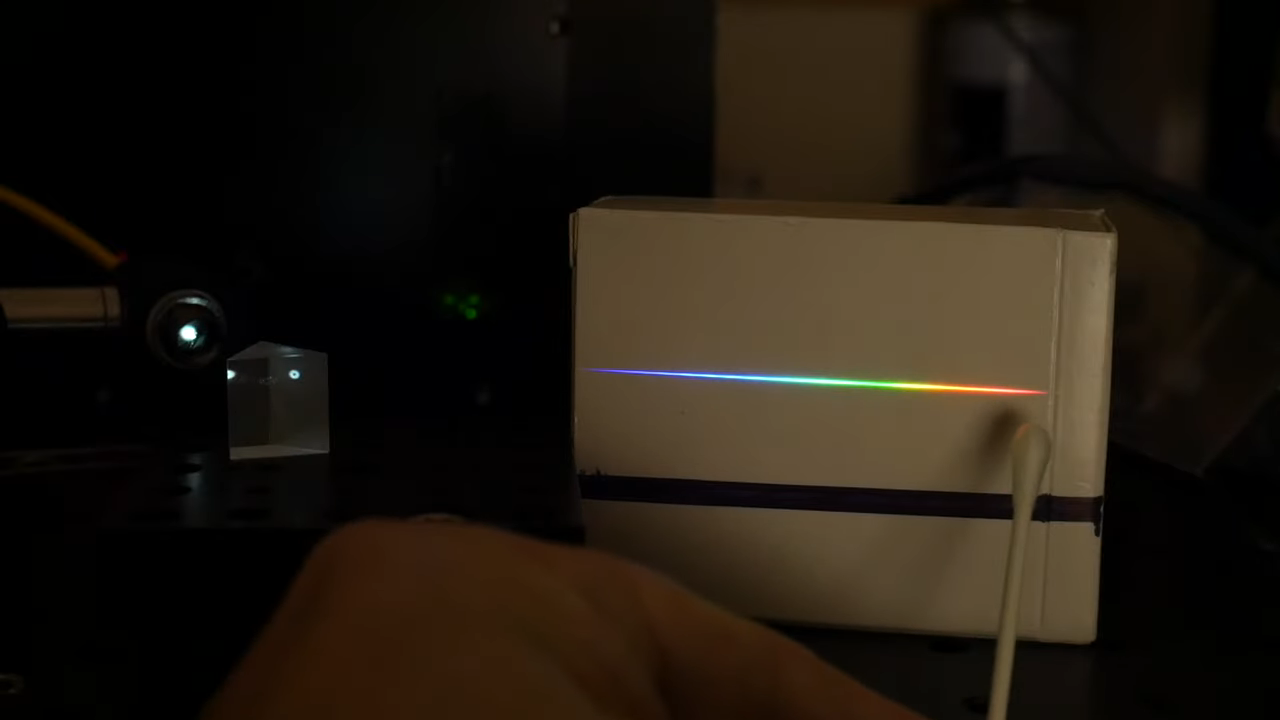
Say the words “white-light laser” and most people imagine a science-fiction flashlight powerful enough to signal passing aliens, slice fog like cake, and make your cat reconsider its career choices. The real story is even more interesting. A white-light laser is not simply a regular laser wearing a brighter outfit. It is an optical balancing act: multiple colors, narrow beams, carefully managed intensity, and enough physics to make a high school prism feel underdressed.
The phrase “A White-Light Laser, On The Cheap” usually points to the maker-friendly dream of creating a visible white beam without needing a university lab, a grant proposal, or a machine that costs more than a used car. But “cheap” needs a little translation. In laser land, cheap does not mean careless, crude, or something you casually point around the room. It means using affordable, accessible optical ideas to demonstrate the principle of white laser light while respecting the fact that lasers are not toys. They are precision light sources with a tiny beam and a big attitude.
This article breaks down what a white-light laser actually is, why it is difficult, how researchers and hobbyists think about it, and where the low-cost version fits in. We will also look at real-world uses, from displays and spectroscopy to laser-based lighting and Li-Fi communication. Consider this a friendly tour through the optics lab, minus the terrifying invoice from the equipment supplier.
What Is a White-Light Laser?
A normal laser is famous for producing light at a very narrow wavelength. A red laser pointer looks red because it mostly emits red light. A green laser looks green because, congratulations, it is green. White light, however, is not one wavelength. White is what the human eye perceives when multiple wavelengths stimulate our red-, green-, and blue-sensitive cone cells in the right balance.
That creates a problem. A laser is usually celebrated for being monochromatic, while white light is associated with broad color content. Asking a laser to be white is like asking a violin to sound like an entire orchestra. It can happen, but you need either multiple instruments or some very clever acoustics. In optics, that means one of several approaches:
1. Combine Red, Green, and Blue Lasers
The most intuitive approach is to combine red, green, and blue laser beams so the eye perceives them as white. This is the same basic color logic behind screens and projectors. If the red, green, and blue powers are balanced well, the resulting beam can appear white. If the balance is off, it can look pinkish, bluish, greenish, or like a tiny rave escaped from a electronics drawer.
2. Use a Monolithic Semiconductor White Laser
Researchers have demonstrated semiconductor laser structures capable of emitting across the visible spectrum. This is the elegant “all-in-one” dream: a compact source that can produce full-color and white lasing without needing three separate laser modules taped together like an optical sandwich. It is a major research milestone because it hints at future lighting, displays, sensing, and communication devices that are smaller, faster, and more efficient.
3. Create a Supercontinuum Source
A supercontinuum source starts with laser light and broadens it into a wide spectrum, often using nonlinear optical fibers or waveguides. The result can look like extremely bright white light, with laser-like directionality and usefulness for spectroscopy, metrology, microscopy, and sensing. This is a powerful route, but “on the cheap” is doing a lot of stretching here. Supercontinuum systems are impressive, but they are usually not budget weekend projects.
4. Use Laser-Excited Phosphor
Another practical method is to use a blue or violet laser to excite a phosphor material, which then emits broader white light. This idea appears in some high-brightness lighting systems, projection technologies, and laser-excited phosphor flashlights. The output is not the same as a pure RGB combined laser beam, because the phosphor converts some laser energy into a wider emission spectrum. It can be very bright, compact, and efficient, but it also requires serious optical and thermal design.
Why White Laser Light Is Harder Than It Sounds
The phrase “white laser” sounds simple because our eyes are easy to fool. Mix the right amount of red, green, and blue light, and the brain happily files the result under “white.” But optical instruments are pickier. A beam made from three narrow laser wavelengths is not the same as sunlight, an LED lamp, or a broad-spectrum incandescent bulb.
That distinction matters for color rendering. A white-looking RGB laser may illuminate some objects strangely because it only contains selected wavelengths. A red apple might look vibrant, while another color with reflectance between the laser wavelengths may look dull or inaccurate. This is why lighting quality is not just about brightness. It is also about spectral coverage, color rendering, stability, and how the light interacts with real materials.
Then there is speckle. Laser light is coherent, meaning the waves are highly ordered. That order is useful for communication, measurement, and precision optics, but it can create grainy interference patterns on surfaces. Anyone who has seen a laser dot sparkle on a wall has met speckle. In white-light laser systems, designers often need to reduce speckle for displays or illumination, otherwise the image can look like it was seasoned with optical pepper.
So What Does “On The Cheap” Really Mean?
A cheap white-light laser project is usually not a true laboratory-grade white laser. It is more often a low-cost demonstration of color mixing, beam combining, or laser-excited phosphor. That does not make it fake. It makes it practical. The budget version teaches the core concept: white light can be produced by combining colors or by converting laser energy into broader-spectrum light.
The most accessible educational version is the RGB idea. Low-power red, green, and blue light sources can be directed into the same general path using optical components such as dichroic mirrors or beam combiners. The goal is not to build a dangerous high-power spotlight. The goal is to understand additive color mixing. When the colors overlap, the eye sees white or near-white. When they separate, the illusion falls apart and the individual colors return like actors leaving the stage after the curtain drops.
That said, the cheap part can be sneaky. The lasers may be affordable, but alignment hardware, proper safety equipment, stable mounts, quality optics, beam dumps, power control, and enclosure design quickly become the grown-ups in the room. In optics, the tiny screws and boring brackets often cost more than the shiny parts. The universe has a sense of humor, and it charges shipping.
The Science Behind RGB White Laser Mixing
RGB mixing works because human vision uses three main types of cone cells. Red, green, and blue light can stimulate those cones in proportions that our brain interprets as white. Displays use this trick constantly. Your phone screen does not contain tiny white suns behind every pixel. It blends red, green, and blue subpixels fast enough and precisely enough that your eyes say, “Sure, close enough.”
Laser mixing applies the same principle with narrower beams. The advantage is high brightness and directionality. The disadvantage is that the beams must overlap well, the intensity balance must be stable, and the wavelengths must be chosen intelligently. Too much blue and the beam looks icy. Too much green and the result looks like a science fair ghost. Too much red and suddenly the “white laser” has become a tiny emergency exit sign.
Another important detail is that mixed colors remain separate wavelengths. If red and green laser light overlap and look yellow to your eye, the light has not magically become a yellow wavelength. It is still red plus green. A filter or spectrometer would see the two original components. Your brain is the one doing the color blending. It is a great brain, but it is not a laboratory instrument.
How Supercontinuum Sources Produce Laser-Like White Light
Supercontinuum light is a different beast. Instead of simply stacking a few colors, it broadens laser pulses into a wide range of wavelengths. The output can cover large parts of the visible and infrared spectrum depending on the design. That makes supercontinuum sources valuable for applications where broad spectral coverage and high brightness matter.
In spectroscopy, a broad laser-based source can help analyze how materials absorb or reflect light across many wavelengths. In microscopy, it can provide flexible illumination for imaging different fluorophores. In precision metrology, broad comb-like spectra can support extremely accurate frequency measurements. If RGB mixing is a three-color smoothie, supercontinuum generation is a full buffet.
The catch is complexity. These sources often rely on ultrafast lasers, specialty fibers, waveguides, careful dispersion control, and heat management. They are not the cheapest path for a casual demonstration. But they are central to the serious world of white-light laser technology because they offer broad bandwidth with properties ordinary lamps cannot match.
Monolithic White Lasers: The Elegant Future
The monolithic white laser is the dream version: one semiconductor platform capable of producing tunable colors and white output. Research in this area matters because a compact white laser could someday influence lighting, high-resolution displays, visible-light communication, biomedical sensing, and lab-on-a-chip systems.
Why is this exciting? Lasers can be modulated faster than many conventional light sources, which makes them attractive for communication. They can be tightly directed, which helps projection and sensing. They can be compact, which matters for consumer devices and scientific instruments. If engineers can make white laser sources reliable, affordable, efficient, and safe, the future might include lighting systems that do more than brighten a room. They might also transmit data, support displays, or assist sensors while looking perfectly ordinary to the human eye.
Of course, the gap between a research breakthrough and a cheap product is where engineering goes to do push-ups. Devices must be manufacturable, durable, safe, efficient, and affordable. A lab result can be brilliant and still need years of development before it becomes something you can buy without a purchase order and a nervous accountant.
Where White-Light Laser Technology Could Be Used
High-Speed Visible-Light Communication
Visible-light communication, often called Li-Fi, uses light to transmit data. LEDs can do this, but laser-based light sources can potentially modulate much faster. That opens the door to extremely high data rates in specialized indoor, vehicle, industrial, or point-to-point systems. The idea is delightfully strange: your ceiling light could someday help move data while also making sure you do not trip over the dog.
Displays and Projection
Laser projectors already use narrowband sources for bright colors and wide color gamut. A better white or full-color laser source could support compact displays with vivid images. The main challenges are speckle reduction, cost, heat, and eye safety. Nobody wants a projector that produces gorgeous color and also requires a warning sign the size of a pizza box.
Spectroscopy and Sensing
Broadband laser-like sources are especially useful in spectroscopy because different molecules absorb different wavelengths. A white-light or supercontinuum laser can help identify materials, detect gases, inspect surfaces, or support biomedical analysis. In these applications, white light is not just pretty. It is information.
Automotive and Specialty Lighting
Laser-excited phosphor systems can deliver intense, compact beams for specialty illumination. In automotive lighting, the idea is not to shine a raw laser down the road. Instead, laser light is converted by phosphor into usable white light. This distinction matters because raw laser exposure can be hazardous, while properly engineered systems manage and convert the beam within a controlled design.
Safety: The Part That Keeps Your Eyes Employed
Any article about cheap lasers needs a safety section, because eyeballs are not subscription-based. You do not get a replacement pair next month. Lasers can cause injury because their energy is concentrated into a narrow beam. Even visible beams can be dangerous, and invisible infrared or ultraviolet lasers can be especially risky because the blink reflex may not protect you.
Responsible laser use means respecting product classifications, labels, enclosures, beam paths, reflections, and protective eyewear appropriate to the wavelength and power involved. It also means avoiding aircraft, vehicles, animals, public spaces, mirrors, shiny tools, jewelry, glass frames, and anything else that can send a beam somewhere unexpected. The safest educational demonstrations use low-power, properly labeled sources under supervision, with beams contained and never directed at people.
Here is the unglamorous truth: safety equipment is part of the project, not an optional accessory. If the budget has room for lasers but not room for safe handling, the project is not cheap. It is unfinished.
Cheap vs. Real: A Practical Comparison
| Approach | What It Does | Budget Friendliness | Main Challenge |
|---|---|---|---|
| RGB laser mixing | Combines red, green, and blue beams so the eye sees white | Relatively accessible for education | Alignment, color balance, speckle, safety |
| Laser-excited phosphor | Uses laser light to excite phosphor that emits white light | Moderate, depending on design | Heat, beam control, phosphor durability |
| Supercontinuum source | Broadens laser pulses into a wide spectrum | Usually expensive | Specialty optics and ultrafast systems |
| Monolithic white laser | Produces full-color or white output from one semiconductor structure | Research-stage compared with hobby builds | Manufacturing, efficiency, stability, cost |
What a Low-Cost White-Light Laser Demonstration Teaches
The value of a budget white-light laser concept is not that it replaces professional laser systems. It teaches optical fundamentals in a way that is visual, memorable, and just flashy enough to make physics feel less like homework and more like wizardry with better labeling.
First, it shows additive color mixing. Red, green, and blue can appear white when balanced properly. Second, it demonstrates that perceived color and spectral content are not the same thing. Third, it highlights beam alignment, diffusion, reflection, and the importance of optical surfaces. Fourth, it proves that engineering is often about controlling unwanted effects. Speckle, heat, drift, uneven brightness, and reflections are not side characters. They are the plot.
Most importantly, it shows why real optical products are expensive. A polished commercial system is not pricey merely because someone sprinkled luxury dust on it. It includes stable mechanics, tested electronics, compliance work, thermal design, optical coatings, safety features, and quality control. A cheap demo can reveal the idea. A reliable product has to survive the real world, which is famously rude to delicate equipment.
Experience Notes: What Working Around a “Cheap White Laser” Concept Feels Like
The first surprise with a low-cost white-light laser demonstration is that “white” is weirdly negotiable. On paper, mixing red, green, and blue sounds as simple as inviting three colors to the same party. In practice, one color always shows up too loud. Green often dominates because the human eye is highly sensitive to it. Blue can look dramatic but cold. Red adds warmth, but too much of it makes the beam look like it is auditioning for a holiday decoration. Balancing the three is less like flipping a switch and more like seasoning soup. A little more here, a little less there, and suddenly the whole thing changes.
The second surprise is that cameras lie differently than eyes. A beam that looks reasonably white in person may appear blue or purple on a phone camera. Auto exposure and white balance try to “fix” the image, and sometimes they fix it straight into nonsense. This is a great reminder that white light is partly physics and partly perception. Your eye, a camera sensor, and a spectrometer can all look at the same source and tell slightly different stories. The spectrometer is usually the least fun at parties, but it is the most honest.
The third lesson is that optics rewards patience. Tiny changes in angle can make a beam wander. Dust becomes visible. Reflections appear in places you did not invite them. A slightly loose mount can turn a clean overlap into a colorful mess. This is where the cheap experiment becomes genuinely educational. It teaches that light is not just something you turn on. It is something you guide, shape, filter, scatter, and sometimes politely beg to behave.
Another experience that stands out is how quickly “cheap” becomes a discussion about priorities. The light source might be inexpensive, but safe handling, stable mounting, and controlled viewing matter more than raw brightness. A dim, well-contained demonstration is better than a bright, chaotic one. The goal should never be to make the most intense beam possible. The goal is to understand the principle clearly without creating risk. In that sense, the best budget setup is not the one with the biggest output. It is the one that teaches the most while behaving itself.
Finally, there is a small moment of magic when separate colors overlap and the eye reads them as white. It feels like a trick, but it is really biology and physics shaking hands. The beam may not be a perfect broad-spectrum white source. It may not have the smoothness of sunlight or the refinement of a professional supercontinuum system. Still, it demonstrates a powerful idea: color is not always what it seems, and light can be engineered in surprisingly creative ways. That is the real charm of a white-light laser on the cheap. It turns an advanced photonics topic into something visible, understandable, and just nerdy enough to make you grin.
Conclusion: Cheap White Laser Ideas Are a Doorway, Not the Whole House
A white-light laser on the cheap is best understood as an accessible doorway into modern photonics. It is not the same as a professional supercontinuum laser, a fully engineered laser-phosphor lighting system, or a monolithic semiconductor white laser from a research lab. But it can demonstrate the central idea beautifully: white light can be created through controlled color mixing or spectral conversion, and lasers offer brightness, directionality, and modulation speed that ordinary light sources cannot easily match.
The future of white-light laser technology is bigger than hobby curiosity. It touches high-speed communication, advanced displays, precision sensing, microscopy, spectroscopy, and compact lighting. Researchers are pushing toward devices that are brighter, faster, smaller, safer, and more efficient. Meanwhile, low-cost educational demonstrations help curious people understand why the field is exciting in the first place.
So yes, a white-light laser can be approached “on the cheap,” as long as cheap means clever, careful, and safety-minded. The magic is not in blasting more power. The magic is in understanding how colors combine, how spectra behave, and how a beam of light can carry both illumination and information. That is a pretty good bargain, even before you account for the joy of making physics look like a tiny controlled rainbow.













