
Fictional romances have given us passionate reunions, dramatic breakups, supernatural complications, missed flights, sinking ships, and enough meaningful eye contact to power a small city. Yet even when beloved characters receive a happy ending, viewers rarely get to see what happens after the credits roll. Do they settle down? Do they have children? More importantly, does the child inherit Mom’s smile, Dad’s eyebrows, or both parents’ alarming talent for attracting trouble?
Digital artist Hidreley Leli Diao explored those questions by combining photographs of famous screen couples and using AI-assisted editing tools to imagine their children. His workflow included applications such as FaceApp and Remini, followed by manual adjustments and finishing work in Photoshop. The results are not scientific genetic predictions. They are creative visual experiments designed to turn fan curiosity into surprisingly convincing family portraits.
Why AI-Generated Children of Fictional Couples Are So Fascinating
Audiences become attached to fictional couples because a good romance feels larger than the plot surrounding it. Viewers remember the tension between two characters, the jokes they share, the sacrifices they make, and the tiny expressions that reveal more than several pages of dialogue. Imagining their children extends that emotional investment into a future the original story may never show.
AI image creation adds a new layer to this familiar fan activity. People have always drawn alternate endings, written fan fiction, and debated what might happen next. Artificial intelligence simply gives those “what if” questions a photorealistic face. It can blend broad visual characteristics, suggest a family resemblance, and create a portrait that feels like a frame from a sequel that was never filmed.
The most successful portraits are not necessarily the ones that divide every feature evenly. A believable child might strongly resemble one parent while carrying only a subtle trace of the other. That unevenness makes the image feel more natural. Real families do not distribute cheekbones according to a fairness policy.
21 Famous Fictional Couples and Their Imagined Children
The collection travels through superhero adventures, workplace comedies, supernatural dramas, classic sitcoms, teen romances, and stories in which family planning would probably be the least complicated item on the characters’ schedules. The following couples form the lineup behind the 21 AI-assisted portraits.
1. Diana Prince and Steve Trevor Wonder Woman
A child of Diana Prince and Steve Trevor would have an unfair advantage in nearly every school activity. The imagined portrait naturally combines Diana’s poised features with Steve’s approachable warmth. Whether this child would inherit Amazonian abilities is a question for mythology, but excellent posture seems almost guaranteed.
2. Monica Geller and Chandler Bing Friends
Monica and Chandler became one of television’s most satisfying slow-burn couples. Their AI-imagined child appears to blend Monica’s expressive eyes with Chandler’s softer facial structure. One can easily picture this kid maintaining an exceptionally organized bedroom while using sarcasm to avoid discussing feelings.
3. Jim Halpert and Pam Beesly The Office
Jim and Pam already represent ordinary family life filtered through workplace comedy, so their imagined child feels unusually plausible. The portrait balances Pam’s gentle expression with Jim’s recognizable smile. The real question is not what the child would look like, but how early Jim would begin teaching advanced prank techniques.
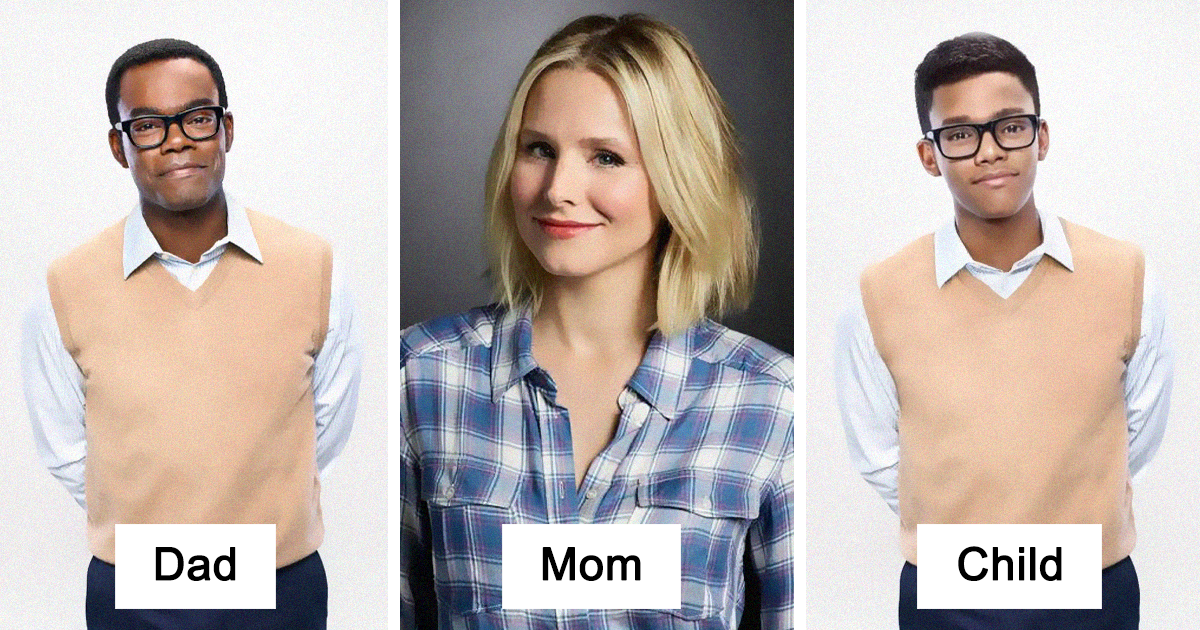
4. Chidi Anagonye and Eleanor Shellstrop The Good Place
A child combining Chidi’s thoughtfulness with Eleanor’s fearless personality could either become a brilliant moral philosopher or spend 45 minutes deciding which cereal is ethically acceptable. Visually, the imagined portrait reflects Chidi’s strong features while preserving Eleanor’s lively energy.
5. Buffy Summers and Spike Buffy the Vampire Slayer
Buffy and Spike had enough chemistry to make audiences overlook several supernatural red flags. Their fictional child looks appropriately intense, with a face that could belong to either a future vampire slayer or the lead singer of a band that performs exclusively after midnight.
6. Patrick Verona and Kat Stratford 10 Things I Hate About You
Patrick and Kat were united by intelligence, stubbornness, and an impressive resistance to ordinary dating behavior. Their imagined child reflects Patrick’s relaxed charisma and Kat’s focused gaze. This is probably the student who challenges the teacher’s interpretation of Shakespeare and somehow earns extra credit.
7. Anna Scott and William Thacker Notting Hill
The movie star and the quiet bookstore owner created one of romantic comedy’s most memorable pairings. Their hypothetical child has the polished appearance of someone comfortable around cameras but the gentle expression of someone who would rather browse a bookstore unnoticed.
8. Mary Jensen and Ted Stroehmann There’s Something About Mary
Mary and Ted’s chaotic love story proves that romance can survive lies, misunderstandings, unusual hair products, and several deeply questionable decisions. Their imagined son carries Mary’s bright appearance and Ted’s more reserved features. Hopefully, he also inherits better judgment than nearly everyone in the movie.
9. Lorelai Gilmore and Luke Danes Gilmore Girls
A child of Lorelai and Luke would be raised on coffee, diner food, rapid-fire cultural references, and arguments that are clearly expressions of affection. The AI portrait suggests Lorelai’s animated features mixed with Luke’s grounded appearance. This child would probably speak quickly but order breakfast very carefully.
10. Jeannie and Tony Nelson I Dream of Jeannie
Jeannie and Tony’s relationship combined domestic comedy with magical disasters. Their imagined child appears cheerful and polished, but the real suspense would begin whenever somebody said, “I wish.” Parenting is challenging enough without a preschooler who can accidentally relocate the living room.
11. Michael Kelso and Jackie Burkhart That ’70s Show
Kelso and Jackie were played by Ashton Kutcher and Mila Kunis, who later became a real-life couple, giving this entry an unusual extra layer. The AI portrait blends their screen appearances into a child who looks confident, photogenic, and possibly aware that everyone else’s wardrobe needs improvement.
12. Maddie Hayes and David Addison Moonlighting
Maddie and David helped define the romantic tension that later television series would stretch across multiple seasons. Their imagined child combines Maddie’s elegance with David’s playful energy. The result feels like someone who could solve a mystery while delivering three jokes before the first commercial break.
13. Pete “Maverick” Mitchell and Charlotte “Charlie” Blackwood Top Gun
The child of Maverick and Charlie would inherit confidence from both sides of the family, although patience might remain in limited supply. The imagined portrait looks capable, composed, and suspiciously comfortable around aviator sunglasses. Career day at school would be difficult for the other parents.
14. Damon Salvatore and Elena Gilbert The Vampire Diaries
Damon and Elena’s relationship survived supernatural battles, complicated loyalties, memory problems, and enough emotional turmoil to fill several human lifetimes. Their AI-imagined son has Damon’s piercing intensity softened by Elena’s features. He looks ready to join the cast before anyone explains the plot.
15. Jamie and Paul Buchman Mad About You
Jamie and Paul made marriage itself the center of a sitcom, finding humor in daily misunderstandings rather than extraordinary circumstances. Their imagined child fits naturally into that world, appearing warm and familiar rather than overly glamorous. Sometimes the most convincing AI portrait is the one that simply looks like a family photograph.
16. Dylan McKay and Brenda Walsh Beverly Hills, 90210
Dylan and Brenda remain a powerful source of nostalgia for longtime television fans. Their hypothetical child combines the intensity associated with Dylan and the expressive quality that made Brenda memorable. This teenager would almost certainly have dramatic problems, perfect hair, and access to an unusually expensive zip code.
17. Romeo and Juliet Romeo + Juliet
Imagining a child for Romeo and Juliet requires giving them an alternate ending considerably less tragic than Shakespeare provided. The resulting portrait combines the youthful appearances of Leonardo DiCaprio and Claire Danes. He looks like a romantic lead who should avoid family feuds and make slower decisions.
18. Joe Goldberg and Guinevere Beck You
Not every fictional pairing belongs on a greeting card. Joe and Beck’s relationship was manipulative, dangerous, and deeply unhealthy, making this portrait more unsettling than romantic. The imagined child may look convincing, but the family history would require a therapist with excellent security precautions.
19. Lucy and Ricky Ricardo I Love Lucy
Lucy and Ricky are among television’s most recognizable couples, and Lucille Ball and Desi Arnaz also shared a real-life marriage and children. The AI experiment nevertheless offers an alternate visual blend based specifically on their classic sitcom appearances. Naturally, the child looks prepared for music, comedy, and household chaos.
20. Sun-Hwa Kwon and Jin-Soo Kwon Lost
Sun and Jin’s emotional journey was one of the strongest relationship stories in Lost. Their imagined child carries a convincing resemblance to both characters, creating a portrait that feels especially poignant. Ideally, the family vacation plan would exclude mysterious islands, unexplained hatches, and flights with suspiciously important passenger lists.
21. David Axelrod and Jade Butterfield Endless Love
David and Jade represent the intense, all-consuming style of romance common in dramatic love stories. Their hypothetical child blends youthful softness with strong, symmetrical features. The portrait looks serene, which is more than can be said for most events surrounding the original relationship.
How an AI Family Portrait Is Built
Choosing Useful Source Images
The starting photographs matter enormously. Images with similar lighting, head positions, ages, and facial expressions are easier to combine than two unrelated publicity shots. A shadow across one face or a dramatic camera angle can influence the final portrait in strange ways. The computer may be clever, but it still struggles when one parent is photographed at an awards ceremony and the other is running from an explosion.
Generating a Plausible Blend
Face-processing software can estimate shared visual patterns such as face shape, skin tone, eye spacing, hair, and other broad characteristics. The output is not a biological simulation. It is a statistically generated interpretation based on visible information in the selected photographs.
Adding the Human Finishing Touch
Raw outputs often contain inconsistencies. An eye may be slightly misplaced, skin texture can appear unnaturally smooth, or the face may resemble one parent so strongly that the second person seems to have missed the appointment. Manual editing helps correct those problems, balance the resemblance, and turn a technical blend into a polished portrait.
This human involvement is significant. Discussions of AI-assisted art increasingly distinguish between a machine-generated output and a work that contains visible human selection, arrangement, revision, or creative modification. The U.S. Copyright Office has similarly emphasized the importance of identifiable human creativity when considering copyright protection for AI-assisted works.
Why Some AI Portraits Feel Uncannily Real
Human beings are remarkably sensitive to faces. We recognize family similarities in the angle of a smile, the shape of an eyebrow, or an expression that appears for half a second. When an AI portrait borrows several familiar signals from two famous actors, the viewer’s brain completes the connection.
That familiarity can also become uncomfortable. A portrait may look almost photographic while containing a small inconsistency that is difficult to identify. Perhaps the eyes are too symmetrical, the expression is unusually neutral, or the skin has the smoothness of a luxury candle. This tension is related to the “uncanny valley,” the uneasy reaction people sometimes experience when something appears human but not completely natural.
In this collection, the slight artificial quality is part of the fun. Viewers are not being asked to mistake the portraits for real children. They are being invited to inspect the resemblance, debate which features came from which character, and decide whether the image belongs in the fictional family album.
Creative Possibilities and Ethical Boundaries
AI fan art can encourage experimentation, inspire new character designs, and provide references for illustrators. It can help creators visualize alternate timelines before committing hours to a detailed painting. It also makes imaginative projects more accessible to people who have strong ideas but limited traditional drawing experience.
However, photorealistic AI imagery should be labeled clearly. Synthetic portraits can be misunderstood when they are removed from their original context. Creators should avoid presenting fictional images as authentic photographs, especially when recognizable actors, performers, or copyrighted characters are involved.
Questions about consent, digital likenesses, training data, character ownership, and commercial use continue to develop. U.S. agencies have highlighted risks associated with realistic digital replicas and have recommended transparency tools that help viewers identify synthetic content. Recent disputes involving entertainment companies also demonstrate that generating recognizable protected characters can create legal complications, particularly in commercial settings.
For a lighthearted fan project, a sensible approach is straightforward: credit the human creator, identify the work as AI-assisted, avoid deceptive presentation, respect image rights, and remember that an entertaining experiment is not an official continuation of the story.
What Creating AI Children for Fictional Couples Is Really Like
Working on a project like this begins with excitement and quickly becomes a lesson in patience. The basic idea sounds almost effortless: choose two famous faces, combine them, and introduce the internet to their imaginary child. In practice, every portrait creates a different problem.
Some couples produce a convincing result almost immediately. Their source images have similar lighting, both actors face the camera, and the software identifies compatible features. Those are the rare moments when technology behaves like the helpful assistant described in the brochure. The first generated face appears, both parents are recognizable, and the portrait needs only minor corrections.
Other combinations seem personally offended by the assignment. One parent disappears from the result. Hairlines move without permission. Eyes become so perfectly identical that the child looks manufactured by a luxury robot company. A smile borrowed from one source photo may clash with the facial structure inherited from the other. The artist then enters a cycle of generating, comparing, editing, rejecting, and quietly negotiating with the software.
Selecting the source photographs is often more difficult than operating the AI. An actor may have appeared across several decades, with different hairstyles, makeup, lighting, and camera technology. The portraits should represent the characters during the same period of their fictional relationship. Combining a youthful film still with a photograph taken many years later can create an imagined child who looks less like a descendant and more like a confused time traveler.
The creative decision-making continues after the initial blend. Should the child resemble both parents equally? Should one person’s eye color dominate? Is the hairstyle making the result feel too modern for the original show? Does the portrait look like a believable individual, or merely two faces layered together? There is no objective answer, which is precisely why human judgment remains important.
The most satisfying moment arrives when the portrait begins to feel independent. It no longer looks like an obvious digital mixture. The child seems to have a personality, even though the image contains only a face and an expression. Viewers may imagine which parent the child takes after, how the family behaves at breakfast, or what role the new character might play in a sequel.
Audience reactions become another part of the experience. Fans study the pictures closely and often disagree with remarkable confidence. One person sees the mother immediately. Another insists the portrait is entirely the father. A third announces that the child resembles an unrelated actor and permanently changes how everyone sees the image. There will also be viewers who point out that certain fictional couples already had children, that the actors became parents in real life, or that the relationship should never have happened. Fan communities rarely allow facts, opinions, or alternate romantic pairings to remain peacefully separated.
That debate is not a weakness of the project. It is the main reason the portraits are engaging. The images offer visual prompts rather than final answers. They encourage people to revisit familiar characters, compare facial details, and imagine stories beyond the original ending.
The experience also teaches a broader lesson about AI art: the machine can generate possibilities, but it does not decide which possibility is meaningful. The creator chooses the couple, finds the photographs, evaluates the resemblance, repairs the mistakes, and decides when the portrait feels complete. AI may supply the face, but human curiosity supplies the reason for making it.
Conclusion
These 21 AI-generated children transform familiar fictional romances into playful glimpses of alternate futures. Some portraits feel instantly believable, while others invite debate about whose eyes, smile, or attitude the child inherited. Together, they demonstrate why AI-assisted art is so appealing: it can make an impossible question visible.
The technology is not predicting genetics, establishing official canon, or secretly announcing 21 new television spinoffs. It is helping artists and fans explore ideas that once existed only in imagination. Used transparently and shaped by careful human editing, AI becomes less of an automatic artist and more of an unusually fast creative sketchbook.
Note: The portraits discussed in this article are fictional, AI-assisted artistic interpretations. They do not depict real children, provide genetic predictions, or represent official story developments approved by the studios, performers, or rights holders.












