
Disney princesses live in a magical loophole: castles crumble, kingdoms modernize, streaming platforms multiply, and yet somehow everyone’s skin remains smoother than a freshly polished glass slipper. But what if time actually showed up at the royal gate? What if Snow White, Cinderella, Ariel, Belle, Jasmine, Tiana, Rapunzel, Moana, and the rest of the official Disney Princess lineup aged the way real people do?
That question inspired this creative age-progression project: I made Disney princesses look the age they’d be today. Not as a joke, not as a “look how old they are” gimmick, and definitely not as a villain-origin story for moisturizer. The goal was to imagine how beloved animated heroines might look if their stories kept moving forward from the year their films were released.
Instead of freezing them forever at 14, 16, 18, or 19, I treated each princess as a real woman with decades of life behind her: laughter lines, silver hair, stronger posture, different fashion choices, deeper confidence, and the kind of expression that says, “I have survived curses, sea witches, stepfamilies, dragons, colonial drama, arranged marriage pressure, and at least one very suspicious apple.”
How I Calculated the Disney Princesses’ Ages Today
Before redesigning the characters, I needed a fair method. Disney does not give every princess a neat birth certificate, and some ages are either stated in the film, implied by the plot, or widely accepted by fans. So I used a simple creative formula: take the princess’s estimated story age and add the number of years since her original animated film release.
Because the current date is 2026, that gives us a fascinating timeline. Snow White, whose film premiered in 1937, becomes a centenarian. Cinderella, released in 1950, becomes a woman in her mid-90s. Aurora, from 1959, enters her 80s. Ariel, Belle, Jasmine, Pocahontas, and Mulan become women in their 40s and 50s. Tiana, Rapunzel, Merida, Moana, and Raya are comparatively younger, ranging from their 20s to 30s.
This is not official Disney canon. It is fan art analysis, digital character redesign, and a playful thought experiment based on real film history. In other words: the math is grounded, but the crow’s feet are mine.
Estimated Ages of Disney Princesses If They Aged in Real Time
| Princess | Original Film | Film Release Year | Estimated Story Age | Approximate Age in 2026 |
|---|---|---|---|---|
| Snow White | Snow White and the Seven Dwarfs | 1937 | 14 | About 102 |
| Cinderella | Cinderella | 1950 | 19 | About 95 |
| Aurora | Sleeping Beauty | 1959 | 16 | About 83 |
| Ariel | The Little Mermaid | 1989 | 16 | About 52 |
| Belle | Beauty and the Beast | 1991 | 17 | About 51 |
| Jasmine | Aladdin | 1992 | 15 | About 48 |
| Pocahontas | Pocahontas | 1995 | 18 | About 49 |
| Mulan | Mulan | 1998 | 16 | About 44 |
| Tiana | The Princess and the Frog | 2009 | 19 | About 35 |
| Rapunzel | Tangled | 2010 | 18 | About 33 |
| Merida | Brave | 2012 | 16 | About 30 |
| Moana | Moana | 2016 | 16 | About 25 |
| Raya | Raya and the Last Dragon | 2021 | 18 | About 23 |
Snow White at 102: The Fairest Elder in the Land
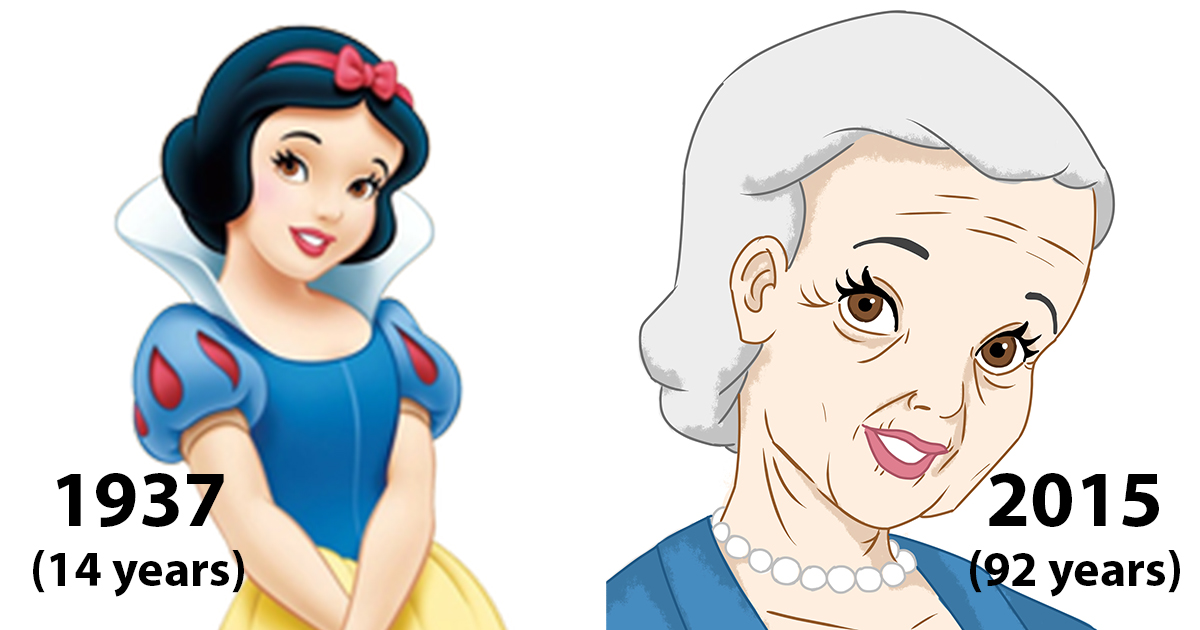
Snow White was the most dramatic transformation. As Disney’s first feature-length princess, she carries almost a century of animation history on her shoulders. At about 102, I imagined her with soft white hair, delicate facial lines, and a warm, grandmotherly expression that still holds her original sweetness.
The challenge was not making her look “old.” That is too easy and too boring. The challenge was preserving Snow White’s gentleness while giving her the dignity of a woman who has seen generations grow up around her. Her red bow became smaller and more elegant. Her dress kept its iconic color palette, but I softened the shapes so she looked less like she was heading to a woodland sing-along and more like she was hosting tea with seven very retired roommates.
Cinderella at 95: Still Elegant, Still Not Cleaning the Attic
Cinderella at 95 had to look graceful without becoming fragile. Her story is often remembered for the glass slipper, but her real superpower is endurance. She survives emotional abuse, overwork, humiliation, and still manages to keep her manners. Frankly, Cinderella walked so modern boundaries could run.
For her aged look, I gave her silver-blond hair, refined makeup, and a calmer version of her blue gown. The fantasy sparkle remained, but it became subtler, like moonlight on satin. Her face needed fine lines around the eyes and mouth because Cinderella would absolutely be someone who smiled often after finally getting out of that house. I also imagined her as the kind of royal elder who funds worker protection laws. Bibbidi-bobbidi-unionize.
Aurora at 83: Beauty After the Nap
Aurora is tricky because her original personality is dreamy, soft, and romantic. She spends a significant part of her story asleep, which is relatable to anyone who has ever opened their phone before bed and accidentally lost three hours. At around 83, I imagined Aurora as serene rather than sleepy.
Her hair stayed golden but became pale and luminous, with silver woven through it. I kept her posture elegant and ballet-like, because Sleeping Beauty’s visual style is built around long lines and medieval-inspired design. Her older look became almost ethereal: part queen, part retired forest poet, part woman who has no patience for cursed spinning wheels being left around without safety labels.
Ariel at 52: The Mermaid Who Learned About SPF
Ariel at 52 was one of my favorite redesigns because she has always been movement, curiosity, and chaos in a seashell bra. As a middle-aged woman, I imagined her still adventurous, still collecting odd human objects, and still calling a fork a dinglehopper just to annoy her children.
Her red hair would remain her signature feature, but with copper, auburn, and silver strands. I added smile lines, a slightly stronger jaw, and sun-kissed skin because Ariel has probably spent decades near beaches, boats, and diplomatic events between land and sea. Her style today would mix ocean-inspired jewelry, flowing fabrics, and practical shoes. After the whole losing-her-voice episode, she is absolutely not wearing anything uncomfortable again.
Belle at 51: The Bookish Queen of Personal Growth
Belle at 51 felt deeply natural. Her original character already seems emotionally mature, intellectually restless, and unimpressed by loud men with antlers on the wall. Aging her meant showing more confidence, not changing her essence.
I imagined Belle with chestnut hair touched by soft gray, reading glasses, and a wardrobe that still honors her golden gown but leans toward elegant library chic. She would have laugh lines, thoughtful eyes, and the expression of someone who has read every book in the castle and has strong opinions about the organizational system. Belle’s older version is not simply beautiful; she is intellectually magnetic. She looks like she could defeat a dinner party argument with one eyebrow.
Jasmine at 48: Royal Confidence With Better Boundaries
Jasmine has always been one of the most direct Disney princesses. She does not want to be controlled, purchased, displayed, or married off like palace decor. At 48, I imagined her as a ruler with sharp political instincts and zero tolerance for nonsense.
Her aged design kept the turquoise color story but upgraded it into a more sophisticated royal silhouette. Her hair became darker at the roots with subtle silver at the temples. I gave her stronger cheekbones, expressive eyes, and a poised stance. This Jasmine has survived court politics, magical scandals, and probably several trade negotiations involving flying carpets. She is glamorous, but not decorative. There is a difference, and she knows it.
Pocahontas at 49: Strength, Stillness, and Respectful Redesign
Pocahontas requires more care than many Disney characters because she is based on a real historical figure, even though the animated film heavily fictionalizes her life. For that reason, I approached her aged look with restraint. I did not want to exaggerate, glamorize, or treat her as a costume concept.
At about 49, I imagined her with a grounded presence, mature features, and a calm expression shaped by experience. Her hair remains long but more natural, with a few silver strands. Her clothing is simplified and respectful rather than over-accessorized. The goal was to suggest wisdom and resilience, not fantasy decoration. In this redesign, her power comes from stillness. She does not need glitter to hold the frame.
Mulan at 44: The Warrior Who Earned Every Line
Mulan at 44 might be the easiest princess to imagine aging magnificently. Her story is about courage, family, strategy, and refusing to accept a role that does not fit. By her 40s, she would not look tired; she would look seasoned.
I gave her a strong posture, practical clothing, minimal ornamentation, and faint lines around the eyes from squinting across battlefields and laughing at people who underestimated her. Her hair could be partly tied back, with a few silver strands. Mulan’s older face should not be overly polished. It should show discipline, humor, and lived experience. She is not chasing youth. She has already chased invading armies. Youth can catch up if it wants.
Tiana at 35: Ambition With a Business Plan
Tiana is one of the younger princesses in this project, but aging her even slightly changes the emotional tone. At 35, she is not just dreaming about opening a restaurant; she has probably expanded the business, trained staff, managed suppliers, survived bad reviews, and learned that gumbo is easier than payroll.
Her look today would be polished but practical. I imagined her in elegant New Orleans-inspired fashion, with warm skin, confident eyes, and a smile that says she has work to do but still knows how to dance. Tiana’s age progression is less about wrinkles and more about authority. She becomes the woman who built the dream, owns the building, and knows exactly where the emergency beignet stash is hidden.
Rapunzel at 33: Freedom Looks Good on Her
Rapunzel at 33 is fascinating because her original story is about leaving isolation and discovering the world. A decade and a half later, she would be more grounded, more self-aware, and much less likely to trust the first charming thief who climbs through a window. Character development, people.
I imagined her with shorter, practical hair, perhaps still golden but less impossibly long. Her face would keep its bright curiosity, but her expression would be more centered. She would still paint, explore, and ask too many questions in the best possible way. Her older look should feel creative and free, not trapped in the image of who she was at 18.
Merida at 30: Still Not Interested in Your Marriage Plan
Merida at 30 is basically Merida with better aim, stronger opinions, and possibly a leadership role she pretends not to want but is excellent at. Her age progression focused on athletic maturity rather than softness. She is not a porcelain princess. She is a woman who rides horses, climbs cliffs, argues with destiny, and probably owns more bows than shoes.
I gave her wilder curls, a more defined face, and practical Highland-inspired clothing. At 30, Merida would still reject being boxed in, but she might understand her mother better. Her redesign balances rebellion with responsibility, which is the emotional sweet spot of growing up.
Moana at 25 and Raya at 23: The New Generation
Moana and Raya are the youngest in this project, so their age-progressed looks are subtle. Moana at 25 would look more like a seasoned wayfinder: stronger shoulders, calmer confidence, and the relaxed authority of someone who has crossed the ocean enough times to know when the weather is being dramatic.
Raya at 23 would still be young, but less guarded than she was in her film. Her design would keep the warrior practicality while softening her expression. Trust is central to her story, so aging her forward means imagining what healing looks like after survival. She would still carry a blade, obviously, but maybe now she also carries snacks and emotional availability. Growth comes in many forms.
Why Aging Disney Princesses Feels Surprisingly Powerful
At first, this project sounds like a fun internet idea: take famous princesses and make them older. But the longer I worked on it, the more meaningful it became. Pop culture often treats women characters as if their value depends on staying young forever. Princesses are especially frozen in time, preserved at the exact moment they become marketable icons.
But real life does not end at 16, 18, 30, 50, or 90. Aging is not a curse. It is not the villain’s spell. It is the evidence that someone kept living. When we imagine older Disney princesses, we are not ruining the magic. We are expanding it.
Snow White at 102 is still Snow White. Cinderella at 95 is still Cinderella. Ariel at 52 is still curious. Belle at 51 is still brilliant. Mulan at 44 is still brave. Tiana at 35 is still ambitious. Their identities do not disappear when youth does. If anything, their stories become richer because we can imagine what happened after the final song, after the wedding, after the battle, after the transformation.
My Experience Creating the Age-Progression Looks
Creating this Disney princess age progression project was more emotional than I expected. I started with a simple artistic question: what would these characters look like if time passed normally? I thought the process would be mostly technical: add wrinkles, adjust hair color, change clothing, refine facial structure, and keep the recognizable features. But very quickly, I realized that aging a beloved character is not just a visual edit. It is a storytelling decision.
The first challenge was keeping each princess recognizable. Snow White without her round face and gentle eyes does not feel like Snow White. Ariel without her expressive energy becomes just a red-haired woman near water. Belle needs intelligence in her gaze. Jasmine needs confidence. Mulan needs quiet strength. Tiana needs drive. If those emotional signatures disappear, the redesign fails, no matter how realistic the aging effects look.
The second challenge was avoiding stereotypes about older women. It would have been easy to make the oldest princesses look frail, gloomy, or comedic. But that would miss the point. Aging is not one single visual language. Some people become softer. Some become sharper. Some become elegant. Some become wonderfully eccentric. Some look like they have conquered five kingdoms and still have time to judge your soup recipe. So I tried to give each princess a different relationship with age.
Snow White became tender and grandmotherly. Cinderella became refined and quietly powerful. Aurora became serene and almost mythic. Ariel became lively and sunlit. Belle became intellectual and warm. Jasmine became regal and politically alert. Mulan became disciplined and practical. Tiana became accomplished and business-minded. Rapunzel became freer. Merida became stronger. Moana became more grounded. Raya became more open.
The most interesting part was realizing how much fashion tells the story. I did not want to simply put the same teenage gowns on older bodies. That would look like a costume party at a very determined retirement home. Instead, I asked what each princess might choose after decades of life. Cinderella might keep elegant blue and silver but in a more mature silhouette. Belle might lean into warm golds, soft browns, and library-ready layers. Tiana might choose polished New Orleans glamour that still allows her to run a kitchen. Mulan would probably reject anything that slows her down. Merida would wear whatever lets her move, ride, and ignore unsolicited royal advice.
By the end, the project felt less like “Disney princesses but old” and more like “Disney princesses allowed to keep living.” That difference matters. The best redesigns did not erase beauty; they changed the definition of it. Beauty became memory, personality, humor, confidence, and survival. And honestly, that is much more interesting than perfect skin.
Conclusion
Making Disney princesses look the age they’d be today turned into more than a playful fan art experiment. It became a way to look at time, beauty, nostalgia, and the stories we allow women to have after youth. These princesses are cultural icons because they represent hope, courage, curiosity, kindness, independence, and transformation. None of those qualities expire.
If Disney princesses aged in real time, some would be elders, some would be middle-aged, and some would still be young adults. But all of them would still carry the traits that made audiences love them in the first place. Snow White would still be gentle. Cinderella would still believe in better days. Ariel would still chase the unknown. Belle would still ask questions. Jasmine would still demand freedom. Mulan would still protect her family. Tiana would still work for her dream. Moana would still follow the horizon.
And maybe that is the real magic: not staying young forever, but becoming more yourself with every passing year.
SEO Tags
Note: This article is a creative age-progression interpretation based on public Disney film history, commonly cited character ages, and the official Disney Princess lineup. The ages and visual descriptions are not official Disney canon.











