
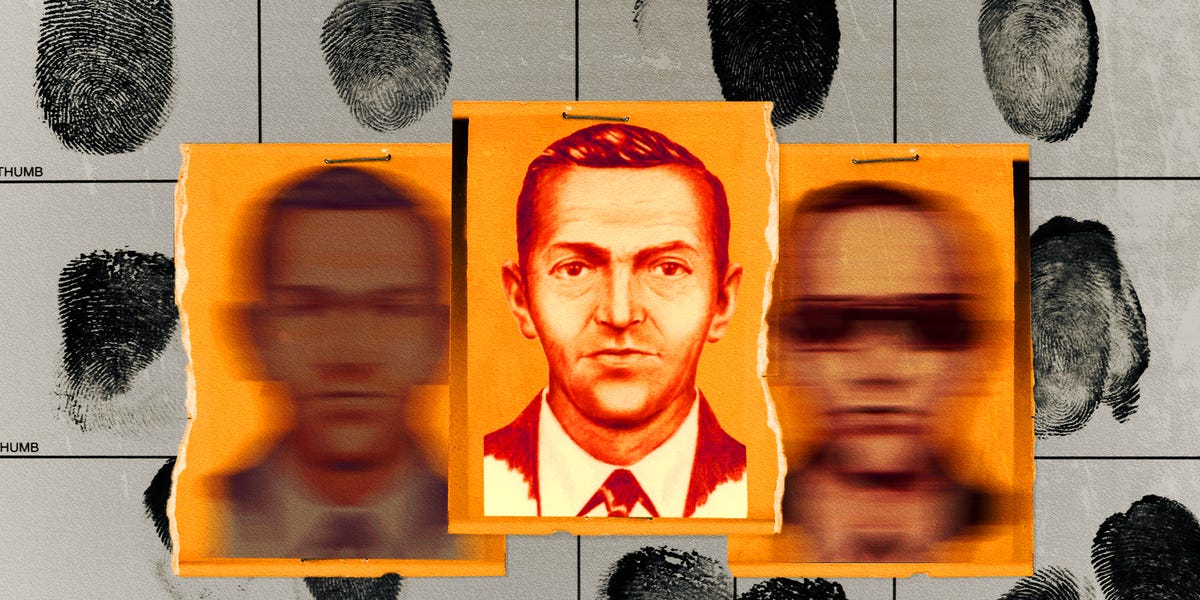
Editorial note: The D.B. Cooper case remains officially unsolved. The parachute discussed in this article has been reported as a possible new lead, but the FBI has not publicly confirmed that it identifies Cooper or links Richard Floyd McCoy Jr. to the 1971 hijacking.
The Cold Case That Refuses to Stay Cold
Few American mysteries have aged as stylishly as the D.B. Cooper case. It has everything: a man in a business suit, a bourbon and soda, a briefcase allegedly packed with explosives, a Boeing 727, $200,000 in ransom money, four parachutes, a rainy Pacific Northwest night, and an exit so dramatic that Hollywood would have been accused of overdoing it.
On November 24, 1971, a man using the name Dan Cooper boarded Northwest Orient Flight 305 from Portland, Oregon, to Seattle, Washington. During the flight, he told a flight attendant he had a bomb and demanded $200,000 in cash and four parachutes. After the plane landed in Seattle, he exchanged the passengers for the money and parachutes, kept a few crew members aboard, and ordered the aircraft back into the sky. Sometime after takeoff, he lowered the rear stairs and jumped into the night with the ransom.
Then he vanished. No confirmed body. No confirmed identity. No triumphant postcard saying, “Wish you were here.” Just a legend, a stack of FBI files, a few physical clues, and more theories than a Thanksgiving dinner table can safely handle.
Now, decades later, a parachute reportedly connected to one of the most discussed suspects may be the kind of physical evidence investigators always said could matter. The big question is simple: could a parachute once in the FBI’s possession finally solve the D.B. Cooper mystery?
Why the Parachute Matters So Much
In most true-crime mysteries, a new witness can be useful. A confession can be interesting. A family story can be emotionally powerful. But physical evidence is the heavyweight champion. In the D.B. Cooper case, physical evidence has always been thin, strange, and frustratingly incomplete.
The FBI had Cooper’s clip-on tie, which reportedly produced a DNA sample years later. Investigators recovered some of the ransom money in 1980 when a boy found rotting $20 bills along the Columbia River. They had passenger descriptions, flight crew memories, the aircraft, and a mountain of paperwork. But they never had a suspect who could be conclusively tied to the jump, the ransom, or the parachute Cooper used.
That is why the new parachute lead has drawn so much attention. The FBI officially redirected resources away from the active D.B. Cooper investigation in 2016, but it left the door open for specific physical evidence related to the parachutes or ransom money. In other words, the Bureau did not say, “Never call us again.” It said, in effect, “Call us if you find the right thing.”
A parachute is exactly the right kind of thing.
The Richard McCoy Connection
The parachute lead points back to Richard Floyd McCoy Jr., a former Army veteran, helicopter pilot, and skydiver who committed a remarkably similar hijacking in April 1972, less than five months after the Cooper incident. McCoy hijacked a United Airlines Boeing 727, demanded $500,000 and four parachutes, and bailed out over Utah with the ransom money.
Unlike Cooper, McCoy did not disappear into legend. He was tracked down, arrested, convicted of aircraft piracy, sentenced to prison, escaped, and was later killed in a shootout with FBI agents in 1974. His story already sounded like the sequel to the D.B. Cooper case, except the sequel had more fingerprints and a much worse escape plan.
For years, McCoy has been one of the most debated D.B. Cooper suspects. Supporters of the theory point to the similarities: both hijackings involved Boeing 727 aircraft, ransom money, parachutes, written demands, and escape through the rear of the plane. Skeptics point to equally important differences, including witness descriptions. The FBI’s public history notes that McCoy was ruled out because he did not match the descriptions given by flight attendants and for other reasons.
That tension is what makes the parachute so intriguing. If a parachute associated with McCoy could be shown to match the gear provided to Cooper, it would reopen a door many investigators believed had been closed. If it does not match, it may simply become another fascinating object in the long museum of Cooper maybes.
How the New Parachute Lead Emerged
Recent reporting has focused on a parachute rig reportedly discovered on property connected to McCoy’s family in North Carolina. Aviation YouTuber and retired pilot Dan Gryder, who has investigated the Cooper case, has said he found the rig and believes it may be connected to the 1971 hijacking. McCoy’s children have also publicly said they believe their father was D.B. Cooper.
According to reports, the parachute, a harness, and a skydiving logbook were turned over to the FBI after Gryder and McCoy’s son met with agents. Later reporting stated that the FBI tested the material and eventually returned it in December 2025 without publicly announcing a conclusion.
That last part is important. A returned parachute is not the same as a solved case. It does not prove Cooper’s identity. It does not prove the Bureau found nothing. It only proves the public still does not know what, if anything, investigators learned.
And in the D.B. Cooper world, silence is not empty. Silence is rocket fuel for theories.
What Investigators Would Look For
If investigators test a parachute connected to a decades-old case, they are not simply asking, “Does it look old?” A lot of things look old. Half the furniture in a college apartment looks old. The real questions are more technical.
1. Does the parachute match the known gear?
Cooper demanded four parachutes. FBI materials state that he jumped with two and left others behind, including one that had been used for instruction and was sewn shut. If a newly found rig has modifications or construction details matching descriptions of the gear supplied in 1971, that could matter. Stitching, canopy type, harness configuration, alterations, serial numbers, and repairs can all become clues.
2. Is there biological evidence?
DNA would be the dream evidence, but time is not kind. A parachute stored for decades in changing temperatures and humidity may carry degraded, contaminated, or mixed DNA. Investigators would have to separate meaningful material from years of handling, dust, insects, storage conditions, and family contact. This is detective work with a microscope and a headache.
3. Can ownership be established?
Even if the parachute belonged to McCoy, that alone does not prove it was used by Cooper. Investigators would need a chain of evidence showing where it came from, who used it, and whether it could plausibly be the same rig tied to the 1971 hijacking.
4. Does it fit the timeline?
For the parachute to matter, it must make sense with Cooper’s jump, McCoy’s known activities, and the later 1972 hijacking. Timelines are cold-case lie detectors. A good theory must survive the calendar.
The Problem With the Cooper Legend
The D.B. Cooper mystery is not just a criminal investigation. It is an American folk tale wearing sunglasses. That makes it harder to solve because people do not merely ask, “What happened?” They ask, “Which version of the myth do I prefer?”
Some people want Cooper to be a criminal mastermind who outwitted the system. Others believe he died in the woods shortly after jumping, undone by bad weather, rough terrain, unsuitable clothing, and a non-steerable parachute. Some imagine a trained parachutist. Others see an impulsive amateur who knew just enough to be dangerous. The truth may be less glamorous than the legend, which is usually how truth behaves at parties.
The new parachute lead is powerful because it pulls the story back from myth into material reality. A parachute has fabric, stitching, wear patterns, hardware, possible residue, and maybe biological traces. It cannot tell campfire stories. It can only sit there and be tested.
Why the Case Has Been So Difficult to Solve
D.B. Cooper was careful in ways that created long-term problems for investigators. He retrieved many of his written notes. He kept the crew at a distance when it mattered. He jumped into darkness, rain, and forested terrain. He left behind few clues that could be confidently tied to him.
The FBI investigated hundreds of suspects in the early years, searched possible landing zones, analyzed the aircraft, reviewed the ransom bills, and built one of the most famous case files in American law enforcement history. Still, the result was a mystery without a final page.
The $5,800 found in 1980 confirmed that at least some ransom money ended up near the Columbia River. But it did not explain how the money got there. Did Cooper land nearby? Did the money wash downstream? Was it buried? Did someone else move it? The discovery answered one question and opened five more, which is very on-brand for this case.
Could the Parachute Solve the Mystery?
Yes, but only under certain conditions. A parachute could help solve the D.B. Cooper mystery if forensic testing connected it to the 1971 gear, if it contained usable biological evidence, or if it established a credible chain linking McCoy to the Cooper jump. It could also help eliminate a theory if testing shows it is unrelated.
The most realistic outcome may be somewhere in the middle: the parachute could strengthen the McCoy theory without proving it beyond doubt. Cold cases often move in inches, not fireworks. A new artifact may narrow possibilities, challenge old assumptions, or inspire a fresh review of other evidence.
But for the D.B. Cooper case to be truly solved, the evidence would need to do more than sound exciting. It would need to connect Cooper’s identity, the hijacking, the parachute, and the timeline in a way that survives skeptical review. That is a high bar, and it should be. History does not need another confident guess in a trench coat.
Why People Still Care About D.B. Cooper
Part of the fascination is the clean absurdity of the escape. A man hijacks a plane, gets paid, jumps into the dark, and disappears. It feels impossible, which makes it unforgettable. The case sits at the crossroads of aviation history, criminal investigation, pop culture, and the American love of a good vanishing act.
There is also the mystery of personality. Cooper was described as calm and polite. He did not physically harm the passengers. He seemed to know enough about aircraft operations to make specific demands. Yet he made choices that may have been reckless or even fatal. Was he a genius, a desperate man, a trained parachutist, a military veteran, a lucky criminal, or someone who misunderstood the danger of his own plan?
The parachute lead matters because it offers the possibility of moving from character study to evidence. After decades of theories, a physical object can feel like a voice from the past saying, “Stop arguing and test me.”
Experiences Related to Following the D.B. Cooper Parachute Mystery
Following the D.B. Cooper parachute story feels less like reading an ordinary crime update and more like walking into a room where everyone has been debating the same question for 50 years and somehow nobody has run out of coffee. The experience is strange, addictive, and occasionally hilarious in the way only famous unsolved mysteries can be.
First, there is the thrill of the object itself. A parachute is not abstract. It is not a rumor overheard by someone’s cousin at a diner in 1978. It is a thing you can fold, inspect, photograph, test, and compare. That gives the story weight. When readers hear that a parachute connected to a long-discussed suspect was reportedly examined by the FBI, the mystery suddenly feels less like folklore and more like an active puzzle.
Second, there is the experience of realizing how fragile certainty can be. The McCoy theory is tempting because the similarities are obvious. McCoy hijacked a plane months later. He demanded parachutes and ransom money. He knew how to jump. He had the nerve. On paper, he looks like a suspect wearing a blinking neon sign. But then come the complications: witness descriptions, official skepticism, uncertain evidence, family memories, and the brutal problem of proving anything after half a century.
That is what makes the case such a good lesson in critical thinking. It reminds readers that a compelling story is not the same thing as a proven story. A theory can be elegant and still be wrong. Evidence can be fascinating and still be inconclusive. In the Cooper case, every exciting lead must pass through a fog machine powered by time.
There is also a deeply human experience at the center of it. For the families connected to suspects, the mystery is not just entertainment. It can be inheritance, suspicion, grief, loyalty, fear, and unfinished business. When McCoy’s children say they believe their father was Cooper, they are not simply adding a new theory to an internet forum. They are attaching a family history to one of America’s most famous crimes. That adds emotional force, but it also demands caution.
For readers, the best way to experience this story is to enjoy the mystery without letting the legend do all the thinking. Imagine the parachute on an evidence table. Imagine the investigators checking fibers, stitching, hardware, storage damage, and possible DNA. Imagine the frustration of finding “maybe” where everyone wants “yes.” That is the real rhythm of cold-case work. It is not always dramatic. Sometimes it is patient, technical, and quiet.
And maybe that is why the D.B. Cooper mystery endures. It gives us the fantasy of a perfect disappearance, then forces us to wrestle with imperfect evidence. The parachute may solve the case, or it may become one more artifact in a mystery that refuses to land. Either way, it has done something remarkable: it has made a 1971 skyjacking feel alive again.
Conclusion
A parachute in the FBI’s possession may not yet solve the D.B. Cooper mystery, but it has revived the most important question in the case: what kind of evidence would finally be enough? The answer is not another dramatic theory. It is proof. The parachute connected to the Richard McCoy discussion could matter if it links the suspect, the equipment, and the 1971 hijacking through verifiable forensic or documentary evidence.
Until then, D.B. Cooper remains suspended between history and legend. He is both a real criminal who endangered lives and a cultural ghost who stepped out of an airplane and into American mythology. The parachute may be the clue that brings him back to earth. Or, in classic Cooper fashion, it may leave us staring into the dark, wondering where he went.











