
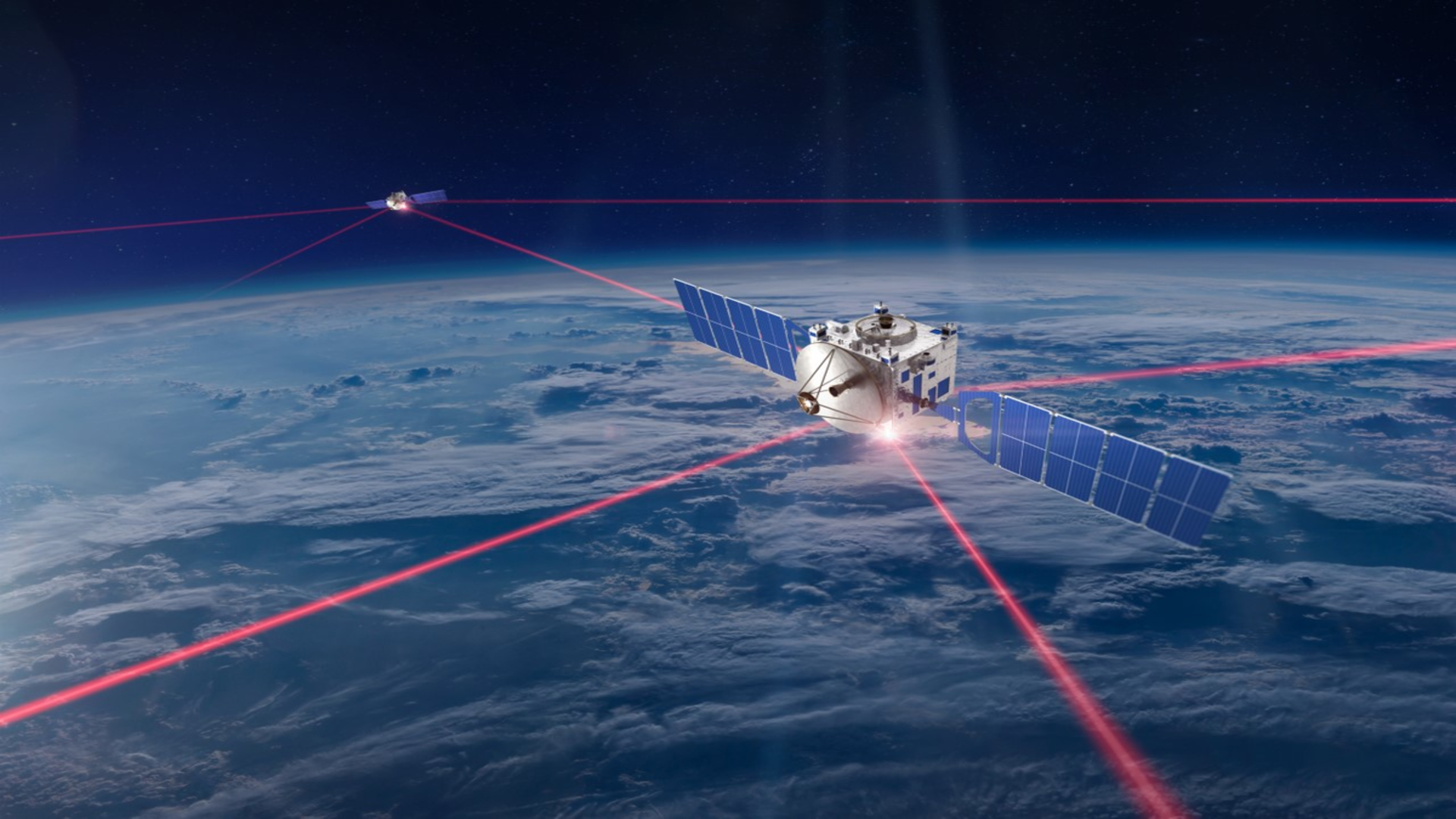
Starlink’s inter-satellite laser links are no longer just a futuristic party trick in orbit. They are becoming the hidden backbone of a global internet network that can move staggering amounts of data without waiting for a nearby ground station.
Space Lasers Are Finally Having Their Main Character Moment
For decades, “space lasers” sounded like something a movie villain would say while stroking a cat in a rotating chair. In Starlink’s case, however, the lasers are not for dramatic entrances or moon-based mischief. They are for moving internet traffic between satellites at extremely high speed, across oceans, polar regions, rural areas, ships, aircraft, disaster zones, and places where fiber cables are either impossible, expensive, or inconveniently located beneath a mountain.
The headline number is big enough to make even a data center administrator blink twice: Starlink’s inter-satellite laser network has been reported to move more than 42 petabytes of customer data per day. In more familiar terms, that is 42 million gigabytes daily. That is not “my phone needs a software update” data. That is a planetary-scale data river flowing through a mesh of satellites in low Earth orbit.
What makes this record especially interesting is not only the volume. It is the architecture. Starlink does not depend solely on a simple path from user terminal to satellite to ground station. With optical inter-satellite links, a satellite can hand data to another satellite, which can hand it to another, until the network finds a better route to the internet. Think of it as a game of orbital hot potato, except the potato is a video call, the players are moving at thousands of miles per hour, and everyone has to aim a laser with ridiculous precision.
What Are Starlink Inter-Satellite Laser Links?
Starlink inter-satellite laser links, also known as optical inter-satellite links or ISLs, are communication systems that allow satellites to talk directly to each other using tightly focused beams of light. Instead of sending every packet down to Earth immediately, satellites can pass traffic across the constellation in space.
The Basic Idea
A user’s Starlink dish connects to a satellite overhead through radio-frequency links. From there, the satellite has choices. It may send the traffic down to a nearby gateway station connected to terrestrial fiber. Or, when that route is not available or not efficient, it may use laser links to move data across the satellite network until it reaches a better exit point.
This matters because Earth is inconveniently round. Oceans are large. Polar regions are remote. Ships move. Aircraft do not wait politely under cell towers. Rural communities may be far from fiber routes. Laser links help Starlink reduce dependence on nearby ground stations and improve coverage in places where traditional network infrastructure is thin, missing, or very expensive to build.
Why Lasers Instead of Radio?
Radio waves are still essential to Starlink. They connect user terminals, gateways, and satellites. But laser communication has special advantages in space. Optical links can carry very high data rates, use narrow beams, and avoid some of the spectrum congestion that affects radio systems. NASA has also emphasized that laser communications can send data at higher rates while using lighter and lower-power systems, which is a beautiful combination in spacecraft engineering. In space, every gram matters. If your satellite has to go on a diet, laser terminals are the kind of high-performance snack it wants.
The trade-off is precision. A laser beam is narrow, which is great for capacity and security but demanding for pointing. Two satellites moving rapidly in low Earth orbit must acquire, track, and maintain alignment. That is not like pointing a flashlight at the garage. It is more like trying to thread a needle from a roller coaster while the needle is also on a roller coaster.
Why 42 Million GB Per Day Is a Serious Milestone
Forty-two million gigabytes per day is a number that begs for translation. A single gigabyte might hold a few hundred photos, a short HD video, or a chunky app update. Multiply that by 42 million, every day, and you are looking at an internet backbone that is not experimental anymore. It is operational, heavily used, and scaling fast.
The reported figure means Starlink’s laser mesh is not merely a backup feature. It is carrying real customer traffic at enormous volume. The system has been described as using thousands of space lasers across the constellation, with individual links capable of very high throughput. Some reports have referenced links operating around 100 Gbps and peaks higher than that, depending on design and conditions.
The most important point is this: Starlink is turning low Earth orbit into a networking layer. In the old satellite internet model, satellites often acted like mirrors in the sky. A signal went up, bounced through a satellite, and came back down. Starlink’s laser mesh is more like a constantly changing fiber-style network above the atmosphere, except the nodes are satellites and the “cables” are beams of light.
A Mesh Network That Moves
On Earth, a fiber network is mostly fixed. Routers sit in buildings. Cables lie in trenches or under oceans. In orbit, everything moves. Starlink satellites travel quickly around the planet, which means the network topology is always changing. Links form, strengthen, weaken, and break as satellites move relative to each other.
To make that usable, Starlink needs rapid acquisition, precise pointing, dynamic routing, and software that can change paths quickly. When a route becomes crowded or a satellite moves out of range, the network can shift traffic through another path. This flexibility is one of the reasons the laser links matter so much for latency, reliability, and global reach.
How Starlink Laser Links Improve Global Internet Coverage
The obvious advantage of inter-satellite links is coverage. If every satellite had to be near a ground station to provide good service, Starlink would need a dense global network of gateways. That is manageable in some countries but complicated over oceans, remote islands, deserts, polar regions, and politically sensitive areas.
Laser links allow a satellite above a remote user to send traffic sideways through space until it can reach a satellite with access to a gateway or a better network path. This is especially useful for maritime users, aviation customers, emergency responders, researchers in remote regions, and communities far from terrestrial broadband.
Oceans, Aircraft, and the “No Fiber Here” Problem
Imagine a cargo ship crossing the Pacific. There is no convenient cell tower bobbing politely beside it. Undersea cables exist, of course, but ships do not plug into them while moving. A Starlink terminal on the vessel can connect to an overhead satellite, and laser links can help route the traffic across orbit until it reaches an appropriate ground connection.
The same logic applies to aircraft. In-flight connectivity has traditionally been a mixed bag: sometimes decent, sometimes expensive, sometimes slow enough to make loading an email feel like archaeology. Laser-linked LEO satellites can improve the routing options available for moving aircraft, helping reduce the dependence on local ground infrastructure beneath the flight path.
For remote regions, the benefit is even more direct. A user terminal in an isolated area can connect upward, and the satellite network can do the heavy lifting in space. It does not magically solve every affordability, regulatory, or capacity problem, but it changes the basic economics of reaching hard-to-serve locations.
Latency: The Hidden Battle Behind the Big Data Number
Bandwidth gets the flashy headlines, but latency is what users feel. A huge download speed sounds great, but if a video call stutters, an online game lags, or a web page hesitates, people notice. Starlink’s low Earth orbit design already has an advantage over traditional geostationary satellite internet because its satellites orbit much closer to Earth.
Laser links can help latency by creating shorter or more efficient routes when the nearest ground path is not ideal. But they can also add distance if traffic takes extra hops in space. This is why Starlink’s routing software matters so much. The goal is not simply to use lasers because lasers are cool, although, to be fair, they are cool. The goal is to choose the route that best balances congestion, distance, available gateways, and service quality.
Why Shorter Paths Are Not Always Obvious
In a moving satellite constellation, the “best” route can change quickly. A path that is excellent now may be less useful seconds later. The network must consider which satellites are visible, how long links will last, how busy each path is, and where the traffic needs to land on Earth.
Starlink has publicly discussed work aimed at reducing latency, including software tuning, better gateway planning, improved routing, and additional points of presence. That is important because user experience depends on the whole chain: terminal to satellite, satellite to satellite, satellite to gateway, gateway to internet exchange, and then all the way back again. The laser links are one dramatic piece of the puzzle, but the full performance story is a team sport.
V2 Mini Satellites and the Capacity Race
Starlink’s laser milestone also fits into the broader evolution of the satellite hardware. SpaceX’s second-generation Starlink satellites, including the V2 Mini design launched on Falcon 9, were built to provide more capacity than earlier satellites. SpaceX has described V2 Mini satellites as having four times the capacity for serving users compared with previous counterparts.
More satellite capacity means more room for customer demand, more traffic handling, and better performance in busy areas. The laser links then help move that traffic efficiently across the constellation. It is similar to upgrading both the neighborhood roads and the interstate system. Faster local connections are useful, but if the highway is jammed, everyone still gets grumpy. Starlink is working on both parts.
The Network Is the Product
One easy mistake is to think of Starlink as just a dish and a satellite. In reality, the service is a full-stack network: user terminals, satellites, phased-array antennas, optical laser links, ground gateways, internet points of presence, software schedulers, collision avoidance systems, launch cadence, and customer support. The dish in the yard is only the visible tip of a very expensive iceberg.
The laser network makes that iceberg more interesting. It means satellites are not isolated relays. They are nodes in an orbital internet architecture. That opens the door to better resilience, broader coverage, and potentially new services that depend on low-latency space-based routing.
Why This Matters Beyond Home Internet
For everyday users, the appeal is simple: faster, more reliable internet in more places. But the implications stretch beyond streaming movies at a cabin or sending emails from a sailboat.
Emergency Response and Disaster Recovery
When hurricanes, wildfires, earthquakes, or floods damage terrestrial networks, satellite connectivity can become critical. A laser-linked constellation can support communication in areas where cell towers are down, fiber is cut, or roads are blocked. Starlink has already played roles in emergency connectivity, and the growth of Direct to Cell services points toward a future where satellite networks supplement mobile coverage during crises.
Maritime, Aviation, and Remote Industry
Mining sites, offshore platforms, research bases, fishing fleets, cargo ships, private aircraft, and commercial airlines all need connectivity. Many of these users operate far from dense infrastructure. Inter-satellite laser links improve the odds that data can find a useful route even when the closest ground station is nowhere nearby.
Commercial Space and Third-Party Satellites
SpaceX has also signaled interest in selling satellite laser link technology to other companies. That could turn Starlink’s optical network experience into a broader space infrastructure business. If other satellites can use compatible optical terminals, the future may include more spacecraft that connect to orbital data networks instead of waiting for limited ground station passes.
The Challenges: Space Lasers Are Not Magic Wands
Starlink’s laser links are impressive, but they do not remove every technical, environmental, or regulatory challenge. Scaling a satellite constellation is hard. Scaling one that carries millions of customers and moves petabytes of data every day is harder.
Precision and Reliability
Laser links require accurate pointing and tracking. Satellites must maintain alignment while moving rapidly. Hardware must survive radiation, temperature swings, vibration from launch, and years of orbital operation. The more the network depends on optical links, the more important reliability becomes.
Routing Complexity
Because satellites are constantly moving, Starlink has to manage a dynamic mesh. This requires sophisticated routing algorithms that can respond quickly to changing conditions. It is not enough to build fast links; the network must also know when to use them, when to avoid them, and how to recover when a path disappears.
Space Sustainability
Large constellations raise concerns about orbital congestion, collision risk, astronomy impacts, and long-term sustainability. SpaceX has emphasized low operating altitudes, autonomous collision avoidance, demisable spacecraft design, and post-mission disposal. Those measures are important, but public scrutiny will remain high as satellite numbers grow. The sky is big, yes, but low Earth orbit is starting to feel like a popular parking lot after a holiday sale.
Weather and Optical Ground Links
Inter-satellite laser links operate in space, where clouds are not a problem between satellites. But laser links from space to Earth face atmospheric challenges, including clouds and turbulence. That is one reason radio links remain essential for user terminals and gateways. The future is not laser versus radio; it is laser plus radio, each doing what it does best.
What Comes Next for Starlink’s Laser Network?
The 42 million GB per day milestone should be seen as a marker, not a finish line. As SpaceX launches more capable satellites, improves routing software, expands ground infrastructure, and develops future satellite generations, the amount of data moving through optical links could grow dramatically.
Future Starlink satellites are expected to push capacity higher, and regulatory approvals continue to shape how the constellation expands. The FCC has authorized additional second-generation Starlink satellite deployments, while also placing conditions around operations, coordination, and spectrum use. That combination of technical ambition and regulatory oversight will define the next chapter.
The most exciting possibility is that inter-satellite laser links become a normal part of global communications infrastructure. People may not think about them, just as most people do not think about undersea cables when sending a message. But behind the scenes, the internet may increasingly route through a blend of fiber, wireless, terrestrial towers, satellites, and lasers in orbit.
Experience Notes: What a Laser-Linked Starlink World Feels Like
The most interesting thing about Starlink’s inter-satellite laser links is that, for most users, the experience should not feel dramatic. No one opens a laptop and says, “Ah yes, my packet has just completed a tasteful optical handoff above the North Atlantic.” People simply want the meeting to connect, the map to load, the payment terminal to work, and the movie not to buffer during the one scene where the detective finally explains everything.
Picture a family staying at a remote cabin. The nearest town is far away, the road is mostly gravel, and the local internet options are the digital equivalent of a sleepy turtle. A Starlink terminal changes the rhythm of the place. Someone can take a work call. Kids can stream cartoons after hiking. A parent can check weather radar before driving into a storm. The laser links are invisible, but they help create the feeling that the cabin is no longer digitally stranded.
Now imagine a small research team working in a polar or maritime environment. Their daily needs are not glamorous: upload data, check forecasts, coordinate logistics, call home, send reports, update instruments, and occasionally watch something cheerful because morale matters. A laser-linked satellite network helps reduce the old dependence on being near the right ground station at the right time. Connectivity becomes less like a lucky window and more like a service.
For aviation, the experience may be even more subtle. Passengers do not care whether their in-flight Wi-Fi uses satellites, lasers, gateways, or a tiny wizard living in the overhead bin. They care whether they can send a file, message family, or survive a long flight with entertainment intact. Behind that ordinary expectation is extraordinary coordination: aircraft moving across continents, satellites moving overhead, beams forming and breaking, and software choosing paths faster than a traveler can decide whether to order tomato juice.
Emergency scenarios show the human value most clearly. When terrestrial networks fail, communication becomes more than convenience. It becomes safety. A message that gets through after a storm can tell someone where help is needed. A working connection can help responders coordinate supplies, shelters, medical teams, and evacuation routes. In those moments, the technology stops being a headline about petabytes and becomes something simpler: a way to reduce silence.
There is also an emotional shift. People in remote places are used to being told that modern connectivity is coming “eventually.” Eventually can feel like a very polite word for never. Satellite broadband, supported by laser-linked routing, changes that promise. It does not make every plan affordable or every connection perfect, but it makes high-speed access more plausible in places that have spent years outside the broadband conversation.
The funny part is that the better Starlink’s laser network becomes, the less users will notice it. That is the fate of good infrastructure. Roads are noticed when they have potholes. Power is noticed when the lights go out. Internet is noticed when the video freezes with someone’s face stuck in a tragic rectangle. The goal of Starlink’s laser links is not to make users admire orbital engineering every morning. The goal is to make the connection feel normal, even when the route behind it is anything but normal.
Conclusion: Starlink’s Laser Links Are Building an Internet Above the Internet
Starlink’s reported 42 million GB per day laser-link milestone is more than a big number. It is evidence that optical inter-satellite communication has moved from experimental promise to operational infrastructure. The constellation is not just sending signals up and down; it is routing traffic sideways through space, creating a flexible orbital mesh that can support global coverage, remote connectivity, maritime service, aviation internet, emergency response, and future satellite-to-mobile systems.
The technology is not perfect, and the challenges are real. Precision pointing, dynamic routing, orbital safety, regulatory coordination, astronomy concerns, and capacity management will remain major issues. But the direction is clear. Low Earth orbit is becoming a communications layer, and Starlink’s inter-satellite laser links are one of the strongest signs that the internet’s next backbone may not be buried underground. It may be racing overhead, quietly moving petabytes through beams of light.











