
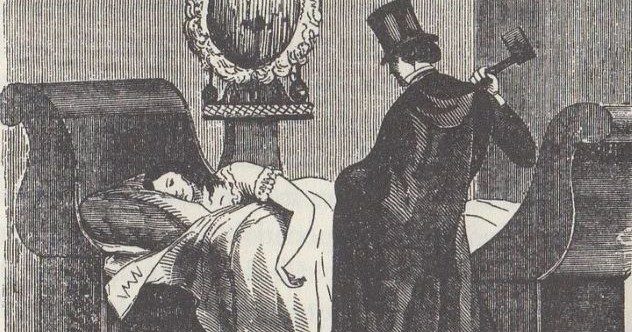
Long before podcasts asked us to “solve the case” from the comfort of a commuter train, Americans were already devouring crime stories with the enthusiasm of people who had discovered both gossip and cheap newspapers at the same time. The 1836 murder of Helen Jewett and the trial of Richard P. Robinson created one of the earliest full-blown media sensations in the United States.
It had nearly every ingredient modern true crime audiences recognize: a mysterious victim, a wealthy-looking suspect, lurid headlines, competing theories, questionable witnesses, class tension, sexual scandal, courtroom drama, and an ending that left the public furious. The only thing missing was a streaming-service documentary with ominous piano music.
The Helen Jewett case did not invent public fascination with murder. People had been interested in shocking crimes for centuries. But it helped create the style of crime coverage that would eventually evolve into tabloids, courtroom reporting, true crime books, television specials, podcasts, documentaries, and the endless online debates that begin with, “Okay, but here is my theory.”
Why the Helen Jewett Murder Trial Matters in True Crime History
Helen Jewett was a young woman living in New York City during a period of rapid growth, intense inequality, and fierce competition among newspapers. Her murder became more than a criminal investigation. It became a national argument about money, morality, gender, sex work, privilege, and whether a respectable young man could ever be capable of violence.
The resulting coverage transformed a private tragedy into public entertainment. Newspapers printed graphic details, competing portraits of the people involved, courtroom updates, rumors, editorials, and moral lectures. Readers did not simply learn about the case. They were invited to choose sides.
That is one reason the Helen Jewett murder trial is often described as an early foundation of the true crime trend. It taught publishers a lesson that media companies have never forgotten: people will read a lot of words about a shocking crime, especially when the story involves wealth, sex, mystery, and a verdict nobody agrees with.
10 Facts About the Murder Trial That Helped Launch True Crime
1. Helen Jewett Was Not Her Birth Name
Helen Jewett was born Dorcas Doyen in Maine around 1813. Her early life was difficult, and she spent part of her childhood in a household where she received an education uncommon for many girls of her social position. She was intelligent, literate, and known for writing letters that mixed romance, performance, and carefully managed self-presentation.
By the time she reached New York, she had adopted the name Helen Jewett. That reinvention fascinated newspapers and later historians. The press often treated her multiple identities as evidence of deceit, but reinvention was also a survival strategy for women with limited economic choices. In modern terms, she was trying to control her own brand before branding experts had business cards.
2. She Worked at an Upscale Manhattan Brothel
Jewett lived and worked at a fashionable brothel operated by Rosina Townsend on Thomas Street in lower Manhattan. This was not the dusty, cartoonish version of a brothel often seen in old movies. It was a polished establishment that served clients with money, professional ambitions, and reputations they preferred to keep off the record.
The location mattered because it placed Jewett at the intersection of several worlds: working-class New York, commercial sex, business culture, political influence, and social aspiration. Her clients included men who wanted discretion during the day and adventure after dark. Naturally, that combination was highly combustible once a murder occurred.
3. The Crime Scene Was Designed for Headlines
In the early hours of April 10, 1836, Jewett was found dead in her room after a violent attack. Contemporary accounts described severe head wounds caused by a sharp weapon, often identified as a hatchet, and a fire set in or near her bed after the killing.
The brutality of the crime shocked New Yorkers. Murder was not unknown in the city, but this case offered newspaper editors a grimly irresistible combination: a stylish brothel, a well-known victim, clues involving clothing and a possible weapon, and a fire that made the scene even more dramatic. The crime was tragic. The coverage was theatrical almost immediately.
4. Richard P. Robinson Became the Prime Suspect
Richard P. Robinson was a 19-year-old dry-goods clerk from a respectable background. He had been one of Jewett’s regular clients and was known to have used the alias “Frank Rivers” when visiting women in the city’s brothels. That detail alone gave newspapers enough material to build a character arc before the trial had even started.
Witnesses connected Robinson to Jewett on the night of the murder, and investigators found circumstances that appeared suspicious, including reports about whitewash stains on his clothing after someone fled the building and crossed a freshly whitewashed fence. But the case against Robinson was largely circumstantial, and the legal system of the era was deeply shaped by assumptions about class, gender, and credibility.
5. The Case Turned the Penny Press into a Crime Machine
The Helen Jewett murder arrived at exactly the right moment for the penny press. These inexpensive newspapers were aimed at ordinary readers rather than wealthy political elites. They needed exciting stories, fast reporting, and headlines that made someone stop at a newsstand instead of saving that penny for lunch.
James Gordon Bennett’s New York Herald covered the case aggressively, publishing vivid descriptions, speculation, commentary, and material that blurred the line between reporting and entertainment. Rival papers took different sides, creating a nineteenth-century version of competing news channels, minus the studio lighting and scrolling ticker.
6. Newspapers Built Competing Versions of Helen Jewett
One of the most disturbing features of the coverage was how often Helen Jewett herself became the subject of judgment. Some newspapers portrayed her as glamorous, intelligent, and wronged. Others attacked her character, treating her work as a reason to doubt her worthiness as a victim.
This pattern remains familiar in modern crime reporting. Instead of focusing solely on evidence, the public often receives a simplified version of a victim: saint, sinner, mystery, cautionary tale, or headline accessory. The Jewett case shows how easily media coverage can turn a murdered person into a symbol while losing sight of the human being at the center of the story.
7. The Trial Was Also a Debate About Class and Respectability
Robinson’s defenders emphasized his appearance of respectability. He was young, educated, employed, and connected to people with money and influence. Jewett, meanwhile, was a sex worker. That imbalance shaped how witnesses were treated and how readers interpreted the evidence.
The question beneath the trial was not simply, “Who killed Helen Jewett?” It was also, “Whose testimony deserves belief?” Women who worked in the brothel were treated as unreliable because of their profession. Robinson’s social status, by contrast, gave him a presumption of moral credibility in the eyes of many observers. The courtroom became a stage where class prejudice wore a very serious hat.
8. The Defense Had a Powerful Lawyer and an Effective Strategy
Robinson’s defense included Ogden Hoffman, a skilled attorney and former New York district attorney. The defense challenged the reliability of prosecution witnesses, emphasized the weakness of circumstantial evidence, and benefited from the fact that many key witnesses were women from the brothel.
In a legal system where testimony from sex workers was already viewed with suspicion, the defense did not need to prove an alternate killer beyond doubt. It only needed to create enough uncertainty to prevent a conviction. That strategy worked. The case revealed a timeless truth about criminal trials: evidence matters, but the perceived credibility of the people presenting it can matter just as much.
9. Robinson Was Acquitted, but the Public Was Not Satisfied
Robinson’s trial began in June 1836 and lasted several days. The jury returned a verdict of not guilty, shocking many members of the public who had followed the case closely through newspapers and pamphlets. The acquittal did not settle the story. It made the story larger.
People argued that Robinson had escaped justice because of his social connections. Others believed the prosecution had failed to prove its case. The official legal result was clear: Robinson was acquitted. The public verdict, however, remained deeply divided. That unresolved tension is one reason the case still feels like true crime. The courtroom closed, but the argument did not.
10. The Story Kept Selling Long After the Trial Ended
The Jewett case became a publishing phenomenon. Newspapers revisited it, pamphlets circulated lurid accounts, lithographs depicted scenes from the murder and trial, and fictionalized versions appeared in print. The people involved became characters in a continuing national drama.
This is perhaps the clearest connection to modern true crime culture. The event was not treated as a one-day news story. It became a reusable narrative property. Readers wanted updates, analysis, theories, biographies, moral lessons, and dramatic retellings. The format has changed from penny papers to podcasts, but the business model remains suspiciously familiar.
What the Helen Jewett Trial Reveals About the True Crime Trend
The Helen Jewett murder trial was not simply an early sensational crime story. It showed how media can shape a criminal case before a jury reaches a verdict. It also demonstrated how public fascination with violence can become inseparable from debates about gender, money, social status, and power.
Modern true crime often promises clarity: one mystery, one timeline, one suspect board covered in red string. The Jewett case offers a less comfortable lesson. Real cases are rarely neat. Evidence can be incomplete. Witnesses can be dismissed unfairly. Newspapers can distort reality. And a legal acquittal can leave painful questions unanswered.
That is why this nineteenth-century trial remains relevant. It was not just an early media event. It was an early warning about what happens when tragedy becomes entertainment, when public opinion races ahead of the facts, and when the person with the least power becomes the easiest person to judge.
Experience: What Reading This Original True Crime Story Feels Like
Reading about the Helen Jewett case can feel strangely modern. At first, the details seem distant: horse-drawn New York, one-cent newspapers, handwritten letters, gaslit streets, and courtroom spectators in heavy coats. Then the patterns begin to look uncomfortably familiar. Readers were hungry for updates. Publishers fought for attention. People formed opinions before all the evidence was known. The victim’s private life became public property. The accused man’s background became part of the argument. Suddenly, 1836 does not feel quite as far away.
The experience is also a reminder that true crime can be both compelling and ethically messy. It is easy to become absorbed by the clues: the possible hatchet, the whitewash stains, the disputed alibi, the letters, the fashionable brothel, and the rapid acquittal. Those details are dramatic because they create a puzzle. But Helen Jewett was not a puzzle created for public entertainment. She was a real person whose death became profitable for publishers, writers, artists, and storytellers.
That tension is part of what makes this case important for modern audiences. Good true crime writing should not only ask who committed a crime. It should ask who gets believed, who gets protected, who gets blamed, and who gets turned into a character instead of remembered as a person. In the Jewett case, newspapers often used her life to sell moral lessons. Some portrayed her as seductive and dangerous. Others made her into a tragic heroine. Both approaches risked flattening her into a convenient story.
There is also a useful lesson for readers who enjoy crime podcasts, documentaries, and courtroom coverage today: skepticism is healthy. A dramatic headline is not evidence. A confident narrator is not a judge. A popular theory is not a verdict. The Helen Jewett story became famous partly because newspapers confidently printed rumors, speculation, and highly emotional descriptions. That made the story exciting, but it did not necessarily make the story accurate.
The most valuable experience of revisiting this case may be learning to read true crime with two minds at once. One mind can appreciate the history, mystery, and cultural impact. The other should stay alert to bias, missing evidence, exploitation, and the humanity of the people involved. That balance does not make true crime less interesting. It makes it smarter.
Nearly two centuries later, the Helen Jewett murder trial still asks the same uncomfortable question modern true crime audiences should ask themselves: are we seeking justice, understanding, and historical contextor are we simply treating someone else’s worst day as our favorite genre?











