
New York City does not have background noise. It has supporting characters.
Stand on a subway platform, wait in a crowded coffee shop, or walk behind two friends moving at exactly one-third of the legal sidewalk speed, and you may hear a sentence that rearranges your understanding of humanity. Nobody introduces the characters. Nobody explains the plot. You simply receive one spectacular fragmentoften involving rent, dating, bagels, therapy, pigeons, or all fiveand spend the rest of the day wondering what happened next.
The environment is ideal for unforgettable NYC conversations. More than 8.8 million people were counted in the city in the 2020 Census, and nearly half of residents speak a language other than English at home. The result is a dense, multilingual metropolis where cultures, accents, professions, generations, and personal crises constantly overlap.
Then there is the subway, New York’s unofficial moving living room. The system recorded about 1.28 billion rides in 2025, creating billions of opportunities for strangers to hear phone calls, breakups, business pitches, parenting negotiations, and debates about whether an empty subway car should ever be trusted. Spoiler: it should not.
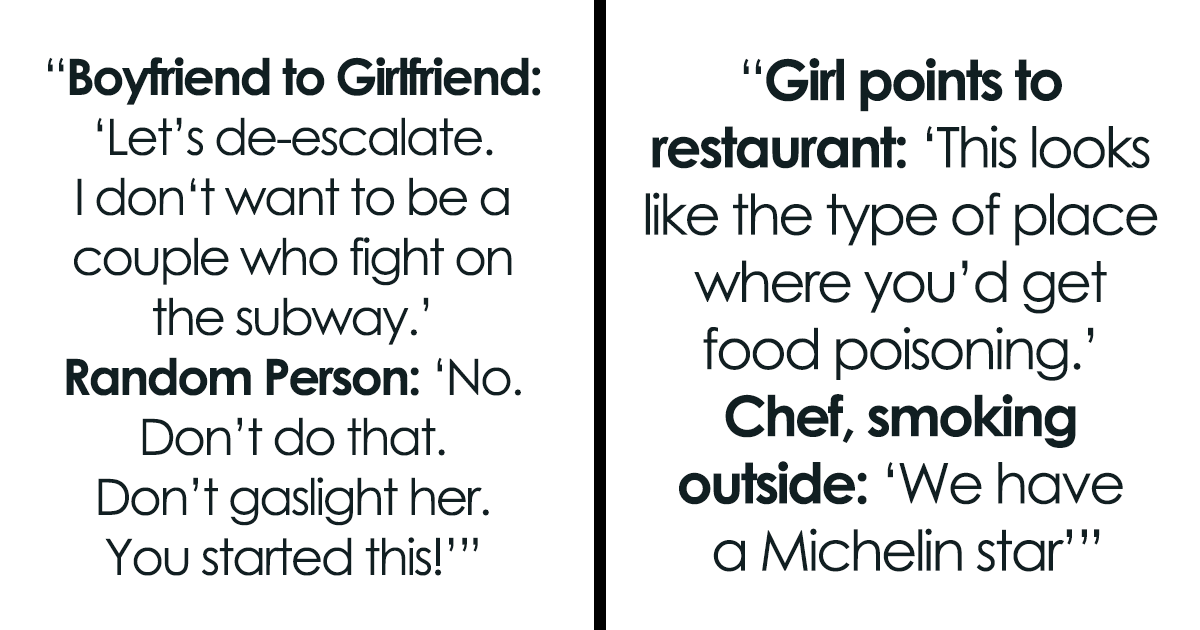
Overheard dialogue has become its own form of New York storytelling, appearing in long-running online collections, illustrated features, humor pages, and social media accounts. The funniest snippets work like miniature plays: one line establishes the problem, another delivers the twist, and the closing doors remove the cast before anyone can request an explanation.
The 50 scenes below are original, fictionalized composites inspired by that public-conversation tradition. They capture the rhythm and attitude of funny New York conversations without identifying real people or reproducing submitted quotes.
50 Wild NYC Conversations That Deserve Their Own Sitcom
Subway Logic and Commuter Philosophy
-
The Speed Strategy
I missed the express because I was trying to get somewhere faster.
A perfect summary of commuting in a city where efficiency often requires three delays and a surprise shuttle bus.
-
The Emotionally Delayed Train
This train is being held because the train ahead of us is emotionally unavailable.
Honestly, that explanation feels more believable than “train traffic ahead.”
-
Door Problems
Do not lean on the doors. They already have commitment issues.
The subway announcement nobody asked for but every dating app user understands.
-
The Empty-Car Warning
An empty subway car is never a gift. It is a warning with fluorescent lighting.
This is not pessimism. It is advanced New York survival knowledge.
-
Alternative Navigation
I don’t need directions. I need the city to rearrange itself around my appointment.
Google Maps has declined the request and suggested leaving home earlier.
-
Two Types of Downtown
He said he would meet me downtown.
Which downtowngeographically or emotionally?
In New York dating, both locations can be difficult to reach.
-
Underground Judgment
I paid a subway fare just to be judged by a pigeon underground.
The pigeon paid nothing and still behaved like the senior executive in the relationship.
-
The Times Square Transfer
We can transfer at Times Square.
I would rather transfer my identity.
Some connections are technically possible but spiritually irresponsible.
-
Stand Clear
The conductor said to stand clear. That is also my therapist’s advice.
Public transportation and emotional boundaries occasionally share the same vocabulary.
-
One-Percent Decisions
My phone has one percent left, so every decision is now constitutional.
Should you call home, open the map, or watch one final video? History is waiting.
Dating, Romance, and Apartment-Based Compatibility
-
The Long-Distance Relationship
He lives in Jersey.
So you broke up?
I said he lives in Jersey.
Geography has ended relationships for less.
-
The New Love Language
She asked about my love language. I said a rent-stabilized lease.
Words of affirmation are lovely, but predictable monthly housing costs are irresistible.
-
Advanced Ghosting
I don’t ghost people. I gradually become a scheduling conflict.
A sophisticated technique involving delayed texts, calendar screenshots, and suspiciously frequent dental appointments.
-
No Closet, No Future
We had chemistry, but his apartment had no closet.
Passion fades. Seasonal storage remains.
-
Bodega Romance
He brought me flowers.
From where?
The bodega.
Marry him.
A bouquet purchased beside lottery tickets and phone chargers still counts.
-
The Walking Date
Our first date lasted fourteen blocks because neither of us wanted to pay surge pricing.
Romance blossomed somewhere between the third complaint and the second closed restroom.
-
She Needed Space
She said she needed space, so I sent her a studio listing in Queens.
It was 280 square feet and somehow still outside her budget.
-
Limited Availability
He’s emotionally available from 7:15 to 7:45 on Wednesdays.
Appointments require two weeks’ notice and may be rescheduled during playoff season.
-
The Serious Relationship
I knew it was serious when she gave me her laundromat card.
Passwords can change. Wash-and-fold loyalty is forever.
-
Calendar Infidelity
We are exclusive, but our calendars are seeing other people.
They remain committed despite brunches, networking events, birthdays, and one suspiciously recurring Pilates class.
Office Drama, Money Problems, and Professional Delusion
-
The Corporate Family
My boss says we’re a family.
Families don’t schedule 8 a.m. brainstorming sessions.
At least most families provide snacks without requiring a quarterly review.
-
Quiet Quitting, Loud Status
I resigned quietly, but my Slack status was screaming.
The red “Do Not Disturb” icon had been preparing for this moment.
-
The Invisible Raise
The raise was spiritual. I had to believe it existed without seeing evidence.
Payroll called it a growth opportunity.
-
Multiple Careers
I have three jobs and one email signature.
The signature simply says, “Best,” because there is no time to specify which version of the person sent it.
-
The Perfect Client Request
The client wants it authentic, premium, viral, finished tomorrow, and free.
They also requested “a little more wow,” the official phrase of approaching disaster.
-
Side-Hustle Expansion
My side hustle has developed its own side hustle.
Neither provides health insurance, but both send motivational newsletters.
-
Networking Strategy
I don’t network. I stand near the cheese and make professional eye contact.
Many careers have begun beside a sweating wheel of brie.
-
The Necessary Meeting
That meeting could have been an email, but the email wanted witnesses.
Forty-five minutes later, everyone agreed to schedule another meeting.
-
Opportunity Relocated
I moved to New York for opportunity. Opportunity moved to Queens.
Fortunately, it remains accessible by train after two transfers and weekend service changes.
-
Modern Budgeting
I manage my finances by refusing to open the banking app.
No new information means no new financial emergency. Economists hate this trick.
Bagels, Fashion, Wellness, and Other Essential Industries
-
The Premium Bagel
This bagel costs eight dollars.
Does it come with health insurance?
No, but the cream cheese was described as “curated.”
-
The Witnessing French Fries
I ordered the salad because the fries were listening.
The fries heard everything and will discuss it in group therapy.
-
Seasonal Pricing
The waiter said the menu was seasonal.
Which season of my financial decline?
Apparently it was heirloom tomato season, historically expensive for everyone.
-
The Therapeutic Coffee
My order is simple: large, iced, and emotionally reparative.
The barista added an extra espresso shot but stopped short of offering life advice.
-
Vintage Mathematics
It’s vintage.
It’s from last year.
Exactly. It was a very difficult year.
Trauma apparently accelerates the aging process for clothing.
-
Subway Yoga
I don’t need hot yoga. The subway already provides heat, balance training, and strangers breathing near me.
The class begins whenever the air-conditioning stops working.
-
The Times Square Skincare Plan
My skincare routine is mostly avoiding Times Square.
Dermatologists may not recognize the method, but locals understand its emotional benefits.
-
Practical Footwear
These shoes are practical.
You can’t walk in them.
I said practical for photographs.
Walking is a separate activity requiring backup sneakers in a tote bag.
-
Branded Rain
I bought organic water.
That is rain with branding.
The bottle included a mountain illustration, so the price was apparently justified.
-
The Secret Restaurant
The restaurant doesn’t have a sign.
That’s how you know the menu has feelings.
Reservations open for nine seconds every third Tuesday.
Tourists, Children, Pigeons, and Neighborhood Philosophers
-
The Podcast Explanation
Why is that man yelling into his phone?
He has a podcast.
The child accepted this as a complete explanation of adult behavior.
-
Walking to Brooklyn
Is Brooklyn walkable?
Everything is walkable if your shoes and regrets are strong enough.
The tourist immediately opened a rideshare app.
-
Siri’s Emotional Response
I asked Siri where I was, and she sighed.
Even artificial intelligence can become overwhelmed near Penn Station.
-
Pigeon Taxation
A pigeon stole my croissant.
That isn’t theft. That’s local taxation.
The pigeon declined to provide a receipt.
-
Expanding the Apartment
The rent increased, so the hallway is now my home office.
The fire escape becomes a conference room when weather permits.
-
Building Character
The listing said the building has character.
That’s mold with a publicist.
The exposed brick charges an additional monthly fee.
-
Manifesting a Parking Space
You can’t park there.
I’m not parking. I’m manifesting.
The traffic officer remained committed to traditional enforcement methods.
-
Neighborhood Change
This neighborhood has really changed.
You mean the pharmacy sells candles now?
Nothing announces transformation like a twelve-dollar candle named “Urban Stillness.”
-
Reinvention by Train
I came to New York to reinvent myself.
Take the L. Everyone does.
The advice was simultaneously geographical, emotional, and mildly insulting.
-
The New York Exchange
Only in New York can a stranger ruin your morning and improve your story.
That may be the city’s most generous unwritten contract.
Why Overheard New York Conversations Are So Addictive
The best overheard conversations in New York feel both unbelievable and completely natural. People in the city often conduct private business in public because there is nowhere else to put it. Apartments are small, restaurants are close-packed, sidewalks are crowded, and subway cars place dozens of unrelated lives within listening distance.
Mobile phones blur the boundary even further. A person may feel alone while talking through earbuds, but everyone within ten feet can hear one side of the argument. Research on cellphone etiquette has noted that conversations once considered private now regularly become part of the soundscape in buses, stores, sidewalks, parks, and waiting areas.
New York also contains thousands of informal stages. The city maintains pedestrian plazas, street seating, parks, transit hubs, libraries, cafés, and hundreds of privately owned public spaces designed for sitting, socializing, and watching urban life. Each one brings strangers close enough to share air, opinions, and unsolicited restaurant recommendations.
The humor comes from compression. A listener usually misses the introduction and receives only the strangest sentence. “My mother hates him” is ordinary. “My mother hates him because he alphabetizes the refrigerator” is a story. With no context, the imagination supplies a beginning, middle, and increasingly chaotic conclusion.
There is also a recognizable New York rhythm: quick observations, economical sarcasm, practical complaints, and jokes delivered without waiting for applause. Regional speech patterns and the city’s enormous language diversity add even more texture. A single subway ride can contain several accents, languages, professional dialects, and generations of slang.
The Experience of Hearing New York in Real Time
Experiencing New York through its conversations begins before the city appears fully awake. At 7:30 in the morning, commuters may look silent, but the quiet is deceptive. One person is whispering into a headset about a spreadsheet. Another is negotiating with a child who has rejected both breakfast and the concept of Tuesday. Somewhere nearby, a construction worker is explaining a complicated family disagreement with the precision of a courtroom attorney.
You quickly learn that listening in New York is rarely intentional. The city simply places stories in your path. On a crowded train, you cannot move farther away from the person discussing a disastrous first date. At a café, the tables are close enough that three business plans, two breakups, and one argument about oat milk merge into a single unofficial radio program.
The most memorable moments often begin with a sentence that sounds ordinary. Someone says, “I told her not to do it,” and your attention barely shifts. Then comes the second line: “But she had already mailed the iguana.” The train reaches your stop before the speaker explains who “she” is, where the iguana went, or why the United States Postal Service became involved. You step onto the platform carrying questions that may remain unanswered for the rest of your life.
By lunchtime, the city’s conversational energy becomes louder. Office workers occupy benches and plazas, delivery cyclists exchange route complaints, tourists compare maps, and friends evaluate relationships as if presenting evidence to a jury. Public spaces function as informal third placesneither home nor workwhere people pause, connect, debate, and accidentally entertain everyone nearby.
Late afternoon produces a different genre. Schoolchildren ask questions adults are unprepared to answer. Dog walkers conduct negotiations with animals that are clearly winning. Grocery shoppers call relatives to request clarification about ingredients, brands, prices, and family recipes that were apparently never written down because “you are supposed to know.”
At night, restaurants and bars supply longer stories. Voices become more confident. Professional frustrations transform into dramatic monologues. People announce life-changing decisions that may not survive until breakfast. A person at the next table might quit a job, restart a relationship, plan a move to Los Angeles, cancel that move, and order dessert within twenty minutes.
The experience teaches an important lesson about New Yorkers: apparent indifference is often a form of courtesy. People hear plenty, but most continue looking at their phones, books, or shoes. Urban life depends on a practice sometimes described as civil inattentionrecognizing the presence of strangers without demanding interaction. The city offers limited physical privacy, so residents often create social privacy by pretending not to notice.
That unspoken agreement matters when overheard moments move online. A funny anonymous sentence can celebrate the city’s personality, but identifying details can turn harmless amusement into humiliation. Ethical storytelling removes names, workplaces, addresses, faces, and anything else that could expose a private person. Being audible in public does not mean someone volunteered to become content.
After enough time in New York, you begin collecting fragments mentally. You remember the child who described a skyscraper as “an apartment for clouds.” You remember the exhausted commuter who apologized to a trash can after bumping into it. You remember two strangers arguing about the correct direction, only to discover that neither was going to the same place.
These moments make the city feel enormous and intimate at once. Millions of individual stories remain mostly separate, yet they brush against one another every day. For thirty seconds on a platform or at a crosswalk, you receive a tiny window into someone else’s ambitions, anxieties, relationships, or lunch order. Then the light changes, the train arrives, and everyone returns to being a stranger.
How to Enjoy NYC’s Public Comedy Without Becoming the Villain
Keep People Anonymous
Remove names, company details, exact addresses, social media handles, and physical descriptions that could identify a speaker. The sentence should be the star, not the stranger.
Do Not Record Vulnerable Moments
A harmless argument about pizza toppings is one thing. Medical information, personal trauma, financial trouble, or an emotional crisis should remain private.
Remember That Context Is Missing
An overheard fragment can sound ridiculous because listeners did not hear what came before it. Present it as a funny moment, not definitive proof that the speaker is foolish, dishonest, or terrible.
Choose Humor Over Humiliation
The best New York street stories celebrate the city’s quick wit and unpredictability. They should make readers recognize a shared human experience, not encourage a digital crowd to locate and punish an unknown person.
Conclusion: New York Is Always Writing New Material
New York City does not need a writers’ room. It has subway platforms, bodega lines, office elevators, dog parks, crowded restaurants, and more public seating than any storyteller could reasonably monitor.
The wildest NYC conversations are funny because they reveal how people adapt to an intense, expensive, crowded, multilingual city. New Yorkers compress entire philosophies into one sentence. They turn rent anxiety into comedy, commuting problems into metaphors, and bad dates into neighborhood folklore.
Tomorrow will bring another delayed train, another expensive bagel, and another stranger confidently saying something nobody nearby will ever forget. The city keeps moving, the conversations keep colliding, and somewhere in Queens, opportunity is still waiting for a transfer.
Note: The conversation snippets in this article are newly written fictional composites inspired by New York’s public storytelling culture. They are not verbatim quotes from private individuals. Background research was synthesized from reputable sources including the U.S. Census Bureau, NYC Department of City Planning, MTA, NYC DOT, NYC Comptroller, New York Transit Museum, New York Public Library, Pew Research Center, Smithsonian Magazine, The Atlantic, Time, The New Yorker, the American Psychological Association, and current coverage of overheard-conversation culture.











