
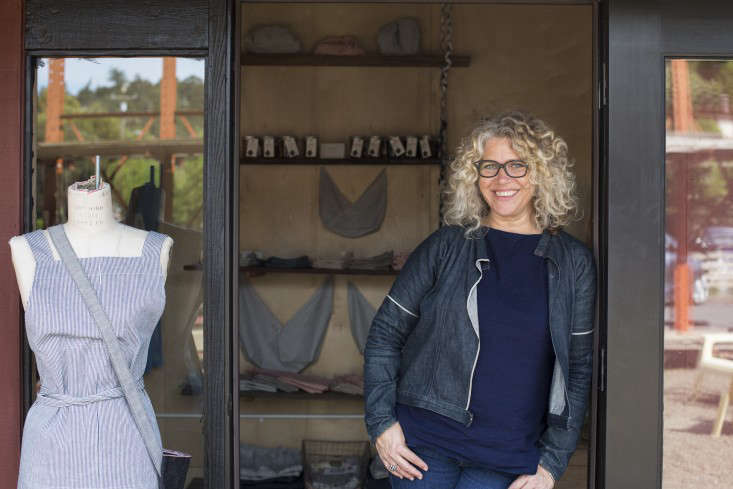
Long before reusable grocery bags became checkout-line accessories and “zero waste” turned into a social-media hashtag, Molly de Vries was already staring suspiciously at shampoo bottles, disposable packaging, and synthetic fabric. For the Mill Valley designer behind Ambatalia, sustainability was never primarily about buying a prettier version of something disposable. It was about questioning why the disposable thing needed to exist in the first place.
That distinction helps explain why de Vries became such an interesting figure in Northern California’s sustainable-design community. Her work brought together textiles, food, craftsmanship, local production, reuse, and an almost detective-like curiosity about garbage: Where did this material come from? How long will it last? What happens when we’re finished with it? And, perhaps most important, did we really need to throw something away after using it for twelve minutes?
Her story also feels particularly relevant today. The U.S. Environmental Protection Agency places reducing and reusing ahead of recycling in its waste-management hierarchy, while Mill Valley has adopted rules encouraging reusable foodware and reducing single-use items. In other words, ideas de Vries explored through cloth bags, furoshiki, bowl covers, aprons, and everyday habits now sound considerably less eccentric than they once did.
From a DIY Mill Valley Childhood to Sustainable Design
Q: Where did Molly de Vries’ environmental outlook begin?
De Vries grew up in Mill Valley in a large family surrounded by people who made, repaired, reused, and collected things. Her mother sewed, while her father carved wood and repurposed discarded materials. Family trips included treasure hunting at Marin-area flea markets, where a supposedly useless object could earn a second career if someone looked at it imaginatively enough.
That childhood environment mattered. Sustainability wasn’t presented as a solemn checklist of environmental commandments. It was simply practical life. Clothes could be sewn. Furniture could be found instead of purchased new. Materials could be transformed. An old object was not necessarily trash; it might merely be waiting for better management.
The result was an aesthetic based on usefulness rather than novelty. De Vries developed an appreciation for objects that were durable, handmade, adaptable, and visibly connected to the people who produced them. Those ideas would eventually become central to Ambatalia.
Q: Was she always a textile designer?
Not at all. De Vries spent roughly two decades working as a hairdresser. Even there, however, her interest in waste kept sneaking into the room like an environmentally conscious cat.
During the 1990s, she encouraged customers to bring back shampoo bottles so they could be refilled from bulk supplies. At a time when refill shops and package-free retail were far less familiar to American consumers, this was not exactly the easiest business idea to explain. Still, it revealed a pattern that would define her later work: instead of accepting packaging as inevitable, she tried to redesign the routine around it.
A turning point came around age 40, when de Vries began thinking more seriously about what she actually wanted to create. She has described exploring singing as part of that period of self-discovery. The important lesson was not becoming a professional singer. It was recognizing the satisfaction of pursuing something personally meaningful.
The Birth of Ambatalia
Q: How did Ambatalia begin?
In 2004, de Vries opened Ambatalia in Mill Valley as a fabric shop focused on environmental and cultural sustainability. Instead of treating cloth as anonymous yardage that magically appeared under fluorescent retail lighting, she paid attention to fibers, manufacturing, geography, labor, and durability.
The shop featured materials such as organic cotton, hemp, vintage textiles, wool, linen, and specialty fabrics. De Vries was particularly interested in fabric that had an understandable story: where the fiber came from, how it was produced, who worked with it, and whether the finished material could survive years of actual use.
In 2008, she closed the original retail shop and redirected Ambatalia toward designing reusable textile goods. That change turned out to be important. Instead of simply selling sustainable fabric, she could demonstrate what a less disposable household might actually look like.
Q: Why focus so heavily on kitchens and food?
A collaboration with chef and fellow Mill Valley figure Tyler Florence helped push Ambatalia further toward kitchen textiles. De Vries began developing products connected to shopping, carrying, storing, preparing, and serving food.
The kitchen was a logical laboratory. Walk through an ordinary grocery trip and disposable materials appear everywhere: produce bags, bread bags, plastic wrap, takeout containers, paper towels, coffee cups, utensils, napkins, and packaging wrapped around other packaging because apparently one layer wasn’t feeling secure enough.
Ambatalia approached that problem with fabric. Produce bags could be washable. Bread could travel in cloth. A bowl could be covered with textile instead of immediately reaching for plastic wrap. Napkins could return to being objects people washed rather than objects people threw away.
Furoshiki, Bowl Covers, and the Power of Multipurpose Design
Q: What made de Vries’ furoshiki-inspired textiles distinctive?
De Vries drew inspiration from the Japanese tradition of furoshiki, square cloths that can be folded and tied for carrying or wrapping objects. What fascinated her was not merely their appearance but their adaptability.
A thoughtfully designed piece of cloth could wrap groceries, carry a dish to a party, function as an apron, serve as a scarf, or replace disposable wrapping. One textile could therefore eliminate the need for several specialized objects.
That is sustainability by subtraction. Rather than designing five new “eco products” and asking consumers to buy the complete matching collection, multipurpose design asks whether one durable object can perform five jobs.
Q: What about Ambatalia’s cloth bowl covers?
The same philosophy appeared in cloth covers designed for bowls and food storage. They offered an alternative for situations in which people might otherwise automatically reach for plastic film or another disposable covering.
De Vries’ interest in food storage went beyond simply replacing plastic with prettier fabric. Different foods require different conditions. Some vegetables benefit from moisture; others prefer drier environments. Using washable textiles encouraged people to pay attention to food itself instead of assuming that everything belonged inside plastic.
That awareness also supports another environmental goal: reducing food waste. The most sustainable grocery item is not particularly sustainable if it spends ten days becoming an archaeological specimen in the back of the refrigerator.
A Store That Practiced What It Preached
Q: What was unusual about de Vries’ Mill Valley retail space?
At one stage, Ambatalia operated from a converted shipping container at the Mill Valley Lumber Yard. The space itself reflected de Vries’ preference for making use of what already existed.
Rather than attempting an extravagant retail transformation, she worked with the container’s basic structure. Reclaimed windows, simple plywood, existing flooring, and repurposed materials helped create a space whose personality came from resourcefulness instead of elaborate construction.
Even shelving could become an experiment in reuse, with textile scraps incorporated into functional displays. This was not sustainability hidden in a corporate mission statement. It was visible in the walls, furniture, products, and working methods.
Local Fiber, Local Labor, and the Fibershed Idea
Q: Why did local textile production matter to de Vries?
One of the recurring themes in de Vries’ work is that textiles connect people to agriculture, land, water, manufacturing, craft, and local economies. Cloth is not born folded neatly on a store shelf. Someone grows or produces the raw material, someone processes it, someone weaves or knits it, and someone turns it into a finished object.
Her involvement with the Northern California Fibershed movement reinforced that perspective. Fibershed applies a regional approach to clothing and textiles, exploring how natural fibers, farmers, mills, dyers, designers, and makers can form more transparent local systems.
For de Vries, this relationship between fiber and place helped make sustainability tangible. “Local” wasn’t limited to tomatoes and peaches. Wool, dyes, fabric, sewing skills, and manufacturing could also belong to a regional economy.
Q: Why favor natural fibers?
De Vries has long expressed a preference for materials such as linen, organic cotton, and wool while questioning heavy reliance on petroleum-based synthetic textiles.
Her approach was not simply nostalgic. Natural fibers fit her broader interest in understanding materials from their origins through their eventual disposal. Linen begins with flax. Wool begins with an animal and agricultural system. Cotton begins in a field. Those supply chains have environmental impacts of their own, of course, but they can be examined through farming methods, durability, processing, and local production.
The larger lesson is useful for any shopper: “eco-friendly” should not be treated as a magic adjective. Ask what something is made from, where it was made, how often it will be used, whether it can be repaired, and what will happen when it finally wears out.
The Nondisposable Life Is Not a Perfection Contest
Q: Was de Vries advocating literal zero waste?
One of the most appealing parts of de Vries’ philosophy is her resistance to perfectionism. She has acknowledged that real family life sometimes includes takeout packaging, commercially packaged snacks, and other compromises. Her message has consistently been closer to awareness and gradual change than environmental purity.
That makes her approach more useful than the fantasy of producing exactly one mason jar of garbage every decade while personally weaving your socks from locally negotiated alpaca hair.
The point is to notice waste and make better decisions where practical. Refuse the disposable water bottle. Carry utensils. Use cloth shopping bags. Avoid unnecessary packaging. Buy quantities of food you are likely to eat. Repair something before replacing it. Compost what can be composted according to local rules.
Tiny changes sound unimpressive individually. Repeated daily across years and thousands of households, they become systems.
Q: How does Mill Valley’s current sustainability policy fit the picture?
Mill Valley’s environmental policies now reflect many ideas associated with the broader reuse movement. The city’s Reusable Foodware Ordinance, adopted in 2023, requires reusable foodware for dine-in service at covered businesses, restricts automatic distribution of certain accessories, and establishes standards intended to reduce single-use waste.
California also requires widespread separation and collection of organic waste under SB 1383. Residents and businesses are increasingly expected to understand what belongs in recycling, compost, and landfill streams.
These policies should not be credited to one designer, but they demonstrate how dramatically the conversation has evolved. Habits that looked unconventional when de Vries was refilling shampoo bottles in the 1990s now sit comfortably beside municipal ordinances and statewide climate policy.
What Molly de Vries Teaches Us About Sustainable Living
Q: What is the biggest lesson from her work?
Probably this: sustainability becomes easier when useful objects are also pleasurable objects.
A scratchy reusable bag that lives permanently forgotten in a closet is theoretically virtuous but practically useless. A durable textile that feels good, looks beautiful, washes easily, performs several jobs, and becomes familiar over time has a much better chance of replacing disposable alternatives.
De Vries therefore occupies an interesting space between environmental activism and design. She does not merely tell people to consume less. Her work asks designers to create things people will actually want to keep.
This aligns neatly with the EPA’s emphasis on source reduction and reuse before recycling. Recycling matters, but preventing waste begins earlierat the moment an object is designed, purchased, used, or refused.
Experience Notes: Living with the Ideas Behind Ambatalia
To understand why de Vries’ philosophy has staying power, imagine applying it to an ordinary week rather than an idealized zero-waste makeover. The most revealing experiences are often surprisingly small.
Experience 1: The grocery-store test
Start with one shopping trip. Bring two cloth produce bags, a reusable tote, and perhaps a container for a bulk item if the store permits it. Immediately, shopping becomes more intentional. Instead of automatically pulling plastic bags from the roll, you begin asking whether an apple needs a bag at all. Spoiler: it has survived rain, sunshine, agricultural machinery, and transportation. It can probably handle the twelve-foot journey to your cart without protective custody.
The experience shows why reusable living is partly about attention. Once you notice one unnecessary package, you start noticing twenty.
Experience 2: The kitchen-towel experiment
Replace paper towels for routine jobs with a stack of washable cloths for one week. The transition feels awkward for about twelve minutes. Then the washable cloth becomes normal.
The important part is convenience. If reusable towels are buried upstairs behind the Christmas decorations, nobody will use them. Put them exactly where disposable products used to live. Sustainable design succeeds when the environmentally preferable action is also the easiest action.
Experience 3: Carrying your own utensils
A utensil roll is a wonderfully boring objectand that is a compliment. Keep one in a work bag or car. Suddenly, takeout meals do not automatically require another plastic fork or disposable chopsticks.
The environmental impact of refusing one fork is obviously tiny. The behavioral effect is larger. Carrying a reusable item turns waste prevention from an abstract belief into a routine. You stop waiting for restaurants, retailers, or governments to eliminate every disposable object before changing your own habits.
Experience 4: Learning to look at leftovers differently
A reusable kitchen is not merely a kitchen containing fashionable containers. It is a kitchen where food receives more attention.
Try dedicating one visible refrigerator shelf to ingredients that need to be eaten soon. Wrap suitable produce in washable cloth, use clear reusable containers for leftovers, and plan one weekly “use-it-up” meal. The meal may occasionally resemble an international peace conference between half a zucchini, leftover rice, three mushrooms, and a heroic amount of cheese. That’s fine.
The purpose is not culinary perfection. It is remembering that wasted food represents wasted money, farming inputs, transportation, refrigeration, packaging, and labor.
Experience 5: Buying one thing instead of three
The most Ambatalia-like experience may be choosing a multipurpose object. A generously sized cloth can serve as a table covering, bread wrapper, produce carrier, picnic napkin, gift wrap, or emergency scarf.
This is the opposite of modern product segmentation, in which consumers are encouraged to buy a separate device for every imaginable activity. Multipurpose objects reduce clutter as well as waste, and they often become more personally valuable because they accumulate stories through repeated use.
Experience 6: Accepting imperfect progress
Perhaps the most important experiment is deliberately refusing to turn sustainability into a competition.
You will forget a reusable mug. Someone in the household will bring home something wrapped in plastic. A busy evening will end with takeout. The recycling bin will occasionally contain an object that causes ten minutes of internet research followed by existential despair.
Keep going anyway.
This is where de Vries’ philosophy feels especially practical. Environmental responsibility becomes durable when it can survive ordinary life. A system requiring flawless behavior usually collapses as soon as somebody gets sick, works late, travels, has children, or simply has a terrible Tuesday.
A nondisposable life is better understood as a direction rather than a destination.
Conclusion: Why Mill Valley’s “Queen of Green” Still Matters
Molly de Vries’ story is not simply about reusable napkins, linen bags, or an ingenious piece of cloth that can transform itself into half the objects in a kitchen drawer. It is about learning to see materials differently.
Her Mill Valley upbringing taught her that old things could become useful things. Hairdressing made her notice packaging and chemical waste. Ambatalia allowed her to connect textiles with food, craft, agriculture, local manufacturing, and environmental responsibility. Her experiments with furoshiki, natural fibers, reusable kitchen goods, reclaimed materials, and locally connected production offered an alternative to throwaway culture that was practical rather than preachy.
The most useful takeaway is refreshingly manageable: do not wait until you can live perfectly. Start noticing. Keep the objects that work. Refuse disposable items when the alternative is easy. Choose materials carefully. Repair something. Carry a bag. Pack a fork. Eat the forgotten carrots.
Saving the planet may require enormous technological and political changes, but it can also involve one stubborn person looking at a plastic fork and thinking, “Seriously? We’re doing this again?”
Note: This article is an independently written synthesis based on documented interviews and profiles of Molly de Vries and Ambatalia, alongside U.S., California, Marin County, and Mill Valley guidance concerning waste reduction, reuse, recycling, composting, textiles, and reusable foodware. Key biographical and design details are supported by reporting from Remodelista, KQED, Fibershed, the San Francisco Chronicle, SFGATE, and other sustainability-focused sources, while current waste-policy context reflects government guidance from the EPA, CalRecycle, and the City of Mill Valley.











