
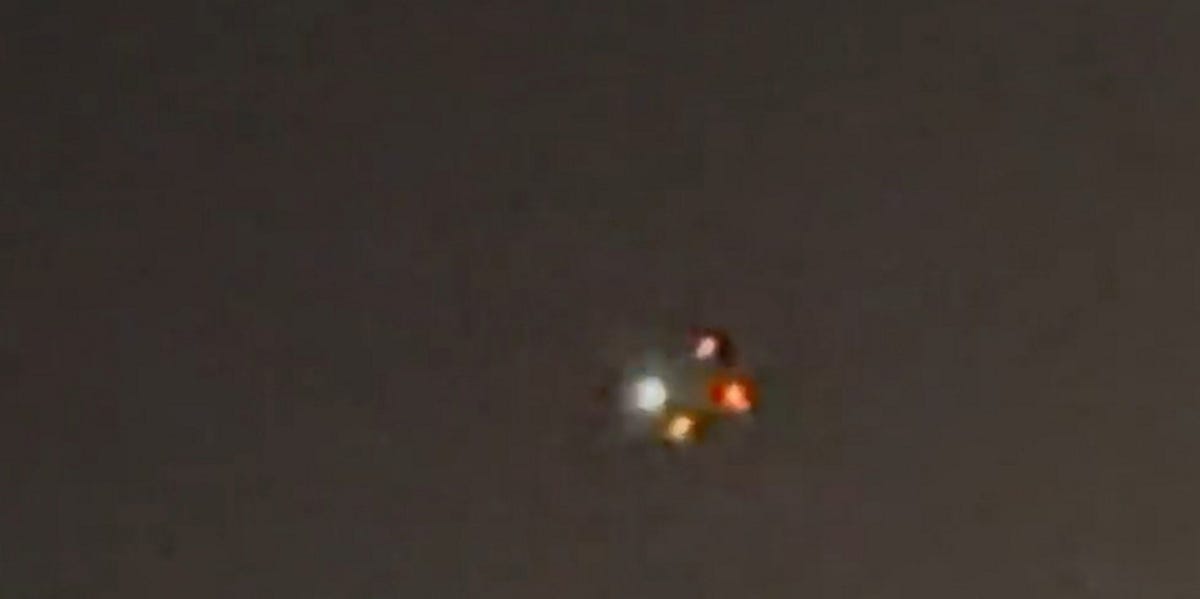
For several weeks in late 2024, New Jersey residents looked up and saw something unusualor at least something that appeared unusual. Bright occasionally seemed to travel in groups. Videos spread across social media, local officials demanded answers, and the phrase “New Jersey drone sightings” became a national obsession almost overnight.
The mystery initially centered on reports near the Raritan River, Picatinny Arsenal, residential communities, reservoirs, and other sensitive locations. Some witnesses described objects as being unusually large, while others reported repeated nighttime activity. The FBI eventually received more than 5,000 tips, although only about 100 generated investigative leads.
After reviewing videos, flight data, electronic detection results, and witness reports, federal agencies concluded that the sightings did not appear to come from one enormous, coordinated fleet. Instead, investigators described a mixture of lawful drones, airplanes, helicopters, law-enforcement aircraft, stars, and inaccurate visual estimates.
That answer was less cinematic than an alien invasion or an offshore drone mothership, but reality often refuses to hire a special-effects department. Here are nine evidence-based explanations that may account for the drone sightings over New Jersey.
What Investigators Actually Established
The sightings began drawing widespread attention in November 2024. By early December, the FBI’s Newark field office, the New Jersey State Police, and the New Jersey Office of Homeland Security and Preparedness were asking the public to submit photos, videos, and other information.
Federal investigators deployed trained observers and advanced detection equipment. The Department of Homeland Security, FBI, Federal Aviation Administration, and Department of Defense later reported that they had not identified widespread anomalous activity or evidence of a national-security threat over civilian areas.
That does not mean every report was imaginary. Officials acknowledged that people were seeing real objects, including real drones. The important distinction is that thousands of reports did not necessarily describe the same type of object, the same operator, or the same mission.
9 Possible Explanations for the New Jersey Drone Sightings
1. Commercial Airplanes Mistaken for Drones
One of the simplest explanations is also one of the most strongly supported: many supposed drones were ordinary airplanes operating along established flight paths.
New Jersey sits beneath some of the busiest airspace in the United States. Newark Liberty International Airport, John F. Kennedy International Airport, LaGuardia Airport, Philadelphia International Airport, and numerous regional airports generate a steady parade of aircraft. Depending on their direction, commercial planes can appear to hover when they are traveling toward an observer.
At night, an approaching airplane may look like a nearly motionless cluster of lights. Its landing lights can be visible from many miles away, while its navigation lights may appear to blink or change position as the aircraft turns. Without a clear reference point, judging its altitude, distance, and size becomes extremely difficult.
This can turn a perfectly ordinary passenger jet into what looks like a refrigerator-sized drone floating above the neighborhood. The jet has not stopped moving; the observer simply has very little sideways motion to use as a visual clue.
2. Helicopters and Small Manned Aircraft
Not every conventional aircraft in the sky is a commercial airliner. News helicopters, medical helicopters, police aircraft, private planes, military aircraft, and flight-school airplanes also operate throughout the region.
Helicopters are especially easy to confuse with large drones because they can hover, fly slowly, change direction quickly, and operate at relatively low altitudes. From a distance, their engine or rotor noise may be difficult to hear, particularly near highways, neighborhoods, or windy areas.
Small fixed-wing planes can create similar confusion. A plane circling an airport, surveying an area, or practicing flight maneuvers may repeatedly pass over the same location. To someone who is already watching for mysterious drones, repeated passes can look like coordinated surveillance.
Several official reviews of submitted images found that objects labeled as drones displayed lighting patterns or flight behavior consistent with manned aircraft. In at least one widely discussed example outside New Jersey, an object reported as a drone was recognizable as an airliner once observers examined it more carefully.
3. Recreational Drones Flown by Hobbyists
Some of the objects almost certainly were dronesjust not sinister ones.
Consumer drones are now common. They are used for photography, racing, real-estate videos, social-media content, and the timeless human activity of purchasing an expensive gadget and immediately testing how high it can fly.
Recreational drone flights are legal in many locations when pilots follow FAA rules. Depending on the aircraft and operation, those rules can include registration, Remote ID compliance, altitude limits, visual-line-of-sight requirements, airspace authorization, and restrictions near airports or sensitive facilities.
Night flights are also permitted when required safety conditions are met. That means seeing a lighted drone after sunset is not, by itself, evidence of criminal activity.
With hundreds of thousands of registered recreational drones in the country, even a small percentage flying on a clear evening can generate numerous reports. Once the public began actively searching the sky, routine hobby flights became much more noticeable.
4. Commercial and Industrial Drone Operations
Drones are no longer merely flying cameras for vacation videos. Companies use them for mapping, construction surveys, roof inspections, infrastructure monitoring, agriculture, filmmaking, real-estate marketing, and utility maintenance.
A commercial drone may be larger than a typical consumer model and carry specialized cameras, thermal sensors, or mapping equipment. Some industrial aircraft can remain airborne longer, produce unfamiliar sounds, or follow repeated grid-like routes.
Those patterns can appear suspicious when the purpose of the flight is not visible from the ground. A drone inspecting power lines, for example, might move slowly along the same corridor on several evenings. A mapping operation might fly straight, parallel routes that resemble coordinated surveillance.
Commercial operators generally must comply with FAA regulations, but nearby residents are not automatically notified whenever a lawful flight occurs. As a result, an ordinary infrastructure inspection can look remarkably mysterious from a backyard.
5. Law-Enforcement and Public-Safety Drones
Police departments, fire departments, emergency-management agencies, and search-and-rescue teams increasingly use drones. These aircraft can help locate missing people, document accident scenes, assess fires, monitor hazardous situations, or give responders a view of an area before sending personnel into danger.
Federal investigators specifically identified law-enforcement drones as part of the mixture observed during the Northeast sighting wave.
This explanation also introduces a wonderfully confusing feedback loop. Authorities may launch a drone to investigate a reported drone. A resident then sees the investigative drone, records it, and submits a second report. Investigators may subsequently receive a tip about their own equipment.
Public-safety operations are not always announced in real time, particularly when they involve an active incident. Therefore, a law-enforcement drone may appear unidentified even though its operator is authorized and its mission is legitimate.
6. FAA-Authorized Research or Testing Flights
In January 2025, the White House said that drones flown over New Jersey in large numbers had included flights authorized by the FAA for research and other purposes. The statement also said many additional drones were operated by recreational or private pilots.
This announcement offered an explanation for at least part of the activity, although it did not publicly match every sighting to a specific research program, operator, aircraft, or location. It should therefore be treated as one piece of the puzzle rather than a serial-number-level explanation for every video shared online.
Research flights can test navigation systems, detection equipment, air-traffic-management technology, sensors, autonomous operations, or methods for safely integrating drones into crowded airspace. Such flights may involve multiple aircraft or repeated routes.
To an observer without access to the flight plan, a carefully controlled test can look coordinated because it is coordinatedjust not for the reasons circulating in online conspiracy theories.
7. Copycat Flights Inspired by the News
Public attention can create additional drone activity. Once the New Jersey sightings became national news, hobbyists and curious drone owners had a powerful reason to take their own aircraft outside.
Some may have wanted to search for the mysterious objects. Others may have flown simply because drones were suddenly the hottest topic in town. A few may have enjoyed the possibility that their aircraft would be filmed and discussed online.
This creates another self-reinforcing cycle. Reports encourage people to launch drones. Those drones produce new reports, which encourage more people to watch the sky or launch additional aircraft.
Copycat behavior does not require a coordinated organization. It can emerge naturally from thousands of individuals reacting to the same viral story. The result may look like a sudden increase in mysterious activity even when the original sightings had several unrelated causes.
8. Stars, Planets, and Visual Misinterpretations
Federal officials also found that some reported drones were stars. That may sound embarrassing until you spend several minutes watching a bright object through a shaky phone camera.
A bright star or planet near the horizon can appear to flash, change color, or move slightly because of atmospheric turbulence, camera movement, digital zoom, and the observer’s own motion. Thin clouds can make the light brighten and fade. Tree branches moving in the foreground can create an illusion that the object itself is traveling.
Phone cameras make the problem worse. Digital zoom enlarges pixels rather than revealing crisp detail, autofocus struggles against a dark background, and image stabilization can cause a point of light to jump around the frame. The final video may show a pulsating blob that looks much stranger than the original object.
Stars are not the only possibilities. Planets, satellites, meteors, distant towers, and aircraft viewed through clouds can all produce unusual nighttime visuals. The sky has always contained confusing lights; social media merely gave them a group chat.
9. A Limited Number of Unauthorized or Still-Unresolved Flights
A broad conventional explanation does not mean every single report was solved. Federal officials acknowledged a limited number of drone sightings near military facilities and restricted areas. Unauthorized drone incursions around sensitive sites were a real concern before the New Jersey story and remain one today.
Some operators may violate altitude limits, fly beyond visual line of sight, enter restricted airspace, disable required identification systems, or operate too close to airports. Others may simply misunderstand the rules.
It is also possible that a small number of reports involved drones whose operators and purposes were never publicly identified. “Unresolved,” however, does not automatically mean foreign espionage, secret weapons, or extraterrestrial visitors. It means investigators did not have enough verified information to reach a specific conclusion.
The most reasonable overall explanation is therefore not that every witness was wrong. It is that real drones, unauthorized flights, lawful aircraft, celestial objects, and honest mistakes were blended into one enormous public mystery.
What the Evidence Did Not Support
No Verified Iranian “Mothership”
One highly publicized theory claimed that Iran had positioned a ship off the East Coast and was launching drones toward New Jersey. The Pentagon directly rejected the claim, saying there was no Iranian vessel off the coast launching drones at the United States.
No publicly presented radar data, imagery, intelligence report, or recovered aircraft supported the mothership theory. It attracted attention because it offered a dramatic and simple villain, not because investigators produced evidence for it.
No Confirmed Widespread Foreign Operation
Federal agencies reported no evidence that the overall New Jersey activity had a foreign nexus. Defense officials also said the information available to them did not indicate that the observed flights were being controlled by a foreign country.
That conclusion does not suggest that unauthorized drones can never create security risks. It means that the specific evidence reviewed during the New Jersey investigation did not establish a coordinated foreign campaign.
No Evidence of an Alien Invasion
Extraterrestrial theories appeared almost immediately, as they tend to do whenever lights, darkness, and an unreliable zoom function meet. No official investigation produced evidence connecting the sightings to nonhuman technology.
An unidentified light is simply unidentified until better evidence becomes available. It is not automatically a spacecraft from another solar system that thoughtfully installed FAA-style blinking lights before arrival.
Why the New Jersey Drone Mystery Grew So Quickly
The controversy was fueled by several factors happening at once. Initial reports included descriptions of large objects and activity near sensitive locations. Officials could not immediately identify every sighting, while different agencies released statements at different times and with different levels of detail.
Residents understandably wanted a direct explanation. Statements saying there was no known threat did not answer the question many people were actually asking: “What, specifically, am I looking at?”
Social media filled that information gap. Videos stripped of location, direction, time, flight-tracking data, and camera settings circulated widely. Each new clip was interpreted through the existing mystery, even when it showed an ordinary plane or star.
The episode demonstrates the difference between uncertainty and danger. Officials can be uncertain about an individual light while still having strong evidence that there is no coordinated hostile operation. Unfortunately, “probably several ordinary things” is not the sort of headline that causes the internet to calmly close its laptop.
Experiences Related to the New Jersey Drone Sightings
The Experience of Watching the Sky
For many New Jersey residents, the most memorable part of the episode was not a government statement or radar report. It was the simple experience of stepping outside at night and looking upward with unusual concentration.
A light that would normally receive two seconds of attention suddenly became a fifteen-minute investigation. Neighbors gathered in driveways, compared phone videos, checked flight-tracking applications, and debated whether an object was moving. Families who had barely noticed the region’s air traffic began counting blinking lights.
This change in attention mattered. Once people expected to see drones, every ambiguous object became a candidate. A plane that had followed the same route for years could suddenly appear unfamiliar. A hovering light might become a giant aircraft until someone opened a tracking app and discovered a jet approaching Newark.
The experience was not foolish. It showed how rarely most people study the night sky and how difficult aerial observation can be without instruments. Distance is hard to estimate, sounds may arrive late or disappear in background noise, and a bright light offers few clues about an object’s shape.
The Experience of Local Officials and Police
Local police departments faced a different challenge. They had to take residents seriously while recognizing that officers on the ground often lacked the equipment or legal authority needed to identify, track, or interfere with drones.
A report might arrive after the object had disappeared. A video might show only a few bright pixels. Even when officers saw something themselves, visual observation alone could not reveal the operator, flight authorization, altitude, or purpose.
Officials also had to communicate uncertainty without sounding dismissive. Telling worried residents that an investigation had found no threat was reassuring to some people but frustrating to others. Many residents interpreted the absence of a detailed explanation as evidence that information was being hidden.
The episode exposed a genuine policy problem: state and local agencies do not always have access to the detection technology, identification data, or counter-drone authority that communities assume they possess. The public often expects the nearest police department to identify any aircraft instantly. In practice, airspace regulation and drone mitigation are heavily controlled at the federal level.
The Experience of Sorting Evidence From Viral Claims
Online communities became enormous crowdsourced investigation rooms. Some users compared navigation lights, mapped flight routes, checked astronomical charts, and identified conventional aircraft. Others enlarged blurry images until compression artifacts resembled windows, wings, engines, or occasionally an entire interstellar civilization.
The most useful reports included exact times, locations, viewing directions, uninterrupted video, and nearby landmarks. The least useful clips were heavily zoomed, repeatedly edited, and posted without context. Unfortunately, the second category was often more entertaining and therefore traveled farther.
The experience offered a practical lesson in evaluating unusual sightings. A compelling video is not automatically strong evidence. Investigators need metadata, multiple viewing angles, electronic detection, radar information, Remote ID data, and comparisons with known air traffic.
The Experience of Living With an Unfinished Answer
Perhaps the most frustrating part of the New Jersey drone story was that no single explanation neatly accounted for every report. People prefer mysteries with one cause and one final reveal. This episode instead produced a layered answer: many airplanes, some helicopters, numerous lawful drones, authorized activity, stars, copycat flights, possible violations, and a limited number of unresolved observations.
That conclusion can feel emotionally unsatisfying, but it is common in large investigations built from thousands of eyewitness reports. The reports were collected from different locations, on different nights, under different weather conditions, using different cameras. There was no scientific reason to assume they all described one phenomenon.
The experience also demonstrated why public communication matters. When authorities provide only reassurance, speculation can become more persuasive than official information. Clear explanations of how sightings are evaluatedalong with examples of identified planes, drones, and starscan help people understand the evidence rather than merely asking them to trust the conclusion.
Conclusion
The New Jersey drone sightings were probably not one mystery with one answer. They were a collision of busy airspace, rapidly expanding drone use, lawful research and commercial activity, public-safety operations, copycat behavior, optical confusion, unauthorized flights, and intense social-media attention.
Some residents undoubtedly saw real drones. Others recorded airplanes, helicopters, stars, or objects that could not be identified from the available evidence. Investigators found no support for a broad foreign operation or immediate public-safety threat, although limited unauthorized activity near sensitive locations remained a legitimate concern.
The best explanation is therefore a mixed one. New Jersey did not suddenly become the parking lot for a single mysterious aerial fleet. Instead, thousands of people began watching one of America’s busiest skies at the same timeand discovered that the sky is much harder to interpret than it looks.
Note: Never shoot at a suspected drone or point a laser toward any object in the sky. The object may be a manned aircraft, and both actions can cause a deadly accident and serious criminal consequences. Record the time, location, direction, and appearance of a concerning flight, then report it to the appropriate aviation or law-enforcement authority.











