
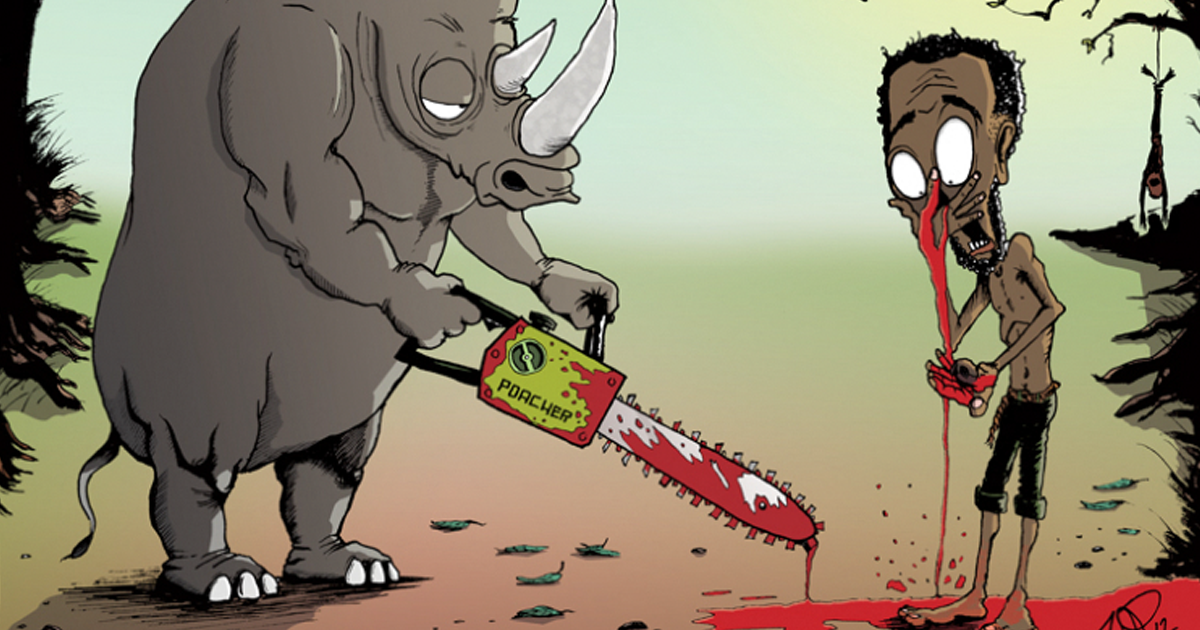
A fox wears a human coat. A laboratory animal holds the clipboard. A fish leans over a boat while a terrified person dangles from a hook. In this unsettling collection ofed, and suddenly the excuses humans make about animal suffering sound much less comfortable.
A Parallel Universe With No Comfortable Distance
The illustrations work through a brutally simple idea: switch the species, keep the treatment. Animals become farmers, hunters, scientists, consumers, entertainers, and pet owners. Humans become livestock, trophies, test subjects, accessories, meals, and creatures confined for somebody else’s convenience. The scenes are exaggerated, satirical, and sometimes graphic, but their purpose is not subtle. They ask viewers to stop observing animal cruelty from a safe emotional distance and imagine what vulnerability feels like from the other side.
Research basis: is empathy by ambush. One moment you are scrolling; the next, a chicken is discussing the tenderness of a human drumstick. Dark? Absolutely. Effective? Also absolutely. The images do what a thousand stern pamphlets often cannot: they make the moral problem impossible to file under “somebody else’s issue.”
What the 53 Animal Rights Illustrations Are Really Saying
Farm Animals Are Individuals, Not Inventory
Several role-reversal scenes target industrial farming, where bodies can be treated as units of production. In the imaginary parallel universe, humans are packed into pens, separated from their young, milked, fattened, or graded for quality. The shock comes from recognizing how quickly ordinary agricultural language becomes horrifying when the subject has a human face.
The emotional point is not that a pig thinks exactly like a person. It does not need a mortgage, a favorite sitcom, or an opinion about office coffee. The relevant fact is that pigs are social, inquisitive animals capable of learning, problem-solving, communication, and strong bonds. Humane Society materials describe pigs maintaining close family relationships and learning tasks that include controlling a joystick with the snout. Turning the pig into a product label erases all of that complexity with remarkable efficiency.
Research basis: ashion Looks Different When the Wearer Changes
Fur, leather, feathers, and exotic skins become especially disturbing in the reversed images. An animal proudly wearing a human-skin coat is absurd enough to be grotesque, yet that grotesqueness is the point. The illustration asks why elegance should depend on mentally separating material from origin. Once the material is visually restored to a body, the glamour has a difficult time keeping a straight face.
Entertainment Is Not Automatically Enrichment
Other illustrations turn zoos, circuses, marine shows, races, and rides inside out. Humans perform tricks while animal spectators laugh, photograph them, or complain that the show is not exciting enough. These scenes distinguish entertainment for the audience from well-being for the performer. An activity can look cheerful from the seats while producing fear, frustration, isolation, or exhaustion backstage.
Laboratory Role Reversal Removes the Euphemisms
Scientific language is designed for precision, but it can also make distress sound emotionally distant. In the illustrations, animals restrain humans, administer chemicals, observe reactions, and record results. Suddenly words such as “procedure,” “endpoint,” and “specimen” regain the physical reality they can conceal.
Hunting and Fishing Become Personal
A mounted human head over an animal’s fireplace makes trophy hunting look less like tradition and more like domination with home décor. A person gasping on a hook makes recreational fishing feel less peaceful. Fish do not scream in a register humans recognize, which has made it easy to treat silence as evidence of insensitivity. Yet reviews of fish sentience research report evidence involving stress, fear, anxiety, and pain across many species, while also acknowledging continuing debate about how subjective experience should be measured.
Research basis: ompanion Animals Communicate Distress
Animal body language offers clues about fear and anxiety. The ASPCA lists signs such as trembling, pacing, panting, salivating, dilated pupils, rigid posture, flattened ears, and defensive behavior as possible indicators of distress in dogs and cats. Reading those signals is not mystical pet telepathy; it is basic observation combined with knowledge of species, context, and individual history.
Research basis: n>
Do Animals Actually Feel What These Illustrations Suggest?
Cross-species affective neuroscience has identified deeply rooted emotional systems in mammalian brains, while broader reviews describe emotions as functional states that help organisms respond to threats, rewards, social opportunities, and changing environments. Researchers also warn against sloppy inference. A tail movement, vocalization, or facial expression cannot be interpreted correctly without species-specific evidence and context.
Research basis: e scientific direction, however, is increasingly difficult to dismiss. The 2024 New York Declaration on Animal Consciousness states that there is strong scientific support for conscious experience in mammals and birds, plus a realistic possibility of conscious experience in all vertebrates and many invertebrates. A Cornell report on a large interdisciplinary survey likewise found broad agreement among animal behavior researchers that many nonhuman animals experience emotions.
Research basis: mpathy, Attachment, and Social Reward
Rats have repeatedly freed trapped companions in experiments, even when chocolate was available as an alternative reward. Follow-up work found that anxiety reduction could suppress this helping behavior, supporting the interpretation that emotional arousal plays a role. Apparently, rats can face the eternal moral dilemma of “save a friend or eat dessert,” which is more ethical drama than many television finales manage.
Research basis: gs provide another familiar example. Awake-brain-imaging research at Emory has found reward-related responses to familiar human scents and, in some dogs, stronger responses to praise than to food. This does not prove that dogs write invisible love poetry about their guardians, but it does show that social connection can carry measurable reward value.
Research basis: rief and Responses to Death
Scientists and field observers have documented death-related behavior in elephants, primates, cetaceans, birds, and other species. Individuals may remain near a body, touch it repeatedly, alter routines, vocalize, or show prolonged behavioral changes after a companion dies. Researchers debate how much animals understand about death, but the growing evidence makes it harder to dismiss every response as meaningless instinct.
Research basis: eelings Beyond Fur and Feathers
Evidence is also expanding beyond the animals humans find easiest to relate to. In one study, octopuses avoided places associated with injury and preferred places where they had experienced pain relief, behavior interpreted as evidence consistent with affective pain. This matters because an octopus looks so unlike us that empathy cannot rely on a familiar face. Eight arms, no eyebrows, still potentially having a terrible day.
Research basis: n>
Is Role-Reversal Art Just Anthropomorphism?
Yes, deliberately. The illustrations give animals human posture, clothing, tools, and motives. But anthropomorphism is not automatically a factual error; it is a storytelling method. The danger appears when people assume an animal’s inner life is identical to a human’s. A frightened horse is not necessarily composing a tragic monologue. A relaxed cat is not necessarily forgiving our species for inventing vacuum cleaners.
The opposite error is anthropodenial: refusing to recognize meaningful similarities simply because acknowledging them would be inconvenient. Humans and other animals share evolutionary histories, biological systems, social needs, and mechanisms for responding to reward and threat. Good interpretation sits between sentimental projection and emotional blindness.
That balance makes the artwork useful. It does not function as a scientific diagram. It functions as a moral simulation. By placing a human body where an animal body normally appears, it forces the viewer to notice power, confinement, dependency, and fear before habit has time to dull the reaction.
Why Shocking Animal Illustrations Stay in the Mind
Humor helps, though it is often uncomfortable humor. Satire lowers the door just enough for the message to enter. You laugh at the absurdity of a rabbit shopping for lucky human feet, then realize the joke has quietly handcuffed you to a moral question. That delayed impact is one reason illustrated advocacy travels so effectively across social media.
Still, shock has limits. Graphic content can motivate some viewers and make others disengage. The most responsible use of disturbing art includes context, content warnings, accurate claims, and practical next steps. Otherwise, outrage becomes emotional fireworks: bright, loud, and over before anyone changes a habit.
What Viewers Can Do After the Shock Wears Off
Make Consumption More Deliberate
Learn how food, clothing, cosmetics, and household products are produced. Reduce purchases connected to practices you cannot support. Some people begin with one meat-free day, choose higher-welfare options, buy fewer animal-derived fashion items, or select companies with transparent testing policies. The specific path can vary; the useful habit is refusing to let convenience do all the ethical thinking.
Choose Animal Encounters Carefully
Before visiting a wildlife attraction, ask whether animals are forced to perform, handled constantly, bred for tourist contact, or denied normal social and environmental needs. Genuine sanctuaries generally prioritize rescue and lifetime care rather than selfies, tricks, rides, or convenient baby-animal availability.
Become Better at Reading Animals
For companion animals, learn species-specific body language, provide enrichment, maintain veterinary care, and respect signals asking for distance. For wildlife, admiration is often best expressed by not approaching, feeding, chasing, or rearranging the animal for a photograph. Nature does not need every visitor to become its unpaid creative director.
Experiences That Make the Illustrations Feel Real
Some ideas become understandable only after they move from theory into experience. Consider a first visit to an animal shelter. The building may be clean, the staff kind, and the dogs well cared for, yet the sound can be overwhelming. One dog spins in circles. Another presses against the kennel door. A third remains silent at the back, watching every movement. None of those reactions provides a perfect translation of emotion, but together they make confinement impossible to romanticize. The reversed illustrations suddenly stop looking exaggerated. They begin to look like emotional shorthand.
A farm sanctuary can create a different kind of surprise. People often expect rescued pigs, cows, chickens, or goats to behave like generic background animals from a children’s book. Instead, individuals emerge quickly. One pig investigates every pocket. One cow seeks scratching in the same spot. One goat treats a wheelbarrow as a personal climbing challenge and a legally binding invitation to chaos. Their preferences are funny, but the humor has a serious consequence: personality makes the category “livestock” feel incomplete.
Wildlife rehabilitation offers another perspective. An injured bird may struggle fiercely during treatment, then become still only when exhausted. The goal is not to make the animal grateful or friendly; it is to restore independence. That experience can correct a common human bias. Compassion is not measured by how affectionate an animal becomes toward us. Sometimes the kindest outcome is an animal that wants nothing to do with people and flies away without a backward glance.
At a responsible aquarium, watching an octopus solve a feeding puzzle can produce yet another mental shift. Its arms explore separately, suckers taste and touch, and the body changes color and texture. The animal is captivating precisely because its intelligence does not look human. That encounter makes the moral imagination stretch. Concern should not depend on whether another being has soft fur, expressive eyebrows, or excellent public-relations instincts.
Even ordinary life supplies smaller lessons. A dog may hesitate at a doorway after one frightening event. A cat may hide when a carrier appears because it predicts a veterinary visit. Backyard birds may change their alarm calls when a predator arrives. Horses may become distressed when separated from familiar companions. These patterns show memory, expectation, and social context operating in everyday behavior. They also remind us that animals experience environments we control but cannot explain to them.
The most powerful experience may be noticing how quickly language changes perception. Call a pig “pork,” a fish “sport,” a fox “fur,” or a mouse “pest,” and the individual disappears behind a human purpose. Reverse the labels and the discomfort returns. That is the lasting achievement of these 53 shocking illustrations: they make the hidden subject visible again. After seeing the world through that parallel universe, it becomes harder to claim that the real one is morally neutral.
Conclusion: The Images Ask for More Than a Reaction
“53 Shocking Illustrations Reveal How Animals Feel” is not powerful because every drawing proves a scientific claim. It is powerful because the collection turns an ethical abstraction into a visual encounter. By switching animals with humans, the artists expose the imbalance beneath farming, fashion, experimentation, entertainment, hunting, neglect, and habitat destruction.
Science cannot provide a perfect subtitle track for every animal mind. It can, however, show that many animals respond to pain, reward, loss, companionship, fear, and relief in complex, meaningful ways. Once that evidence is combined with the imaginative force of role-reversal art, the question changes. Instead of asking whether animals feel exactly as humans do, we begin asking how much uncertainty is enough to justify greater care.
The answer does not require guilt as a permanent lifestyle. It requires attention, better choices, and the humility to recognize that humans are not the only creatures for whom life can go well or badly. The illustrations are shocking, but the real shock is how ordinary many of the original situations have become.












