
Note: This article is written as body-only HTML for easy web publishing. It is an original synthesis in standard American English and does not include source links.
Some headlines whisper. This one kicks the door open, points at the sky, and says, “Do you see this?” Because when people talk about “50 pics” that sum up what is happening in Australia, they are not really talking about photography alone. They are talking about evidence. Evidence of a country where fire seasons keep getting nastier, floodwaters keep showing up like unwanted houseguests, marine heat keeps bleaching one of the most famous reefs on Earth, and ordinary people keep getting asked to be far more resilient than anyone should have to be.
Australia has always been a land of extremes. Droughts, flooding rains, scorching summers, and dangerous bushfires are not new there. What feels different now is the scale, frequency, and exhausting rhythm of it all. One disaster barely has time to leave the group chat before the next one shows up. A sky goes orange. Then black. Then a river jumps the curb. Then the ocean gets too warm and turns living coral bone-white. The result is a visual record that feels less like a weather album and more like a warning label for the future.
This is what those 50 pictures really capture: not just chaos, but a pattern. Not just shocking moments, but a system under pressure. And not just Australia’s pain, but a very modern form of climate anxiety playing out in real time, with ash on the windshield and mud on the kitchen floor.
Why These Photos Hit So Hard
The power of disaster images is that they make abstraction disappear. “Climate trend” sounds distant. A kangaroo framed by smoke, a family standing in floodwater, or coral that looks like it has been drained of color by some cruel cosmic filter does not. Photos collapse the distance between statistics and lived reality.
That is why images from Australia spread so quickly. They are cinematic, yes, but not in a fun popcorn-movie way. They look unreal because reality has become increasingly intense. Streets vanish under brown water. Fire fronts turn the horizon into a furnace. Smoke clouds travel so far they affect air quality far beyond the burn zone. Beaches and reefs that once sold the dream of paradise begin to look fragile, stressed, and exhausted. In picture after picture, the message is the same: this is not a one-off bad day. This is a country being repeatedly stress-tested.
The Fire Photos: Australia’s Most Famous Alarm Bell
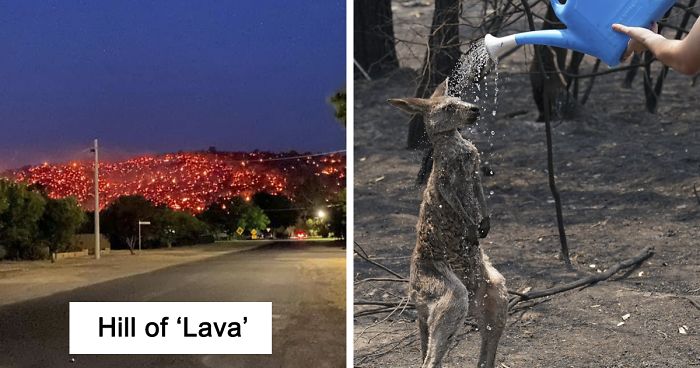
If you had to choose the category that defines Australia’s recent “hell on Earth” reputation, it would be bushfire imagery. Entire hills glowing at night. Red noon skies. Firefighters dwarfed by walls of flame. Cars packed for evacuation. Charred fence lines stretching into the distance like someone drew them with a burnt match.
The Black Summer fires of 2019 and 2020 became a global symbol for a reason. They were not just severe. They were historically shocking in their intensity, scale, and ecological damage. Since then, the country has continued to face dangerous fire conditions, especially when heat, dryness, and wind line up like the worst possible band reunion. More recent fire outbreaks in places like Victoria have reminded everyone that the danger did not end when the first wave of headlines faded.
And fire photos are never just about fire. They are about everything fire touches. Homes. Roads. Schools. Farms. Parks. Wildlife corridors. Mental health. Insurance bills. Local economies. When a bushfire burns through a region, it does not politely limit itself to the scenic parts.
What the Fire Images Reveal
They reveal how quickly normal life can become evacuation life. A backyard turns into a hazard zone. A holiday town becomes an emergency map. A national park becomes a battlefield. And because the Australian landscape is so visually dramatic to begin with, the contrast is brutal. Blue-sky beauty becomes orange dread in a matter of hours.
Those photos also reveal something less flashy but just as important: preparedness is no longer optional. In many communities, “fire season” increasingly means air-quality alerts, go-bags, emergency apps, backup plans, and a permanent low buzz of “What if it turns our way?” That is not just weather awareness. That is lifestyle adaptation.
The Smoke Photos: The Disaster That Sneaks Into Your Lungs
Flames get the attention, but smoke is the uninvited guest that overstays, spreads widely, and makes everything worse. Pictures of smoke-choked cities can look oddly beautiful from a distance, all amber light and moody haze. Up close, they are a story about sore throats, asthma flare-ups, anxious parents, canceled sports, and air that no longer feels safe to breathe.
Smoke images matter because they show that bushfires are not only a problem for people standing next to the flames. They are a regional health issue. They are also a wildlife issue. Animals that survive the front edge of a fire still face heat stress, habitat loss, food shortages, and smoke exposure afterward. In other words, survival is not the same thing as recovery.
There is a special kind of emotional whiplash in seeing iconic skylines or quiet coastal towns look like the set of an apocalypse movie. The brain says, “That cannot be normal.” The lungs say, “Correct.”
The Flood Photos: When the Country Swings From Burning to Drowning
Australia’s climate drama does not stop at fire. One of the most unsettling things about the country’s recent run of disasters is how often the story flips. After drought and flame come torrents of rain, swollen rivers, flash flooding, and neighborhoods coated in sludge. If the fire photos are all heat and panic, the flood photos are exhaustion made visible.
You see couches on curbs. Boats where cars should be. People carrying ruined photo albums, moldy drywall, and whatever dignity is left after spending days shoveling mud out of a house. Flood pictures are less flashy than infernos, but they may be even more demoralizing. Fire destroys fast. Floods often destroy slowly, thoroughly, and with a depressing amount of cleanup.
That swing from drought to deluge is part of what makes Australia’s recent imagery so emotionally intense. The country can look like a giant oven one month and a giant bathtub the next. Communities do not just rebuild once. They brace, absorb, rebuild, and then do the whole miserable sequel.
Why Flood Images Feel Different
Flood photos often show the long middle of disaster rather than the explosive beginning. They capture what happens after the sirens, when people are sorting through soaked mattresses, warped floors, dead appliances, and insurance paperwork that somehow feels heavier than the waterlogged furniture.
They also expose a cruel truth: when extreme events stack up, resilience starts sounding less like a virtue and more like a job description nobody applied for.
The Reef Photos: Paradise, But Under Stress
Then there are the Great Barrier Reef images, and these may be the most haunting of all because they are quiet. No flames. No collapsing roofs. Just coral turning pale under marine heat stress, as if color itself has decided to evacuate.
Bleaching photos disturb people because they do not look violent in the usual way. But they document a major ecological crisis. Coral bleaching happens when stressed corals expel the algae that help feed them and give them their vivid color. When the ocean stays too warm for too long, reefs can bleach, weaken, and die. That affects biodiversity, fisheries, tourism, shoreline protection, and the broader identity of a place that has long been sold to the world as a natural wonder.
And the images have kept coming. Bleaching events have struck the Great Barrier Reef multiple times in recent years, with scientists and authorities warning that repeated heat stress is making recovery harder. A reef can bounce back from damage if it gets enough time. The problem is that the planet is increasingly bad at giving ecosystems a breather.
The Visual Tragedy of Bleaching
Dead coral does not roar. It fades. That makes the pictures strangely eerie. Reefs that should look exuberant and alive can look ghostly, brittle, and tired. It is environmental loss in pastel tones, which is somehow worse because the destruction arrives wearing a deceptively quiet face.
The Wildlife Photos: The Images Nobody Forgets
If Australia’s disasters have a face, sometimes it has fur. Or feathers. Or paws. Images of koalas, kangaroos, wallabies, birds, and other animals caught in the path of fires or struggling in damaged habitats have become some of the most shared pictures of all. And for good reason: wildlife photos cut through politics, jargon, and policy debate in about two seconds flat.
People can argue online for days about emissions targets. Show them a burned habitat and a thirsty animal seeking shelter, and suddenly the conversation gets very quiet.
What makes these photos so devastating is that they show a crisis hitting creatures that did not build the system causing it. Australia’s biodiversity is one of its greatest treasures, but it is also vulnerable when fires burn hotter, drought stretches longer, floods rip through river systems, and smoke blankets huge areas. Some species lose habitat at a pace that recovery cannot easily match.
And here is the uncomfortable truth: wildlife rescue photos are inspiring, but they are not a happy ending. They are emergency response. The real win would be fewer emergency rescues needed in the first place.
What These 50 Pics Actually Add Up To
Put all 50 pictures together and they tell a bigger story than “Australia had a rough week.” They show a nation where climate-linked extremes increasingly overlap with existing natural volatility. Fire is worsened by heat and dryness. Floods follow scorched ground that cannot absorb water well. Warmer oceans stress coral. Smoke damages health. Ecological loss affects tourism, farming, insurance, and daily life.
In other words, the pictures are not separate episodes. They are connected chapters.
That is why the title feels so intense. “Hell on Earth” is dramatic, sure, but it captures the mood of seeing one brutal image after another from the same country: glowing skies, ash-covered beaches, submerged streets, white coral, blackened forest, displaced wildlife, tired residents. It feels like Earth is trying out every terrible setting on the same map.
Australia Is Not Just a Victim. It Is Also a Warning
One reason these photos resonate globally is that Australia is often viewed as a preview. It is wealthy, modern, highly urbanized, deeply tied to the natural environment, and already living through climate extremes that other regions increasingly recognize. What happens there does not stay there, at least not as a lesson.
The images also challenge a comforting myth: that developed countries can simply engineer their way out of climate risk. Better forecasting, better emergency response, and smarter land management absolutely matter. Indigenous fire knowledge and controlled burning also deserve far more serious attention in policy conversations. But none of that changes the basic fact that when the climate system loads the dice, the disasters get meaner.
That is the real takeaway from these 50 pictures. Not just that Australia is suffering. It is that no amount of modern infrastructure looks especially magical when the atmosphere, oceans, and landscapes are all under stress at the same time.
The Human Experience Behind the Camera
The most powerful thing about these images may be what they cannot fully show. A photo catches the moment a family stands ankle-deep in water, but not the smell of mud that lingers for weeks. A picture captures a firefighter under an orange sky, but not the fatigue of going home, checking the app, and wondering whether tomorrow will be worse. A drone shot can show miles of burned forest, but not the strange silence that follows after birdsong disappears.
And yet those lived experiences are exactly what make the pictures matter. Behind every viral image is a person breathing that air, cleaning that house, evacuating that road, or grieving that loss. The camera freezes the frame. Life keeps going inside it.
500 More Words on the Experience of Living Through It
To understand why this topic grips people so strongly, you have to imagine the experience of living inside the scenes those 50 pictures capture. Not scrolling them. Living them.
Start with a fire day. You wake up and the light feels wrong. Not cloudy, not stormy, just wrong. The sun looks weak and bruised. The air tastes faintly metallic, like the world has been left too close to a toaster. You refresh emergency apps before breakfast. You move important documents into one folder. You check on older relatives. You keep one eye on the sky and the other on your phone. Every gust of wind suddenly feels personal.
By afternoon, the smoke is thicker. Outdoor plans are canceled. Kids stay inside. People who work outside keep going because bills do not care about air quality. The radio voice sounds calm in that way professionals do when everyone else is spiraling. Maybe the fire is still miles away. Maybe that means nothing. In places that have lived this before, distance is not always comfort. Distance is sometimes just the beginning of a sentence nobody wants to finish.
Now switch scenes. Flood season. The rain starts, then keeps starting. People who have seen bad weather before begin using a different tone. Streets go glossy, then brown, then impassable. The river is no longer scenic. It is a threat with a postcode. You move things to higher shelves. Then higher again. There comes a moment in many flood stories when people realize they are no longer protecting possessions. They are deciding what they can bear to lose.
After the water recedes, the labor begins. Not glamorous labor. Not cinematic labor. Wet carpet labor. Mold labor. Shovel labor. Pile-everything-on-the-curb labor. The kind that makes whole neighborhoods look like they are moving out at once. People bring gloves, bleach, casseroles, generators, and sympathy. It helps. It also does not erase the fact that rebuilding a life is harder than rebuilding a wall.
Then there is the reef experience, which is quieter but no less heartbreaking. Divers, tour operators, marine scientists, and coastal communities know the pain of revisiting a place they love and seeing the signs of heat stress written directly into it. Healthy reefs feel electric. Bleached reefs feel like someone turned the music off. The grief is different from fire or flood grief. It is not about a single dramatic day. It is about repeated loss, measured in seasons, surveys, and the fading confidence that nature will recover before the next hit comes.
And across all these experiences is a peculiar exhaustion: the exhaustion of adaptation without closure. People are asked to be practical, brave, informed, neighborly, and endlessly resilient. Many are. But resilience has a cost. It takes time, money, health, patience, and emotional bandwidth. Eventually, even strong communities start to feel like they are training for a marathon that keeps moving the finish line.
That is why these 50 pictures land so hard. They are not just dramatic images from far away. They are visual proof of what it feels like when a country keeps cycling through heat, fire, flood, smoke, and ecological stress. Australia still dazzles. It still has beauty, humor, grit, and extraordinary communities. But the camera has caught something else, too: a place on the front line, living through extremes that increasingly look like a preview of a hotter, harsher century.
Conclusion
So yes, “50 Pics That Sum Up The Hell On Earth That Is Taking Place In Australia” is a dramatic title. But the images behind it earn that drama. They show a country where nature’s beauty and nature’s fury now share the same frame more often than anyone would like. Fire, flood, smoke, reef bleaching, and wildlife loss are not random visual shocks. They are signs of a changing risk landscape.
If there is one hopeful thing buried inside all this devastation, it is that pictures can still move people. They can cut through numbness. They can make distant suffering feel immediate. And sometimes, they can do what reports and charts struggle to do: make it impossible to look away.












