
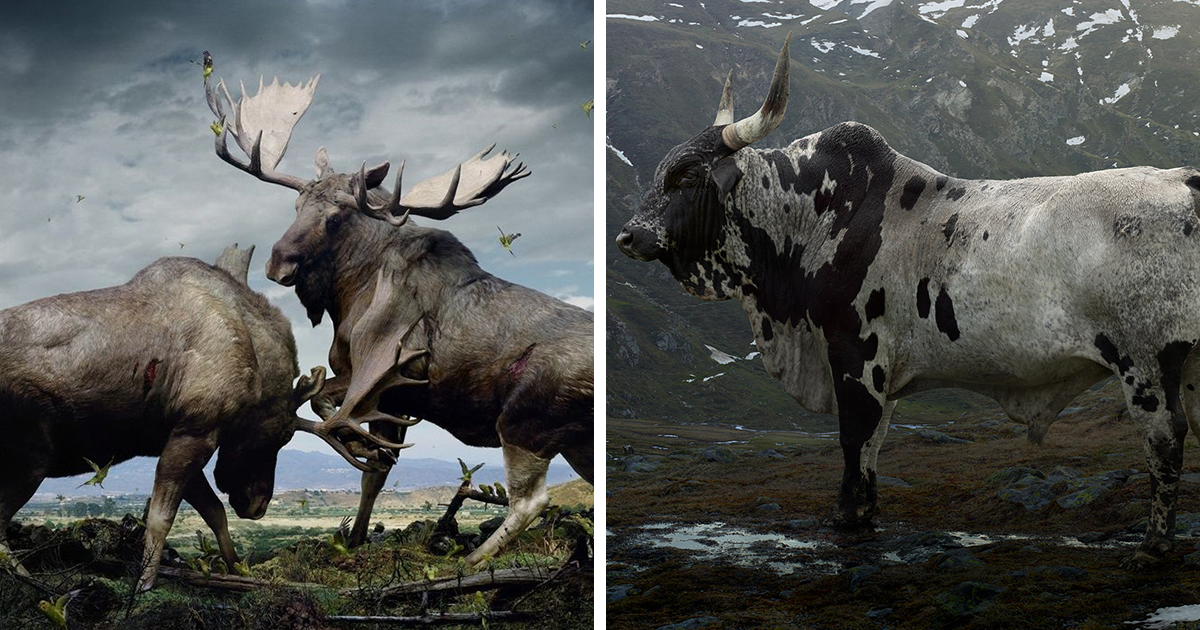
Some animal photographs make you say, “Aww.” Simen Johan’s animal images make you say, “Aww… wait, why do I suddenly feel like that llama knows my browser history?” That deliciously strange reaction is exactly what makes his work so memorable. In the world of contemporary photography, Johan has carved out a rare territory where wildlife, fantasy, digital manipulation, sculpture, environmental anxiety, and fairy-tale unease all wander through the same misty forest.
The title “37 Surreal And Magical Animal Images By Simen Johan” points to the kind of visual journey that has made Johan’s ongoing body of work, especially Until the Kingdom Comes, so captivating. His animals do not simply pose. They appear to perform, mourn, disguise themselves, dream, judge, and occasionally look like they are seconds away from delivering a philosophical TED Talk in the woods.
Born in Kirkenes, Norway, raised in Sweden, and based in New York City since the early 1990s, Simen Johan is a contemporary artist, photographer, and sculptor known for bending reality until it becomes both beautiful and unsettling. His animal images often look like documentary photographs at first glance. Look longer, though, and the world begins to wobble. A zebra stands in foliage that does not quite belong. Birds gather in landscapes that feel apocalyptic. Monkeys, foxes, owls, snakes, giraffes, and llamas inhabit scenes that are too polished to be accidental and too emotionally charged to be mere wildlife pictures.
Who Is Simen Johan?
Simen Johan first drew attention in the 1990s by combining traditional darkroom methods with early digital manipulation. Long before everyone had editing apps in their pockets and called themselves “visual storytellers” after adding a moody filter to brunch, Johan was already exploring how photography could become a constructed psychological space.
His early work often focused on eerie human figures and staged imagery. Later, he shifted toward the natural world, but he brought the same fascination with ambiguity, illusion, and emotional tension. In Until the Kingdom Comes, Johan’s best-known animal-centered series, the viewer enters a world that feels familiar enough to believe and strange enough to distrust.
That tension is the engine of his art. Johan does not ask, “Is this real or fake?” in a simple before-and-after Photoshop way. He asks something more interesting: Why do we trust images at all? Why does nature feel authentic to us, even though animals camouflage, mimic, deceive, adapt, and perform constantly? And why do humans keep imagining the animal kingdom as either innocent paradise or savage nightmare, when it is obviously bothand sometimes wearing better eyeliner than we are?
The Magic Behind Until the Kingdom Comes
Until the Kingdom Comes is not wildlife photography in the traditional sense. Johan photographs animals, landscapes, natural textures, and environmental details in different places, then combines them into carefully built compositions. The final result may include live animals, captive animals, taxidermied subjects, studio elements, and landscapes photographed elsewhere. The magic is not only in the editing; it is in the way every detail seems emotionally necessary.
These works often appear hyperreal. Fur, feathers, scales, fog, mud, branches, snow, and light are rendered with such detail that the viewer’s eye accepts the scene before the brain starts filing complaints. That split second of belief is important. Johan’s images do not scream “digital art.” They whisper, “Maybe the world has always been this odd and you simply forgot to look carefully.”
The title itself suggests longing. “Until the kingdom comes” can sound biblical, fairy-tale-like, or apocalyptic. In Johan’s hands, it becomes a meditation on the human desire for resolution. We want nature to reveal a clear meaning. We want beauty to stay beautiful and danger to carry a warning label. Johan’s animals refuse to cooperate. They exist in a visual kingdom where innocence and menace share the same address.
Why These Animal Images Feel So Surreal
1. The Animals Look Both Real and Impossible
One reason Simen Johan’s surreal animal photography works so well is that the animals are not cartoonish fantasy creatures. They are recognizable: zebras, foxes, owls, monkeys, flamingos, snakes, giraffes, birds, llamas, and other creatures we know from zoos, documentaries, nature books, or childhood picture encyclopedias. The weirdness comes from context.
A flock of birds might appear in a setting that feels too theatrical. A fox may seem to weep. Owls may look almost comically expressive. Flamingos can resemble dancers caught mid-performance. Johan takes the familiar animal body and places it in a psychological landscape. Suddenly, a creature you thought you understood becomes a riddle with whiskers.
2. The Landscapes Are Beautiful, But Not Comforting
Johan’s environments often contain lush forests, pale snow, volcanic darkness, strange skies, barren land, or tangled vegetation. These settings are not neutral backdrops. They behave like characters. Sometimes they cradle the animals; sometimes they swallow them. In several images, the landscape feels damaged or unstable, hinting at climate change, habitat loss, and human disturbance without turning the work into a lecture with antlers.
This is one of Johan’s great strengths. His art can be environmentally suggestive without becoming preachy. You feel the unease before you can explain it. The image does not say, “Please read this policy report.” It says, “Look at this magnificent creature standing in a world that may or may not be falling apart.” Somehow, that is more difficult to ignore.
3. Digital Manipulation Is Used Like a Paintbrush
In less skilled hands, digital manipulation can feel like a magic trick performed by someone who keeps asking if you noticed the rabbit. Johan’s editing is quieter and more painterly. He uses digital tools to create atmosphere, composition, and symbolic friction. His images are constructed, but they do not feel lazy or gimmicky. They feel composed the way a painting is composed, with every gesture controlled.
That is why his work often appeals to people beyond the photography world. Fans of surrealism, cinematic art, fantasy illustration, environmental art, and contemporary sculpture can all find something to admire. The images are not just clever edits; they are full visual ecosystems.
37 Images, One Strange Kingdom
A collection of 37 surreal and magical animal images by Simen Johan is best experienced slowly. This is not the kind of gallery you scroll through while half-watching a sitcom and eating cereal directly from the box. Each image asks for attention. The more time you give it, the more it misbehaves.
In one kind of Johan image, an animal appears regal and isolated, like a monarch of a kingdom nobody else can enter. In another, groups of animals create strange social dramas: birds swarm, snakes tangle, mammals stare, and creatures gather in poses that feel staged but emotionally true. Some scenes lean toward dark fairy tale. Others feel like natural-history museum displays that have quietly become sentient after closing time.
The number 37 also matters in the context of online viewing. A large visual set allows patterns to emerge. You begin to notice Johan’s recurring interests: camouflage, misplacement, emotional projection, environmental fragility, animal dignity, and the human habit of turning nature into metaphor. The images may differ in species and setting, but they speak the same dream-language.
The Emotional Power of Johan’s Animal Portraits
What makes Johan’s animal images truly magical is not simply that they are surreal. Plenty of images are surreal. Some are surreal because the artist had a deadline and discovered the clone stamp tool at midnight. Johan’s images endure because they carry emotional intelligence.
Many of the animals seem to possess inner lives. Of course, that is partly our projection. Humans are experts at projecting emotion onto animals. We see a dog blink slowly and decide he understands mortgage anxiety. Johan uses that tendency with precision. His animals appear melancholy, sly, noble, confused, radiant, or spiritually exhausted. The viewer knows these emotions may be manufactured by pose, lighting, and contextbut the feeling still lands.
This creates a fascinating mirror effect. We look at the animal and think we are interpreting it. In reality, we are often revealing ourselves. A fox that looks sorrowful may be less about fox sorrow than human sorrow. A llama standing proudly in an exaggerated pastoral scene may be less about llamas than our desire to see nature as pure, noble, and slightly better dressed than modern civilization.
Beauty and Brutality in the Same Frame
One of the most important themes in Johan’s work is contradiction. His images can be charming and ominous at the same time. A scene may be visually gorgeous while suggesting decay, predation, or environmental ruin. This is where the work becomes deeper than “cool animal edits.” Johan understands that nature is not a greeting card. It is beautiful, violent, comic, fragile, and indifferent. Sometimes all before lunch.
The animals in his photographs do not exist as cute decorations. They appear as beings caught in systemsecological, symbolic, and emotional. The viewer senses that something larger is happening outside the frame. Perhaps the animals are adapting. Perhaps they are trapped. Perhaps they are performing for us. Perhaps we are the ones trapped, staring into an image that refuses to explain itself.
How Simen Johan Changes the Way We See Wildlife Photography
Traditional wildlife photography often values patience, timing, and access to the natural world. Simen Johan respects the visual language of wildlife photography but shifts it into another register. He is less interested in documenting a single untouched moment and more interested in constructing a scene that reveals psychological truth.
This does not make the work less connected to nature. In fact, it may make the connection more honest for the digital age. Most people today encounter animals through screens, edited documentaries, zoo enclosures, museum displays, viral clips, and conservation campaigns. Our relationship with wildlife is already mediated. Johan makes that mediation visible. He shows us an animal kingdom filtered through imagination, technology, memory, anxiety, and desire.
That is why these images feel so current. In a time when artificial intelligence, photo editing, and synthetic media are reshaping visual culture, Johan’s work reminds us that photography has never been a simple window. It has always involved selection, framing, timing, and belief. His images do not destroy trust in photography; they make trust more interesting.
Examples of Themes Viewers Notice in Johan’s Images
Camouflage and Disguise
Many Johan images play with animals blending into or clashing with their surroundings. A zebra’s stripes may echo nearby foliage. Spots, feathers, branches, and shadows create visual confusion. Camouflage becomes both biological strategy and artistic metaphor. Nature hides in plain sight, and so does meaning.
Childlike Wonder With a Dark Edge
Some images could almost belong in a children’s storybookuntil you realize the storybook might have been written by someone who found a portal in a swamp. The sweetness is real, but so is the danger. This balance gives Johan’s work its fairy-tale charge.
Environmental Unease
Without shouting, Johan’s animal scenes often suggest damaged habitats, unnatural displacement, or a world out of balance. The animals may look majestic, but their surroundings can feel unstable. The result is a quiet ecological tension that lingers after viewing.
The Human Face of Animals
Johan’s creatures frequently seem to carry human emotion. This does not mean they are humanized in a cartoonish way. Instead, the images reveal how quickly viewers assign personality, motive, and mood to nonhuman beings. The animal becomes a screen for human feeling.
Why These Images Are Perfect for Art Lovers and Casual Viewers
You do not need an art-history degree to enjoy Simen Johan’s work. You only need curiosity and a willingness to be mildly haunted. His images function on several levels. At first, they are visually stunning. Then they become strange. Then they become philosophical. Then, if you are like many viewers, you start wondering whether every pigeon in your neighborhood has been part of an elaborate symbolic performance all along.
For art lovers, Johan’s work offers rich connections to surrealism, constructed photography, cinematic composition, and environmental art. For casual viewers, it offers immediate visual pleasure. That combination is rare. The images are accessible without being shallow and sophisticated without requiring a decoder ring.
Experience: What It Feels Like to Spend Time With Simen Johan’s Animal Kingdom
Looking through a series like 37 Surreal And Magical Animal Images By Simen Johan feels less like browsing a gallery and more like entering a dream where the animals arrived early and already know the rules. The first reaction is usually admiration. The images are polished, detailed, and cinematic. You notice the soft light on fur, the texture of feathers, the drama of a dark landscape, or the perfect stillness of an animal staring back at you. It is easy to be pulled in by beauty alone.
Then the second reaction arrives: suspicion. Something is off. A habitat feels geographically impossible. A pose looks too theatrical. A creature seems too emotionally readable. The scene may be natural, but it behaves like a stage. This is the moment Johan’s work becomes addictive. You stop consuming the image and start investigating it. Your eyes move across the frame like tiny detectives wearing hiking boots.
The third reaction is emotional. The animals begin to feel less like subjects and more like presences. A bird is not just a bird; it is a messenger. A fox is not just a fox; it is a mood wearing fur. A group of animals becomes a community, a warning, a joke, or a ritual. The images invite interpretation without forcing a single meaning. That openness is part of their magic. You can come to them for visual pleasure and leave with questions about ecology, mortality, illusion, and why an owl can look more emotionally stable than most people in a Monday meeting.
For viewers who love photography, Johan’s work is a reminder that technical skill matters, but imagination matters just as much. The images are not impressive only because they are carefully edited. They are impressive because the editing serves a deeper atmosphere. Every manipulation has a purpose. Nothing feels thrown in just to say, “Look what software can do.” Instead, the technology disappears into the mood of the image.
For viewers who love animals, the experience can be surprisingly complex. Johan’s animals are beautiful, but they are not reduced to cuteness. They seem autonomous and mysterious. They do not beg for affection. They confront the viewer. In a world where animal images are often used for quick entertainment, memes, branding, or emotional comfort, Johan gives animals back some of their strangeness. He reminds us that other species are not simply accessories in the human story.
Spending time with these images can also change the way you look at ordinary animals afterward. A pigeon on a sidewalk may suddenly seem more dramatic. A dog in a patch of sunlight may appear staged by an invisible art director. A squirrel pausing on a fence may look like it is guarding an ancient woodland secret, even if it is probably just deciding whether your trash can is worth the effort. That shift in perception is valuable. Great art does not only show us a different world; it makes our own world harder to ignore.
Ultimately, the experience of Johan’s animal kingdom is one of wonder mixed with unease. The images are magical, but not escapist. They are surreal, but not random. They suggest that nature is not a simple place outside human life. It is a mirror, a mystery, a wound, a theater, and a kingdom we keep tryingand failingto fully understand.
Conclusion
37 Surreal And Magical Animal Images By Simen Johan is more than a catchy title for a beautiful gallery. It is an invitation to enter a world where animals become symbols, landscapes become emotional weather, and photography becomes a bridge between reality and dream. Johan’s work stands out because it refuses easy categories. It is wildlife imagery, but not documentary. It is digital art, but not gimmicky. It is beautiful, but not merely decorative. It is strange, but never empty.
Simen Johan reminds us that the animal kingdom has always been magical, not because it is cute or comforting, but because it remains partly unknowable. His images give that mystery a visual form: precise, haunting, humorous, elegant, and just unsettling enough to make you look twice. And then, of course, a third timebecause that llama still knows something.
Note: This article is an original, rewritten synthesis based on publicly available information about Simen Johan’s biography, exhibitions, artistic statements, and critical discussion of Until the Kingdom Comes. No source links are included in the article body as requested.













