
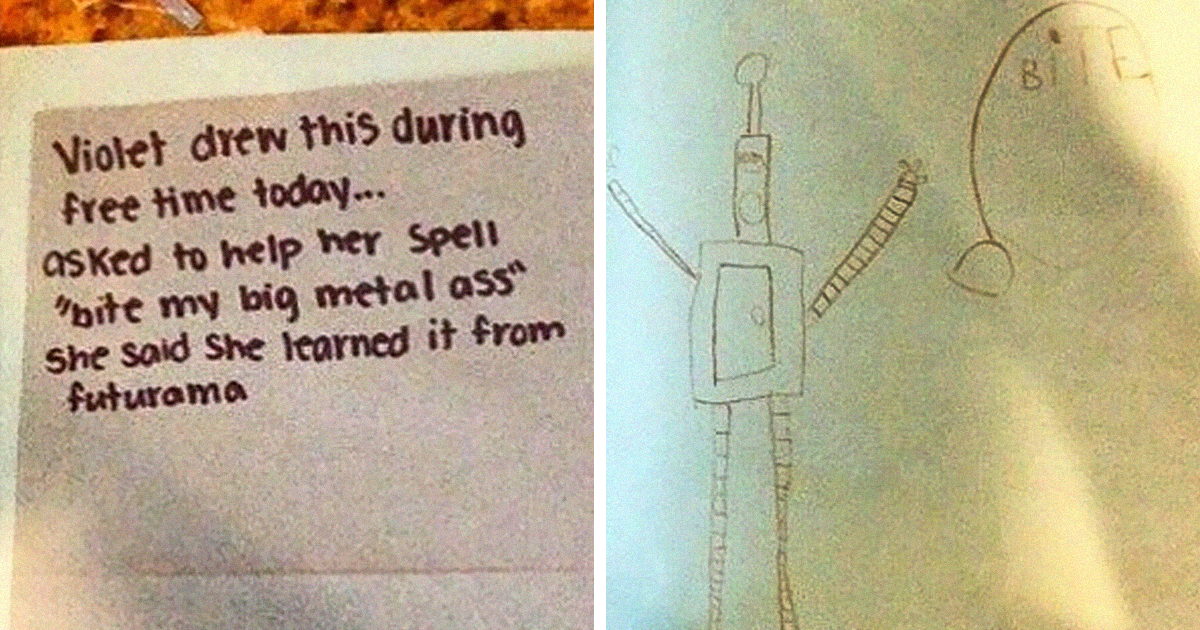
There are few parenting experiences more suspenseful than watching your child pull a folded note from a backpack and say, “My teacher tost teacher-parent communication is useful, professional, and genuinely intended to help students. Occasionally, however, a note arrives with the emotional subtlety of a fire alarm. It may be strangely specific, unintentionally judgmental, dramatically vague, or so funny that the parent has to read it twice before deciding whether to laugh, apologize, or contact a tiny attorney.
The examples below are original composite recreations inspired by recurring stories, public school-note collections, and common communication mishaps. They are not presented as verbatim messages from identifiable teachers or students. Still, any parent who has opened a school folder knows that the general energy is painfully believable.
When a Teacher’s Note Sounds Like Breaking News
1. The Good News and the Extremely Specific Bad News
“Good news: Mason has stopped eating crayons. Bad news: he is now trading them for snacks.”
This note raises more questions than it answers. When did the crayon-eating phase begin? How stable is the new classroom economy? Most importantly, what is the exchange rate between a blue crayon and a package of fruit snacks?
2. The Five-Year-Old Acting Principal
“Please remind Olivia that she is not authorized to dismiss other students early.”
Olivia apparently reviewed the school’s leadership structure and found it inefficient. One can admire the initiative while also explaining that possession of a clipboard does not automatically grant administrative authority.
3. The Child With an Elaborate Secret Life
“Your son told the class that he is 42, owns a boat, and is currently going through a difficult divorce.”
Some children invent imaginary friends. Others create entire middle-aged identities complete with property, emotional baggage, and marina fees. The note is awkward, but the commitment to character is impressive.
4. The Drawing That Requires Context
“Emma drew a detailed picture of me being chased by wolves. She says it is not personal.”
Children’s artwork can reveal creativity, strong observation skills, and occasionally a plot that would make a school counselor sit up very straight. Before anyone panics, it helps to ask what happened in the story. The wolves may simply be late for reading circle.
5. The Classroom Currency Crisis
“Noah has created a financial system based on erasers. Several students now owe him interest.”
Noah did not disrupt math class; he launched a lightly regulated lending industry. The teacher probably expected students to practice subtraction, not experience their first debt restructuring.
6. The Mildly Terrifying Fun Fact
“Ava announced that she knows where I live. She does not know where I live. I would like to keep it that way.”
Children often repeat mysterious fragments of adult conversations without understanding why everyone suddenly looks uncomfortable. Ava may have meant that her teacher lives “near a store.” Unfortunately, she delivered the information like the final scene of a thriller.
When Students Turn Schoolwork Into Performance Art
7. The Student Who Discovered the Word “Technically”
“Ethan used the word ‘technically’ 17 times during a ten-minute math discussion.”
Technically, that is fewer than two uses per minute. Technically, he may have had valid objections. Technically, the teacher is probably one more technicality away from requesting a transfer.
8. The Correction Nobody Wanted
“Your daughter corrected my spelling in front of the class. Unfortunately, she was correct.”
This is a difficult note to write because the teacher must report the behavior while quietly carrying the burden of defeat. The parent now has to discuss respectful communication with a child who is already preparing evidence for an appeal.
9. The One-Sentence Masterpiece
“Liam’s entire personal narrative was: ‘Long story short, the dog did it.’ Your family does not appear to own a dog.”
Liam understands two important literary concepts: brevity and plausible deniability. Unfortunately, his fictional suspect cannot be interviewed, and the assignment required three paragraphs.
10. The Book Report About Cafeteria Pizza
“Sofia’s book report contains one sentence about the novel and four paragraphs reviewing today’s pizza.”
She may not have analyzed the protagonist’s motivation, but she thoroughly investigated crust texture, sauce distribution, and what she described as “a suspicious amount of cheese.” Somewhere, a restaurant critic has been born.
11. Homework as an Unwanted Subscription
“Benjamin referred to homework as ‘a subscription service I never signed up for.’”
Benjamin has discovered the language of consumer complaints. His next move will probably involve requesting a refund, canceling automatic renewal, and leaving a one-star review for long division.
12. The War Against Lowercase Letters
“Mia refuses to use lowercase letters because, according to her, ‘important people do not whisper.’”
That is not how capitalization works, but it is a magnificent defense. Every worksheet now looks as though Mia is delivering an urgent announcement from the roof of city hall.
Food, Glue, and Other Classroom Emergencies
13. The Boiled-Egg Marketplace
“Please consider sending a different snack. The boiled eggs have become a valuable trading item and are affecting classroom negotiations.”
Apparently, lunch is no longer lunch. It is a commodities exchange. One student wants crackers, another wants chocolate, and someone in the back is attempting to corner the egg market before recess.
14. The Unlicensed Yogurt Doctor
“Your child told classmates that yogurt is medicine and attempted to prescribe it for several conditions.”
Parents should probably clarify that strawberry yogurt cannot treat headaches, broken pencils, or disappointment over losing at kickball. On the positive side, the child’s bedside manner was reportedly excellent.
15. The Glue-Stick Beauty Tutorial
“Today, Harper demonstrated how to use a glue stick as lip balm. We have reviewed the difference.”
Every classroom contains at least one student willing to conduct product testing without consulting the label. The teacher’s restrained wording suggests an exhausting day involving water, tissues, and several deep breaths.
16. The Mysterious Pocket Spaghetti
“We found cooked spaghetti in Caleb’s coat pocket. He has declined to explain.”
Some mysteries do not require solutions. They require a washing machine. Still, the silence is unsettling. Was the pasta saved for later, transported for scientific purposes, or simply placed there because pockets exist?
17. The Emergency Cupcake Policy
“Ella told the class that her family celebrates every Wednesday with cupcakes. Several students now expect invitations.”
Ella has accidentally created a weekly holiday and placed her parents in charge of catering. By Thursday, other children may be asking why their own families have neglected this important national tradition.
18. The Child Who Weaponized a Juice Box
“During lunch, Lucas discovered that stepping on a juice box produces a surprisingly long spray.”
The wording is calm. The event was almost certainly not. Somewhere between “discovered” and “spray,” a teacher watched a quiet lunch period transform into a sticky physics demonstration.
Classroom Chaos With Unforgettable Details
19. The Recess Union Organizer
“Amelia encouraged students to refuse classroom work until recess was extended.”
Amelia may need a reminder about following directions. She may also have a future in collective bargaining. Her classmates reportedly supported the proposal until they learned that refusing work would delay recess even further.
20. The Student Who Became a Cat
“For most of the afternoon, Henry would answer questions only by meowing.”
This is difficult behavior to address because every follow-up question receives the same response. Was Henry tired? Overstimulated? Committed to the role? Nobody knows. The cat is not talking.
21. The Extremely Honest Show-and-Tell
“Grace brought your electricity bill for show-and-tell and explained that it made Daddy ‘speak in capital letters.’”
Children are talented investigative reporters with no concern for privacy. They will happily tell 24 classmates what their parents said, wore, burned for dinner, or attempted to hide behind the refrigerator.
22. The Imaginary Field Trip
“Jackson told several students that tomorrow’s field trip is to a water park. It is actually to the public library.”
The teacher now has to manage a room full of disappointed children carrying towels. Jackson, meanwhile, may be wondering why nobody appreciates his contribution to school spirit.
23. The Desk With a Doorbell
“Samuel attached a homemade doorbell to his desk and asks visitors to ring before speaking to him.”
Boundaries are healthy. Wiring classroom furniture without permission is less ideal. Samuel has transformed his desk into private property and may soon begin charging rent.
24. The Unauthorized Weather Report
“Chloe announced a tornado warning during quiet reading. There was no tornado.”
Chloe may have noticed strong wind, a dark cloud, or one dramatic leaf. Unfortunately, her confident delivery triggered the kind of reaction normally reserved for actual emergencies and surprise birthday cake.
When the Adults Also Need a Communication Reset
25. The Vaguest Note in Educational History
“We need to discuss your child’s choices.”
Which choices? At what time? On which planet? A message this vague does not prepare a parent for collaboration. It prepares a parent to imagine everything from unauthorized talking to the theft of a school bus.
26. The Personality Review
“Your child has a very unusual personality.”
That sentence is not useful feedback. It is the opening line of either a mystery novel or an uncomfortable family reunion. Effective school communication should describe observable behavior, not assign a dramatic label to a developing human being.
27. The Note Written at Peak Frustration
“Please tell your son that I am not amused.”
The parent cannot solve a problem without knowing what happened. Perhaps the student made a disruptive joke. Perhaps the teacher had a difficult day. Either way, irritation is understandable, but it should not be the entire message.
28. The Accidental Parenting Critique
“Perhaps you could teach her how to behave appropriately.”
Nothing turns a potential partnership into a defensive standoff faster than suggesting that a child’s mistake proves parental failure. Parents and teachers see students in different settings; comparing those observations is far more productive than assigning blame.
29. The Message With No Path Forward
“Daniel continues to be disruptive. Please handle this.”
A parent needs details: What does “disruptive” mean? When does it happen? What occurs immediately before it? What strategies have helped? “Please handle this” transfers responsibility without offering the information needed to handle anything.
30. The Compliment That Somehow Became an Insult
“Your daughter is very intelligent when she decides to use it.”
The teacher may have intended encouragement, but the wording implies laziness or deliberate failure. A better message would identify the student’s strength, explain the current challenge, and suggest one realistic next step.
Why Cringy Teacher Notes Go Wrong
Most awkward school messages are not written by villains. They are written by busy people, often between lessons, meetings, grading sessions, and attempts to locate the cap for a missing marker. Teachers may be responsible for dozens or even hundreds of students. Parents may read messages while working, commuting, cooking, or managing three other problems at once.
Trouble begins when a note contains emotion but not information. Words such as “rude,” “lazy,” “difficult,” or “inappropriate” summarize an adult’s judgment without describing what the student actually did. A useful message replaces labels with observations: the student called out six times during independent work, left the assigned area twice, or declined to begin a reading task.
Context matters too. Behavior can be a form of communication. A student who jokes during reading may be avoiding work that feels too difficult. A child who constantly interrupts may need clearer instructions for requesting help. A student who appears defiant may be overwhelmed, embarrassed, anxious, or confused. That does not mean every behavior should be excused. It means adults need to understand the reason before choosing an effective response.
The strongest teacher-parent communication is specific, respectful, and two-way. It explains what happened, notes any pattern, asks what the family has observed, and proposes a manageable next step. Positive messages also matter. When every school notification signals trouble, parents begin reacting to the teacher’s name as though it were a low-battery smoke detector.
Experiences Behind the Notes: What Teachers, Parents, and Children Actually Feel
The Parent Opening the Backpack
For a parent, receiving a teacher note can trigger an instant mixture of worry, embarrassment, and protectiveness. Even a neutral sentence may sound severe when it concerns your child. The parent may wonder whether the behavior is part of a larger problem, whether other families know about it, or whether the teacher has already formed a negative opinion.
The awkwardness increases when the child behaves differently at home. A parent who knows a quiet, cooperative eight-year-old may struggle to believe that the same child organized a pencil-throwing contest after lunch. Yet children often respond differently to different environments. School includes academic pressure, social rules, noise, transitions, crowded spaces, and a limited amount of adult attention. Home has its own demands, but it is not the same laboratory.
The Teacher Writing the Message
Teachers experience the other side of the exchange. Imagine managing a lesson while one student meows, another sells erasers, and a third is persuading classmates that the fire drill is actually a surprise parade. By the end of the day, the teacher may be tired enough to write a note that communicates frustration more clearly than facts.
There is also a practical dilemma. A teacher does not want to alarm a family over one odd moment, but waiting too long may allow a pattern to grow. Writing about behavior requires judgment: What should be documented? What can be handled in class? When should a parent be contacted? How can the concern be described without embarrassing the student or sounding accusatory?
A rushed handwritten note may therefore be less polished than a scheduled conversation. That does not excuse disrespectful wording, but it explains why some messages feel as though they were composed while someone was simultaneously supervising dismissal and separating two children arguing over a plastic dinosaur.
The Child Carrying the Evidence Home
The child occupies the most uncomfortable position of all. That folded paper may feel like a sealed envelope containing the end of civilization. Some students hand it over immediately. Others bury it beneath old worksheets, one mitten, and a banana that has entered a new stage of matter.
Children may also struggle to explain what happened. A young student might remember the teacher’s reaction but not the sequence that caused it. An older child may minimize the event to avoid consequences. Another may genuinely interpret the situation differently. That is why adults should gather information before turning the kitchen into a cross-examination room.
A Better Real-World Response
The most constructive parent response begins with calm curiosity: “Tell me what happened from the beginning.” After listening, the parent can contact the teacher for details and focus on the shared goal rather than proving which adult is right. Questions such as “When does this usually happen?” and “What seems to help?” move the discussion toward a solution.
Teachers can make that process easier by including concrete observations and an invitation to collaborate. Instead of writing, “Your child was impossible today,” a teacher might explain that the student repeatedly left their seat during writing time, appeared frustrated by the assignment, and responded well when the task was divided into smaller steps.
That version gives the family something useful. It protects the student’s dignity, recognizes a strategy that worked, and creates consistency between home and school. Nobody has to pretend the behavior was acceptable, but nobody has to turn a difficult afternoon into a permanent character judgment either.
Years later, families may laugh about the mysterious spaghetti, the imaginary water-park trip, or the week their child communicated exclusively through cat noises. In the moment, however, the note should do more than become a funny family story. It should help the adults understand the child standing between themand help that child have a better day tomorrow.











