
Pregnancy has a remarkable talent for changing ordinary activities into unexpected athletic events. Sitting at a desk can feel like an endurance sport, getting out of bed may require choreography, and reaching for a coffee mug can suddenly annoy the muscles between your shoulder blades.
Although lower-back discomfort receives most of the attention, upper back pain during pregnancy is also common. It may feel like a dull ache between the shoulder blades, tightness across the shoulders, soreness near the bra line, or a stubborn knot that becomes worse after working, driving, carrying a child, or scrolling on a phone.
In many cases, the discomfort comes from muscle fatigue and changing posture rather than a serious spinal problem. As the abdomen grows, the body’s center of gravity shifts. The abdominal muscles stretch, the breasts may become heavier, and the shoulders may gradually round forward. Pregnancy hormones also loosen ligaments and joints, which can make surrounding muscles work harder to maintain stability. More than half of pregnant people experience some form of back discomfort, according to Johns Hopkins Medicine.
The good news is that a few consistent adjustments can often provide meaningful pregnancy back pain relief. The three approaches below focus on posture, pregnancy-safe movement, and supportive recovery.
Why Does the Upper Back Hurt During Pregnancy?
The upper back, also called the thoracic region, runs from the base of the neck to the bottom of the rib cage. It is supported by muscles that control the shoulder blades, ribs, neck, and arms. Those muscles may become overloaded when pregnancy changes the way you stand, sit, sleep, and move.
Your posture gradually shifts
As the uterus becomes heavier, the center of gravity moves forward. Many pregnant people respond by leaning backward through the lower spine while allowing the head and shoulders to drift forward. That combination can strain both the lower and upper back. Poor desk posture, long periods of driving, and looking down at a phone can add another layer of tension.
Your chest and abdomen need more support
Breast growth can pull the shoulders forward, especially when a bra no longer fits correctly. At the same time, stretching abdominal muscles provide less assistance with trunk stability. The muscles around the shoulder blades may attempt to compensate, sometimes with the enthusiasm of an employee covering three vacant positions.
Everyday tasks become mechanically different
Lifting groceries, carrying a toddler, washing dishes, and getting out of bed all require slightly different movement patterns as pregnancy progresses. Repetitive reaching, twisting, carrying on one side, or bending from the waist can leave the upper back feeling overworked.
Stress can increase muscle tension
Pregnancy can bring excitement, uncertainty, fatigue, and an impressive number of things to organize. Stress often causes people to raise their shoulders, tighten the jaw, and take shallow breaths. When this becomes a daily habit, the neck and upper-back muscles may stay partially contracted for hours.
1. Improve Your Posture and Daily Setup
The first way to relieve upper back pain during pregnancy is not to force yourself into a stiff, military-style posture. Instead, aim for comfortable alignment that distributes physical effort more evenly.
Use the “stacked” standing position
Imagine your ears positioned over your shoulders and your shoulders positioned over your hips. Keep your chin gently tucked rather than poking forward. Let your shoulders remain relaxed, keep your knees soft, and distribute your weight across both feet.
Avoid aggressively pulling your shoulders backward. That can create a different kind of tension. Think “wide collarbones and relaxed shoulder blades,” not “pretend a drill sergeant just entered the room.”
When standing for a long period, change positions frequently. Placing one foot on a small stool can reduce strain through the spine. Supportive, low-heeled shoes with good arch support may also improve balance and reduce compensatory posture.
Create a pregnancy-friendly workspace
If your pain grows worse throughout the workday, your workstation may be contributing. Try these adjustments:
- Position the monitor so you can look forward instead of repeatedly looking down.
- Keep the keyboard and mouse close enough that you do not have to reach.
- Use a chair that supports your back and allows your feet to rest flat.
- Rest your forearms on armrests or the desk so your shoulders can relax.
- Place a small cushion behind your lower back to discourage slumping.
- Stand, walk, or gently move at least once every 30 to 60 minutes.
Changing positions is often more valuable than finding one supposedly perfect posture. Even excellent posture can become uncomfortable when held for three straight hours.
Change the way you use your phone
Bring your phone closer to eye level instead of dropping your head toward your chest. Support your elbows with a pillow when sitting on a couch or in bed. This small adjustment can reduce the amount of work required from the neck and upper-back muscles.
Use better body mechanics when lifting
Stand close to the object, use a wide and stable stance, bend your knees, and lift with your legs. Keep the item near your body rather than holding it at arm’s length. Avoid lifting and twisting at the same time.
When carrying a toddler or heavy bag, alternate sides instead of repeatedly loading one shoulder. Better yet, accept help. Pregnancy is not the ideal season for proving that you can carry six grocery bags, a diaper bag, and a watermelon in one trip.
Check your bra fit
A supportive maternity bra with wide straps and a correctly fitted band can distribute weight more comfortably. Straps should not dig deeply into the shoulders, while the band should provide most of the support. Because breast size and rib-cage circumference can change during pregnancy, a bra that fit during the first trimester may be less helpful several months later.
2. Use Gentle Mobility and Strengthening Exercises
Resting for a short time can calm irritated muscles, but complete inactivity may increase stiffness. Regular, appropriate physical activity can help maintain back strength and mobility during pregnancy. Walking, water exercise, prenatal yoga, and exercises recommended by a physical therapist are commonly used options.
Movement should feel controlled and comfortable. Stop any exercise that produces sharp pain, dizziness, bleeding, fluid leakage, regular painful contractions, chest pain, or unusual shortness of breath. Contact your prenatal care provider for guidance.
Try shoulder-blade squeezes
- Sit or stand with your head centered over your shoulders.
- Relax your shoulders away from your ears.
- Gently draw your shoulder blades toward each other and slightly downward.
- Hold for three to five seconds while breathing normally.
- Release completely and repeat eight to ten times.
The movement should be subtle. Avoid thrusting the ribs forward or arching the lower back. This exercise activates muscles that support the shoulder blades and may counteract prolonged slumping.
Open the chest in a doorway
- Stand in a doorway and place one forearm against the frame.
- Keep the shoulder relaxed and below ear level.
- Take a small step forward until you feel a mild stretch across the chest.
- Hold for 15 to 30 seconds without bouncing.
- Repeat on the other side.
Use a lower arm position if raising the arm causes shoulder discomfort. A gentle stretch is enough; this is not an audition for a gymnastics team.
Perform pregnancy-friendly cat-cow movements
- Begin on your hands and knees with your hands beneath your shoulders.
- Keep your neck in line with your spine.
- Exhale and gently round your back while allowing your head to lower slightly.
- Inhale and return toward a neutral spine.
- If comfortable, allow a small, controlled arch without dropping deeply through the lower back.
- Repeat five to ten times.
Moving on hands and knees can mobilize the thoracic spine without requiring you to lie flat on your back. Keep the range small if your wrists, pelvis, or abdomen feel uncomfortable. Cat-cow movements are frequently included in pregnancy and core-mobility guidance.
Add gentle wall slides
- Stand with your back near a wall and your feet a comfortable distance forward.
- Keep your ribs relaxed instead of forcing your entire spine against the wall.
- Place your forearms against the wall in a comfortable position.
- Slowly slide your arms upward as far as you can without pain or shoulder shrugging.
- Lower your arms and repeat five to eight times.
This exercise encourages shoulder mobility and upper-back muscle control. If your hands or elbows do not touch the wall, that is perfectly fine. The wall is not grading you.
Practice slow rib breathing
Sit with your hands resting around the sides of your lower ribs. Breathe in through your nose and imagine the ribs expanding sideways and into your back. Exhale slowly without forcing the abdomen inward. Repeat for one or two minutes.
This type of breathing may help relax muscles around the ribs, neck, and shoulders. It is especially useful when upper-back tightness seems connected to stress or prolonged shallow breathing.
Build a realistic 10-minute routine
You do not need a heroic workout. A practical routine might include one minute of slow breathing, ten shoulder-blade squeezes, two doorway stretches on each side, eight cat-cow repetitions, six wall slides, and a short walk.
If your upper back pain persists, a physical therapist with prenatal or pelvic health experience can evaluate your posture, strength, joint mobility, breathing pattern, and daily activities. Physical therapy may be particularly helpful when discomfort interferes with sleep, work, or normal movement.
3. Combine Safe Heat, Massage, and Sleep Support
The third approach is to help overworked muscles recover. Warmth, gentle massage, and better sleep positioning may not correct the original mechanical cause, but they can make it easier to relax and move comfortably.
Apply mild heat carefully
A heating pad, warm water bottle, or warm compress may soothe tight upper-back muscles. Use the lowest comfortable setting, place a towel between the heat source and your skin, and limit each session rather than leaving the pad in place for hours. Check your skin regularly and avoid falling asleep on a heating pad.
The goal is to warm a small muscle area, not raise your core body temperature. Avoid hot tubs, saunas, hot yoga, and other activities that can cause overheating unless your healthcare professional has specifically advised otherwise. ACOG and other medical organizations recommend low-temperature, limited heat for sore back muscles.
Experiment with cold therapy
If the discomfort began after unusual activity or feels irritated rather than simply tight, a wrapped cold pack may feel better. Never place ice directly against the skin. Some people prefer cold during the first day of a flare and gentle heat later, while others respond better to warmth from the beginning.
Use gentle massage
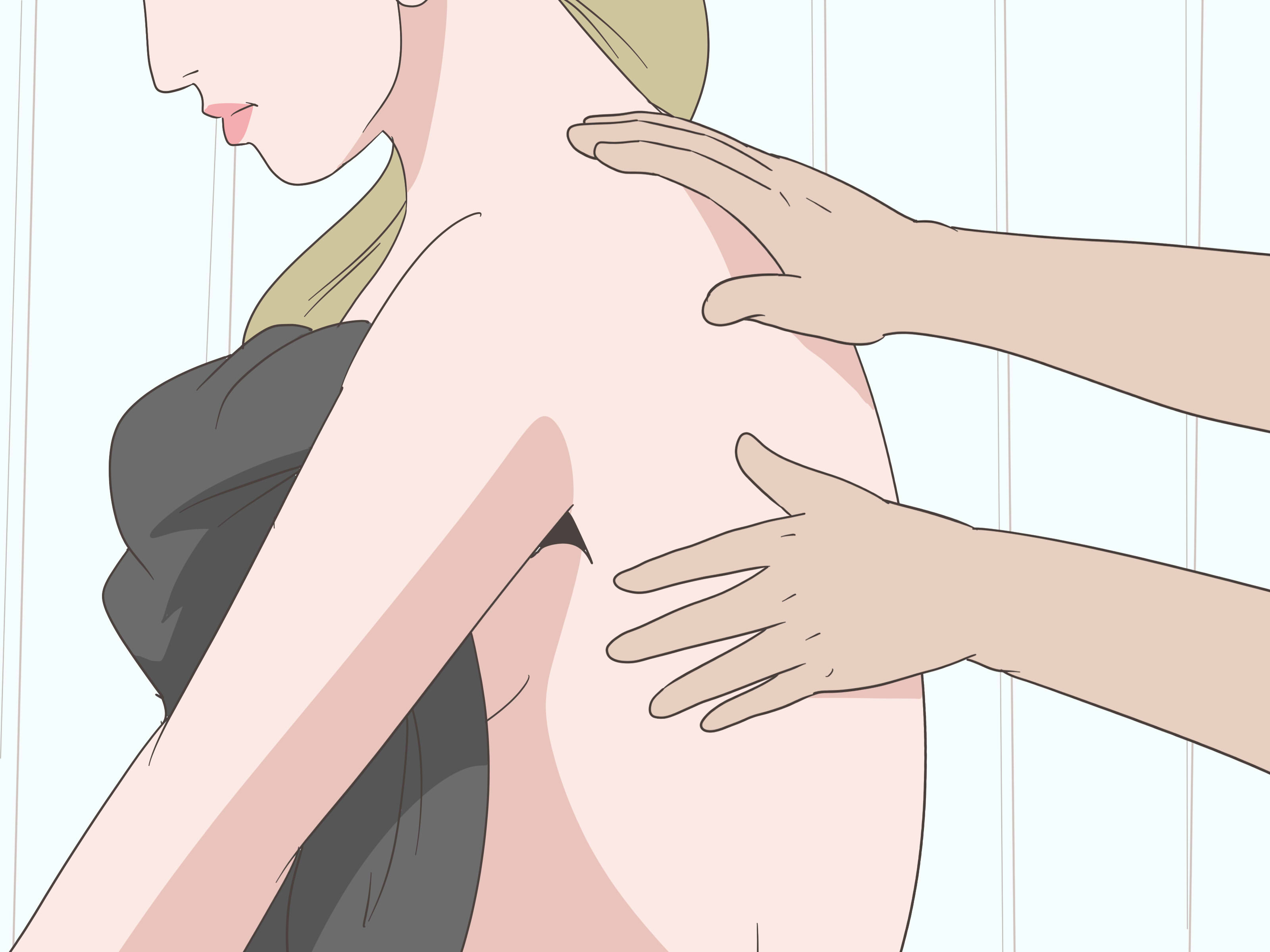
A partner can massage the muscles around the shoulder blades using slow, comfortable pressure. Avoid pressing directly on the spine or using force that causes pain, tingling, or numbness.
For professional treatment, choose a licensed massage therapist trained in prenatal positioning and tell the therapist how far along you are. Side-lying or supported semi-reclined positions are commonly used as the abdomen grows. Massage may offer short-term comfort even though it is not guaranteed to provide lasting relief by itself.
Support your body while sleeping
Side sleeping is often more comfortable as pregnancy progresses. Keep the knees slightly bent and use pillows to prevent the trunk from twisting. One pillow can go between the knees, another beneath the abdomen, and a third behind the back. Hugging a pillow may also support the upper arm and prevent the top shoulder from rolling forward.
The pillow arrangement does not have to look elegant. If your bed resembles a pillow warehouse but your back feels better, the system is working.
When getting out of bed, roll onto your side, move your legs over the edge, and use your arms to push your torso upright. This reduces the need to twist or perform an improvised sit-up.
What Should You Avoid?
Do not forcefully stretch a painful area, perform sudden twisting movements, or repeatedly “crack” your upper back in an attempt to release pressure. Avoid prolonged bed rest unless your clinician has prescribed it for a specific pregnancy complication. Gentle activity is usually more useful for ordinary muscular stiffness.
Do not assume that every over-the-counter pain medicine is safe during pregnancy. Acetaminophen may be appropriate for some patients, but medication decisions should be discussed with a qualified healthcare professional. Nonsteroidal anti-inflammatory drugs, including ibuprofen and naproxen, can carry pregnancy-related risks and should not be used unless specifically directed by your clinician.
Be cautious with herbal creams, essential oils, electrical stimulation devices, aggressive spinal manipulation, and deep-tissue techniques. “Natural” does not automatically mean pregnancy-safe.
When Upper Back Pain Needs Medical Attention
Most mild muscular aches improve after changing position, moving gently, resting, or applying a warm compress. Contact your prenatal care provider when pain is severe, steadily worsening, lasts longer than about two weeks, repeatedly wakes you, or prevents normal daily activities.
Seek prompt medical advice when upper or lower back pain occurs with:
- Vaginal bleeding or fluid leakage
- Regular cramping or contractions
- Fever or chills
- Pain or burning during urination
- Persistent numbness, tingling, or weakness
- Severe abdominal pain
- Pain following a fall, collision, or other injury
Chest pain, fainting, severe shortness of breath, coughing blood, or sudden pain with significant breathing difficulty requires urgent medical evaluation. Back pain during pregnancy can occasionally accompany preterm labor, infection, injury, or another condition that cannot be diagnosed through posture adjustments alone.
Experience-Based Scenarios: Making These Three Strategies Work
The following examples are illustrative composites based on common pregnancy-related movement patterns. They are not descriptions of specific patients and should not be interpreted as medical diagnoses.
The afternoon ache between the shoulder blades
Imagine someone who is 24 weeks pregnant and works at a computer. She feels comfortable in the morning, but by 3 p.m. a burning ache appears between her shoulder blades. Stretching once before bed does very little because the muscles spend most of the workday holding the same slumped position.
Her most useful change is not a complicated exercise program. She raises the monitor, moves the keyboard closer, supports her forearms, and places a cushion behind her lower back. Every 45 minutes, she stands for two minutes, walks to refill her water, and performs five gentle shoulder-blade squeezes.
After work, she uses a warm compress for 15 minutes and takes a short walk. The lesson is simple: a small adjustment repeated throughout the day can be more effective than one large corrective effort after the muscles are already exhausted.
The parent carrying a toddler on one hip
Now picture a pregnant parent who frequently carries a toddler on the left hip. The right side of her upper back becomes tight because her trunk constantly leans and rotates to balance the load. She also bends from the waist to pick up toys, laundry, and the occasional cracker that has somehow become structurally attached to the floor.
She begins asking the toddler to climb onto a stable step before being lifted. She bends her knees, keeps the child close, and alternates carrying sides. When possible, she sits and lets the toddler climb onto her lap instead of lifting from floor level. She also divides heavy bags into smaller loads and accepts help with the car seat.
Her exercise routine includes chest stretches, cat-cow movements, and gentle wall slides. The important lesson is that pain relief does not always come from stretching the sore spot. Sometimes it comes from changing the task that keeps irritating it.
The third-trimester sleep problem
A third person notices that her upper back hurts most when she wakes up. She sleeps on her side, but the top shoulder rolls forward and her torso twists toward the mattress. By morning, the muscles around the shoulder blade feel stiff and compressed.
She begins hugging a firm pillow to support the upper arm. Another pillow goes between her knees, while a smaller cushion supports the abdomen. A pillow behind her back prevents her from rolling into an awkward position. She also replaces an overstretched bra that had been digging into her shoulders during the day.
Her discomfort does not disappear overnight, but it becomes less intense because her body is no longer spending seven hours in a twisted position. The broader lesson is that sleep support should stabilize the entire body, not just cushion the area that hurts.
What these experiences have in common
In each scenario, the best results come from combining the three main strategies: improve alignment, move regularly, and help the muscles recover. None requires punishing exercise or perfect posture. The changes are modest enough to repeat consistently.
It is also useful to track patterns. Note when the pain starts, what you were doing beforehand, which side hurts, how long it lasts, and what makes it better. A brief symptom record can help your clinician or physical therapist distinguish ordinary muscle fatigue from a problem that needs further evaluation.
Conclusion
Upper back pain during pregnancy may be common, but you do not have to simply grit your teeth until delivery. Begin by improving your posture and modifying the activities that repeatedly strain your shoulders. Add gentle mobility and strengthening exercises that feel appropriate for your stage of pregnancy. Finally, support recovery with mild heat, prenatal massage, frequent position changes, and a strategic collection of pillows.
The most effective solution is usually not one dramatic treatment. It is a collection of small habits practiced throughout the day. Your back is adapting to major physical changes while helping you work, sleep, drive, lift, and prepare for a baby. Giving it better support is not indulgent; it is sensible maintenance.
Editorial research note: This article synthesizes pregnancy and back-care guidance from the American College of Obstetricians and Gynecologists, Mayo Clinic, Cleveland Clinic, Johns Hopkins Medicine, the U.S. National Library of Medicine, the American Physical Therapy Association, Hospital for Special Surgery, UT Southwestern Medical Center, March of Dimes, and Mount Sinai Health System.












