
Digital PR outreach has a funny way of humbling even the most confident marketer. You can have a sparkling data study, a headline with more punch than a double espresso, and a landing page so polished it practically winks at visitors. Then you send the pitch, wait, refresh your inbox, refresh again, and suddenly wonder whether journalists have collectively moved to a cave with no Wi-Fi.
The truth is less dramatic and more useful: great outreach is not magic. It is a disciplined mix of relevance, personalization, and clarity. The classic Moz-style lesson behind “3 Digital PR Tenets for Excellent Outreach” still holds up because it focuses on the human side of earned media. Digital PR is not just about building backlinks. It is about earning attention from real editors, reporters, bloggers, creators, and audiences who have endless reasons to ignore you unless you give them one strong reason not to.
In modern SEO, digital PR sits at the intersection of brand authority, content marketing, media relations, and link earning. When done well, it can generate high-quality backlinks, improve organic visibility, create brand mentions, drive referral traffic, and help your company become part of a bigger conversation. When done poorly, it becomes inbox confetti: colorful, annoying, and immediately swept into the trash.
This article breaks down the three digital PR tenets that make outreach work: research and relevance, thoughtful personalization, and short, straightforward communication. We will also look at practical examples, common mistakes, and field-tested experience from real outreach scenarios so your next pitch does not sound like it was launched from a marketing cannon.
What Is Digital PR Outreach?
Digital PR outreach is the process of promoting newsworthy content, expert commentary, brand stories, original research, or useful resources to online publishers. The goal is to earn media coverage, brand visibility, backlinks, social sharing, and trust. Unlike traditional link building, digital PR does not start with “please link to us.” It starts with “here is something your audience will genuinely care about.” That difference is enormous.
Traditional link building often focuses on acquiring backlinks through guest posts, resource pages, partnerships, or direct requests. Digital PR focuses on creating a story worth covering. The link is a byproduct of editorial value, not the entire sales pitch. That is why digital PR tends to produce stronger, more natural, and more defensible links. It is also why it requires patience. You are not placing an order at a backlink vending machine. You are building credibility with people whose job is to protect their readers’ attention.
Why Excellent Outreach Matters for SEO
Search engines have become better at identifying the difference between earned authority and manufactured noise. Google’s spam policies make it clear that manipulative link practices can create risk, while reputable editorial mentions remain valuable because they reflect real-world trust. Bing also rewards helpful, authoritative, relevant content that satisfies users. In plain English: if your digital PR strategy looks like a shortcut, it may eventually become a very scenic route to nowhere.
Excellent outreach supports SEO in several ways. First, it can earn authoritative backlinks from relevant publications. Second, it can increase branded search demand when readers discover your company through credible coverage. Third, it can help subject-matter experts become recognizable voices in their fields. Fourth, it creates referral traffic from people who are already interested in the topic. Finally, it strengthens topical authority because your brand is being discussed in the same editorial environment as important industry conversations.
But none of that happens if your pitch is irrelevant, generic, or longer than a Victorian novel. Let’s unpack the three tenets.
Tenet 1: Research and Relevance Are Non-Negotiable
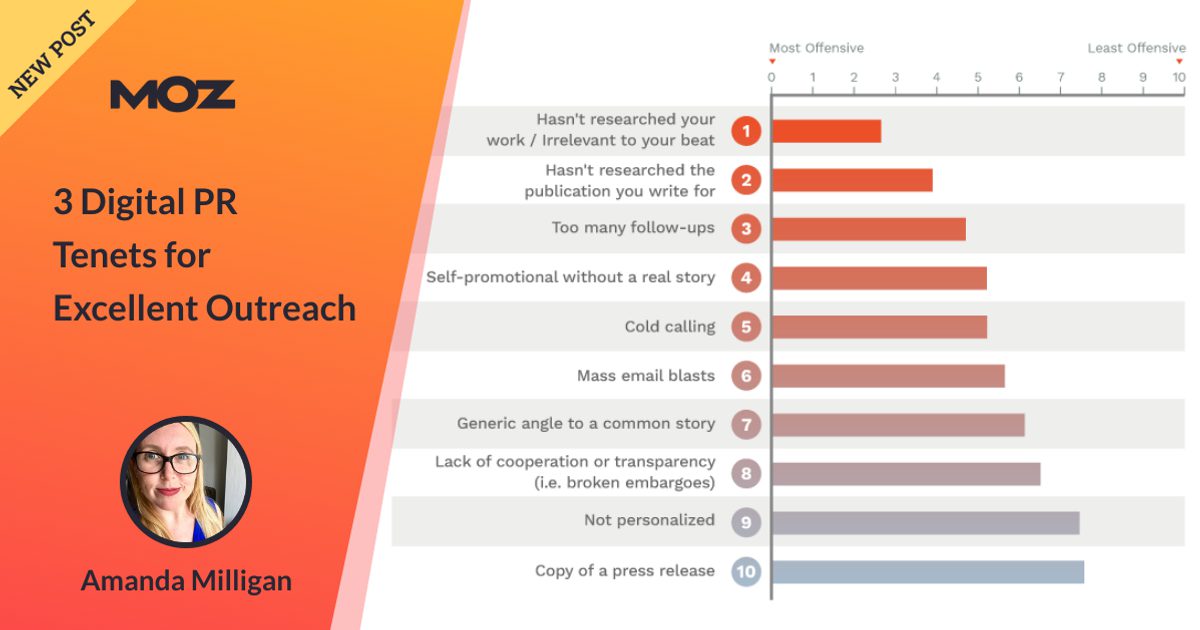
The first rule of digital PR outreach is simple: do not pitch people who have no reason to care. This sounds obvious, yet irrelevant pitching remains one of the most common reasons journalists ignore or block PR professionals. A reporter covering cybersecurity threats does not want a pitch about smoothie trends unless your smoothie has been hacked, leaked customer data, and issued an apology on LinkedIn.
Relevance begins with beat research. A “beat” is the topic area a journalist regularly covers. However, beats are often narrower than they appear. A business reporter might cover venture capital, not retail. A health writer might focus on mental health, not nutrition. A technology editor might care about artificial intelligence policy, not your new productivity app unless it intersects with regulation, funding, labor, security, or consumer behavior.
How to Research the Right Media Contacts
Before adding someone to an outreach list, review their recent articles. Look for patterns in topics, tone, publication type, article format, and audience. Ask yourself: Does this person cover external research? Do they cite data? Do they publish expert quotes? Do they cover company announcements? Do they write quick news briefs, long analysis pieces, product roundups, or trend explainers?
Also check whether the publication can support the type of content you are pitching. Some outlets love data visualizations. Others avoid interactive assets. Some prefer expert commentary. Others want consumer-friendly statistics with a strong emotional hook. A perfect pitch to the wrong format is still a wrong pitch. It is like bringing a wedding cake to a gym class: impressive, but poorly timed.
Relevance also applies to geography, timing, and audience. A national outlet may want broad trend data, while a local publication may prefer city-specific insights. A finance writer may care about household budget impact, while a lifestyle editor may care about how a trend changes daily routines. The content does not need to change completely, but the angle should.
Example: Turning One Study Into Multiple Relevant Angles
Imagine your company publishes a survey about remote work habits in the United States. A weak outreach strategy sends the same email to 500 journalists: “We made a remote work study. Please cover it.” A smarter strategy builds angles for specific audiences.
For a business reporter, lead with productivity, hiring, office costs, or management challenges. For a real estate writer, highlight changing demand for home office space. For a personal finance journalist, focus on commuting savings or hidden work-from-home expenses. For a local news outlet, provide state or city-level findings. For a workplace culture writer, lead with employee burnout, flexibility, or generational differences.
Same campaign, different relevance. That is the difference between outreach that feels helpful and outreach that feels like a flyer tucked under a windshield wiper.
Tenet 2: Personalization Matters, But Do Not Get Weird
Personalization is the second tenet of excellent digital PR outreach. It tells the recipient, “I chose you for a reason.” That tiny signal matters because journalists and editors receive a steady stream of pitches that appear to have been copied, pasted, and launched into the universe by someone who believes “Dear Writer” is a charming greeting.
Good personalization is not flattery wallpaper. It is specific, relevant, and brief. Mention a recent article they wrote, a recurring theme in their coverage, or a connection between your pitch and their audience. The goal is to prove fit, not to prove you scrolled through seven years of their social posts. There is a line between “thoughtful” and “I know what you ate during spring break in 2018.” Stay on the sunny side of that line.
What Good Personalization Looks Like
A strong personalized opener might say: “I saw your recent piece on how small businesses are adapting to higher customer acquisition costs. Our new analysis of 2,000 e-commerce brands found a related trend: referral traffic from editorial mentions converted better than paid social in several categories.”
This works because it is relevant to the writer’s coverage and quickly connects your asset to their audience. It is not vague praise. It is not a paragraph about your company’s mission to “disrupt synergy through innovation.” It gives the journalist a reason to continue reading.
Bad personalization sounds like this: “I loved your article. It was very insightful. Anyway, here is our press release.” That opener could apply to anyone, which means it feels like it applies to no one. If your personalization can be copied into every email without changing a word, it is not personalization. It is confetti with a mail merge field.
Use Social Listening Without Being Creepy
Following journalists on social platforms can help you understand what they care about, how they frame stories, and whether they are looking for sources. But social listening should support professional relevance. Comment when you have something useful to add. Share their work if it genuinely helps your audience. Keep notes on coverage preferences. Do not treat personal details as secret passwords to force intimacy.
Personalization works best when it feels like professional attention. A sentence or two is enough. You are not writing a biography. You are opening a door.
Tenet 3: Emails Should Be Short and Straightforward
The third tenet is the one many marketers know but still violate: keep the email short. Journalists are busy. Editors are busy. Bloggers are busy. Everyone is busy. Even your inbox is busy, probably throwing a small protest right now.
A strong digital PR pitch should be easy to scan in seconds. The subject line should be clear. The opening should establish relevance. The body should explain the story, why it matters, and what the recipient can use. The email should include a direct link to the full asset, key findings, and any available expert commentary or visuals. Do not ask, “Would you like to see the report?” Just include it. Making a journalist request the obvious next step adds friction, and friction is where pitches go to nap forever.
The Anatomy of a Strong Outreach Email
A practical outreach email can follow this structure:
- Subject line: Clear, specific, and tied to the story angle.
- Personalized opener: One sentence connecting the pitch to the journalist’s beat or recent work.
- Core pitch: One short paragraph explaining the asset and why it matters now.
- Key takeaways: Three to five bullet points with the strongest findings.
- Useful assets: Link to the report, images, charts, expert quotes, or methodology.
- Close: A simple offer to provide more context, data, or an interview.
Notice what is missing: twelve paragraphs about your company history, three attachments large enough to injure Wi-Fi, and the phrase “just circling back” before anyone has had a chance to breathe.
Subject Lines That Help, Not Hype
A subject line should communicate the story, not perform a magic trick. “New data: Gen Z spends more on pet care than streaming” is better than “You won’t believe this shocking trend!” The first subject line gives the editor a usable headline direction. The second sounds like a raccoon wrote clickbait after drinking cold brew.
For digital PR, clarity usually beats cleverness. A little creativity is fine, but do not bury the news. If the strongest part of your pitch is a surprising statistic, put it near the front. If the story is timely, mention the timing. If it is local, include the location. If it is tied to a major trend, make that connection obvious.
Digital PR Outreach and Link Earning: The Right Mindset
One of the biggest mistakes brands make is treating journalists as link distributors. That mindset is not only ineffective; it is disrespectful. Journalists are not waiting at their desks thinking, “I hope a SaaS brand asks me for anchor text today.” They need stories, sources, facts, context, and material that helps their readers understand something important, surprising, useful, or timely.
If you want links, earn coverage. If you want coverage, bring value. If you want value, start with a strong content asset. Digital PR outreach cannot rescue weak content. A boring report with a beautiful pitch is still a boring report. A thin infographic with no credible data will not become newsworthy because you used the recipient’s first name correctly.
Strong digital PR assets often include original surveys, proprietary data, expert analysis, interactive tools, trend reports, consumer insights, rankings, maps, calculators, or timely commentary. The best assets answer the editor’s silent question: “Why should my audience care today?”
Common Digital PR Outreach Mistakes
Mistake 1: Sending the Same Pitch to Everyone
Mass outreach may feel efficient, but it often reduces response quality. Segment your list by beat, publication type, audience, and angle. A smaller, better-targeted list can outperform a giant list of barely relevant contacts.
Mistake 2: Making the Brand the Hero
Your company is usually not the story. The audience problem, trend, data point, or expert insight is the story. Put the reader first and the brand second. This is difficult for companies that love themselves very much, which is most companies, but it is essential.
Mistake 3: Hiding the Best Information
Do not make journalists dig through a landing page to find the good stuff. Put the strongest findings in the email. Use bullets. Add context. Make the story easy to understand and easy to cover.
Mistake 4: Following Up Too Aggressively
One polite follow-up is reasonable. Two may be acceptable in certain contexts. Five follow-ups with “thoughts?” is how you become a campfire story told by editors to frighten interns.
Mistake 5: Ignoring Measurement
Track more than backlinks. Measure placements, referring domains, domain relevance, referral traffic, assisted conversions, branded search lift, social engagement, quote usage, journalist relationships, and future coverage opportunities. Digital PR is both an SEO channel and a brand-building channel.
A Practical Digital PR Outreach Workflow
Start by identifying the campaign’s strongest story angle. Then define audience segments and publication categories. Build a media list manually or with reputable PR tools, but always review contacts before pitching. Create angle-specific pitch templates, personalize each opener, and prepare supporting assets. Send outreach in waves so you can learn from early responses. If one angle gets traction, adapt the next wave accordingly.
After outreach, log responses carefully. Note who replied, who declined, who asked for more data, and who covered the story. This relationship history becomes a powerful asset for future campaigns. The best digital PR teams do not restart from zero every time. They build institutional memory, which is a fancy way of saying they remember who actually likes their stuff.
Experience-Based Lessons From Digital PR Outreach
After working through many outreach-style campaigns, one lesson becomes painfully clear: the list is just as important as the pitch. Early in a campaign, it is tempting to spend most of the time polishing the email. That matters, of course. But if the recipient list is poorly researched, even the best pitch becomes a beautifully wrapped package delivered to the wrong house. The person opening it may admire the ribbon, but they still did not order a toaster.
In practice, the strongest results often come from careful segmentation. For example, a data campaign about personal finance might have five separate angles: family budgeting, credit card behavior, regional cost differences, inflation stress, and holiday spending. Each angle deserves a different media list. A local journalist may care about state-level findings. A national finance writer may care about consumer behavior. A lifestyle editor may care about practical household tips. Sending all three the same message weakens the campaign before it begins.
Another experience-based lesson is that the first wave of outreach is a learning tool, not just a distribution tactic. If nobody replies, the problem may be the subject line, the timing, the pitch angle, the asset, or the media list. Instead of panicking, review the signals. Are people opening but not replying? The subject line may work, but the body may not. Are people not opening at all? The subject line or sender reputation may need work. Are people replying with “not my beat”? Your targeting needs a tune-up. Outreach is not a one-shot performance. It is an iterative process, like making pancakes: the first one tells you whether the pan is too hot.
Personalization also tends to work best when it is tied to the journalist’s professional interests. A simple line like “Your recent coverage of retail media networks made me think this new ad-spend data may be useful” can outperform a longer, warmer, but less relevant introduction. The best personalization is not decorative. It is functional. It explains why the story belongs in that person’s inbox.
Short emails consistently perform better because they respect the recipient’s time. However, short does not mean vague. A pitch can be concise and still include the essential facts: what the asset is, why it matters, what is new, who it affects, and where to find supporting material. In many successful pitches, the bullet points do the heavy lifting. They let the journalist scan the story quickly and decide whether it fits their editorial calendar.
Follow-up timing is another area where experience teaches restraint. A helpful follow-up might add a new angle, a fresh data point, or a timely connection to breaking news. A weak follow-up simply says, “Just checking in.” The best follow-ups provide additional value. For instance, if a national trend suddenly appears in the news, you can reconnect your study to that topic and explain why your data adds context. That feels useful rather than needy.
Finally, digital PR works best when the content team and outreach team collaborate from the beginning. Outreach specialists know what journalists actually cover. Content strategists know how to shape the asset. SEO professionals know which links and topics matter. When these teams plan together, the final campaign is more likely to be newsworthy, searchable, and pitchable. When they work separately, the outreach team may inherit a finished asset and quietly wonder how to make “Our CEO Had Thoughts” sound like news. Spoiler: sometimes they cannot.
The biggest experience-based takeaway is this: excellent digital PR outreach feels less like selling and more like matchmaking. You are matching a story with a writer, a writer with an audience, and an audience with information they will find useful. When all three fit, coverage becomes much easier to earn.
Conclusion
The three digital PR tenets for excellent outreach are timeless because they are built around respect: respect for the journalist’s beat, respect for the individual behind the inbox, and respect for everyone’s limited time. Research and relevancy ensure your pitch belongs. Personalization proves you did your homework. Short, straightforward emails make the story easy to understand, evaluate, and cover.
Digital PR is not a shortcut for SEO. It is a long-term authority strategy that rewards brands willing to create useful content, pitch it thoughtfully, and build real relationships with publishers. The best campaigns do not chase links like loose shopping carts in a parking lot. They earn attention by offering something credible, timely, and genuinely valuable.
If you remember only one idea, make it this: outreach begins before the email. It begins when you choose the story, shape the angle, research the audience, and decide whether your content deserves coverage. When the answer is yes, the pitch becomes much easier. When the answer is no, even the world’s most charming subject line cannot save it.











