
Springfield is not exactly famous for emotional stability. Its police chief naps through emergencies, its nuclear plant glows in several medically concerning colors, and its most successful businessman has attempted to block out the sun. Yet beneath the satire, slapstick, and suspiciously affordable doughnuts, The Simpsons has always been a story about people who love one another despite being magnificently bad at showing it.
The best wholesome Simpsons moments do not turn the characters into perfect sitcom saints. Homer remains impulsive, Bart remains chaotic, and Grampa can still convert a simple memory into a three-hour lecture about onions. What makes the tender scenes work is that affection appears through their flaws. A child apologizes after making a terrible mistake. A father sacrifices comfort for his daughter. A brother quietly chooses his sister’s future over his own happiness.
These heartwarming Simpsons scenes prove that the show’s emotional core is just as important as its jokes. Critics and cast members have frequently celebrated that mixture of comedy and genuine feeling, especially in episodes centered on Lisa, Homer, and the complicated Simpson family bond.
Wholesome Simpsons Moments About Parents and Children
1. Homer Turns a Cruel Sign Into “Do It for Her”
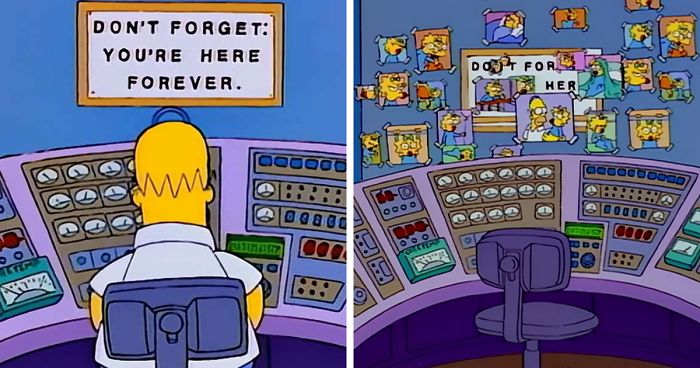
In “And Maggie Makes Three,” Homer gives up his dream job at the bowling alley and returns to the nuclear plant after learning that Marge is pregnant. Mr. Burns installs a humiliating sign telling Homer never to forget that he is trapped there forever. Homer covers it with Maggie’s baby pictures, transforming the message into “Do It for Her.” It is fatherhood expressed through office decoration and quiet sacrifice.
2. Mr. Bergstrom Reminds Lisa Who She Is
Lisa finally meets a teacher who appreciates her intelligence, curiosity, and delightfully intense eight-year-old worldview in “Lisa’s Substitute.” When Mr. Bergstrom must leave, he gives her a tiny note reading, “You are Lisa Simpson.” The message is powerful because it offers no instructions. Lisa does not need to become someone else to deserve respect; being herself is already enough.
3. Maggie Secretly Says “Daddy”
After complaining that children begin arguing as soon as they learn to speak, Homer tucks Maggie into bed and leaves the room. Maggie removes her pacifier and quietly says her first word: “Daddy.” Homer never hears it, which somehow makes the moment sweeter. Maggie’s affection exists without applause, witnesses, or a commemorative doughnut.
4. Lisa’s First Word Changes Bart’s Heart
“Lisa’s First Word” also reveals that toddler Bart initially resented his new sister. His jealousy disappears when baby Lisa says “Bart” as her first word. For one brief moment, Springfield’s future prank king realizes that he is already important to someone. It is an early glimpse of the loyalty that will survive years of teasing, arguments, and suspiciously competitive hockey.
5. Bart Gives Marge a Proper Christmas Photo
After Bart is caught shoplifting in “Marge Be Not Proud,” Marge becomes emotionally distant rather than delivering one of television’s usual five-minute speeches about honesty. Bart eventually buys a framed photograph of himself and gives it to her as a Christmas present. He cannot undo the theft, but he can show that her disappointment matters to him.
6. Lisa Buys Back Bart’s Soul
Bart jokingly sells his soul to Milhouse, then becomes terrified that the transaction might have been real. Lisa secretly buys the paper back and returns it to her brother. She still teases him because she is Lisa, not a greeting card, but her action proves that she takes Bart’s fear seriously even when his spiritual crisis began with cafeteria nonsense.
7. Bart Writes Lisa a Birthday Song
Bart forgets Lisa’s birthday and scrambles to repair the damage in “Stark Raving Dad.” With help from the family’s unusual houseguest, he writes and performs a song celebrating his little sister. The lyrics are simple, sincere, and almost alarmingly free of insults. Lisa’s happiness shows that a thoughtful effort can matter more than an expensive present.
8. Homer Works a Second Job for Lisa’s Pony
Homer buys Lisa the pony she has always wanted, then secretly works an exhausting night shift at the Kwik-E-Mart to pay for it. When Lisa discovers what he is sacrificing, she gives the pony back. Both characters surrender something they love for the other’s well-being, creating one of the purest examples of the Homer and Lisa relationship.
9. Homer Chooses Lisa’s Saxophone Over Air Conditioning
When Homer learns that Lisa is intellectually gifted, he spends the family’s air-conditioner savings on her first saxophone. Years later, when that instrument is destroyed, he makes essentially the same sacrifice again. The Simpson house may be hot enough to roast a turkey on the couch, but Lisa has the tool that allows her to express everything Springfield refuses to understand.
10. Marge Lets Lisa Feel Sad
In “Moaning Lisa,” Marge initially advises her daughter to smile so other people will feel comfortable. After witnessing the consequences, she reverses course. Marge tells Lisa she can be sad when she needs to be and that her family will remain beside her. It is a thoughtful lesson in emotional validation delivered years before “emotional validation” became a phrase printed on wellness mugs.
Heartwarming Moments Between Homer, Lisa, Bart, and Marge
11. Homer Sees Lisa Through a Father’s Eyes
When Lisa feels unattractive in “Lisa the Beauty Queen,” Homer insists that no one is prettier than his little girl. Marge points out that he is viewing Lisa through a father’s eyes. Homer replies that he would happily replace his eyes with someone else’s if it would help him see differently. His wording is medically horrifying, but his unconditional admiration is unmistakable.
12. Homer and Lisa Reconcile Over Vegetarianism
Homer initially treats Lisa’s decision to stop eating meat as a personal attack on barbecue, civilization, and probably ketchup. Eventually, both recognize that their argument has gone too far. Homer accepts that Lisa has the right to follow her conscience, and the episode ends with him carrying her home on his back. Neither changes beliefs; they simply choose love over winning.
13. Bart and Lisa Refuse to Fight on the Ice
In “Lisa on Ice,” Springfield turns a children’s hockey game into a miniature gladiator tournament. When Bart and Lisa face each other for the deciding play, memories of their childhood bond overwhelm the rivalry. They drop their equipment and embrace while the crowd reacts like reasonable adults whose investment portfolios have just exploded.
14. Lisa’s New Friends Accept the Real Lisa
Lisa reinvents herself during a beach vacation in “Summer of 4 Ft. 2,” fearing that her intelligence makes friendship impossible. Bart exposes her academic, saxophone-playing identity, but her new friends still like her. They fill her previously blank yearbook with messages and decorate the family car with seashells, proving that belonging does not require pretending to be less interesting.
15. Homer Believes Lisa About Jebediah Springfield
When Lisa discovers that Springfield’s heroic founder was actually a violent pirate, nearly everyone dismisses her evidence. Homer does not. He tells Lisa that she is usually right about this kind of thing and proudly joins her investigation. For once, the town’s least scholarly resident becomes the first adult willing to trust the smartest child in the room.
16. Intelligent Homer Tells Lisa How Amazing She Is
After doctors remove a crayon from Homer’s brain in “HOMR,” his intelligence increases and he finally connects with Lisa on an intellectual level. Unable to tolerate the isolation that comes with his new mind, he has the crayon reinserted. Before doing so, he leaves Lisa a note explaining that being smart helped him understand just how remarkable she truly is.
17. Homer Calls Lisa His Greatest Accomplishment
In the future depicted by “Lisa’s Wedding,” Homer tells his grown daughter that she is the best thing ever connected to the Simpson name. He says she taught him to understand Marge and become a better person. Lisa responds that he is babbling, allowing Homer to observe that she is still helping him. Naturally, the show places a joke exactly where the tears become dangerous.
18. Future Bart Gives Lisa Her Scholarship
“Future-Drama” imagines Bart receiving a scholarship that originally belonged to Lisa. He eventually abandons his own romantic plans, races to protect his sister from a miserable future, and returns the scholarship to her. Bart may spend most episodes placing firecrackers in household objects, but when Lisa’s future is genuinely at stake, he chooses her.
19. Maggie Chooses Marge
After the Simpson children are placed with the Flanders family in “Home Sweet Homediddly-Dum-Doodily,” Maggie begins adapting surprisingly well to the relentlessly cheerful household. During the reunion, she briefly seems ready to remain with them. Then she sees Marge and immediately reaches for her mother, who appears from Maggie’s perspective surrounded by radiant light.
20. Marge Finds Homer Walking Home From Prom
In “The Way We Was,” teenage Marge attends prom with Artie Ziff but leaves after he behaves inappropriately. She finds Homer walking alone beside the road and offers him a ride. Homer uses his corsage to repair her torn dress strap, and Marge realizes that the awkward boy she overlooked is the person who makes her feel safe.
Unexpected Kindness Throughout Springfield
21. Homer Chooses a Bike Ride With Marge
After completing a month without alcohol in “Duffless,” Homer is free to return to Moe’s Tavern. Instead, he joins Marge for a sunset bicycle ride while they sing together. It is romantic without becoming polished or glamorous. Homer chooses companionship over beer, at least temporarily, which by Springfield standards is approximately equivalent to climbing Mount Everest in slippers.
22. Maggie Returns Bobo to Mr. Burns
Mr. Burns spends “Rosebud” desperately searching for Bobo, the teddy bear he loved as a child. Maggie becomes attached to the bear, but after seeing Burns’s grief, she willingly gives it back. The youngest Simpson recognizes vulnerability inside Springfield’s coldest man and responds with compassion, despite receiving no stock options in return.
23. Grampa Uses His Inheritance to Help Other Seniors
Grampa inherits $100,000 after the death of his companion, Bea, but spending it on himself brings no peace. He ultimately uses the money to renovate the Springfield Retirement Castle and names its dining room after her. Grief becomes generosity, and Bea’s memory improves the lives of people who are normally treated as background furniture.
24. Moe and Maggie Save Each Other
In “Moe Baby Blues,” Moe catches Maggie after she is accidentally thrown from the family car. The rescue gives the lonely bartender a sense of purpose, and the two form an unlikely friendship. Later, Moe risks himself to save Maggie from danger. Her grateful kiss leaves him smiling and admitting that life suddenly does not feel so bad.
25. Bart Helps Lisa Conquer the Eliminator
Lisa enters military school and faces an obstacle course designed to defeat her. Although Bart initially enjoys fitting in with the other cadets, he secretly helps Lisa train. During her final attempt, he shouts encouragement while she struggles across the course. Lisa completes the challenge because her brother finally uses his talent for yelling constructively.
26. The Simpsons Adopt Santa’s Little Helper
In the first full-length episode, Homer loses the family’s Christmas money at the dog track. The losing greyhound Santa’s Little Helper is abandoned by his owner, and Homer brings him home instead of presents. Bart declares that the dog is pathetic and therefore belongs with them. The Simpsons’ first televised Christmas becomes a celebration of rescuing another lovable failure.
27. Homer Watches the Stars After Mona Leaves
Homer briefly reunites with his fugitive mother in “Mother Simpson,” only to lose her again when she must escape. Rather than ending with a punchline, the episode holds on Homer sitting alone on his car and looking toward the stars. The silence communicates childhood longing, forgiveness, and love more clearly than any speech could.
28. Homer Takes Lisa’s Fear Seriously
In “Halloween of Horror,” Lisa becomes overwhelmed by a frightening theme-park attraction. Homer immediately takes her home and stays with her instead of forcing her to continue celebrating. He does not mock her or tell her to grow up. He recognizes that courage sometimes means admitting an experience is too much and trusting someone to keep you safe.
29. Adult Bart and Lisa Reconnect in Their Treehouse
“Holidays of Future Passed” shows Bart and Lisa as adults struggling with parenthood. They retreat to their childhood treehouse, discuss the family that shaped them, and rediscover the bond beneath decades of sibling friction. The scene works because they do not idealize their upbringing. They simply recognize that they survived it together and still understand one another better than anyone else.
The Experience of Rewatching These Wholesome Simpsons Moments
Rewatching The Simpsons can feel very different from discovering it for the first time. As children, many viewers naturally focus on Bart’s rebellion, Homer’s accidents, the visual gags, and the joy of hearing adults say things that would earn real children a long conversation with the principal. Years later, the same episodes reveal quieter stories about financial pressure, parental insecurity, loneliness, marriage, and the fear of disappointing the people we love.
“And Maggie Makes Three” is a perfect example of that changing experience. A young viewer may remember Homer dramatically quitting the power plant and crawling back to Mr. Burns. An adult may notice the painful economic reality underneath the jokes. Homer abandons work he enjoys because his growing family needs stability. The “Do It for Her” reveal becomes more affecting after a viewer has accepted an exhausting responsibility for someone else’s benefit. The episode does not pretend sacrifice is pleasant. It suggests that love can give an unpleasant sacrifice meaning.
Episodes involving Lisa also become richer with age. Children may understand that she is lonely, but adults are more likely to recognize how exhausting it is to remain curious in an environment that rewards conformity. Mr. Bergstrom’s note works because it gives Lisa something many people spend years seeking: recognition without conditions. He does not praise a test score or predict a prestigious career. He affirms her identity. That makes “You are Lisa Simpson” useful far beyond the episode. It is the emotional equivalent of handing someone a compass when everyone else keeps asking why they are wandering.
The sibling scenes can also trigger unexpected nostalgia. Bart and Lisa insult each other with professional efficiency, yet their strongest episodes reveal how deeply they depend on one another. Watching them refuse to fight in “Lisa on Ice” or reconnect as adults in “Holidays of Future Passed” can remind viewers of childhood arguments that once seemed catastrophic. Many sibling relationships are built from exactly that mixture: ruthless teasing, territorial warfare, shared memories, and immediate loyalty when an outsider causes trouble.
Another pleasure of revisiting these heartwarming Simpsons scenes is noticing how carefully the comedy protects them from becoming sentimental. Homer’s loving speeches usually contain strange medical imagery. A sincere reunion may be followed by property damage. Emotional music can lead directly into a joke about food. Rather than weakening the tenderness, those interruptions make it believable. Real families rarely produce perfectly edited moments. Somebody says the wrong thing, a phone rings, a child asks for a snack, or a dog steals something from the table.
A rewarding viewing experience is to select several emotional episodes instead of watching them randomly. Pair “Lisa’s Substitute” with “HOMR” to examine how Lisa connects with different father figures. Watch “Lisa’s First Word,” “Lisa on Ice,” and “Holidays of Future Passed” as a miniature history of Bart and Lisa’s relationship. Combine “The Way We Was” with “Duffless” to see why Homer and Marge remain together despite enough marital chaos to employ every counselor in Springfield.
These episodes also work well across generations. Parents may relate to Marge changing her advice when she realizes Lisa needs permission to feel sad. Children may understand Lisa’s frustration immediately. Adults recognize Homer’s sacrifices, while younger viewers see the pony, saxophone, and jokes. Everyone enters through a different door, but the family story places them in the same living room.
Why the Heart of The Simpsons Still Matters
The most wholesome things that occurred on The Simpsons endure because they never erase the characters’ imperfections. Homer remains careless, Bart remains mischievous, Lisa remains intense, and Marge remains more patient than modern science can explain. Their kindness matters precisely because it must fight through those flaws.
Springfield may be dysfunctional, polluted, and governed with the organizational discipline of a raccoon inside a vending machine. Nevertheless, its finest stories remind us that people can apologize, reconsider, sacrifice, forgive, and show up for one another. Behind every “D’oh!” is a family still trying to get home together.












