
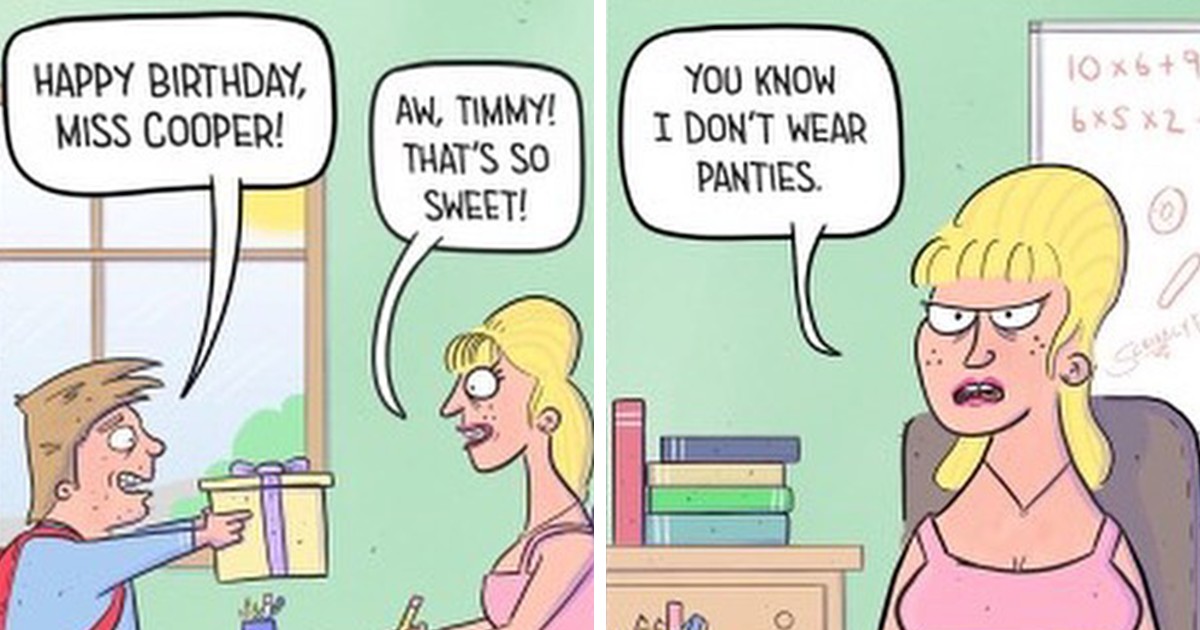
Some comics politely tap you on the shoulder. Scribbly G’s comics sneak up behind you with a rubber chicken, a philosophical crisis, and possibly a tiny dinosaur holding an engagement ring. That is the charm of 25 unpredictable comics with dark humor, illustrated by Scribbly G: they look simple at first glance, then suddenly swerve into a punchline you absolutely did not schedule for your emotional calendar.
Dark humor comics work best when they are fast, sharp, and just a little bit wrong in the right way. Scribbly G, a South African cartoonist currently living in Milton Keynes in the United Kingdom, has built a recognizable style around exactly that formula. His webcomics often begin with ordinary setupsfamily life, pets, school, romance, work, technology, fairy tales, zombies, or animals behaving suspiciously like humansand then finish with a twist that makes the reader laugh, pause, and occasionally whisper, “I should not have enjoyed that as much as I did.”
What makes Scribbly G stand out is not just the darkness. Plenty of internet comics try to shock readers. His best jokes are more controlled than that. They use clean visual storytelling, short setups, and a punchline that lands because the comic understands timing. The drawings feel accessible and slightly chaotic in a friendly way, which makes the darker turn even funnier. It is comedy wearing slippers while hiding a trapdoor under the rug.
Who Is Scribbly G?
Scribbly G is the online name of a cartoonist whose work has moved from webcomic circles into broader publishing, illustration, and entertainment spaces. His official biography describes him as a South African cartoonist based in the UK, with cartoons published in outlets such as Airmail, The Times Luxury, The Critic, The Oldie, and The Phoenix. He has also created promotional comics for mobile games including The Walking Dead: Survivors, Clash of Kings, and Mattel’s UNO and Phase 10 games.
That range matters because it shows a creator who is not limited to one joke format. Scribbly G can do absurd one-off panels, short gag strips, character-based scenes, dark fairy-tale energy, and longer-form projects. His first graphic novel, Simulation James, also points to a bigger storytelling ambition behind the quick-hit humor. The webcomics may be bite-sized, but the imagination behind them is clearly not running on snack mode.
Why These 25 Comics Feel So Unpredictable
The word “unpredictable” gets thrown around a lot online, usually to describe anything that has a surprise ending. Scribbly G’s comics earn the label because the surprises are built into the structure. The opening panel invites you to assume one kind of story. The next panel quietly encourages that assumption. Then the final beat turns the situation sideways, sometimes into absurdity, sometimes into social satire, and sometimes into a tiny cartoon disaster with excellent comic posture.
For example, one comic may start with a harmless pet scenario and end with a moral reversal. Another may use cavemen to joke about school and history. A wedding scene might turn into a joke about modern distraction. A genie setup might begin exactly where every wish-granting joke begins, then immediately flee the expected route like it owes the punchline money. Zombies, dinosaurs, lab mice, flies, virtual reality dads, bananas, and unlucky dogs all become vehicles for the same trick: comfort first, chaos second.
The Setup Is Usually Familiar
Scribbly G often begins with scenes that require almost no explanation. A couple at the altar. A father talking to a child. A person encountering a strange creature. A pet owner dealing with a dog. A doctor’s office. A prehistoric family moment. These familiar images help the reader enter the comic instantly. There is no dense lore, no complicated cast list, and no need to read three paragraphs before the joke begins stretching its legs.
The Twist Rewrites the Scene
The punchline usually does more than add a funny sentence. It changes what the entire comic was about. That is why the jokes are memorable. A normal family scene becomes a joke about failure. A romantic moment becomes a survival problem. A cute animal moment becomes a miniature ethical crisis. The reader’s brain has to perform a quick reset, and that reset is where the laugh happens.
The Darkness Is Softened by the Art
One reason Scribbly G’s dark humor works is that the art does not feel cruel. The characters are expressive, simple, and slightly silly. Even when the subject matter gets morbid, the visual tone keeps the experience playful. This is important because dark comedy depends on balance. Too gentle, and the joke has no bite. Too mean, and the reader stops laughing and starts mentally drafting a complaint letter. Scribbly G usually finds the middle ground: spooky enough to surprise, cartoonish enough to enjoy.
Dark Humor Comics and the Art of Laughing at the Wrong Moment
Dark humor has a long tradition in literature, theater, cartoons, and everyday conversation. It often combines uncomfortable subjects with comic framing, creating the strange experience of laughing at something serious without necessarily dismissing its seriousness. In comics, that effect becomes even sharper because the format is so compressed. A few panels can take a reader from “aww” to “oh no” to “why am I laughing?” in under ten seconds.
Scribbly G’s work fits this tradition because his comics frequently use absurdity to make dark ideas feel approachable. Death, fear, failure, loneliness, technology, bad parenting, strange relationships, and social awkwardness all appear in ways that are exaggerated enough to be funny. The reader is not being asked to treat misery as entertainment. Instead, the comic turns life’s weirdness into something small enough to hold, inspect, and laugh at before it grows fangs.
Specific Themes That Keep Appearing in Scribbly G’s Comics
1. Animals With Suspiciously Human Problems
Dogs, mice, flies, dinosaurs, and other creatures often appear in Scribbly G’s comics, but they rarely behave like simple animals. They worry, argue, misunderstand, judge, and occasionally become the center of a joke much darker than their adorable design suggests. This contrast is a reliable engine for comedy. A cute creature makes readers lower their guard. Then the comic politely steals their emotional wallet.
2. Family Life Gone Sideways
Parents, children, weddings, and domestic situations provide rich material because they are already loaded with expectations. We expect family comics to be warm, relatable, or mildly chaotic. Scribbly G often takes that expectation and adds a twist that makes the scene absurdly bleak. The humor works because family life is already full of tiny disasters; his comics simply add a trapdoor, a monster, or a punchline wearing steel-toed boots.
3. Technology as a Comedy Villain
Modern technology appears as both a tool and a troublemaker. A virtual-reality joke about parenting, for instance, can poke fun at escapism, screen dependence, and the fantasy of controlling life through simulation. Scribbly G’s tech jokes are not lectures. They are little cartoons that say, “Maybe the machines are not the problem. Maybe we are just extremely creative at avoiding responsibility.” Rude, but fair.
4. Fairy-Tale Logic With a Darker Smile
Scribbly G has also explored dark fairy-tale territory, and that influence shows in the way some comics treat wishes, monsters, transformations, and moral consequences. Fairy tales have always had a grim streak, even before modern culture polished them into bedtime-friendly shapes. Scribbly G taps into that older energy, where magic is not a free gift but a suspicious contract with tiny print and terrible customer service.
Why Readers Love Unpredictable Webcomics
Webcomics are built for fast reading, but the best ones linger. Scribbly G’s comics are easy to consume on a phone screen, which makes them ideal for social media sharing. A reader can understand the setup instantly, react to the twist, and send it to a friend with a message like, “This is horrible. I loved it.” That shareability is one reason dark humor comics continue to perform well online.
Another reason is emotional efficiency. Life is busy. People may not have time to read a long essay about the absurdity of modern existence, but they do have time for three panels where a banana, a zombie, or a confused caveman accidentally explains the human condition. Good webcomics compress observation into a single hit. Scribbly G’s best work feels like a joke, a tiny story, and a minor personal attack all at once.
The Visual Style: Simple, Expressive, and Sneakily Effective
Scribbly G’s drawing style is not about hyper-detailed realism. That is part of the appeal. The figures are clean, readable, and expressive enough to carry the joke without distracting from it. In short-form comics, clarity is everything. If the reader has to decode the artwork before understanding the punchline, the joke loses speed. Scribbly G keeps the visual language direct, allowing the timing and absurdity to do most of the heavy lifting.
The style also gives the comics a handmade personality. The lines feel loose enough to be fun, but controlled enough to guide the eye. Facial expressions are especially important. A blank stare, a tiny smile, a nervous posture, or a character standing too calmly in a deeply alarming situation can become part of the punchline. Sometimes the funniest thing in a Scribbly G comic is not what happens, but how little the character seems prepared to process it.
What Makes a Scribbly G Punchline Work?
A strong punchline depends on timing, misdirection, and emotional contrast. Scribbly G often uses all three. First, the comic sets a rhythm. Then it lets the reader predict the ending. Finally, it breaks that prediction in a way that still feels logical after the fact. The best twist endings are not random for the sake of randomness. They are surprising, but once you see them, they feel inevitable in the weird little universe of the strip.
This is why the comics reward rereading. On the first read, you enjoy the surprise. On the second read, you notice how the setup quietly prepared the joke. The character placement, the object in the background, the wording of a line, or the expression on someone’s face may all be doing more work than you realized. The comic is not just yelling “plot twist!” It is planting a banana peel and waiting politely.
Dark Humor Without Losing the Reader
The biggest challenge in dark humor is tone. A comic can be edgy and still feel lazy if the only goal is shock. Scribbly G’s stronger comics avoid that trap by making the darkness part of the joke’s logic. The humor usually comes from reversal, irony, or absurd consequence rather than cruelty alone. The result is a style that can be morbid without feeling empty.
That balance is especially important for online audiences. Readers arrive from different backgrounds, moods, and sensitivities. A dark joke that works for one person may not work for another. Scribbly G’s comics often succeed because they keep the world exaggerated. The characters are cartoons, the situations are absurd, and the punchlines operate in a heightened reality. That distance gives readers permission to laugh without feeling like they are endorsing real-world harm.
Why “25 Unpredictable Comics With Dark Humor” Is a Perfect Entry Point
A collection of 25 comics gives new readers a strong sample of Scribbly G’s range. One or two strips might show the style, but a larger set reveals the pattern: everyday setup, expressive characters, fast escalation, and a final turn that refuses to behave. The variety also helps. If one joke leans more absurd, another may lean more satirical. If one uses animals, another uses fantasy. If one is almost wholesome, the next may kick wholesomeness into a cartoon pit.
For longtime fans, these collections are enjoyable because they highlight how consistent the voice is. Scribbly G’s world is unpredictable, but the comic identity is clear. You know the laugh will probably arrive from a strange angle. You just do not know whether it will be carried by a dog, a ghost, a caveman, a mouse, a genie, or a parent making an extremely questionable life choice.
How Scribbly G Fits Into the Modern Webcomic Scene
The modern webcomic scene rewards creators who can build a recognizable tone quickly. Readers scroll fast, and a comic has only a moment to catch attention. Scribbly G’s work is well suited to that environment because each strip communicates its premise visually and lands its joke quickly. The comics are also flexible: they can live on Instagram, Facebook, humor websites, artist portfolios, and curated galleries without needing heavy context.
At the same time, Scribbly G’s career shows that webcomics can be more than casual posts. His publishing credits, game-related promotional work, animation experience, caption contest recognition, and graphic novel projects all point to the broader creative value of a distinctive cartoon voice. Internet humor may look quick and disposable from the outside, but building a style that readers recognize takes discipline, experimentation, and a strong tolerance for drawing weird things at odd hours.
Experience: Reading Scribbly G’s Dark Comics Feels Like Walking Into a Joke Trap
Reading a batch of Scribbly G comics is a specific kind of experience. At first, you think you are in control. You see a simple scene, maybe a dog on a walk, a couple having a moment, a caveman family, or a character facing a strange little problem. You settle in. You think, “I know where this is going.” This is the first mistake. The comic has already seen your confidence and is quietly sharpening a punchline behind the sofa.
The fun comes from that repeated loss of control. Each strip trains you to expect betrayal, but not the exact shape of it. One joke may end with an absurdly literal interpretation. Another may reveal that the innocent character is not innocent at all. Another might shift the entire moral center of the scene in the final panel. After a while, you stop trying to predict the ending and start enjoying the suspense. It becomes less like reading ordinary comics and more like opening tiny mystery boxes labeled “probably fine.” They are not fine. That is the point.
There is also a strangely comforting quality to the darkness. The comics are morbid, but they are not heavy in the way real bad news is heavy. They take uncomfortable ideas and shrink them into cartoon form. Fear becomes a zombie gag. Social awkwardness becomes a wedding joke. Failure becomes a caveman problem. Parenting becomes a virtual-reality nightmare. The world is still ridiculous, but now it is ridiculous in four panels, which is much easier to manage than the full-size version.
Another enjoyable part of the experience is how shareable the comics are. You can send one to a friend who likes twisted humor and immediately know whether your friendship is healthy or merely well-matched in chaos. The best Scribbly G comics produce the kind of laugh that comes with a tiny apology. You laugh, then you look around to make sure nobody is judging you, then you send it to three people because apparently judgment is more fun as a group activity.
For readers who enjoy dark humor, the appeal is not simply that the comics are edgy. It is that they are clever about the edge. Scribbly G usually does not rely on long explanations or complicated references. He trusts the reader to follow the setup, enjoy the reversal, and appreciate the weird emotional aftertaste. That confidence makes the comics feel sharp rather than desperate. They do not beg for attention. They quietly arrange the scene, open the trapdoor, and let gravity handle the rest.
By the end of a 25-comic collection, you may feel as if you have toured a tiny amusement park designed by someone who finds normal life suspicious. There are animals, monsters, doomed expectations, strange relationships, and enough absurdity to make everyday problems look slightly more cartoonish. That is the hidden benefit of Scribbly G’s work: after reading it, the real world may still be stressful, but at least it seems a little more willing to become a joke.
Conclusion
25 unpredictable comics with dark humor, illustrated by Scribbly G is more than a gallery of quick laughs. It is a showcase of how short webcomics can use timing, visual clarity, and twisted imagination to create memorable comedy. Scribbly G’s work succeeds because it knows how to start with the familiar and end somewhere delightfully wrong. The jokes are dark, but the delivery is playful. The drawings are simple, but the comic instincts are sharp. The result is a collection that feels chaotic, clever, and strangely refreshing.
For readers who love unexpected endings, absurd situations, and humor that wanders into the shadows without completely turning off the lights, Scribbly G is worth following. His comics remind us that laughter does not always arrive wearing a sunny hat. Sometimes it shows up with a weird little grin, a suspicious animal, and a punchline that kicks the door open.
Note: This article is written as original SEO content based on publicly available information about Scribbly G, his webcomics, official biography, published work, and broader dark humor comic trends.











