
Black-and-white street photography has a funny way of making everyday life look like it secretly hired a film director. A stranger crossing a road becomes a symbol. A puddle turns into a portal. A child at a window suddenly feels like the emotional center of the universe. That is exactly why the 2025 Macadam Awards gallery lands with such force. These 23 recognized images do not rely on flashy color or visual sugar rush. They lean on something harder to fake: timing, atmosphere, geometry, and the old-fashioned magic of noticing what everyone else missed.
The black-and-white wing of the 2025 Macadam Awards celebrates street photography at its most alert and alive. The official results highlight three prize winners and 20 honorable mentions, and the broader takeaway is clear: monochrome still has serious bite. In a photography culture that is often loud, bright, and just one preset away from a meltdown, these images feel disciplined. They prove that strong street photography does not need fireworks. Sometimes it just needs a shadow, a gesture, a little mystery, and a photographer patient enough not to blink too soon.
What makes this set especially compelling is its range. Some images feel cinematic. Some are humorous. Some carry quiet loneliness. Others punch with motion, tension, or visual surprise. Together, they show why black and white remains one of the sharpest tools in the street photographer’s kit. Color can be glorious, of course. But black and white is color’s cooler cousin: less chatty, more observant, and rarely overdressed.
Why These 23 Photos Stand Out
The strongest black-and-white street photos do not merely document a place. They reorganize it. They strip away distractions and turn the city into a stage of light, texture, rhythm, and gesture. That is the common thread running through the Macadam winners. The photographs seem less interested in “look what happened” and more interested in “look what this moment means once form and feeling lock together.”
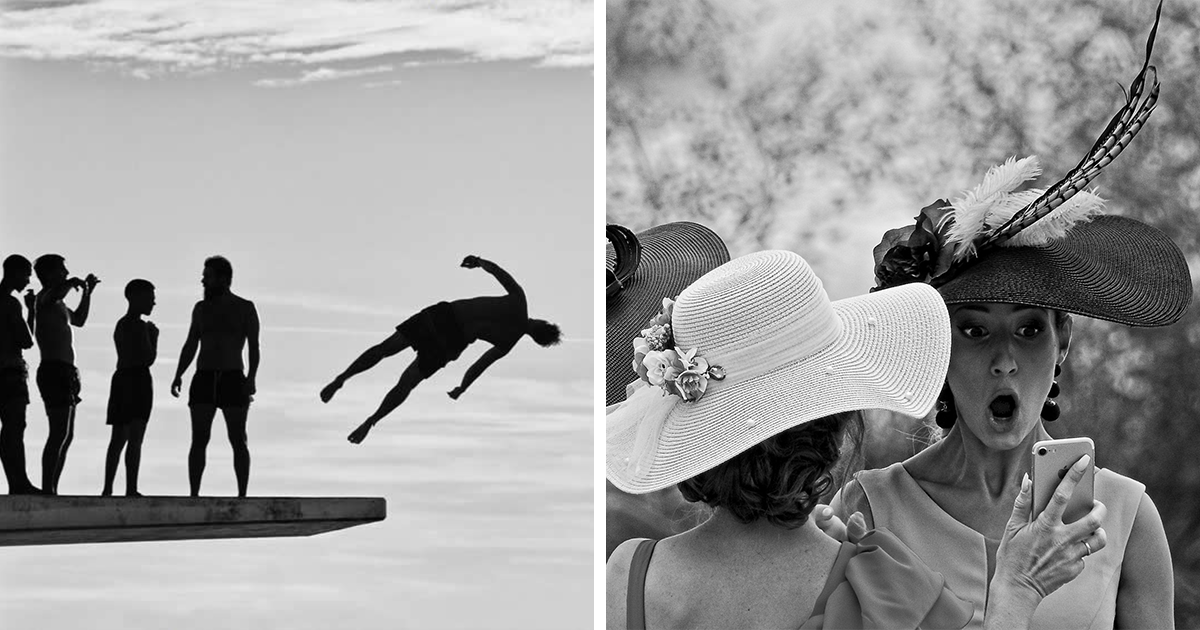
Several of the recognized works reportedly feature scenes that sound ordinary on paper but hit much harder in grayscale: women in elaborate hats caught in a candid flash of expression, chefs moving through a steamy kitchen, a child staring through a reflective window, a runner mirrored in a puddle, people carrying umbrellas through snow, and a lone pedestrian crossing a nearly empty intersection under long shadows. None of those situations needs exotic subject matter. What they need is arrangement. The best street photographers know that reality already comes with enough drama. Their job is to catch it before it wanders off.
That is also why this collection feels modern without being trendy. You can sense contemporary life in the movement, isolation, crowding, and accidental theater of public space, but the images are not chained to a gimmick. They are built on timeless visual ingredients: contrast, spacing, silhouettes, repetition, texture, and emotional ambiguity. In other words, the stuff that still works long after hashtags go to lie down.
What Black and White Does Better Than Almost Anything Else
1. It turns light into the main character
In monochrome, light stops being background decoration and starts running the show. Bright sidewalks, deep doorways, reflective glass, fog, steam, snow, and cloud cover all become compositional tools instead of atmospheric extras. The Macadam selections clearly lean into this strength. Even from their brief public descriptions, many of the images seem built around tonal drama: dark coats against pale sand, figures against snowy streets, bodies against industrial textures, movement against empty space.
That matters because black-and-white street photography thrives when the world gets simplified without becoming dull. Remove color, and the viewer starts paying closer attention to edges, shapes, and how tones balance across the frame. Suddenly, a staircase, a window bar, or a patch of pavement can do as much storytelling as a face.
2. It makes gesture feel louder
One hand raised, one shoulder slumped, one jump timed a fraction of a second right, and the whole image changes. That is the decisive-moment magic street photographers chase, and the Macadam winners seem full of it. A person mid-run, children in acrobatic play, people caught in transit, a figure framed by reflection, bodies arranged along a diving board: these are not static records. They are tension captured just before it dissolves.
In color, the eye may wander toward bright objects and decorative detail. In black and white, posture and timing tend to hit harder. You do not just notice what someone is wearing. You notice what they are doing, how they occupy space, and whether the moment feels comic, fragile, heavy, strange, or electric.
3. It adds mystery without trying too hard
Great monochrome images leave room for the viewer to participate. A reflective window can feel introspective. A crowded station can feel anonymous and overwhelming. A person alone in an open street can feel liberated or isolated depending on the exact balance of space and shadow. The Macadam gallery appears rich in that kind of interpretive openness. These photographs do not hand you a neat little moral in a gift bag. They let you wander around inside the frame a bit.
That ambiguity is a huge part of street photography’s lasting appeal. Public life is messy, layered, and occasionally ridiculous. A good street image respects that complexity. A very good black-and-white street image makes complexity look elegant.
The Top Winners and the Mood of the Gallery
The top three recognized photographers in the public roundup are Eddy Verloes, Frank Proost, and Mariana Basurto. Even without reproducing the images here, the descriptions alone suggest why these placements resonated. Verloes’ winning image is associated with a windswept scene of dark-clad figures moving across sandy dunes under a cloudy sky. Proost’s second-place image centers on three women in striking hats caught in a wonderfully expressive candid instant. Basurto’s third-place image reportedly captures children practicing acrobatics in an aging urban-industrial setting.
Notice how different those scenes are. One feels elemental and expansive. One feels social and theatrical. One feels playful, physical, and rooted in place. Yet all three appear to share the same core discipline: they do not just record subjects; they organize visual energy. That is the sweet spot in award-level street photography.
The honorable mentions widen the emotional field even further. Among the publicly described images are a child behind reflective glass, umbrellas moving through snow, a runner in puddle reflection, an underwater figure beneath dramatic clouds, a person using a payphone, and a lone pedestrian cutting across a dawn intersection. That spread is important. It shows the competition did not reward one single “look.” It rewarded photographers who could find poetry, wit, tension, or atmosphere in wildly different public moments.
Just as importantly, the official Street Macadam page notes that the three winners were set to be exhibited at the Treviso Photographic Festival, while the winners and honorable mentions were to be published in a special edition magazine. That gives the selection an extra layer of legitimacy. These are not just social-media-friendly one-offs. They are images meant to hold attention beyond the scroll.
The 23 Recognized Photographers
- Eddy Verloes 1st Prize
- Frank Proost 2nd Prize
- Mariana Basurto 3rd Prize
- Hezy Holzman Honorable Mention
- David Niu Honorable Mention
- Marko Buntic Honorable Mention
- Susana Sanchez Honorable Mention
- Gavin Libotte Honorable Mention
- Dario Athanasio Vergos Honorable Mention
- Zeren Yu Honorable Mention
- Gaspard Claude Honorable Mention
- Anna Biret Honorable Mention
- Mania De Praeter Honorable Mention
- Alex Mccilntock Honorable Mention
- Floriano Da Silva Honorable Mention
- Leroy Skalstad Honorable Mention
- Roberto Crucitti Honorable Mention
- Emir Bozkurt Honorable Mention
- Asako Naruto Honorable Mention
- Leone Von Dizik Honorable Mention
- Chauva Varun Honorable Mention
- Bimurtya Ganguli Honorable Mention
- Bradley Grochocinski Honorable Mention
What Photographers Can Learn From This Gallery
First, stop waiting for extraordinary locations. These images suggest that the street’s real gift is not spectacle but possibility. A station platform, a road, a kitchen, a snowy sidewalk, a phone booth, or a patch of industrial emptiness can all become compelling when form and timing align. Street photography is often less about travel and more about attention. The passport helps, sure, but the eyes do most of the work.
Second, black and white rewards pre-visualization. You have to think in tones, not just in things. Ask what happens to the scene when red, blue, and yellow are no longer doing the heavy lifting. Does the image still hold? Are there strong blacks, readable grays, and clean highlights? Is the frame driven by shape? If the answer is yes, you are already playing the right game.
Third, street photography benefits from restraint. The Macadam winners feel edited in the best sense of the word. Nothing appears wasted. The frames seem to know what matters and what does not. That is an underrated skill in a time when overshooting is easy and deleting is an emotional support system.
Finally, let ambiguity breathe. A strong street photo does not need a giant explanation strapped to its back. Sometimes the image should raise a question, not close a case. That is part of why these award-winning black-and-white street photos linger in the mind. They are not just scenes. They are invitations.
The Experience of Looking at These Photos, Then Walking Back Into the Real World
Here is the strange side effect of spending time with a gallery like this one: when you step back outside, the world starts looking suspiciously well composed. You notice things you probably ignored an hour earlier. The hard line of sunlight cutting across a building. A bus stop reflection that briefly turns strangers into layered ghosts. Someone carrying groceries in a way that looks oddly noble. A child dragging a shoe on the pavement like a drummer warming up. The city has not changed, exactly. Your attention has.
That may be the most valuable experience these 23 award-winning black-and-white street photos offer. They remind you that street photography is not only about making images. It is about learning how to see. Really see. Not in the vague, mystical, “the universe whispered to my lens” way. More in the practical, human way. You begin to understand that public life is full of little collisions between order and chaos. People move through patterns they do not realize they are creating. Light arrives at odd angles and suddenly gives ordinary scenes a pulse.
After looking through work like this, even a short walk can feel like a field study in timing. A person exits a shop into a blast of white light. Two strangers pause under the same awning but never acknowledge each other. A cyclist cuts through the frame just as a dog turns its head. A gust of wind flips a coat, and for one second the fabric becomes sculpture. None of these moments announces itself with trumpets. They appear, shrug, and disappear. That is why street photographers look half patient and half possessed.
There is also an emotional shift that comes with black-and-white viewing. Color tends to report the world as it appears. Monochrome often reports the world as it feels. That is a loose rule, not a law, but it helps explain why these images seem to linger. A snowy street becomes lonelier. A crowded platform becomes more feverish. A shadow across concrete feels heavier, almost narrative. The absence of color does not empty the scene. It concentrates it.
And then there is the humility factor. A gallery like this is inspiring, yes, but also mildly rude in the most helpful possible way. It reminds you how much can happen in a fraction of a second, and how often photographers succeed not because they found a rare spectacle, but because they were ready when ordinary life briefly turned into visual music. That realization is both encouraging and annoying. Encouraging because the material is everywhere. Annoying because now you cannot blame the universe for your lazy framing.
The best part, though, is that these photos make the street feel worth paying attention to again. Not because every corner hides an award winner, but because every corner hides potential. Public life is full of comedy, friction, tenderness, loneliness, style, boredom, grace, and accidental theater. The Macadam gallery does not invent that truth. It reveals it. And once you have seen it, the walk home is never just the walk home anymore.
Final Thoughts
The 2025 Macadam Awards gallery is a sharp reminder that black-and-white street photography is nowhere near obsolete. If anything, it feels newly relevant. In a visual world crowded with noise, monochrome offers clarity. In a culture hooked on speed, these images reward slower looking. And in a medium often obsessed with gear chatter and trend cycles, the winning photos bring the conversation back to what matters most: observation, timing, structure, and emotional intelligence.
These 23 photographs do more than celebrate talented photographers. They make a convincing case for the continuing power of the street as a subject and black and white as a language. They show that the everyday is not boring. It is just waiting for the right person to frame it properly. A hat, a puddle, a crossing, a child, a shadow, a crowd, a gust of weather, a split second of human weirdness somehow, that is enough. Actually, on the evidence here, that is more than enough.












