
Southern last names do more than fill out a family Bible or get stitched onto a baseball cap. They carry migration stories, old occupations, regional accents, church records, courthouse dust, and enough family lore to fuel a reunion until the banana pudding disappears. In the American South, surnames often reflect English, Scots-Irish, French Cajun, Spanish, German, African American, and Native influences, which is exactly why Southern family names feel so rich, layered, and unforgettable.
If you are searching for Southern last names and meanings for genealogy, baby-name inspiration, character creation, or plain old curiosity, this list gives you more than a random roll call. It explains where many of these surnames came from, what they originally meant, and why they still sound right at home from Appalachia to Louisiana and from the Carolinas to Texas.
What Makes a Last Name Feel Southern?
No last name is born wearing cowboy boots and carrying sweet tea, but some surnames definitely picked up a Southern drawl over time. Many names now strongly associated with the South arrived through colonial settlement, westward migration, plantation records, military service, church communities, and the Great Wagon Road. Others became rooted in Louisiana through French, Acadian, Spanish, Irish, and Creole communities. Some are widespread across the United States, but they feel especially Southern because of how often they show up in regional history, literature, politics, sports, and family trees.
One important note before we dive in: surname meanings can shift by language, spelling, and family branch. A name may have more than one accepted origin, especially after centuries of migration and Anglicization. Think of this list as a solid, reader-friendly guide, not a courthouse-certified DNA revelation.
200 Southern Last Names & Their Meanings
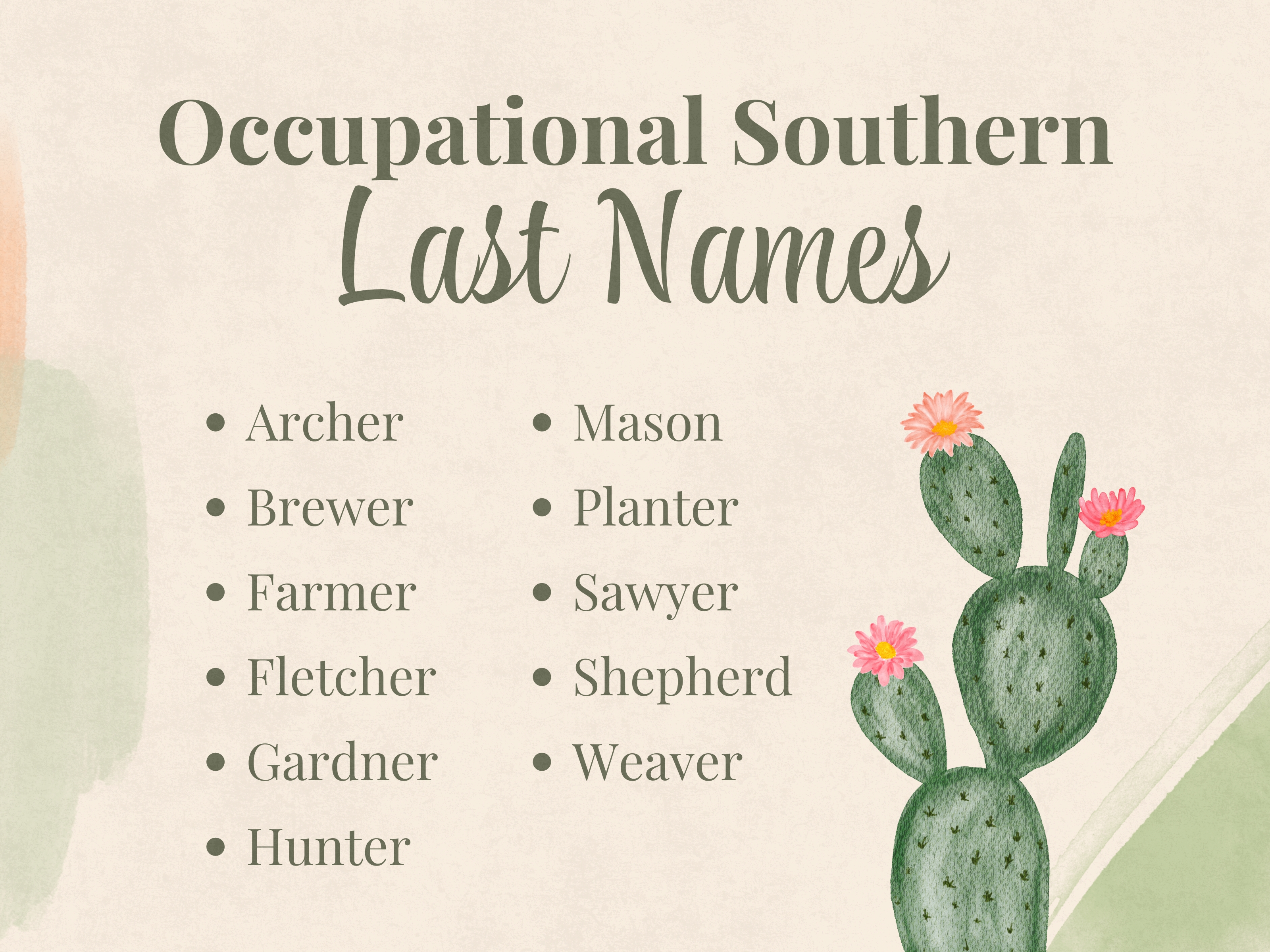
Occupational and Trade Surnames
- Baker an occupational surname for a baker.
- Barber a surname for a barber or groomer.
- Brewer a maker of ale or beer.
- Butcher a meat seller or meat cutter.
- Butler a household steward, often in charge of wine service.
- Carter someone who carried goods by cart.
- Chandler a candle maker or dealer.
- Clark originally a clerk, scholar, or scribe.
- Cook a household or professional cook.
- Cooper a maker of barrels and casks.
- Fletcher an arrow maker.
- Fuller a worker who cleaned and thickened cloth.
- Gardner a gardener or keeper of gardens.
- Harper a harp player or musician.
- Hunter one who hunted game.
- Mason a stone worker or builder.
- Miller a person who ran or worked at a mill.
- Palmer a pilgrim, especially one who carried a palm branch.
- Porter a gatekeeper or doorkeeper.
- Sawyer a wood cutter or saw operator.
- Shepherd a sheep herder.
- Smith a metalworker or blacksmith.
- Taylor a tailor or clothing maker.
- Tucker a cloth fuller, especially in southern English usage.
- Walker originally linked to cloth fulling, later a familiar occupational surname.
Patronymic and Family-Line Surnames
- Adams son or descendant of Adam.
- Andrews descendant of Andrew.
- Davidson son of David.
- Edwards son of Edward.
- Evans son of Evan.
- Harris descendant of Harry or Henry.
- Harrison son of Harry.
- Henderson son of Hendry or Henry.
- Jackson son of Jack.
- Jenkins little John or son of Jenkin.
- Johnson son of John.
- Jones descendant of John.
- Matthews son of Matthew.
- Nelson son of Neil or Nell.
- Owens son of Owen.
- Peters son of Peter.
- Richards descendant of Richard.
- Richardson son of Richard.
- Roberts descendant of Robert.
- Robertson son of Robert.
- Robinson son of Robin.
- Rogers descendant of Roger.
- Stephens son of Stephen.
- Thomas descendant of Thomas.
- Williams son of William.
Scots-Irish and Appalachian Southern Surnames
- Boyd often linked to fair or yellow coloring.
- Burns one who lived by a stream.
- Caldwell cold spring or cold well.
- Campbell traditionally interpreted as “crooked mouth.”
- Carson son of Carr.
- Crawford crow ford.
- Douglas dark water.
- Ferguson son of Fergus.
- Graham gravel homestead.
- Hamilton crooked hill.
- Kennedy often interpreted as helmeted head.
- Knox a hill or rounded rise.
- Logan little hollow.
- McAllister son of Alasdair.
- McBride son of a servant of Saint Brigid.
- McCall son of Cathal.
- McCoy son of Aodh, a name tied to fire.
- McDowell son of Dubhghall, often glossed as dark stranger.
- McIntyre son of the carpenter.
- McKee son of Aodh.
- McNeill son of Niall.
- Morrison son of Morris.
- Stewart steward or household manager.
- Wallace originally a name for a Welshman or foreigner.
- Wilson son of Will.
English Place, Landscape, and Nature Surnames
- Ashby ash-tree farm or settlement.
- Atwood someone who lived at the wood.
- Banks someone who lived on a hillside or riverbank.
- Barton barley farm or outlying farm.
- Beck a small stream.
- Bradley broad meadow.
- Brooks one who lived near brooks or streams.
- Clayton clay settlement.
- Dalton valley town.
- Fields one who lived by open country or fields.
- Ford a river crossing.
- Green one who lived near the village green.
- Hill a person who lived on or by a hill.
- Holloway someone who lived by a hollow road.
- Marsh one who lived near marshland.
- Meadows a dweller by meadows.
- Moore one who lived by a moor or open land.
- Perry linked to a pear tree or pear orchard.
- Rivers a person who lived near rivers or riverbanks.
- Stone someone who lived near a notable stone or rocky place.
- Sutton south settlement or southern town.
- Underwood one who lived below the woods.
- Wade one who crossed water at a ford.
- West a person from the west or western side.
- Woods someone who lived by woodlands.
French, Cajun, and Creole Louisiana Surnames
- Aucoin literally “at the corner.”
- Boudreaux commonly linked to Bordeaux or someone from that region.
- Bourgeois a town dweller or citizen.
- Broussard associated with brushwood or thickets.
- Cormier linked to the service tree.
- Fontenot tied to a fountain or spring.
- Foret forest.
- Gauthier army ruler.
- Hebert bright army.
- Landry ruler or power.
- LeBlanc white or fair.
- Lejeune the young one.
- LeMaire the mayor.
- LeMoine the monk.
- Marchand merchant.
- Mouton sheep.
- Noel Christmas.
- Olivier olive tree.
- Pelletier fur trader or skin dresser.
- Poirier pear tree.
- Richard brave ruler.
- Savoy a person from Savoy.
- Thibodeaux from a name meaning bold people.
- Trahan an old French family name likely based on a personal name.
- Vasseur tenant farmer or vassal.
Spanish, Tejano, and Gulf Coast Southern Surnames
- Alvarez son of Alvaro.
- Campos fields.
- Castillo castle.
- Cruz cross.
- Delgado slender.
- Diaz son of Diego.
- Dominguez son of Domingo.
- Flores flowers.
- Garza heron.
- Guerrero warrior.
- Herrera ironworker or blacksmith.
- Lopez son of Lope, linked to wolf.
- Martinez son of Martin.
- Medina city.
- Molina mill.
- Morales mulberry trees.
- Navarro a person from Navarre.
- Ortega nettle field.
- Reyes kings.
- Rios rivers.
- Romero pilgrim, especially one bound for Rome.
- Sanchez son of Sancho.
- Serrano mountain dweller.
- Solis sunny place or linked to the sun.
- Torres towers.
German and Central European Surnames Found in the South
- Becker baker.
- Braun brown-haired or brown-complexioned.
- Fischer fisherman.
- Frank originally a Frankish person or a free person.
- Hartmann strong man or hardy man.
- Hoffman farm steward or estate manager.
- Keller cellar keeper.
- Klein small.
- Kruger innkeeper or tavern keeper.
- Lang tall or long.
- Meyer farm steward or land manager.
- Muller miller.
- Neumann new man or newcomer.
- Richter judge.
- Roth red-haired.
- Schaefer shepherd.
- Schmidt smith.
- Schneider tailor.
- Schultz village official or sheriff-like officer.
- Weber weaver.
- Wagner wagon maker or cartwright.
- Weiss white or fair.
- Werner defending warrior.
- Wolf wolf, often a nickname for fierceness.
- Zimmerman carpenter.
Classic Southern Surnames with Strong Regional Flavor
- Abbott linked to an abbot or church official.
- Clay one who lived on clay soil.
- Cobb often tied to a rounded hill or lump-like shape.
- Cole dark-haired or swarthy.
- Duke leader or noble title name.
- English a person from England.
- Hardy brave or strong.
- Hatcher keeper or maker of gates or hatches.
- Hayes hedged enclosure.
- Hodge pet form of Roger.
- Justice linked to legal office or a reputation for fairness.
- Knight servant or mounted warrior.
- Lane someone who lived by a narrow road or lane.
- Lamb lamb keeper or a gentle-natured person.
- Long tall person.
- Mercer dealer in fine cloth.
- Pace peace.
- Poole one who lived near a pool or pond.
- Pope nickname for a solemn or priestly-looking person.
- Prince prince or chief.
- Sharp sharp-featured, clever, or quick.
- Short short person.
- Sparks lively or energetic person.
- Strong strong person.
- York from York.
How to Use Southern Last Names Well
If you are picking a Southern surname for a novel, screenplay, brand, or family-history project, the smartest move is matching the name to the region. A Cajun family in south Louisiana may carry a name like Boudreaux, Landry, or Thibodeaux. A mountain family in Tennessee or western North Carolina may sound more like Campbell, McDowell, or Stewart. A Texas family may carry Spanish surnames like Martinez, Herrera, or Torres. The right surname does a surprising amount of storytelling before a character says a single word.
For genealogy, surnames are clues, not final answers. Spelling changes, courthouse errors, marriage patterns, and local pronunciation can all reshape a family name. A LeBlanc line may appear as Blanc. A Scots-Irish name may lose its prefix. A Spanish surname may be shortened in American records. In other words, your family tree may be giving you hints, not subtitles.
Why Southern Surnames Still Matter
Southern last names remain powerful because they sit at the crossroads of identity, geography, memory, and migration. They can point to old trades, old faith communities, old land routes, and old family alliances. They can signal whether a family likely came through Virginia, the Carolinas, Appalachia, Louisiana, or the Gulf Coast. They can also remind us that the South has never been culturally simple. It has always been a layered region, shaped by many peoples whose names still echo in church rolls, military markers, school rosters, storefronts, and front-porch introductions.
That is what makes a list like this more than a naming catalog. These Southern surnames are small historical documents hiding in plain sight. Also, let’s be honest, some of them just sound fantastic. Broussard, Knox, Hayes, Torres, McCall, and Fontenot all bring serious main-character energy.
Experiences and Impressions Related to Southern Last Names
One of the most memorable things about Southern last names is how often they feel like they already come with a backstory. You do not just hear a name like Thibodeaux, McAllister, Hayes, or Poole and think, “That is a label.” You think, “That person probably has an aunt who makes something legendary for Thanksgiving, a granddad with a pocketknife older than the moon, and at least one cousin who can back a trailer into a space that looks mathematically impossible.” Southern surnames have a way of sounding lived in.
Spend enough time around Southern communities and you notice that last names are social shorthand. They show up on church signs, law offices, feed stores, race cars, real-estate banners, and tiny brass plaques on cemetery benches. Sometimes they are spoken with immediate recognition: “Oh, you are one of the Walkers from over by the river,” or “Those Campbells have been here forever.” In many Southern towns, a surname is not just part of your identity. It is also a location pin, a family archive, and occasionally a warning label delivered with a smile.
There is also a special Southern talent for making surnames work overtime. A last name may become a first name, a double name, or the name of a farm, road, or business. That is how you end up with people named things like Taylor Brooks or Parker Hayes, and nobody blinks. In the South, surnames regularly graduate into given names with the confidence of someone who has never once doubted the quality of their casserole recipe. The result is a naming culture that feels both traditional and surprisingly stylish.
Family research adds another layer of experience. Looking through Southern records often means meeting the same surnames again and again, but in different spellings, counties, and combinations. A McNeill becomes MacNeill. A Lejeune shows up in a record with creative spelling choices that suggest the clerk was doing his best and then immediately gave up. A Garza line crosses into a county where English spellings start nudging the original form around. That process can be frustrating, but it is also fascinating because it shows how language, migration, and bureaucracy all leave fingerprints on a family name.
Southern last names are also emotional. They are the names embroidered on quilt squares, carved into military stones, tucked into old recipes, and scribbled in the front pages of Bibles. They appear on deeds, land grants, school yearbooks, and recipe cards with butter stains that should honestly be considered historical artifacts. Even when you do not know the full genealogy, a Southern surname can still feel like a door left cracked open to the past.
And then there is the sound of them. Some Southern surnames are crisp and strong, like Knox, Clark, and York. Others stretch out with rhythm, like Boudreaux, Broussard, and Dominguez. Some feel sturdy and practical, like Miller, Carter, and Ford. Others carry a kind of poetic weight, like Holloway, Underwood, and Rivers. That musical quality is part of why Southern surnames are so appealing in fiction, branding, and family storytelling. They do not just identify people. They create mood.
In the end, that may be the best way to understand Southern last names: they are history that still gets introduced at the door. They tell stories about work, ancestry, movement, language, and belonging. They remind us that names are not random. They are inherited little maps, and in the South, a lot of those maps still lead somewhere interesting.
Conclusion
Southern last names are meaningful because they preserve the region’s mixed cultural roots while still feeling personal and familiar today. Whether your interest is family history, character naming, or pure curiosity, these surnames reveal how much history can live inside a few syllables. From occupational classics like Smith and Taylor to regional standouts like Boudreaux, Campbell, Torres, and Zimmerman, Southern surnames reflect the layered story of the American South in a way few other naming traditions can.













