
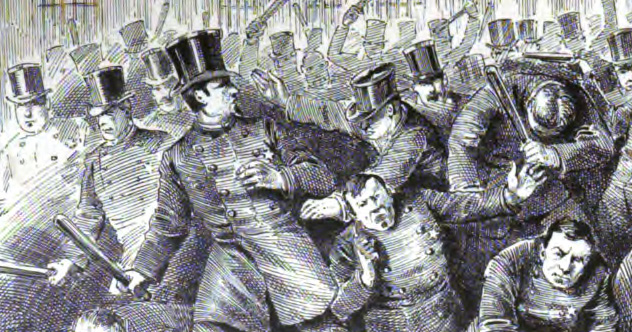
History is full of dramatic uprisings over taxes, kings, land, rights, food, labor, and freedom. Then there are the other riots: the ones that began with eggnog, straw hats, bad wine, clowns, Shakespeare, beer laws, and the ceremonial destruction of disco records. Humanity, it turns out, does not always wait for a grand ideological manifesto before flipping a table.
That does not mean these events were harmless. Many of the bizarre riots throughout history had serious causes hiding under ridiculous-looking triggers. A fight over theater could reveal class warfare. A riot over medical cadavers could expose poverty, racism, and the lack of ethical medical laws. A beer riot could really be about immigrant rights. The strange surface is often just the historical banana peel; underneath it is a much larger mess.
Below are ten of the weirdest riots in history, ranked not by body count or political importance, but by that special “wait, people rioted over what?” quality. Bring a helmet, a sense of humor, and maybe a seasonally appropriate hat.
1. The Nika Riots: Chariot Racing Fans Nearly Toppled an Empire
Modern sports fans can be intense, but the chariot-racing fans of Constantinople in 532 A.D. were operating at a completely different volume. The city’s two major factions, the Blues and the Greens, were not just cheering sections. They were part sports clubs, part political machines, part street gangs, and part “do not sit next to them at family dinner.”
The Nika Riots began after supporters from both factions demanded clemency for condemned men connected to earlier violence. When Emperor Justinian I refused to satisfy the crowd, the fans united under the chant “Nika,” meaning “victory” or “conquer.” That is a pretty energetic slogan for people who were supposedly just there for entertainment.
The uprising burned large parts of Constantinople, threatened Justinian’s throne, and ended only after imperial forces trapped and killed thousands inside the Hippodrome. The bizarre part is not merely that chariot racing caused chaos. It is that a sports rivalry briefly became a full-scale rebellion against one of history’s most famous emperors. Imagine a Super Bowl crowd declaring a new president because the referee made a bad call, and you are only halfway there.
2. The St. Scholastica Day Riot: Bad Wine, Worse Manners
In 1355, two Oxford students complained about the quality of wine at a local tavern. In a calm and mature society, this might have led to a refund, a bad Yelp review, or a pointed conversation about barrel management. Medieval Oxford chose another route.
The argument escalated into the St. Scholastica Day Riot, a violent town-versus-gown conflict between university students and townspeople. The fight spread through Oxford and reportedly left many dead. The trigger was almost absurdly small: allegedly bad wine served to scholars who took their customer feedback very, very seriously.
Of course, the real fuel was not wine alone. Medieval Oxford was already tense. Students enjoyed special privileges, townspeople resented university power, and young men with weapons and social immunity rarely improve a civic atmosphere. The wine dispute simply lit the match. It is one of history’s clearest reminders that when a community has enough dry tinder, even a tavern complaint can become a catastrophe.
3. The Doctors’ Riot of 1788: New York Erupts Over Stolen Corpses
The Doctors’ Riot in New York City sounds like the title of a horror-comedy, but the story was grim. In the late 1700s, medical students needed cadavers for anatomical study, yet legal access to bodies was extremely limited. Some doctors and students turned to grave robbing, often targeting the graves of poor and Black New Yorkers because society treated those communities as easier to exploit.
In 1788, public anger exploded after suspicions spread that bodies had been stolen for dissection. Crowds stormed medical facilities, destroyed specimens, and hunted for doctors. The disturbance lasted several days and led to deaths, injuries, and a major crisis of trust between the public and the medical profession.
On the bizarre-riot scale, this one ranks high because it involved mobs furious at anatomy students, hidden cadavers, and an early American city that suddenly looked like a gothic novel with cobblestones. Yet the deeper issue was deadly serious: who gets dignity after death, and who gets treated as raw material for someone else’s education?
4. The Eggnog Riot: West Point Cadets Go Full Holiday Goblin
Christmas at the United States Military Academy in 1826 did not deliver peace on earth. It delivered smuggled whiskey, unauthorized eggnog, broken windows, drawn swords, and a mess that would make any school administrator stare quietly into the middle distance.
Alcohol was banned at West Point under Superintendent Sylvanus Thayer, but cadets decided that Christmas without spiked eggnog was a bridge too far. Whiskey was smuggled in, the punch was mixed, and discipline evaporated faster than spilled rum near a fireplace. The resulting chaos involved about one-third of the student body, damage to academy property, confrontations with officers, and disciplinary hearings afterward.
The Eggnog Riot is bizarre because it took place at an institution designed to produce disciplined military leaders. It is even stranger because some cadets involved or nearby later became major figures in American history. It is a holiday lesson with brass buttons: never underestimate what young people can do when rules, boredom, status, and festive beverages collide.
5. The Flour Riot of 1837: Bread Prices Turned Manhattan Into a Powder Keg
The Flour Riot of 1837 may sound like a food fight with better branding, but it was really a hunger riot. New Yorkers were struggling with high prices, economic anxiety, and fears that merchants were hoarding flour while ordinary families could barely afford bread.
In February 1837, a protest meeting turned into direct action. Crowds attacked flour warehouses and destroyed barrels of flour and bushels of wheat. The event was brief, but it captured the fear and anger of a city where basic food felt increasingly out of reach.
The bizarre part is the image: people storming through Manhattan over flour, a pantry staple that rarely gets cast as a revolutionary object. But bread has always been political. When the price of survival rises too high, a barrel of flour stops being boring. It becomes a symbol of whether the system is feeding people or squeezing them.
6. The Astor Place Riot: When Shakespeare Fans Got Deadly Serious
Today, a disagreement over Shakespeare usually ends with someone quoting “to be or not to be” and everyone else checking their phone. In 1849 New York, it helped trigger one of the deadliest civic disturbances the city had seen.
The Astor Place Riot grew out of a bitter rivalry between American actor Edwin Forrest and British actor William Charles Macready. Their competing styles and national identities became symbols of class, culture, and politics. Forrest appealed to many working-class American audiences. Macready was associated with British refinement and New York’s upper crust. In other words, Macbeth had somehow become a class war in tights.
When Macready performed at the Astor Place Opera House, protesters gathered outside. The confrontation escalated, militia fired on the crowd, and dozens were killed or wounded. The riot is bizarre because its obvious subject was theater criticism. Its real subject was who owned American culture: elite tastemakers or rowdy democratic audiences who wanted their Shakespeare loud, emotional, and preferably not British.
7. The Lager Beer Riot: Chicago Fights for Its Sunday Pint
Chicago’s 1855 Lager Beer Riot began with laws that targeted taverns, Sunday drinking, and liquor licenses. Mayor Levi Boone’s administration pushed policies that many German and Irish immigrants saw as anti-immigrant and anti-working-class. For laborers who worked six days a week, Sunday beer was not just refreshment. It was community, culture, and the tiny weekly reward for not throwing a brick through life.
When authorities cracked down, resentment boiled over. Protesters clashed with police, one person died, and dozens were arrested. The riot became an important moment in Chicago’s political development, helping reveal the power of immigrant communities and the limits of moral reform imposed from above.
On the surface, this was a riot over beer. Underneath, it was about who got to define public morality in a fast-growing city. The bizarre part is that a glass of lager became a battleground for religion, ethnicity, class, labor, and local democracy. Beer: apparently not just for awkward barbecues.
8. The Toronto Circus Riot: Clowns Versus Firefighters
Some historical events require no embellishment. In 1855 Toronto, a group of American circus clowns got into a fight connected to a brothel, local firefighters became involved, and the conflict eventually led to a riot in which the circus was attacked. That sentence sounds like it was assembled from rejected movie pitches, but it happened.
The Toronto Circus Riot involved members of the S.B. Howes’ Star Troupe Menagerie and Circus, local Hook and Ladder firefighters, and broader tensions around police favoritism and civic corruption. Volunteer fire companies in the era could be rough, territorial groups. Circus performers were not exactly known for quiet evenings and early bedtimes. Add alcohol, local rivalries, and weak policing, and suddenly the big top is less “family entertainment” and more “municipal crisis with elephants nearby.”
The riot contributed to public outrage over policing and helped push reforms in Toronto. Its strangeness lies in the cast list: clowns, firefighters, police, and a traveling circus. It is one of the rare moments when “send in the clowns” was not a solution, but the beginning of the problem.
9. The Straw Hat Riot: Fashion Police, But Actually Violent
New York’s 1922 Straw Hat Riot is proof that fashion rules can become ridiculous when enforced by bored young men with too much confidence. At the time, many men followed an unwritten custom: straw hats were acceptable in summer, but after a certain September date, they were supposed to disappear until the next warm season.
Some youths decided to enforce this rule early by knocking straw hats off men’s heads and smashing them. The prank turned into fights. Dockworkers fought back. The conflict spread, leading to arrests and injuries over several days.
It is easy to laugh at a riot over hats, and frankly, history is not making it difficult. But the Straw Hat Riot also says something about masculinity, public humiliation, and the power of social rules. A hat was not just a hat. It was status, dignity, and a sign that a man knew how to belong in the city’s seasonal code. Still, the lesson remains clear: never trust anyone who thinks calendar-based hat enforcement requires violence.
10. Disco Demolition Night: The Baseball Promotion That Ate Itself
On July 12, 1979, the Chicago White Sox hosted Disco Demolition Night at Comiskey Park. Fans could bring disco records for discounted admission, and the records would be blown up between games of a doubleheader. As promotional ideas go, this one had the subtle elegance of lighting a barbecue inside a library.
Radio DJ Steve Dahl, who had built an anti-disco persona after losing a job when his station changed formats, helped lead the event. The crowd was much larger and rowdier than expected. After the records were exploded on the field, fans stormed the diamond, damaged the playing surface, and caused the second game to be forfeited.
Disco Demolition Night was bizarre because it combined baseball, music backlash, cheap tickets, explosives, and cultural resentment into one extremely bad evening. It also had deeper implications. Many critics later argued that anti-disco hostility carried racial and homophobic undertones because disco was strongly associated with Black, Latino, and LGBTQ communities. The night remains a famous example of a stunt that confused “promotion” with “summon chaos and hope it buys nachos.”
Why Bizarre Riots Happen: The Serious Pattern Behind the Weirdness
The strangest riots in history usually look silly only from a distance. Up close, they reveal pressure building beneath daily life. People rarely riot because of one hat, one drink, one actor, or one record crate. They riot because the object becomes a symbol. The hat stands for public shame. The eggnog stands for rebellion against authority. The beer stands for immigrant culture. The cadaver stands for exploitation. The chariot race stands for political identity. The disco record stands for a changing society some people refused to accept.
This is why bizarre historical events are useful for more than trivia night. They remind us that public disorder often begins when institutions ignore what people are actually feeling. A crowd may chant about victory, wine, or theater, but the emotional engine is usually older: resentment, fear, scarcity, identity, humiliation, or distrust.
Modern Experiences That Make These Riots Feel Less Distant
Most of us have never watched chariot factions try to overthrow an emperor, and for that we should be grateful. Still, the emotional ingredients behind these bizarre riots are surprisingly familiar. Anyone who has been in a packed stadium after a devastating loss knows how quickly a crowd can change temperature. One minute, everyone is united by jerseys and overpriced snacks. The next, a few angry people start shouting, and the whole space feels different. You do not need an ancient Hippodrome to understand group energy. A sold-out arena, a transit station after a cancelled event, or a downtown street after a championship game can teach the same lesson.
Fashion-based conflict also has modern echoes. The Straw Hat Riot sounds absurd, but social media enforces style rules every day. Wear the wrong thing, say the wrong phrase, like the wrong trend too late, and the internet may not smash your hat, but it can absolutely stomp your confidence. Public humiliation remains a powerful accelerant. Human beings are social animals, and few things make us more irrational than being laughed at in front of others.
The Eggnog Riot feels familiar to anyone who has seen a strict institution underestimate youthful rebellion. Schools, offices, military academies, and even homeowner associations can create rules that seem sensible on paper but become symbolic targets. Sometimes people break rules because they want the forbidden object. Sometimes they break them because they want to prove the rule-maker cannot control everything. The eggnog was not just eggnog. It was a creamy little declaration of independence with nutmeg on top.
The Flour Riot connects to a modern experience that is not funny at all: watching basic costs rise faster than wages. Food prices, rent, fuel, and medical bills can turn ordinary life into a daily math problem with no good answer. When people feel that essentials are being hoarded, manipulated, or priced beyond reach, anger becomes easier to understand. A bag of flour in 1837 and a grocery receipt today both answer the same question: can working people afford to live?
The Astor Place Riot and Disco Demolition Night also feel modern because culture still divides people into teams. Music, movies, celebrities, sports, and even restaurant preferences can become identity badges. People do not merely say, “I dislike this.” They say, “People like me dislike this, and people like them enjoy it.” That is where culture gets combustible. Once taste becomes tribe, an actor or a song can carry the weight of class, race, politics, gender, and belonging.
What these experiences teach is simple: bizarre riots are rarely random. They are human emotion wearing a ridiculous costume. Sometimes the costume is a straw hat. Sometimes it is a clown suit. Sometimes it is a disco record sailing across a baseball field. The comedy catches our attention, but the analysis keeps the story useful.
Conclusion
The 10 utterly bizarre riots throughout history prove that the past was not a calm museum hallway filled with serious men writing documents by candlelight. It was loud, sweaty, impulsive, and occasionally dressed in a straw hat it should apparently not have been wearing after September 15.
These strange historical riots are funny in outline but revealing in detail. A bad glass of wine exposed town-and-gown hostility. A holiday drink challenged military discipline. A theater rivalry became a class conflict. A baseball promotion revealed cultural resentment. A fight involving clowns helped spotlight policing problems. The triggers were weird, but the causes were human.
That is why bizarre history remains so compelling. It lets us laugh, then think. It shows that society can turn fragile when pride, scarcity, identity, and authority collide. And it reminds us that before dismissing any public outburst as “just about hats” or “just about beer,” we should ask what the hat or beer has come to represent. History may be strange, but it is rarely shallow.











