
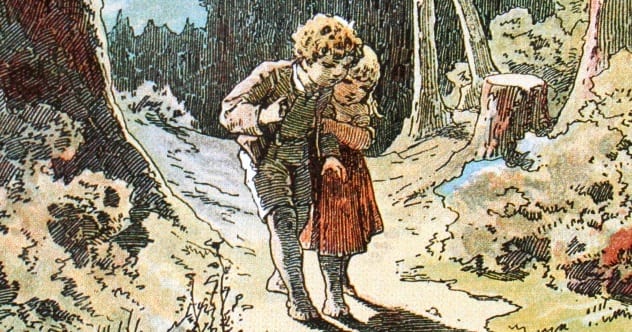
Fairy tales are often sold as cozy packages containing princesses, enchanted castles, helpful woodland creatures, and enough glitter to clog a royal vacuum cleaner. Open an early collection, however, and the atmosphere changes quickly. The birds are delivering warnings, the forests have terrible safety records, and marriage proposals occasionally lead to rooms full of former wives.
The darkest fairy tales were shaped by societies familiar with hunger, disease, dangerous travel, unequal marriages, child abandonment, and sudden death. Their supernatural horrors frequently magnified real fears. A witch might represent starvation, a murderous husband could dramatize the danger of marrying a stranger, and a cruel parent might embody the terrifying vulnerability of childhood.
This ranking considers the severity of each story’s violence, psychological cruelty, tragic consequences, and underlying themes. It focuses on early literary versions associated with the Brothers Grimm, Hans Christian Andersen, Charles Perrault, and Giambattista Basile. Because these tales contain child death, mutilation, cannibalism, coercion, and sexual violence, readers should proceed with the same caution they would bring to a suspicious cottage made entirely of dessert.
Why Were Original Fairy Tales So Dark?
Many traditional fairy tales circulated orally before collectors placed them in books. They were not created exclusively for young children, and they changed whenever storytellers adapted them to new audiences. Some versions emphasized humor, some added religious lessons, and others used spectacular punishments to make moral consequences impossible to miss.
The Brothers Grimm published the first volume of Children’s and Household Tales in 1812 and repeatedly revised the collection. Later editions removed or softened some sexual material while often preserving, expanding, or moralizing the violence. Hans Christian Andersen followed a different path: he wrote literary fairy tales whose sadness frequently came from rejection, poverty, sacrifice, or spiritual longing rather than from a villain receiving a conveniently timed push into an oven.
Modern adaptations generally retain the magical architecture while renovating the disturbing rooms. The following ten stories reveal what was left behind during that remodeling process.
10. Cinderella
The Slipper Fits, but the Punishment Is Brutal
Charles Perrault’s influential version of Cinderella gives readers the pumpkin coach, fairy godmother, and glass slipper familiar from later adaptations. The Brothers Grimm’s Aschenputtel, however, replaces the fairy godmother with a magical tree growing near Cinderella’s mother’s grave. Birds help the heroine complete impossible chores and provide her with beautiful clothing.
The real darkness arrives when the prince searches for the mysterious woman whose golden slipper he possesses. One stepsister cuts off a toe to force her foot into it. The other removes part of her heel. Both attempts fail because birds alert the prince to the blood inside the shoe. At Cinderella’s wedding, pigeons peck out the stepsisters’ eyes, leaving them blind.
The violence is not random decoration. It turns vanity and deception into literal self-destruction. The stepsisters mutilate themselves in pursuit of social status, then lose the ability to see after repeatedly refusing to recognize Cinderella’s humanity. Subtle? No. Memorable? Unfortunately, extremely.
9. The Goose-Girl
A Talking Horse and a Barrel Full of Nails
In the Grimm tale The Goose-Girl, a princess travels to marry a distant prince. Along the way, her servant forces her to exchange clothes and identities. The servant enters the palace as the royal bride, while the real princess is assigned to herd geese.
The false bride also orders the death of Falada, the princess’s loyal horse. His severed head is nailed above a gateway, where it continues speaking whenever the princess passes. This is somehow both touching and a serious concern for the palace sanitation department.
An old king eventually discovers the deception. Rather than naming the guilty servant directly, he describes the crime and asks her to choose a suitable punishment. She declares that such a deceiver should be stripped, placed inside a barrel lined with sharp nails, and dragged through the streets by horses. The king announces that she has judged herself and orders the sentence carried out.
The story’s darkness comes from humiliation, stolen identity, animal death, and merciless justice. Its message is clear: cruelty may temporarily wear royal clothing, but eventually it writes its own verdict.
8. The Little Mermaid
Every Step Hurts, and Love Still Fails
Hans Christian Andersen’s The Little Mermaid is far more painful than the popular romance many readers expect. The young mermaid wants the prince, but she also desires the immortal soul that humans possess. To enter his world, she bargains with the sea witch and surrenders her voice.
Her transformation is not painless magic. Walking on human legs feels as though she is stepping on sharp blades, yet she dances beautifully to please the prince. He cares for her but chooses another woman as his bride. The mermaid is told that she can return to the sea by killing him and letting his blood fall on her feet. She refuses.
At sunrise, she throws herself into the water and dissolves into foam. Andersen then gives her a spiritual continuation as one of the “daughters of the air,” allowing her to work toward an immortal soul through good deeds.
The tale is dark because suffering earns no romantic reward. Her sacrifice is meaningful, but it does not make the prince love her. The story asks whether love remains noble when it requires abandoning one’s body, family, voice, and future.
7. The Little Match Girl
The Monster Is Public Indifference
No witch appears in The Little Match Girl. There is no enchanted murderer, locked chamber, or hungry ogre. Andersen needs only poverty, winter weather, and a city full of people who do not stop to help.
On New Year’s Eve, a poor child wanders barefoot through the freezing streets, trying to sell matches. She is afraid to return home because she has sold nothing and expects punishment. To warm herself, she lights the matches one by one. Each flame produces a comforting vision: a stove, a feast, a Christmas tree, and finally her loving grandmother.
Desperate to keep her grandmother near, the girl lights the entire bundle. In the vision, the grandmother carries her away to a place without hunger or cold. The next morning, people find the child dead in the snow. They notice the burned matches but cannot understand the hope she experienced during her final moments.
This is one of the darkest fairy tales because its tragedy is entirely plausible. Magic provides emotional escape but no physical rescue. The real horror is a community able to walk past a suffering child and continue celebrating.
6. The Red Shoes
A Fashion Choice Becomes a Death Sentence
Andersen’s The Red Shoes follows Karen, a poor girl adopted by a wealthy older woman. Karen becomes obsessed with a beautiful pair of red shoes. She wears them to church and focuses more on her appearance than on worship, charity, or the woman who cares for her.
A mysterious soldier remarks on the shoes, and soon Karen cannot control her feet. She dances across roads, fields, graveyards, and forests, unable to stop even when exhausted. The shoes continue carrying her away from responsibilities and human connection.
Finally, Karen begs an executioner to cut off her feet. He does so, but the severed feet continue dancing in the red shoes. Even after she receives wooden replacements, the enchanted shoes block her path when she tries to enter church. Karen eventually finds spiritual peace through repentance, service, and humility, but she dies soon afterward.
The story can be read as a severe warning against vanity, pride, and distraction from religious duty. Its punishment is so disproportionate, however, that the moral arrives wearing steel-toed boots and kicking down the front door.
5. The Girl Without Hands
A Father Chooses Himself Over His Daughter
In the Grimm story The Girl Without Hands, a poor miller meets a mysterious man who promises him wealth in exchange for whatever stands behind his mill. Believing he is surrendering an apple tree, the miller agrees. He later discovers that his daughter was standing there and that the stranger was the devil.
Because the girl’s purity prevents the devil from taking her, he orders the miller to cut off her hands. The father initially protests, but when the devil threatens him instead, he obeys. His daughter forgives him and leaves home with her mutilated arms tied behind her back.
The remainder of the tale includes a royal marriage, forged letters, exile, attempted infanticide, years of wandering, divine assistance, and the miraculous restoration of the woman’s hands. She eventually reunites with her husband and child.
The happy ending cannot erase the central betrayal. The person responsible for protecting the girl sacrifices her body to preserve his own life and wealth. The supernatural villain is frightening, but the father’s cowardice makes the story truly disturbing.
4. Bluebeard
The Forbidden Room Contains a Marriage History
Charles Perrault’s Bluebeard begins with a wealthy man whose unusual beard and missing former wives make him an alarming romantic prospect. Nevertheless, a young woman marries him after enjoying his luxurious hospitality.
Before leaving on a journey, Bluebeard gives his wife keys to every room in his estate. She may enter any chamber except one. Naturally, this guarantees that the forbidden door will receive her immediate and undivided attention.
Inside, she discovers the bodies of Bluebeard’s previous wives. In shock, she drops a magical key into their blood. The stain cannot be removed. Bluebeard returns, sees the evidence, and prepares to kill her. She delays him while her sister watches for their brothers, who arrive in time to save her and kill Bluebeard.
Although Perrault attached a moral criticizing curiosity, modern readers are more likely to notice the tale’s portrait of coercive control. Bluebeard creates a test, isolates his wife, monitors her obedience, and uses a minor violation to justify murder. The room is horrifying, but the calculated trap outside it is worse.
3. Sun, Moon, and Talia
The Early Sleeping Beauty Was Not a Romance
Giambattista Basile’s seventeenth-century Sun, Moon, and Talia is an early literary relative of Sleeping Beauty. Astrologers warn that Talia will face danger from flax. When a splinter enters her finger, she collapses. Her father leaves her unconscious in an isolated palace.
A married king later discovers her. Unable to wake Talia, he sexually violates her and returns to his kingdom. Still unconscious, she gives birth to twins. One child sucks the flax splinter from her finger, awakening her.
The king eventually returns and begins a relationship with Talia. His jealous wife learns about Talia and the children, named Sun and Moon. She orders a cook to kill the twins and serve them to their father, but the cook hides them. The queen then tries to burn Talia alive. The king intervenes, and the queen is executed instead.
Later retellings transformed this material into a gentler rescue story involving an enchanted sleep and awakening kiss. Basile’s version is dark because its heroine is repeatedly denied agency, first by fate, then by the king, and finally by a queen who treats children as ingredients.
2. The Robber Bridegroom
The Engagement Party Becomes Evidence at Trial
In the Brothers Grimm’s The Robber Bridegroom, a miller promises his daughter to a wealthy suitor. She distrusts the man but is pressured to visit his isolated house in the forest. A caged bird warns her that she has entered a murderer’s home.
An old woman hides the bride behind a barrel. The bridegroom and his band return with another young woman, kill her, dismember her body, and prepare it for cannibalism. When one robber chops off the victim’s finger to remove a ring, the finger flies behind the barrel and lands in the hidden bride’s lap.
The old woman helps her escape. During the wedding feast, the bride recounts what she witnessed while repeatedly pretending it was only a dream. At the climax, she produces the severed finger and ring as evidence. The bridegroom and his companions are captured and executed.
This gruesome fairy tale is also a survival story. The heroine trusts her fear, pays attention to warnings, gathers proof, and exposes a respected man whose wealth has concealed monstrous behavior. It is a crime thriller several centuries early, complete with the world’s least pleasant wedding favor.
1. The Juniper Tree
Child Murder, Cannibalism, and a Singing Witness
The Juniper Tree earns the top position because it compresses domestic jealousy, child murder, cannibalism, psychological manipulation, and supernatural revenge into one deceptively beautiful narrative.
A stepmother resents her young stepson because she wants her daughter to inherit the family property. She lures the boy to a chest, slams its lid onto his neck, and kills him. She then arranges his body to make the death appear accidental and convinces her daughter that she caused it.
The stepmother cooks the boy in a stew and serves him to his father, who unknowingly eats his son. The boy’s sister gathers his bones and buries them beneath a juniper tree. A magical bird emerges and travels through town singing about the crime. By performing its song, the bird receives gifts: a gold chain, red shoes, and a millstone.
It rewards the father and sister, then drops the millstone onto the stepmother, killing her. The bird transforms back into the boy, restoring the family.
The resurrection offers relief, but it cannot make the preceding events less horrifying. The Juniper Tree is the darkest fairy tale on this list because love and violence occupy the same household, and the family dinner becomes the scene of an atrocity no one fully understands until the dead child tells his own story.
What the Darkest Fairy Tales Have in Common
These stories come from different authors and traditions, yet several patterns connect them.
Home Is Often More Dangerous Than the Forest
The central threat frequently comes from a parent, spouse, future spouse, servant, or caregiver. Fairy tales warn that social respectability does not guarantee safety. A polished castle may hide more danger than a witch’s cottage.
Bodies Become Moral Symbols
Feet, hands, eyes, tongues, and voices are repeatedly injured or taken away. Physical transformations make internal conflicts visible. Vanity damages feet, deception costs eyesight, and the surrender of a voice represents the loss of personal power.
Justice Is Spectacular
Traditional fairy-tale justice rarely involves counseling, probation, or a thoughtful restorative circle. Villains are crushed, blinded, burned, dragged, or executed. These extreme endings give powerless audiences the fantasy of seeing hidden wrongdoing publicly exposed and permanently defeated.
Magic Reveals Rather Than Causes the Horror
The supernatural elements often expose crimes already rooted in ordinary human behavior. Talking birds reveal murder. Enchanted keys preserve evidence. Visions illuminate poverty. The magic is strange, but jealousy, greed, abuse, and indifference are painfully familiar.
Reading Experience: What Happens When You Return to These Tales as an Adult?
Reading the darkest fairy tales as an adult is a surprisingly different experience from encountering simplified versions in childhood. At first, the gruesome details attract most of the attention. It is difficult to think deeply about symbolism while processing the fact that Cinderella’s stepsisters have begun performing unauthorized foot surgery. Yet the shock eventually gives way to recognition.
Adult readers notice how often the stories revolve around insecurity. Food may disappear. Parents may die. A marriage can place a young woman under the authority of a stranger. Wealth can vanish overnight. Children depend on adults who may be weak, jealous, frightened, or selfish. The magic exaggerates these anxieties, but it does not invent them.
A useful reading experience begins by comparing versions. Reading Perrault’s Cinderella beside the Grimm tale shows how one narrative can emphasize forgiveness while another demands punishment. Comparing modern Sleeping Beauty adaptations with Sun, Moon, and Talia demonstrates how cultural expectations reshape questions of consent, romance, and heroism. Andersen’s Little Mermaid becomes even more powerful when approached not as a failed love story but as a meditation on identity and spiritual longing.
It also helps to read slowly. Fairy tales move quickly, sometimes covering marriage, exile, childbirth, attempted murder, and royal restoration in a few pages. Characters rarely pause to analyze their trauma. Readers must perform that work themselves. What would it mean to trust a parent after the events of The Girl Without Hands? Can the family in The Juniper Tree truly return to normal? What does Bluebeard’s wife feel after learning that curiosity saved her from becoming another hidden body?
Discussing the stories with other readers adds another layer. One person may interpret The Red Shoes as a religious warning against vanity, while another sees an authoritarian culture punishing a girl for self-expression. Someone may view the violent endings as emotionally satisfying justice; someone else may find them evidence of a world unable to imagine rehabilitation. Fairy tales survive because they can support conflicting interpretations without becoming empty.
The experience is not entirely grim. These stories contain moments of extraordinary resilience. The bride in The Robber Bridegroom escapes, preserves evidence, and controls the public telling of her story. The mermaid refuses to save herself through murder. The sister in The Juniper Tree treats her brother’s remains with tenderness when the adults have failed him. Even in brutal worlds, compassion remains possible.
Returning to these tales can therefore be unsettling, fascinating, and oddly comforting. They admit that homes may be unsafe, adults may fail, love may be unreturned, and justice may arrive late. At the same time, they insist that hidden truths can speak, false identities can collapse, and vulnerable people can survive situations designed to silence them. The happily-ever-after endings may be imperfect, but reaching them still feels like emerging from a dark forest and finally seeing the road.
Conclusion
The ten darkest fairy tales are memorable not simply because they contain blood, severed limbs, cursed objects, and villains with deeply questionable meal plans. Their horrors give physical form to fears that remain recognizable: abandonment, abuse, poverty, forced obedience, social exclusion, and the loss of personal identity.
Modern retellings often remove the cruelty while preserving the wonder. That approach makes the stories accessible, but reading the older versions reveals why they endured. Beneath the magic are warnings about power, trust, survival, and the consequences of ignoring danger. Once those original shadows are visible, even the brightest fairy-tale castle looks a little different.












