
Long before Santorini became the postcard-perfect Greek island of whitewashed houses, blue domes, honeymoon sunsets, and tourists trying very hard not to slip on volcanic steps, it was home to one of the most remarkable cities of the Bronze Age: Akrotiri. This ancient settlement, buried by the catastrophic eruption of Thera, is often called the “Pompeii of the Aegean.” The nickname is catchy, but it only tells half the story. Akrotiri was older than Pompeii, wealthier than many people imagine, and surprisingly advanced for a city that flourished more than 3,500 years ago.
Located on the island of Thera, now known as Santorini, Akrotiri was preserved under layers of volcanic ash and pumice after one of the most powerful eruptions of the ancient world. That disaster destroyed the city, but it also created an archaeological time capsule. Streets, houses, pottery, drainage systems, wall paintings, storage jars, tools, and traces of daily life survived in astonishing condition. In other words, the volcano was both villain and accidental museum curator.
What makes Akrotiri so fascinating is not only the destruction, but the life that came before it. The city reveals a society with international trade, sophisticated architecture, colorful art, practical engineering, and a deep connection to the sea. Here are 10 amazing facts about Akrotiri, the Bronze Age city wiped out by a volcanoand why it still feels strangely modern today.
1. Akrotiri Was a Bronze Age City Before Classical Greece Existed
When people think of ancient Greece, they often jump straight to Athens, Sparta, marble temples, philosophers, and dramatic speeches in sandals. Akrotiri belongs to a much earlier chapter. The settlement flourished during the Aegean Bronze Age, centuries before the Classical Greek world that produced Socrates, the Parthenon, and democracy.
Evidence suggests that the area was inhabited as early as the fifth millennium BCE, beginning as a modest fishing and farming community. Over time, it grew into a prosperous town with paved streets, multi-story buildings, workshops, storage areas, and a busy maritime economy. By the second millennium BCE, Akrotiri had become one of the most important settlements in the Cyclades.
This matters because Akrotiri gives us a rare look at the pre-Greek cultures of the Aegean. It was Cycladic, deeply connected with Minoan Crete, and plugged into a wider Mediterranean network. It was not “ancient Greece” in the familiar textbook sense; it was something older, more mysterious, and just as impressive.
2. The Volcano That Destroyed Akrotiri Also Preserved It
The eruption of Thera, usually dated around the 17th or 16th century BCE, was one of the largest volcanic events of the ancient world. It reshaped Santorini, blasted material into the atmosphere, and buried Akrotiri beneath volcanic debris. The eruption also helped form the dramatic caldera that modern visitors admire today, usually while taking far too many sunset photos.
The destruction was catastrophic. Ash, pumice, pyroclastic material, earthquakes, and possible tsunamis transformed the island and disrupted the surrounding Aegean. But the same volcanic layers that ended Akrotiri also sealed it away from air, weather, and later human disturbance. Organic materials usually vanish over time, but at Akrotiri, archaeologists have found impressions of wooden furniture, storage containers, and architectural details that would normally disappear.
This is why Akrotiri is such a powerful archaeological site. The eruption did not merely leave ruins; it froze a city’s final phase. The result is a Bronze Age snapshot with an unusual level of detail.
3. No Human Skeletons Have Been Found in the City
Here is one of Akrotiri’s strangest mysteries: despite the scale of the disaster, excavators have not found human skeletons in the buried town. That makes Akrotiri very different from Pompeii, where the remains of victims became part of the site’s haunting story.
The absence of human remains suggests that many residents may have had warning. Earthquakes likely damaged the town before the final eruption, giving people time to flee. Archaeological evidence also points to attempts at clearing rubble after earlier tremors, meaning the eruption was probably not a single surprise event that caught everyone mid-breakfast.
Of course, this does not mean the story had a happy ending. People may have escaped the city but still faced ashfall, famine, displacement, dangerous seas, or tsunami waves elsewhere. Their final fate remains unknown. Still, Akrotiri’s empty streets tell a powerful story: this may have been a city evacuated before it was buried.
4. Akrotiri Had Multi-Story Buildings and Smart Urban Planning
Akrotiri was not a cluster of huts clinging nervously to a volcano. It was a planned, sophisticated town. Excavations have revealed buildings with two or three stories, stone staircases, rooms arranged around light wells, workshops, storage spaces, and streets that indicate careful urban organization.
The city’s architecture shows both practicality and elegance. Some buildings had ashlar masonry, meaning carefully cut stone blocks were used in construction. Others contained large storage jars, work areas, and decorated rooms. The layout suggests a community comfortable with urban life, trade, craft production, and social organization.
For a Bronze Age settlement, this level of planning is impressive. Akrotiri was not merely surviving; it was thriving. Its people understood how to build upward, organize space, move goods, store food, manage water, and decorate interiors. Not bad for a city that existed when much of Europe was still trying to decide whether mud, straw, and optimism made a proper wall.
5. The City Had an Advanced Drainage System
One of the most surprising facts about Akrotiri is its drainage system. The town had channels and pipes that helped manage wastewater, connecting buildings to a broader urban network. This is the kind of detail that makes modern visitors blink and think, “Wait, they had plumbing?”
Yes, in a practical Bronze Age sense, they did. The presence of drainage systems shows that Akrotiri’s residents cared about sanitation, comfort, and city maintenance. Water management was essential on a volcanic island, and the people of Akrotiri appear to have developed smart solutions for everyday needs.
This is one reason the site feels so modern. We expect ancient ruins to give us temples, tombs, and mysterious statues. Akrotiri gives us infrastructure. It reminds us that civilization is not only about kings and warriors; it is also about pipes, streets, storage, and not letting wastewater become everyone’s problem.
6. Akrotiri’s Frescoes Are Among the Most Beautiful Images of the Bronze Age
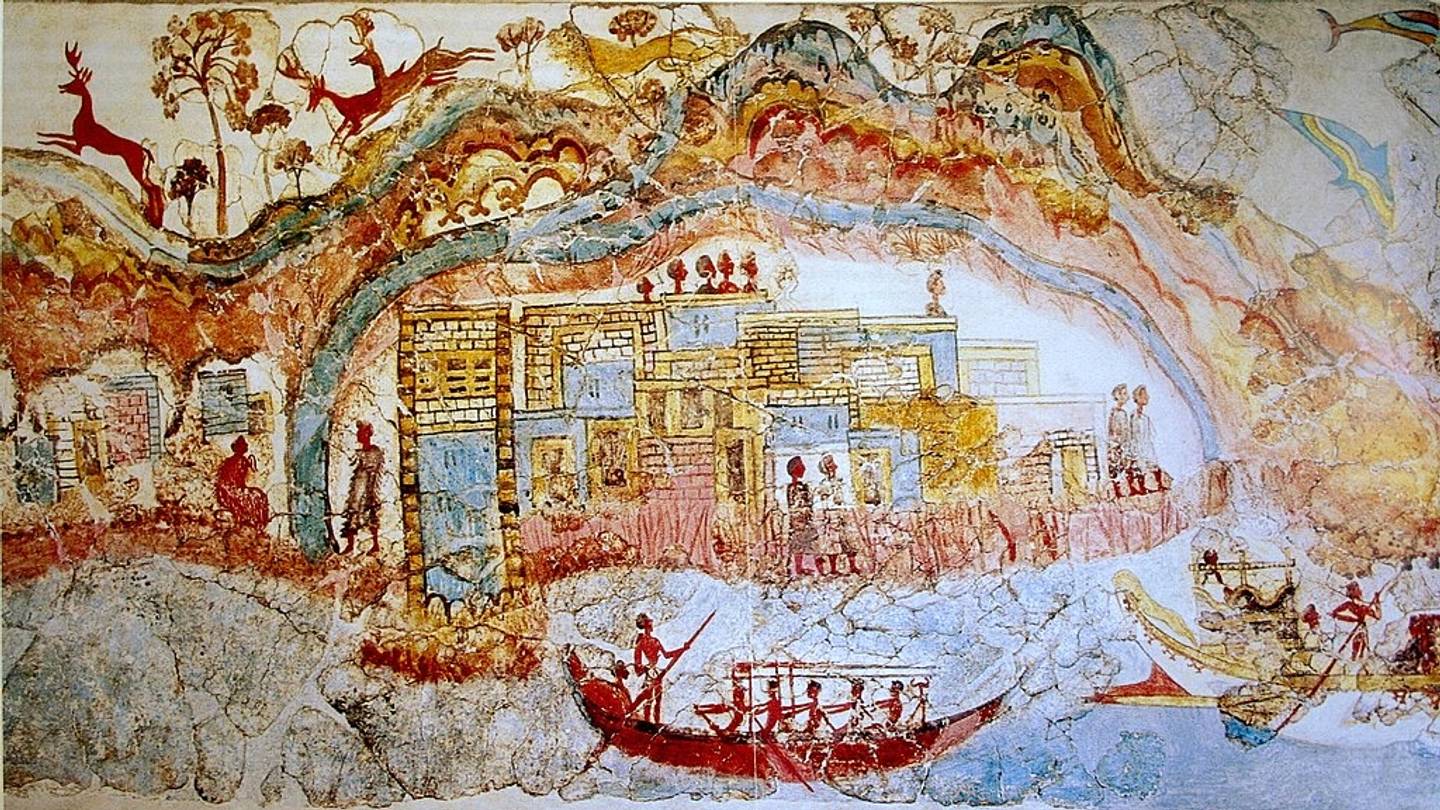
The wall paintings of Akrotiri are spectacular. They show fishermen, boxers, antelopes, blue monkeys, swallows, dolphins, ships, plants, women gathering saffron, and vivid scenes of nature and ritual life. These frescoes are not dull decorations slapped onto walls to impress guests. They are vibrant, elegant, and full of movement.
What makes them even more remarkable is where they were found. Frescoes decorated many buildings, not only elite palaces. This suggests that art played a broad role in Akrotiri’s urban culture. Beauty was not hidden away in one royal building; it appeared throughout the town.
The paintings also reveal what mattered to the people of Akrotiri. The sea appears again and again. Animals, flowers, ships, and landscapes fill the walls. The city’s artists were not obsessed with battle scenes or giant kings crushing enemies. Instead, they painted a world of movement, color, ritual, nature, and trade. If Akrotiri had an Instagram account, it would probably be full of dolphins, saffron flowers, and moody Aegean horizons.
7. Akrotiri Was a Major Trading Hub
Akrotiri’s location made it valuable. Santorini sits in the southern Aegean, between Crete, mainland Greece, the Cyclades, and routes leading toward the eastern Mediterranean. The city benefited from maritime trade and cultural exchange, becoming part of a wide network that included Crete, Cyprus, Egypt, Anatolia, and other Aegean communities.
Archaeologists have found imported goods, pottery styles, raw materials, and evidence of craft specialization. Akrotiri was especially well placed for trade involving metals, including copper, which was essential for bronze production. Bronze, after all, is what gives the Bronze Age its name. No copper, no bronze; no bronze, no fancy tools, weapons, or prestige objects.
This trading identity helps explain the city’s wealth. Akrotiri was not isolated on a pretty island. It was a busy, connected, sea-facing community. Its residents likely knew foreign goods, foreign styles, foreign stories, and perhaps even foreign languages. The town was cosmopolitan long before anyone invented airport lounges.
8. Akrotiri Was Influenced by Minoan Culture, But It Was Not Simply “Minoan”
Akrotiri is often described as a Minoan city because its art and architecture show strong connections with Minoan Crete. That is understandable, but the label needs caution. Akrotiri was located in the Cyclades, not on Crete, and it belonged to a local island culture that absorbed and adapted outside influences.
The city’s frescoes, building styles, pottery, and signs of Linear A writing show close links to the Minoan world. However, influence is not the same as political control. Akrotiri may have admired, traded with, and borrowed from Crete without being ruled by it. Ancient cultures were often connected in flexible ways: through merchants, artists, sailors, marriage ties, religious ideas, and shared tastes.
This makes Akrotiri even more interesting. It was not a copy of Crete; it was a creative crossroads. The city blended Cycladic identity with Minoan style and broader Mediterranean connections. Its culture was layered, hybrid, and dynamicbasically the ancient Aegean version of a great fusion restaurant, except with more frescoes and fewer online reviews.
9. The Eruption May Have Helped Inspire the Atlantis Legend
No discussion of Akrotiri stays away from Atlantis for long. The idea is tempting: a powerful island civilization, a devastating natural disaster, a city swallowed by catastrophe, and a memory that may have echoed through later Greek storytelling. Some scholars and writers have suggested that the eruption of Thera and the destruction of Akrotiri may have contributed to the background of Plato’s Atlantis story.
Still, it is important not to get carried away. Plato wrote about Atlantis more than a thousand years after the eruption, and his story served philosophical and political purposes. There is no simple proof that Akrotiri “was Atlantis.” The safer and more accurate view is that the Thera eruption may have fed into long-lasting cultural memories of catastrophe in the Aegean world.
That said, the comparison is easy to understand. Akrotiri really was a wealthy island city connected to the sea. It really was destroyed by a massive natural event. And it really did vanish from human sight for thousands of years. If that does not sound like the opening chapter of a lost-world legend, what does?
10. You Can Still Walk Through Akrotiri Today
One of the most amazing facts about Akrotiri is that it is not just a story in a museum label. Visitors to Santorini can walk through the archaeological site today. The ancient streets, walls, stairways, storage rooms, and building remains are protected under a modern shelter, allowing people to experience the layout of the Bronze Age town.
The most delicate frescoes and many artifacts are preserved in museums, especially the Museum of Prehistoric Thera in Fira, but the site itself remains deeply atmospheric. Walking through Akrotiri feels different from visiting a temple ruin or a royal tomb. It feels like entering a neighborhood after everyone has just leftquiet, organized, and waiting.
That is the emotional power of the place. Akrotiri is not only about disaster; it is about ordinary lives interrupted. Someone stored grain. Someone painted a wall. Someone repaired a staircase. Someone owned a jar, carried fish, traded goods, or watched ships cross the Aegean. Then the ground shook, the volcano roared, and the city disappeared.
Why Akrotiri Still Matters
Akrotiri matters because it changes how we imagine the Bronze Age. It shows us that ancient island communities could be urban, artistic, technically skilled, and internationally connected. It also reminds us that natural disasters can preserve as well as destroy. Without the eruption, Akrotiri might have been rebuilt, looted, eroded, or forgotten in fragments. Because of the eruption, we can still study its streets and rooms today.
The city also teaches humility. Modern people like to think of themselves as uniquely advanced, but Akrotiri had multi-story buildings, drainage systems, trade networks, art workshops, and an eye for interior design that would make some modern apartments look tragically underachieving. The people of Akrotiri lived in a world without electricity, but not without sophistication.
Above all, Akrotiri is a story about connection: humans connected to the sea, to trade, to art, to nature, and to danger. Santorini’s beauty is inseparable from its volcanic power. The same geological forces that created the island’s dramatic cliffs also destroyed one of its greatest ancient cities. That tension makes Akrotiri unforgettable.
Experiences Related to Akrotiri: What It Feels Like to Encounter a City Frozen in Time
Visiting or studying Akrotiri is not like reading a dry history chart. It feels personal. The site has a strange stillness, the kind that makes you lower your voice without knowing why. You are not standing before a monument built to impress future generations. You are standing inside a place where people cooked, worked, stored goods, decorated rooms, raised children, traded across the sea, and probably complained about the weather like everyone else in human history.
The first experience many people have with Akrotiri is surprise. Santorini is famous for romance, sunsets, beaches, and luxury hotels, so discovering that the island also contains a Bronze Age city buried by one of history’s great eruptions can feel like opening a travel brochure and finding a secret archaeology textbook inside. The contrast is powerful. Above ground, Santorini sparkles. Beneath that beauty lies a reminder that the island was shaped by violence, pressure, and fire.
Walking through the covered archaeological site, visitors often notice how recognizable the city feels. Streets divide blocks. Rooms connect to other rooms. Staircases suggest upper floors that once bustled with life. Storage jars hint at food supplies and trade. Drainage channels reveal practical planning. These details make the past feel less distant. Akrotiri’s people were not mythical shadows. They had homes, systems, habits, and problems to solve.
The frescoes create another kind of experience. Even when viewed in museums rather than in their original rooms, they bring the city’s personality back to life. The blue monkeys are playful and mysterious. The boxing boys feel energetic and human. The saffron gatherers suggest ritual, medicine, beauty, or all three. The scenes of ships and marine life show a society that looked outward across the Aegean. Through these images, Akrotiri stops being a ruin and becomes a world.
There is also an emotional tension in knowing that no human remains were found in the city. On one hand, that fact brings relief; perhaps many people escaped. On the other hand, it deepens the mystery. Where did they go? Did they survive elsewhere? Did they watch the eruption from ships, hillsides, or neighboring islands? Did they understand that their city would never be home again? Akrotiri leaves these questions open, and that openness is part of its power.
For writers, travelers, students, and history lovers, Akrotiri offers a rare experience: it makes the ancient world feel both astonishing and familiar. The city is gone, but its logic remains. Build strong walls. Manage water. Trade with neighbors. Paint beauty where you live. Leave when danger comes. Remember that even the most confident city exists under a sky it cannot control.
That may be Akrotiri’s greatest lesson. Civilizations can be brilliant and fragile at the same time. A city can be advanced, wealthy, artistic, and still vulnerable to forces beneath its feet. The Bronze Age residents of Akrotiri lived with the volcano long before it became a scenic backdrop. Today, their buried city reminds us that history is not only made by kings and armies. Sometimes it is made by ash, silence, and the rooms people leave behind.
Conclusion
Akrotiri is one of the most extraordinary archaeological sites in the Mediterranean because it captures a lost Bronze Age city at the edge of disaster. Its streets, houses, frescoes, drainage systems, trade goods, and empty rooms reveal a society far more advanced and connected than many people expect. The eruption of Thera wiped the city from the living world, but it also preserved the evidence of daily life with breathtaking clarity.
Calling Akrotiri the “Pompeii of the Aegean” is useful, but the city deserves its own identity. It was older, deeply maritime, artistically rich, and mysterious in ways that still challenge archaeologists. No human skeletons, vibrant frescoes, advanced engineering, and a volcano powerful enough to reshape an islandAkrotiri has everything a great ancient story needs, except a neat ending. And maybe that is why it continues to fascinate us.











