
Recessions rarely end with a parade, a press conference, or an economist dramatically ringing a brass bell. More often, the economy quietly changes direction while everyone is still arguing about how terrible things feel. Businesses remain cautious, workers worry about layoffs, and consumers stare suspiciously at grocery receipts as if the eggs have joined a private-equity firm.
That disconnect sits at the heart of Animal Spirits: The Recession is Over, a title used for a March 2021 episode of the Animal Spirits podcast. At the time, the official declaration had not yet arrived, unemployment remained elevated, and many industries were still struggling. Yet financial markets, government support, vaccinations, reopening plans, and improving economic data were already pointing toward recovery.
The larger lesson is still relevant: an economic recession can end before the public feels prosperous, secure, or even mildly relaxed. Understanding why requires looking beyond gross domestic product and examining confidence, expectations, spending behavior, investment decisions, and the powerful psychological forces economists call “animal spirits.”
Note: This article uses the 2021 podcast title as a starting point for analyzing the pandemic recession, the recovery that followed, and the continuing gap between official economic measurements and everyday financial experience.
What Are Animal Spirits in Economics?
The phrase “animal spirits” is most closely associated with economist John Maynard Keynes. It describes the instincts, emotions, expectations, and spontaneous confidence that influence economic decisions when the future cannot be calculated with certainty.
Businesses do not invest only because a spreadsheet says they should. Entrepreneurs open restaurants because they believe customers will arrive. Families purchase homes because they feel secure enough to commit to years of payments. Investors buy stocks because they expect companies to earn more money in the future. In every case, facts matter, but confidence supplies the final push.
Economists George Akerlof and Robert Shiller later expanded the concept, arguing that economic activity is shaped by trust, fairness, stories, fear, corruption, optimism, and money illusion. Their work challenged the tidy idea that people always behave like calm calculating machines.
Real people are not machines. They panic, follow crowds, postpone purchases, chase trends, and occasionally buy digital pictures of cartoon animals for sums that would make their grandparents reconsider the entire purpose of electricity.
Confidence Is an Economic Input
Confidence is not merely a reaction to economic growth. It can help create or destroy growth. When consumers become frightened, they save more and spend less. Businesses respond to weaker demand by reducing orders, delaying expansion, and freezing hiring. Those decisions reduce income for other people, creating a cycle in which pessimism partly validates itself.
The reverse can also happen. Improving expectations encourage spending and investment. Higher demand gives businesses a reason to hire. New jobs strengthen household income, which supports additional spending. Once positive animal spirits return, a recovery can gather speed surprisingly quickly.
Why the Pandemic Recession Ended So Quickly
The National Bureau of Economic Research, or NBER, dates the beginning and end of U.S. recessions. It does not rely solely on the popular rule of two consecutive quarters of negative GDP growth. Instead, its Business Cycle Dating Committee examines employment, income, production, sales, and other broad measures of economic activity.
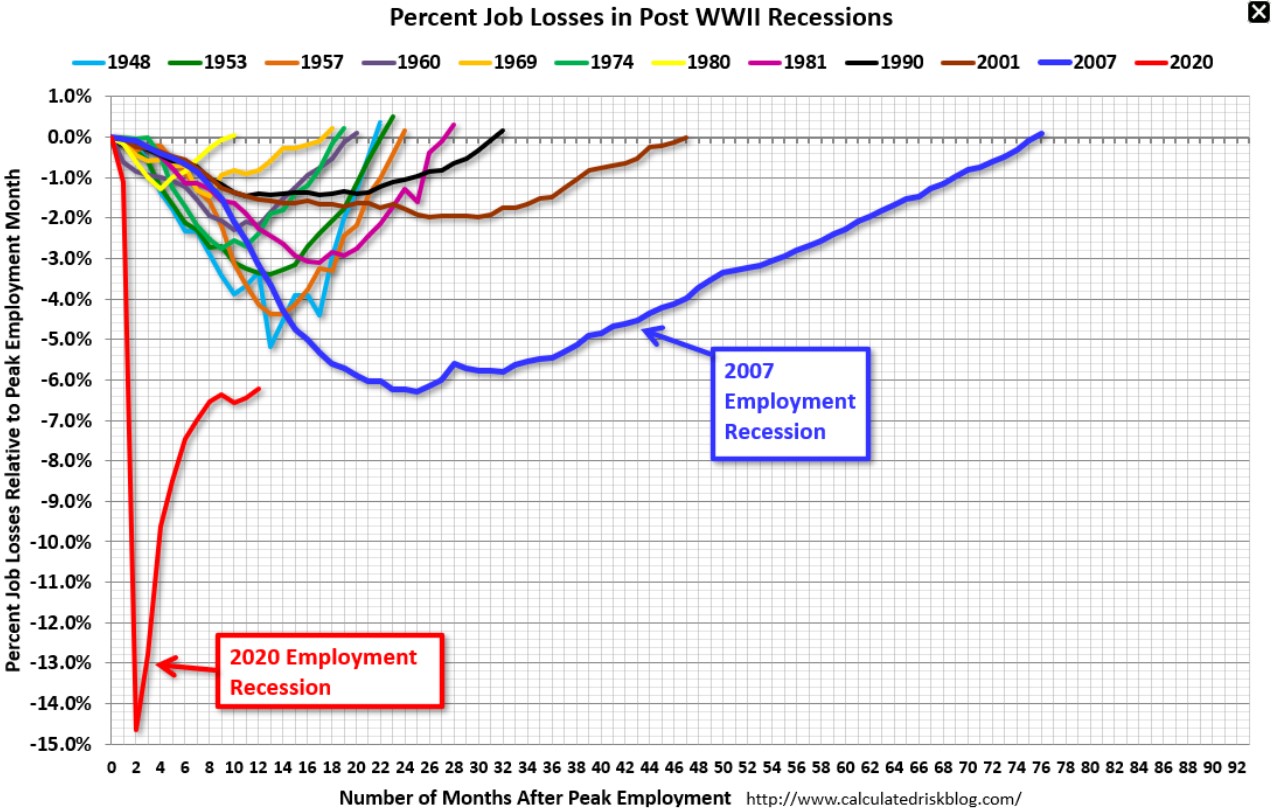
The committee determined that economic activity peaked in February 2020 and reached its trough in April 2020. That made the pandemic downturn a historically deep but exceptionally brief two-month recession.
This did not mean the economy had fully recovered by May. It meant the broad decline had stopped and economic activity had begun expanding again. A patient can leave intensive care without being ready to run a marathon. Similarly, an economy can exit recession while millions of people remain unemployed and entire industries continue operating below capacity.
The official determination of the April 2020 trough was not announced until July 2021. By then, markets and many economic indicators had been signaling recovery for months. This delay is normal because declaring a turning point requires enough evidence to distinguish a genuine recovery from a temporary bounce.
The Difference Between “Over” and “Recovered”
A recession ends at the bottom of the cycle, not when the economy returns to its previous peak. Imagine falling down a staircase. The fall ends when you hit the floor, not when you stand up, repair the railing, and convince your family that everything was completely under control.
That distinction explains why the phrase “the recession is over” can sound absurd to someone who has lost a job, closed a business, accumulated debt, or fallen behind on rent. Aggregate data may improve even while personal hardship continues.
The Forces That Restarted the Economy
Massive Fiscal Support
The federal government responded to the pandemic with several rounds of emergency relief. Programs included direct payments to households, expanded unemployment benefits, forgivable business loans, aid to state and local governments, rental assistance, tax credits, and support for affected industries.
In March 2021, the American Rescue Plan added approximately $1.9 trillion in authorized relief and recovery measures. The package included $1,400 payments for eligible individuals, an expanded Child Tax Credit, extended unemployment support, public-health funding, and assistance for schools and local governments.
This fiscal response helped replace income that would otherwise have disappeared. Many households reduced debt or increased savings, while others used the money for rent, groceries, utilities, and overdue purchases. As restrictions eased, accumulated savings helped fuel a powerful rebound in consumer demand.
Extraordinary Monetary Policy
The Federal Reserve reduced its target interest rate to nearly zero in March 2020. It also purchased large quantities of Treasury securities and mortgage-backed securities to support credit markets and maintain favorable financial conditions.
During the early recovery, the central bank was purchasing roughly $80 billion in Treasury securities and $40 billion in agency mortgage-backed securities each month. These actions helped reduce borrowing costs, encouraged lending, and supported asset prices.
Low interest rates also made cash and conservative bonds less attractive to some investors. More money flowed toward stocks, housing, startups, cryptocurrencies, and other risk assets. The economy did not merely regain its animal spirits; in certain corners of the market, the animals escaped the zoo and opened brokerage accounts.
Vaccines and Reopening
The development and distribution of COVID-19 vaccines transformed expectations. Investors and business owners could envision restaurants reopening, flights filling, offices operating, and consumers returning to services they had avoided.
Economic decisions depend heavily on what people expect six or twelve months ahead. Once a credible path toward reopening appeared, companies began planning for future demand. Financial markets reacted before the recovery became visible in every neighborhood.
Why Wall Street Recovered Before Main Street
The stock market is forward-looking. Share prices reflect expectations about future corporate profits, interest rates, and economic conditions rather than a snapshot of current hardship.
U.S. stocks reached their pandemic low in March 2020, when unemployment claims were exploding and headlines were filled with frightening uncertainty. Investors who waited for reassuring economic news missed a substantial portion of the rebound.
This pattern is common. Markets often begin declining before a recession officially starts and recover before it officially ends. By the time economic reports clearly confirm expansion, investors may have been pricing in better conditions for months.
However, the market is not a flawless economic oracle. It can become excessively optimistic, especially when money is inexpensive and speculation is fashionable. The 2020–2021 recovery produced soaring technology shares, special-purpose acquisition companies, meme-stock rallies, cryptocurrencies, non-fungible tokens, and intense retail trading.
Some enthusiasm reflected legitimate expectations of recovery and technological change. Some of it reflected boredom, stimulus checks, zero-commission trading, social media, and the timeless human desire to become wealthy before lunch.
When Good News Created New Risks
The policies that prevented a depression also contributed to unusually strong demand. Consumers wanted cars, electronics, furniture, building materials, travel, and restaurant meals. Businesses struggled to rebuild inventories while factories, ports, and transportation networks faced disruptions.
Supply could not adjust as quickly as demand. Shortages emerged, shipping costs increased, and companies raised prices. Housing demand surged while construction materials and available properties remained limited. Labor shortages affected restaurants, logistics companies, manufacturers, schools, and health-care providers.
Inflation therefore became the recovery’s unwelcome houseguest. It arrived after the emergency, stayed longer than expected, ate everything in the refrigerator, and eventually forced the Federal Reserve to raise interest rates aggressively.
This sequence demonstrates why economic policy is difficult. Too little support during a crisis can produce unnecessary unemployment and business failures. Too much stimulus maintained for too long can overheat demand, encourage speculation, and intensify inflation. Policymakers must make decisions before complete information is available, usually while economists are politely disagreeing at maximum volume.
The Recovery Was Real but Uneven
National indicators improved rapidly, but the benefits were not distributed equally. Technology companies, homeowners, and many investors experienced strong gains. Workers able to perform their jobs remotely often maintained income while reducing commuting and travel expenses.
Meanwhile, employees in hospitality, entertainment, tourism, personal services, and small retail businesses faced longer disruptions. Parents struggled with school closures and child-care shortages. Lower-income households were more exposed to job losses and rising prices because necessities consumed a larger percentage of their budgets.
In June 2021, the unemployment rate was still 5.9%, well below its pandemic peak but significantly above the pre-pandemic level. Millions of people remained unemployed even though the recession had officially ended more than a year earlier.
This is why GDP growth and stock-market performance should never be treated as complete measures of social well-being. An economic expansion can coexist with housing insecurity, expensive health care, weak wage growth in certain industries, and deep regional differences.
Is the United States in a Recession Now?
As of July 2026, the NBER had not designated a new U.S. recession following the April 2020 trough. Real GDP increased at an annual rate of 2.1% in the first quarter of 2026, following slower but positive growth in the fourth quarter of 2025. The unemployment rate stood at 4.2% in June 2026, while available job openings remained close to the number of unemployed workers.
Those figures describe an economy that is expanding, although not booming evenly. Payroll growth has slowed, uncertainty remains elevated, and consumer confidence has been weak. The University of Michigan’s Consumer Sentiment Index improved in June 2026 but remained considerably lower than a year earlier.
This combination is important. People can feel recessionary pressure without the country being in an official recession. High prices, expensive mortgages, insurance increases, credit-card interest, or fear of unemployment can make a growing economy feel miserable.
Economic reality is therefore best understood through both hard data and lived experience. Ignoring the official statistics is unwise, but telling people that their financial stress is imaginary because GDP increased is equally foolish.
What Investors and Business Owners Can Learn
Do Not Wait for an Official Announcement
Recession declarations arrive after turning points. Investors and business owners should monitor employment, income, sales, credit conditions, inventories, consumer spending, and business expectations rather than waiting for a committee to certify what has already happened.
Separate Economic Conditions From Market Conditions
The economy and stock market are related, but they are not synchronized clocks. Stocks can rise during weak economic conditions because investors expect improvement. They can also decline during strong current growth because investors anticipate tighter policy or lower future profits.
Respect Animal Spirits Without Worshiping Them
Improving confidence can create real opportunities, but enthusiasm is not a substitute for valuation, cash flow, or risk management. A popular investment can continue rising for longer than skeptics expect, yet popularity alone does not make it financially sound.
Build Resilience Before the Next Downturn
Every recession eventually ends, and every expansion eventually encounters trouble. Households can prepare by maintaining emergency savings and controlling high-interest debt. Businesses can preserve liquidity, diversify suppliers, and avoid depending entirely on optimistic forecasts. Investors can use diversified portfolios instead of making dramatic all-or-nothing bets.
Experiences From the Other Side of the Recession
The following representative experiences illustrate how an official recovery can look very different depending on where someone stands in the economy.
The Small-Business Owner
Consider a restaurant owner who survived 2020 by reducing hours, negotiating rent, applying for government assistance, and turning the dining room into a collection of takeout containers. By early 2021, reservations began returning. That was the good news.
The less cheerful news was that food costs had increased, experienced workers had found jobs elsewhere, and customers had developed strong opinions about delivery speed. Revenue recovered before profitability did. From a national perspective, consumer spending was rising. From the owner’s perspective, recovery meant working longer hours to earn roughly what the business had earned before the crisis.
The experience demonstrates that growing sales do not automatically restore healthy margins. Businesses must watch labor costs, supplier contracts, pricing power, and cash flow during an economic rebound.
The Employee Who Changed Careers
A hotel employee who lost work during the pandemic might have used the disruption to complete an online certification and move into technical support. The new job offered remote work, predictable hours, and higher pay. For this worker, the recession was both painful and transformative.
However, changing careers required savings, internet access, time, and confidence that training would lead somewhere. Many workers did not have those advantages. The same recession that created opportunity for one person trapped another in debt or unstable employment.
This experience reminds us that labor-market flexibility sounds simple in an economics textbook but can be expensive and emotionally exhausting in real life.
The First-Time Investor
Millions of people began investing during the pandemic recovery. Some purchased diversified index funds and developed long-term habits. Others discovered options trading, meme stocks, and the educational experience known as “losing money very quickly.”
A first-time investor who bought during the 2020 decline may have learned that frightening headlines can create attractive long-term prices. Yet someone who chased speculative assets in early 2021 may have learned the opposite lesson: a rising price is not proof that an asset is worth buying.
Both experiences are useful. Fear can make investors sell strong assets at poor prices, while excitement can make them ignore risk. A written investment plan is valuable precisely because animal spirits become loudest when calm judgment is most necessary.
The Family Facing Higher Prices
A family receiving stimulus payments might have caught up on utility bills, repaired a car, and built a small emergency fund. Several months later, rising rent, gasoline, food, and child-care costs could consume that progress.
Official data would show higher household income followed by stronger consumer spending. The family might remember the same period as a temporary financial rescue followed by an affordability crisis.
This experience explains why public attitudes toward the recovery were complicated. People appreciated emergency support while remaining frustrated that everyday expenses rose faster than expected.
The Manager Deciding Whether to Hire
A manager entering 2021 faced an unusual decision. Demand was returning, but no one knew whether it would last. Hiring too slowly could lead to poor service and missed sales. Hiring too aggressively could create painful layoffs if another disruption arrived.
The manager therefore watched customer orders, vaccination progress, local restrictions, supplier delays, and employee availability. None of these variables offered certainty. Eventually, the company hired because management believed the future would be better than the recent past.
That decision captures animal spirits in their most practical form. Economic recoveries require people to commit resources before every risk has disappeared. Confidence does not eliminate uncertainty; it allows action despite uncertainty.
Conclusion: The Recession Ends Before the Fear Does
The pandemic recession was extraordinary in both depth and duration. Economic activity collapsed rapidly, but unprecedented fiscal support, aggressive monetary policy, scientific progress, reopening, and resilient consumer demand produced an equally remarkable rebound.
Calling the recession “over” did not mean declaring victory for every household or business. It meant that the broad economic contraction had reached its bottom and expansion had begun. Recovery remained uneven, and later inflation created a new set of problems.
The central lesson is that psychology matters. Fear can deepen a downturn, while confidence can accelerate a recovery. Markets often recognize that shift before official statistics confirm it. Yet optimism must be balanced with discipline because the same animal spirits that encourage investment and hiring can also inflate bubbles.
Recessions end when enough people begin spending, investing, hiring, and taking risks again. The moment rarely feels comfortable. In fact, it usually arrives while the economic news still looks unpleasant. That is the strange rhythm of the business cycle: by the time everyone agrees the storm has passed, many of the best umbrellas are already sold out.
Research note: This analysis synthesizes information from the National Bureau of Economic Research, Bureau of Economic Analysis, Bureau of Labor Statistics, Federal Reserve Board, Federal Reserve Bank of New York, U.S. Department of the Treasury, Congressional Budget Office, University of Michigan Surveys of Consumers, National Federation of Independent Business, Federal Reserve economic research, Princeton University Press materials, and the original Animal Spirits podcast discussion.












