
The school cafeteria is basically a daily pop-up concert: trays clanging, kids talking at “inside voice” volume (so… outside voice),
and somebody always trying to convince a friend that ketchup is a vegetable. So when the cafeteria suddenly gets quiet, it’s either
a surprise fire drill or something genuinely interesting is happening.
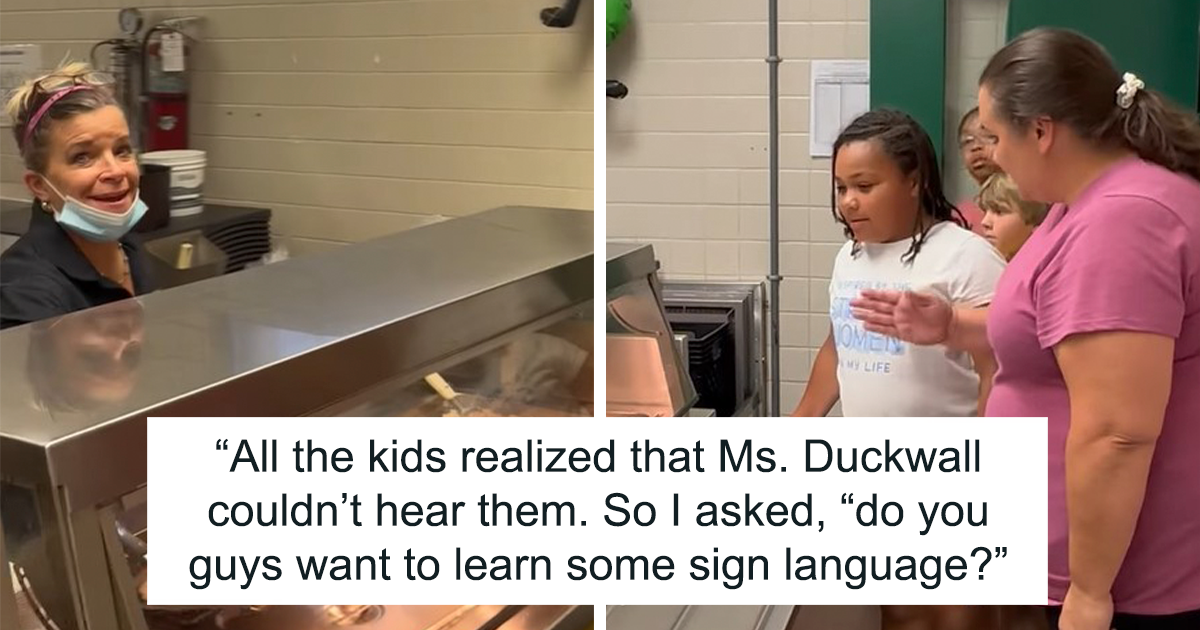
At one elementary school in Suffolk, Virginia, the quiet moment arrived when a teacher started signing with a cafeteria workerright there in the lunch line.
Students watched two adults have a full, normal conversation without a single spoken word. And the kids’ faces basically said, “Wait… we can do that?”
That little spark turned into a schoolwide movement: students began learning American Sign Language (ASL) so they could communicate
directly with a Deaf / hard-of-hearing cafeteria worker instead of relying on the universal language of awkward pointing.
The Moment That Started It All
In the viral story that inspired headlines across U.S. media, a fourth-grade teacher noticed a daily problem that most people had learned to ignore:
students and a Deaf cafeteria worker were stuck in a “point, nod, repeat” routine. It wasn’t anyone being mean; it was a simple communication barrier
playing out hundreds of times a week.
The teacherwho already knew some ASL from family experience and prior learningbegan helping by interpreting quick lunch orders.
But instead of becoming the permanent middleman, she did something smarter: she taught her students enough ASL to order food,
say hello, and express basic courtesy. Soon, students could sign their requests and say “thank you” directly. Even better, the effort spread beyond
one classroom: other classes and staff started learning too, often adding a “sign of the week” during announcements.
The result wasn’t just cute (though yes, it was objectively adorable). It was practical. It reduced frustration, increased independence,
and sent a clear message to a Deaf staff member: “You’re not the only one expected to do the work here. We’ll meet you halfway.”
Why This Small Idea Is Actually a Big Deal
1) Communication is not a “nice-to-have”it’s belonging
When students can’t communicate with a staff member, they often default to the quickest workaround: pointing, pantomime, talking louder (as if volume is a language),
or asking a hearing adult to “handle it.” That teaches kids an unspoken rule: some people are just… harder to talk to, so we don’t really try.
Flipping that script matters. The Deaf community has long emphasized that deafness is not a character flaw or something that needs to be “fixed.”
It’s a lived identity and culture, and language access is central to participation. Even learning a small amount of ASL can turn a daily interaction
from transactional to human.
2) The need is bigger than people think
Hearing differences are common in the U.S.and not only among older adults. Many families include Deaf or hard-of-hearing relatives, and plenty of children
and staff members navigate hearing loss, hearing aids, or communication differences. When a school treats accessible communication like normal,
it helps everyone.
3) It teaches empathy without the cheesy poster
Schools talk about kindness all the time. Posters. Assemblies. Slogans. But the most powerful lessons show up in the “ordinary” moments
like ordering lunch. When kids learn ASL for a real person they see every day, kindness stops being an abstract concept and becomes a daily habit.
What The Teacher Actually Taught (And Why It Worked)
The genius of this story is that it wasn’t an overwhelming “Everyone will be fluent by Friday” plan. It started with the cafeteria,
which is perfect because the cafeteria has three built-in features educators love:
- High repetition: Lunch happens every day, so practice is automatic.
- Clear motivation: Students want food. Few incentives are more reliable.
- Immediate feedback: If you sign “milk” and receive milk, you feel like a wizard.
Many classrooms begin with practical vocabulary: greetings (“hello,” “good morning”), basic manners (“please,” “thank you”),
and common cafeteria items (pizza, fruit, milk, salad, etc.). Some teachers add the ASL alphabet early so kids can fingerspell names
or unknown menu itemsanother easy win because students love spelling secrets to each other.
Once students get comfortable, the lesson expands naturally into short phrases: “I want ___,” “How are you?” and “Have a good day.”
That’s where the interaction stops being a “skill demo” and starts feeling like a relationship.
How Any School Can Replicate This (Without Making It Weird)
Want to turn this heartwarming headline into something your school can actually do? Here’s a realistic blueprint that doesn’t require
a magic wand, a giant budget, or a staff meeting that could’ve been an email.
Step 1: Start with one high-impact setting
Pick a natural “communication hub”: cafeteria, front office, bus line, library checkout, or morning arrival.
The best starting point is wherever students already interact with the same adults every day.
Step 2: Teach “useful first,” not “perfect first”
Focus on the signs students will use immediately. A small vocabulary used daily beats a large vocabulary used never.
Give students permission to be beginners. A lot of kids freeze because they don’t want to “do it wrong.”
The goal isn’t performanceit’s connection.
Step 3: Build in tiny routines
The schools that sustain ASL learning do it in small, consistent bites:
- Sign of the week during announcements
- “Sign-in” greeting at classroom doors
- ASL buddy practice for 2 minutes before lunch
- Mini goal: “This week, everyone signs ‘thank you’ to cafeteria staff.”
Step 4: Involve Deaf voices (and don’t treat them like props)
If your school has Deaf or hard-of-hearing staff, students, or family members, ask what they’d likeand what they wouldn’t.
Some people will be excited to help; others may want privacy. Respect both.
Consider partnering with local ASL educators, community colleges, or Deaf organizations for guidance.
The point is to learn with the community, not just about the community.
Step 5: Keep the language respectful
Terminology matters. Many Deaf advocates recommend avoiding terms like “hearing impaired,” which can feel negative or outdated.
Use “Deaf,” “hard of hearing,” or “Deaf and hard of hearing,” and follow individual preferences when someone tells you what they use.
This isn’t “political correctness”; it’s basic respectlike pronouncing someone’s name correctly.
Beyond The Cafeteria: What Students Gain From Learning ASL
They become better communicatorsperiod
ASL isn’t just hand movements; it’s facial expression, body language, attention, and clarity. Students learn that communication has layers,
and that listening can be visual. That can benefit shy students, multilingual learners, and kids who struggle with spoken language in noisy environments
(which, again, describes most cafeterias).
It supports social-emotional learning in a real way
SEL can feel abstract when it’s delivered as a worksheet about feelings. But learning ASL for a real person teaches empathy, perspective-taking,
and inclusion through action. Kids don’t just learn “be kind”they learn “be kind like this.”
It reflects a broader national trend
ASL has grown in visibility and popularity across the U.S., including in education.
It’s increasingly common to see ASL offered as a language option in secondary schools and colleges.
That means students who learn early aren’t just learning a “random extra”; they’re getting a head start in a legitimate language pathway.
Common Pitfalls (And How To Avoid Them)
Pitfall: Turning the Deaf staff member into the “project”
The story works because the goal is normal communication, not spotlighting someone as a feel-good symbol.
Celebrate the effort, surebut keep the tone grounded: “We’re learning this because everyone deserves direct communication.”
Pitfall: Expecting instant fluency
Kids will mix signs up. They’ll forget. They’ll accidentally sign something that means “turtle” when they meant “turkey.”
(Honestly, that’s still a successful lunch order in spirit.)
Normalize mistakes, encourage practice, and keep the focus on consistency.
Pitfall: Letting it fade after the viral moment
Sustainability beats intensity. A two-minute weekly routine can keep momentum going all year.
If you can build ASL into announcements, classroom greetings, or a lunch-line practice, it becomes part of the school’s identity,
not a one-time campaign.
A Quick, Practical Starter Plan
If you want a simple launch plan inspired by the “deaf cafeteria worker” story, try this four-week arc:
- Week 1: Hello / Good morning / Please / Thank you
- Week 2: Yes / No / More / Finished
- Week 3: Common cafeteria items (choose 6–10 based on your menu)
- Week 4: “I want ___” + fingerspelling names
Keep it light, keep it frequent, and keep it connected to daily life. A school doesn’t need to do everything at once.
It just needs to start.
Conclusion: The Loudest Kindness Is Sometimes Silent
This story resonates because it’s simple and realistic. A teacher saw a small barrier and treated it like it mattered.
Students responded with curiosity, then consistency, then pride. And a Deaf staff member went from “the person we point at food for”
to a fully included member of the daily school conversation.
When schools teach kids ASLeven a littlethey’re not just teaching a language. They’re teaching a worldview:
communication is a shared responsibility. If you can change that lesson in one lunch line,
you can change a lot more than lunch.
Experiences Related to This Topic (500+ Words)
Teachers who try a “cafeteria ASL” approach often describe the same unexpected moment: the kids don’t treat it like a lesson for long.
At first, students are excited because signing feels like a superpower. They’ll practice dramatically in the hallway like they’re starring
in an action movie where the villain is… poor communication. But then something flips. The novelty wears off, and what’s left is habit.
That’s when it becomes meaningful.
One of the most common experiences is watching students realize that “being helpful” isn’t the same as “being loud.” In a busy cafeteria,
hearing kids are used to competing with noisetalking over each other, repeating themselves, or just giving up. When they learn a few signs,
they often become more patient without anyone explicitly teaching patience. They wait for eye contact. They slow down. They learn to take turns.
Those are classroom skills disguised as language practice.
Teachers also report that ASL gives certain students a chance to shine. The kid who hates speaking in front of the class might be the first
to sign confidently to a staff member. A student who struggles with reading may memorize signs quickly and become the “class translator” during
practice. Some students who are easily distracted lock in because signing is physicalhands, face, attentionso it channels energy instead of
fighting it. It’s one of those rare activities that feels like play but behaves like learning.
There’s also a social ripple. Once students learn “thank you” and start using it with cafeteria staff, they often begin using it more broadly:
with custodians, office staff, bus drivers, crossing guards. Not because someone assigned gratitude as homework, but because the act of signing it
makes it feel deliberate. It slows the moment down. A signed “thank you” is hard to mutter while sprinting away.
Of course, the rollout isn’t always smooth. In early days, kids may overdo itsigning wildly, forgetting to look at the person they’re talking to,
or treating it like a performance. That’s normal. Teachers who succeed long-term usually set a gentle tone: “We’re learning this to communicate,
not to show off.” They also remind students that Deaf people are not “inspirational props” in a school story. The goal is normal conversation,
normal respect, normal inclusion.
Another common experience is the staff response. When students consistently sign to a Deaf or hard-of-hearing worker, the worker often appears more
relaxedbecause they’re no longer forced to solve every interaction through guesswork. Teachers sometimes notice the cafeteria line moving faster,
not because the students are rushing, but because fewer exchanges require repeating or correcting. Even hearing staff benefit because the lunch line
stops depending on one “helper adult” to translate every time.
The biggest “aha” moment tends to come weeks later. A teacher will overhear (or, more accurately, oversee) students signing to each other
outside the cafeteriaon the playground, in the hallway, during group work. That’s when you know it stuck. The language moved from “school activity”
to “student culture.” And that’s exactly how inclusion stops being a slogan and starts being the way a community operates.












