
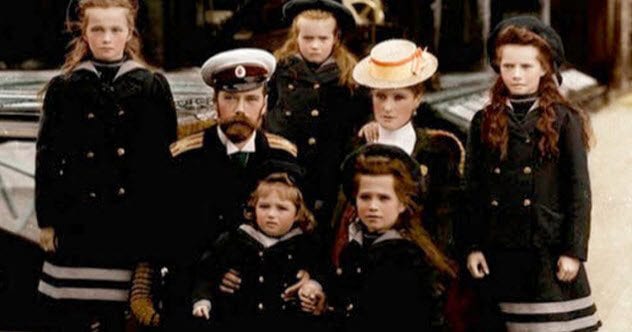
Note: This article is based on modern historical and forensic research, including DNA findings, archival reporting, and expert analysis from sources such as Smithsonian Magazine, HISTORY, PLOS ONE, PubMed, Penn State, Discover Magazine, National Geographic, and other reputable U.S.-accessible references. Key findings include the 1991 exhumation, the 2007 discovery of the second grave, later DNA confirmations, and the continuing debate between forensic science and religious recognition.
The murdered Romanovs have been gone for more than a century, yet their story refuses to stay quietly buried. And, honestly, history has rarely produced a mystery with this much drama: a fallen dynasty, a basement execution, missing bodies, secret graves, impostors, DNA tests, royal cousins, church disputes, and enough whispered theories to keep documentary producers happily employed until the next ice age.
For decades, the fate of Tsar Nicholas II, Empress Alexandra, their five children, and four loyal attendants was wrapped in Soviet secrecy. The official story was vague. The bodies were hidden. Rumors filled the silence. Did Anastasia escape? Was Alexei smuggled away? Were the remains burned beyond recognition? Modern forensic science has answered many of those questions, but it has also revealed details that make the Romanov murders even more haunting.
Below are the top 10 recently uncovered or scientifically clarified facts about the murdered Romanovsfacts that turn a famous tragedy into something even more chilling, human, and historically important.
1. The Romanov Burial Site Was Found Long Before the Public Knew
One of the strangest facts about the Romanov case is that the first grave was not discovered in 1991, as many people assume. It was actually located in 1979 by amateur investigators, including geologist Alexander Avdonin. They found the remains near Yekaterinburg but quickly reburied them because the Soviet Union was not exactly famous for saying, “Great job, citizen historian, please continue embarrassing the state.”
The discovery stayed secret until the political climate changed. Only after the Soviet Union began to collapse did officials conduct a formal exhumation in 1991. That grave contained the remains of Nicholas II, Alexandra, three of their daughters, and four members of their household staff. The secrecy explains why rumors survived for so long: for most of the 20th century, there was no body, no open investigation, and no public proof.
2. DNA Finally Confirmed the Main Romanov Grave
In the 1990s, forensic scientists used mitochondrial DNA and short tandem repeat testing to identify the remains in the main grave. The results confirmed a family group: two parents and three daughters, along with the Romanovs’ physician and servants. This was one of the most famous early uses of DNA in historical identification, and it helped transform forensic genealogy from a specialist tool into something the public could understand.
Prince Philip, Duke of Edinburgh, played a surprising role. Because he was maternally related to Empress Alexandra, his DNA helped confirm the identity of Alexandra and her daughters. Imagine being asked to help solve a royal murder mystery with a blood sample. Most family reunions settle for potato salad.
3. Two Romanov Children Were Missing From the First Grave
The first grave answered many questions but left one enormous problem: two children were missing. Those missing remains kept the Anastasia survival myth alive. For decades, people wanted to believe that one of the Romanov children had escaped the massacre. The missing children were generally understood to be Alexei, the hemophiliac heir, and one daughtereither Maria or Anastasia.
This gap gave impostors room to operate. It also gave historians and conspiracy theorists endless fuel. Without the full set of remains, even strong DNA evidence could not completely close the case in the public imagination.
4. The Second Grave Was Found in 2007
In 2007, searchers found a second burial site about 70 meters from the first grave. It contained bone fragments and teeth from two people: a teenage girl and a young boy. Later DNA testing confirmed that these remains belonged to children of Nicholas II and Alexandra. This was the discovery that effectively ended the romantic escape theories.
The remains were fragmentary and partially burned, which matched historical accounts that the killers tried to destroy and conceal the bodies. The evidence showed that the Romanovs were not simply executed and buried; their murderers made deliberate attempts to hide the crime.
5. The Famous Anastasia Legend Is Almost Certainly False
Few Romanov myths are more famous than the idea that Grand Duchess Anastasia survived. The story inspired books, movies, stage musicals, and a small army of dramatic “lost princess” fantasies. But DNA has not been kind to the legend.
The most famous claimant, Anna Anderson, insisted she was Anastasia. After her death, scientists tested tissue and hair samples linked to her. The results showed she was not a Romanov. Her DNA matched the Schanzkowska family, supporting the conclusion that she was likely Franziska Schanzkowska, a Polish factory worker.
That does not make the Anastasia myth uninteresting. It makes it more revealing. People clung to the story because it offered a tiny candle in a very dark room. Unfortunately, forensic science blew out the candle.
6. Alexei’s Hemophilia Was Confirmed by Genetic Research
Tsarevich Alexei’s illness was not just court gossip. Genetic analysis confirmed that he had hemophilia B, a blood-clotting disorder connected to the royal bloodline of Queen Victoria. Alexandra was a carrier, and Alexei inherited the condition through his X chromosome.
This detail matters because Alexei’s illness shaped imperial politics. Alexandra’s desperation to protect her son helped increase Rasputin’s influence at court, which damaged the monarchy’s reputation at the worst possible time. In other words, a genetic disorder became a political earthquake. History sometimes has very small hinges and very large doors.
7. The Execution Was More Chaotic Than a Simple Firing Squad
Popular summaries often describe the Romanovs as being lined up and shot. The reality was more horrifying and more chaotic. The family and their attendants were taken to a basement room in the Ipatiev House in the early hours of July 17, 1918. They were told, falsely, that they were being moved for safety.
When the execution began, the room filled with smoke, noise, dust, and confusion. Some victims did not die immediately. Accounts and later forensic interpretations suggest that bullets ricocheted or failed to kill instantly, partly because the grand duchesses had jewels sewn into their clothing. What looked like hidden wealth became accidental armorbut only briefly, and tragically.
8. Jewelry Sewn Into Clothing Complicated the Murders
The Romanov daughters reportedly had diamonds and precious stones sewn into their garments, likely as a way to hide family valuables during captivity. During the execution, those jewels may have slowed bullets and contributed to the killers’ panic when some victims remained alive after the first shots.
This is one of the most grimly ironic details of the Romanov murders. Wealth, which had symbolized imperial privilege, became a desperate survival tool for a few terrible minutes. But it did not save them. Instead, it made the killing more prolonged and brutal.
9. The Bolsheviks Triedand Failedto Erase the Evidence Completely
After the murders, the killers attempted to dispose of the bodies in ways meant to prevent identification. Historical evidence indicates that the bodies were moved, damaged, burned, and treated with acid. The plan was concealment, not dignity.
But the attempt failed. The main grave survived. The second grave survived. Bone fragments, teeth, and DNA survived. Even the killers’ efforts to erase the Romanovs became evidence. It is one of history’s colder lessons: cover-ups often leave fingerprints.
10. Science and the Russian Orthodox Church Still Do Not Fully Agree
Modern DNA evidence has strongly supported the identification of the Romanov remains. Russian investigators announced additional confirmations in 2018, including testing connected to Nicholas II’s father, Alexander III, and living Romanov relatives. Yet the Russian Orthodox Church has been cautious about fully accepting all findings, especially regarding the remains of Alexei and one sister.
This is not simply a scientific dispute. It is also religious, political, and emotional. The Romanovs were canonized as passion-bearers by the Russian Orthodox Church in 2000, and their remains carry enormous symbolic weight. For scientists, the question is DNA. For believers, it can also be sanctity, memory, and trust.
Why These New Romanov Facts Still Matter
The Romanov case is not just royal trivia dressed in pearls and tragedy. It is a story about how governments hide violence, how families become symbols, how rumors grow in silence, and how science can reopen history’s locked rooms.
The murdered Romanovs also show how myth can outlive evidence. Anastasia did not need to survive physically to survive culturally. She became a legend because people needed one. Alexei’s illness became more than a medical condition because it affected the fate of an empire. The hidden graves became more than burial sites because they represented decades of political denial.
For readers, the most powerful takeaway is that history is rarely finished. A crime committed in 1918 was still being clarified in 1991, 2007, 2009, 2018, and beyond. Every new test, archive, and analysis adds another layer. The Romanovs were murdered in a basement, but the truth about that night had to climb out of the ground piece by piece.
Experiences and Reflections Related to the Murdered Romanovs
Reading about the murdered Romanovs is a strange experience because the story keeps shifting between the enormous and the intimate. On one page, you are looking at the collapse of a 300-year dynasty. On the next, you are reading about children, family photographs, illness, fear, and a mother trying to protect her son. That contrast is what makes the Romanov tragedy so difficult to shake off.
For many people, the first encounter with the Romanovs comes through the Anastasia legend. It feels almost like a fairy tale: a lost princess, a hidden identity, a chance that one child escaped the nightmare. But once the forensic evidence enters the story, the fairy tale changes. The mystery becomes less about escape and more about why people wanted escape to be true. That emotional reaction is part of the Romanovs’ lasting power. People are not only studying what happened; they are grieving what they hoped happened instead.
There is also a deeply modern feeling to the Romanov investigation. DNA testing, forensic anthropology, genealogical research, and international laboratory work all helped solve a crime from the age of telegrams and imperial uniforms. The past and present meet in a very literal way. A bone fragment in a forest can speak through modern science. A royal cousin’s DNA can confirm a murdered empress. A tooth can challenge a century of rumor. It sounds like crime television, except the victims were real, the politics were explosive, and the ending was not written for comfort.
The Romanovs also force readers to think about how public memory works. In Soviet times, the family’s fate was obscured because the truth was inconvenient. Later, the family was reinterpreted through religion, nostalgia, nationalism, and popular culture. Depending on who tells the story, Nicholas II may appear as a weak ruler, a tragic father, a saintly sufferer, or a symbol of lost Russia. The same historical figure can wear many costumes, and history, like a theater wardrobe, is not always neatly labeled.
Visiting or reading about Yekaterinburg adds another layer. The Ipatiev House no longer stands, but the site remains heavy with meaning. Memorials, pilgrimages, and church services show that the Romanov murders are not merely a closed chapter. They are part of a living argument about guilt, memory, forgiveness, and national identity. People still walk routes connected to the disposal of the bodies. They still debate the remains. They still ask what justice means when the crime is more than a century old.
Perhaps the most unsettling experience is realizing how ordinary some of the final details were. The family was awakened. They dressed. They went downstairs. They may not have understood exactly what was coming. History books often compress such moments into a sentence, but the human mind slows them down. A staircase. A basement. A chair for Alexei. A command. Then violence. The grandeur of empire disappears, and what remains is a family trapped in a room.
That is why the uncovered facts matter. They do not merely satisfy curiosity. They restore specificity. They replace rumor with names, bones, relationships, causes, and evidence. They remind us that behind every famous historical mystery are real people whose lives were not mysterious to them at all. They were parents, children, workers, patients, believers, and victims. The Romanovs became legend after death, but the facts bring them back down to earth, where history is most painfuland most honest.
Conclusion
The murdered Romanovs remain one of the most fascinating and tragic subjects in modern history because their story combines dynasty, revolution, secrecy, science, and myth. Recent forensic discoveries and DNA analysis have answered many of the biggest questions: the family did not escape, the missing children were found, Anna Anderson was not Anastasia, and the attempts to destroy the bodies failed. Yet the story still carries mysterynot because the evidence is weak, but because memory, politics, and faith do not always move at the same speed as science.
More than a century after the basement execution in Yekaterinburg, the Romanovs continue to haunt history. Their story reminds us that truth can be buried, delayed, disputed, and dressed up as legendbut it has a stubborn habit of resurfacing.













