
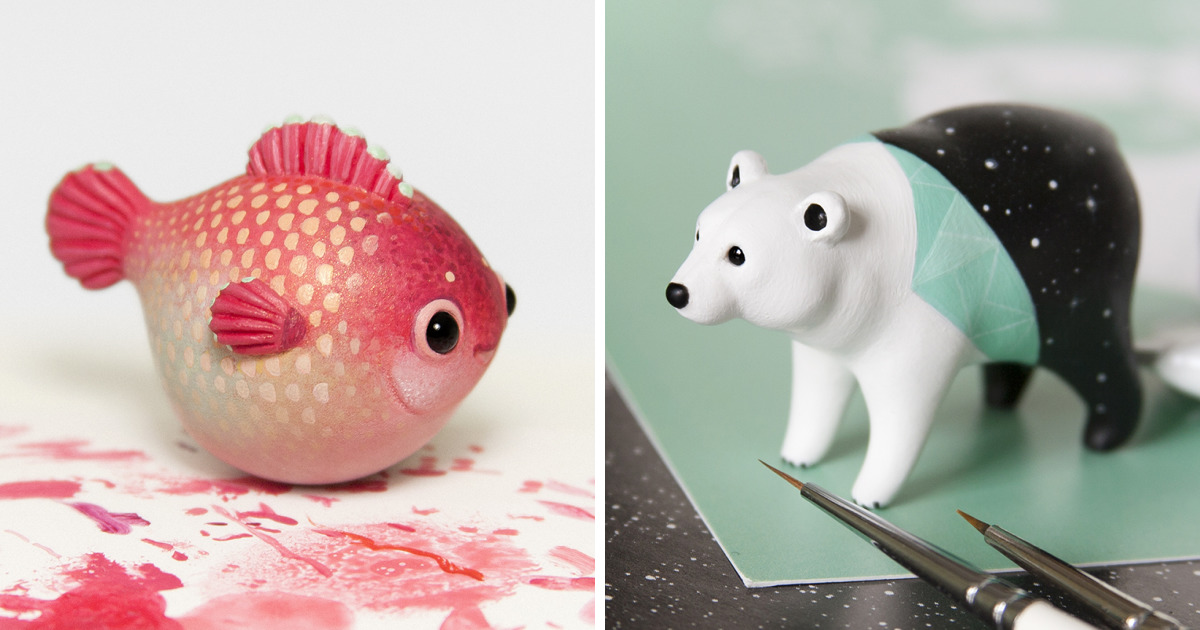
There is something wildly unfair about tiny animal sculptures: they are almost impossible to see without smiling at them. A fox the size of a grape? Charming. A round little owl with dramatic eyebrows? Instant mood booster. A sleepy seal that fits on a fingertip? That is not a sculpture anymore. That is emotional support art.
That is exactly why I keep coming back to tiny animal sculptures made from polymer clay. They let me combine detail, humor, and personality in a format so small it feels like I am building a secret world. One minute I am rolling a bead of clay between my fingers. The next minute I am arguing with myself over whether a miniature hedgehog looks cuter with a shy face or the expression of someone who just discovered the snack drawer is empty.
Working in polymer clay miniatures is one of those crafts that looks simple from across the room and gloriously obsessive up close. The animals may be tiny, but the decisions are not. Ear shape matters. Paw size matters. Tail curve matters. And the placement of two microscopic eyes can mean the difference between “adorable woodland friend” and “creature who knows too much.”
What keeps me hooked is that polymer clay rewards patience without punishing imagination. It stays workable while I refine a tiny snout, smooth a belly, or add texture to feathers. Then, once baked, the sculpture becomes durable enough to display, gift, or turn into a charm, figurine, magnet, or desk companion. In other words, it goes from soft blob to tiny legend.
Why Polymer Clay Works So Well for Tiny Animal Sculptures
If I had to pick the single best reason to use polymer clay for miniature animals, it would be this: it gives me time. Unlike some materials that rush the process or start drying while I am still deciding whether I want to make a raccoon or a red panda, polymer clay stays soft until it is cured in the oven. That makes it ideal for slow, detail-heavy work.
That flexibility matters when sculpting tiny animals because small pieces have a sneaky way of demanding big precision. A miniature bunny can look sweet, curious, sleepy, grumpy, or mildly offended based on the tiniest changes to the eyes and mouth. Polymer clay lets me pause, adjust, and refine before committing.
Another reason I love it is color control. I can use clay that is already colored, mix shades to get more natural tones, or sculpt with a neutral base and paint details later. For realistic pieces, I like muted browns, creams, grays, and soft pinks. For whimsical pieces, all rules leave the building. Lavender fox? Absolutely. Mint-green frog? Why not. Golden hamster with a tiny strawberry hat? At that point, it would be irresponsible not to make it.
Polymer clay is also ideal for miniature animal figurines because it holds texture beautifully. Fur can be suggested with light tool marks. Feathers can be layered or etched. Scales can be stamped. Even a smooth animal, like a seal or whale, benefits from the clean finish that cured clay can achieve after careful sanding or buffing.
And then there is durability. When baked correctly, a finished sculpture can become surprisingly sturdy. That makes handmade clay animals more than just cute experiments. They can become collectibles, gifts, ornaments, keychains, shelf décor, or keepsakes tucked into places where they can quietly ambush people with joy.
How I Turn a Lump of Clay Into a Tiny Animal With Personality
I start with the silhouette, not the details
The biggest mistake beginners make with polymer clay animals is falling in love with details too early. Tiny ears are fun. Tiny whiskers are fun. Tiny toe beans are ridiculously fun. But if the basic shape is off, no amount of microscopic charm will save it.
So I begin with the silhouette. Is this animal round and compact, like a hamster or owl? Long and elegant, like a fox or ferret? Chunky and upright, like a bear? Flat and low, like a turtle? When the overall shape feels right, I can add the features that make it specific.
At this stage, I focus on three major forms: body, head, and any signature feature. For a squirrel, the tail is the signature. For a bunny, it is the ears. For a penguin, it is the contrast between the smooth body and the little flipper wings. If those shapes read clearly from a quick glance, I know I am heading in the right direction.
Then I simplify the anatomy
Tiny sculpture is not about copying every anatomical fact. It is about choosing which facts deserve to survive the size reduction. On a one-inch animal, I am not sculpting every muscle group. I am choosing the traits the eye recognizes instantly.
A fox gets a pointed face, triangular ears, and a sweeping tail. A cat gets a rounded body, upright ears, and a confident sitting pose. A hedgehog gets a compact shape with texture concentrated on top. A seal gets smooth curves and small, expressive eyes. In miniature work, clarity beats complexity every time.
This is also where style enters the room. Some of my tiny animal sculptures lean realistic, with natural poses and restrained facial features. Others go fully cute, with oversized heads, tiny limbs, and expressions that look like they just heard someone open a bag of chips. Neither approach is wrong. The sculpture simply needs internal logic. If the proportions are exaggerated, they should feel intentionally exaggerated.
Texture is where the sculpture wakes up
Once the major shapes are in place, texture gives the piece life. This is one of my favorite parts because it is where a small sculpture stops looking like a smooth toy and starts feeling like a tiny character.
For fur, I use light directional marks rather than deep scratches. Heavy texture can overwhelm a miniature piece and make it look messy. Instead, I let the texture follow the body: outward on cheeks, downward on the chest, slightly curved along the haunches, and feathered at the tail. For birds, I suggest feather groupings rather than carving every feather like I am filling out a tax return for pigeons.
Smooth animals need attention too. Whales, seals, mice, and frogs often look best when the surface stays clean and rounded. In those cases, the personality comes from gesture and expression instead of texture. A slight tilt of the head or the tiniest upward curve in the mouth can do a lot of work.
The face makes or breaks everything
If there is one area where I slow down and become absurdly picky, it is the face. Tiny eyes that are placed too high, too wide, or too deep can change the entire vibe. That is not an exaggeration. I have watched a sweet baby otter become a suspicious accountant in less than thirty seconds.
I usually keep facial details simple. Small indented eye sockets, tiny clay dots, painted features, or a mix of the two all work. What matters most is symmetry and spacing. In miniature sculpture, subtlety wins. Too much detail can crowd the face. Too little can make it feel blank. The sweet spot is usually somewhere between “storybook charm” and “yes, this creature clearly has opinions.”
Baking is not the glamorous part, but it is the part that keeps the tail attached
No craft project enjoys a dramatic oven surprise. With oven-bake clay art, careful curing is everything. I make sure the clay is properly conditioned before sculpting, avoid trapped air, and keep thickness reasonably even. For larger miniatures or pieces with rounded bodies, I sometimes bulk out the inside with foil so the clay layer stays more consistent.
I also pay close attention to the package directions for time and temperature. Guesswork is not cute here. Too little curing can leave fragile areas weak. Too much heat can scorch the clay or create unpleasant fumes. Tiny sculptures are especially unforgiving because details can burn, flatten, or crack if the process gets sloppy.
In other words, the baking stage is where discipline earns its paycheck.
The Small Tools That Do the Big Work
I do not think anyone needs a laboratory of specialty tools to begin making cute animal sculptures, but a few basic ones make the process dramatically easier.
A blade helps me cut clay cleanly. A needle tool is perfect for tiny nostrils, feather lines, eye placement, and delicate adjustments. Silicone-tipped tools are excellent for smoothing seams without squashing the whole sculpture into emotional rubble. A small roller or pasta machine helps condition clay and create even sheets. Tweezers are useful when placing details that are too small for fingers to manage without turning into chaos.
Household items earn their keep too. A toothpick can texture fur, mark smile lines, or support a tiny piece during assembly. A soft brush can knock away lint before baking. Aluminum foil can support curved forms or bulk out an interior. Even a toothbrush can become a texture tool in the right hands.
The trick is not owning every tool. The trick is learning what each tool does best. Once that clicks, sculpting becomes less about fighting the material and more about shaping it on purpose.
Mistakes Tiny Polymer Clay Animals Love to Make
Miniature sculpture has a sense of humor, and that sense of humor is usually directed at me. Tiny animal sculptures fail in very specific ways, and most of those ways are surprisingly educational.
First: overworking the clay. The more I poke, smooth, adjust, and re-adjust one tiny area, the more likely I am to blur details or flatten the form. Sometimes the best move is to stop touching it and let the sculpture be a sculpture.
Second: making delicate parts too thin. Tiny tails, ears, legs, wings, and whisker-like appendages look elegant until reality arrives. If a form is so thin that it seems nervous about existing, I reinforce it, thicken it slightly, or redesign the pose.
Third: ignoring balance. A miniature animal should look stable, even if it is posed dynamically. If the center of gravity is off, the piece can lean, tip, or cure in a way that suggests a tragic lack of lower-body planning.
Fourth: using too much finish. Not every sculpture needs glaze. In fact, some look better with a natural matte or softly buffed surface. A heavy incompatible sealer can leave the piece tacky or distract from the sculpted texture. Sometimes less shine equals more character.
Fifth: forgetting that polymer clay is not food-safe. It is perfect for figurines, ornaments, magnets, and decorative objects. It is not the material I reach for when something will directly hold or serve food. Tiny bear on a shelf? Excellent. Tiny bear on a spoon I plan to stir soup with? Hard pass.
Why These Tiny Animal Sculptures Mean More Than “Just a Craft”
People often assume that making polymer clay miniatures is mostly about the result. And yes, the result is a big part of the fun. I like seeing a finished fox sitting on a desk, a whale tucked onto a bookshelf, or a sleepy bunny gifted to someone who needed a tiny, unreasonable amount of happiness that day.
But the deeper appeal is in the making itself. Tiny sculpture asks me to slow down. It demands attention in a way that feels calming instead of draining. I am not doom-scrolling. I am deciding whether a penguin’s belly should be one millimeter wider. That may sound silly, but it is also wonderfully grounding.
There is a quiet satisfaction in taking a small amount of clay and turning it into something that feels alive. Not alive in a haunted-doll sense. More like emotionally present. A good tiny animal sculpture suggests a whole mood, a whole personality, maybe even a tiny backstory. The best ones make people invent names on the spot, which is usually how I know the piece worked.
That is the magic of this craft. It combines skill, observation, humor, and patience in one very compact package. It is serious enough to be an art form and playful enough to remain fun. Honestly, that is a rare combination, and I am happy to keep chasing it one miniature paw at a time.
My Experience Creating Tiny Animal Sculptures From Polymer Clay
When I first started making tiny animals from polymer clay, I thought the appeal would be the final result. I imagined neat little figurines lined up on a shelf, each one polished, cute, and camera-ready. What I did not expect was how much I would enjoy the actual process of making them. Somewhere between rolling the first ball of clay and deciding whether a mouse needed smaller ears, I realized this hobby was doing more than filling a display tray. It was changing the pace of my day.
Creating tiny sculptures forces me to pay attention in a very specific way. I have to notice proportions, curves, angles, and texture. I have to slow down enough to see whether a tail feels too stiff or whether a bird’s body looks more like a potato than a chick. That kind of attention feels refreshingly old-school. It pulls me out of the constant speed of screens and notifications and puts me back into my hands.
There is also something deeply satisfying about working small. Big art can be dramatic, but tiny art feels intimate. A miniature fox or turtle asks people to lean in. They have to pause and really look. That pause matters. In a world that rewards speed, tiny sculptures reward patience. They are little invitations to notice things.
I have also learned that imperfections are often part of the charm. Some of my favorite pieces are not the most technically perfect ones. They are the ones with a slightly crooked smile, a head tilt that happened by accident, or paws that came out just a bit chunkier than planned. Those details make the animal feel individual. They give it personality. Perfection can be polished, but personality is what makes someone say, “Wait, I love this one.”
Another thing I love is how these sculptures naturally lead to stories. A tiny sleeping bear becomes “the exhausted office bear.” A smug frog turns into “the manager of the pond.” A round owl with one wing lifted suddenly looks like it is about to offer questionable life advice. I may start with clay, but somewhere along the line, I end up building characters. That keeps the process fun even when I am repeating a design or making a small collection.
Making tiny animal sculptures from polymer clay has also taught me patience in a very literal sense. I cannot rush conditioning. I cannot rush clean shaping. I cannot rush baking if I want the sculpture to last. If I try to sprint through the process, the clay usually lets me know by humbling me immediately. A cracked ear, flattened face, or lopsided posture is polymer clay’s way of saying, “Nice try. Sit down and do it properly.”
Most of all, this craft keeps surprising me. A single block of clay can turn into a fox, a whale, a bunny, a bat, or some weird made-up woodland creature that looks like it pays taxes but still lives in a mushroom. That sense of possibility is a huge part of the joy. Every new piece feels like a small experiment, and every finished sculpture feels like proof that creativity does not need to be loud to be meaningful. Sometimes it is tiny, handmade, slightly ridiculous, and absolutely delightful.
Conclusion
At the end of the day, making tiny animal sculptures from polymer clay is one of my favorite ways to combine imagination with craftsmanship. It is playful, detailed, calming, and just technical enough to keep things interesting. Whether I am sculpting a realistic fox, a sleepy seal, or a frog with suspiciously heroic energy, the process always gives me the same reward: the pleasure of creating something small that still manages to have a huge amount of character.
If a craft can make me laugh, focus, experiment, and produce a tiny hedgehog that seems emotionally invested in my success, I am calling that time well spent.













