
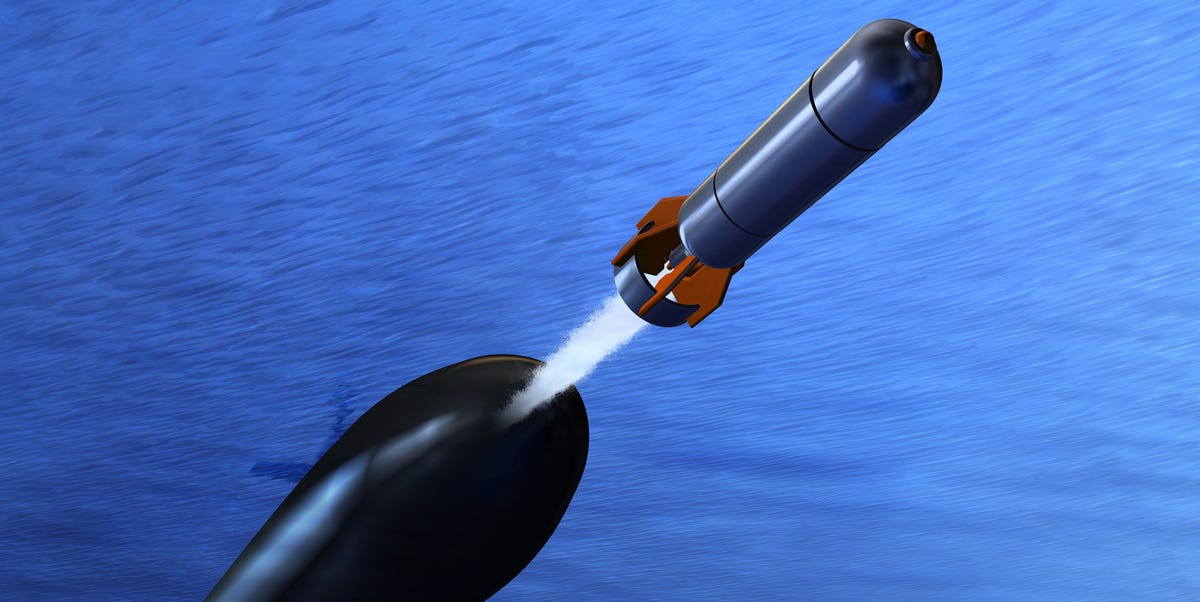
A modern warship can watch the sky hundreds of miles away, share tracks with aircraft and satellites, and launch missiles at threats that are still tiny dots on radar. Then somebody fires a torpedo, and the whole technological confidence trick becomes much less convincing.
The problem is not that navies forgot to invent underwater defense. The ocean is simply an awful place for sensors, communications, weapons, and rapid decisions. Sound bends, reflects, fades, and hides beneath biological and mechanical noise. A torpedo can approach from below the horizon, change guidance modes, reject a decoy, and arrive with little warning. Meanwhile, the defending ship is large, loud, and unable to step sideways.
Modern torpedoes are hard to stop for the same reason a quarterback is hard to sack when the stadium is dark, the field is moving, and the quarterback can hear the defensive calls. Except this quarterback carries a warhead built to break ships.
The Ocean Is a Terrible Place to See Anything
Underwater detection depends on temperamental physics
Radar benefits from electromagnetic waves moving through the atmosphere at the speed of light. Underwater, radio waves are severely limited, so navies depend mainly on sound. Sonar performance is shaped by temperature, salinity, depth, seabed composition, waves, marine life, and the sound-speed profile of the water column.
Those variables can bend sound away from a receiver, create shadow zones, generate multiple paths, or fill a display with reverberation. Naval Postgraduate School material emphasizes that acoustic propagation and sonar performance depend heavily on changing environmental conditions. The ocean does not offer a clean screen; it offers a puzzle made of echoes and then shakes the table.
Shallow coastal water is especially messy because sound may bounce between the surface and bottom while ships, waves, fish, and harbor activity add clutter. Deep water creates different complications, including layers and long-range propagation paths. A sonar that performs beautifully in one area may behave very differently after the ship moves.
Hearing something is not the same as understanding it
A warning system must do more than detect noise. It has to decide whether a contact is a torpedo, estimate its bearing and motion, separate it from friendly weapons or decoys, and provide enough confidence for action. False alarms matter because launching countermeasures or ordering violent maneuvers can disrupt a formation, interfere with friendly sonar, and consume limited defensive stores.
The U.S. Navy publicly treats torpedo defense as an integrated mission involving sensors, warning systems, combat software, and countermeasures. That integration is critical: a brilliant detector connected to a slow decision process is merely an expensive way to discover bad news.
Modern Torpedoes Are Underwater Hunters
They can search, discriminate, and reacquire
The old popular image is a straight-running weapon aimed ahead of a ship. Modern torpedoes are closer to autonomous hunters. Public U.S. Navy descriptions identify the Mk 48 heavyweight torpedo as an acoustic-homing anti-submarine and anti-surface weapon with digital guidance and sophisticated sonar. The Mk 54 uses modern digital signal processing and guidance software, while even the older Mk 46 family received upgraded acoustics, controls, target acquisition, and countermeasure-detection capabilities.
A contemporary weapon may listen passively, transmit active sonar, or combine both methods. Some torpedo types can also receive guidance from the launching platform during part of the run, allowing the weapon to be redirected or held away from autonomous searching until the attack geometry becomes more favorable.
The defender may therefore be trying to fool a weapon that changes behavior, compares signals over time, rejects an implausible contact, and searches again after losing the target. Decoys still matter, but the old idea of tossing a loud noisemaker into the water and calling it a day has aged about as well as leaving car keys under the sun visor.
Wake homing attacks the ship’s trail
Acoustic decoys manipulate what a seeker hears. Wake-homing torpedoes create another problem by sensing the turbulent trail left behind a moving vessel. The wake is broad, persistent, and physically connected to the ship’s recent path. U.S. Naval Institute analyses have long noted that wake-following guidance is difficult to defeat with ordinary acoustic countermeasures because a defender cannot easily manufacture a convincing ship-sized wake on demand.
A wake-homing weapon can use disturbed water as a road toward its source. It does not require a perfect acoustic portrait of the propeller, so simple noise seduction becomes less reliable. Defense must instead combine warning, maneuver, offboard countermeasures, and potentially an interceptor.
The Defensive Timeline Is Brutally Short
A missile may be detected far from a ship by satellites, aircraft, radar pickets, or the target’s own radar. A torpedo begins underwater with no visual signature and no radar track. The launching submarine may remain hidden, and the first unmistakable warning may come from the weapon itself.
After detection, the defender must classify the contact, estimate its path, identify the probable target, choose countermeasures, coordinate with nearby ships, and maneuver while the threat continues to close. Public sources appropriately omit sensitive engagement timelines, but the geometry is unforgiving. Sonar updates may be intermittent, sound moves far more slowly than light, and ships require time and room to turn.
Large vessels face the added problem of mass. A carrier, amphibious ship, tanker, or transport cannot pivot like a speedboat. Even destroyers may be constrained by formation, aircraft operations, mine-avoidance routes, narrow channels, or the need to keep sensors pointed in useful directions.
A Torpedo Does Not Need a Hollywood Direct Hit
Water’s density and the gas bubble created by an underwater blast amplify structural effects. Historical U.S. Navy research and damage accounts describe bubble behavior that can impose severe loads on a hull. Modern torpedoes may use influence fuzes intended to detonate beneath a vessel, where pressure and bubble dynamics can damage the keel and supporting structure.
That raises the defensive standard. A near miss that might be survivable against some above-water weapons can still be disastrous underwater. The defender cannot merely force the torpedo to pass a few yards away and celebrate.
Soft-Kill Defenses Must Tell a Convincing Lie
Soft-kill defenses try to make the torpedo chase the wrong target. Towed devices can produce acoustic signatures behind a ship, while expendable countermeasures may jam, imitate, confuse, or seduce a seeker. NAVSEA has described the AN/SLQ-61 Light Weight Tow as a digitally controlled acoustic countermeasure designed to defend ships against acoustic-homing, wake-homing, and wire-guided torpedoes, building on the role associated with the AN/SLQ-25 Nixie family.
The challenge is credibility. A decoy must look more attractive than a real ship across the frequencies, angles, and behaviors being evaluated. If the weapon decides that a signal is too stationary, too simple, or inconsistent with the target’s motion history, the lie collapses.
Jamming can raise the noise floor or inject confusing signals, but it also announces that something important is nearby. A sophisticated seeker may change mode, alter frequency, or maneuver for another look. Jamming can buy time; it does not turn a 100,000-ton ship into a shy woodland creature.
Hard-Kill Defense Is an Underwater Intercept Problem
Hard-kill systems attempt to destroy or disable the incoming torpedo. The U.S. Navy and its research organizations have publicly worked on countermeasure anti-torpedoes and self-defense intercept concepts.
The idea is simple. Execution is not. The defender needs an accurate track, must launch quickly, guide an interceptor through the same difficult acoustic environment, avoid friendly objects, and engage a small, fast, maneuvering target in three dimensions. The system also needs reliable sensors, command software, launch hardware, safety logic, and crew procedures.
Public GAO and Navy records show why integration has been such a persistent obstacle. Across generations of surface-ship torpedo-defense efforts, promising components have faced development, testing, funding, and fleet-integration difficulties. A hard-kill weapon is only as effective as the entire chain that puts it in the right patch of water.
The Attacker Usually Chooses the Opening Conditions
A submarine does not have to fire from the defender’s favorite sonar range, in friendly weather, after politely announcing its bearing. It can seek a favorable depth, exploit ambient noise, approach from a difficult direction, and wait until the target enters restricted water or an awkward formation.
Quiet submarines make the larger problem worse. DARPA has publicly described modern submarine quieting as a challenge to passive detection and has pursued distributed sensors, unmanned platforms, and active-sonar concepts to improve tracking. The harder the launching platform is to find, the more likely the defender is to confront the torpedo rather than prevent the shot.
This is why the best torpedo defense begins before a weapon enters the water. Patrol aircraft, escorts, unmanned systems, fixed sensors, intelligence, and disciplined operations all aim to deny the attacker a clean firing opportunity. Once a torpedo is inbound, every option becomes shorter-range and less forgiving.
Why “Just Outrun It” Is Not a Plan
Speed and maneuver can improve the geometry, but a torpedo does not have to chase forever. It only needs to reach an intercept point before exhausting its energy. The launching platform can lead the target, and the weapon can cut across a turn. The ship may also be boxed in by coastline, mines, nearby vessels, or other threats.
Higher speed can increase a ship’s acoustic signature and strengthen its wake. It may also make friendly sonar and communications more difficult. Evasion is therefore one layer, not a magic button marked “go faster.”
Real Torpedo Defense Is Layeredand Imperfect
A credible defense combines prevention, detection, classification, maneuver, soft-kill countermeasures, and hard-kill options. It also depends on training. Crews need procedures that work under time pressure and combat systems that fuse information instead of producing competing alarms.
Layering matters because every individual defense can fail. A sonar may detect late. A track may be uncertain. A decoy may be rejected. A maneuver may be constrained. An interceptor may miss. Multiple partial defenses can still reduce the attacker’s chance of success, but no responsible navy treats the problem as solved.
The asymmetry remains ugly: the attacker needs one weapon to work, while the defender needs an entire chain to work quickly enough. That chain runs through physics, software, hardware, tactics, crew judgment, and luck. Any weak link can become the loudest sound on the ship.
A Composite Defense Drill: What the Problem Feels Like
The following is a fictionalized composite based on publicly described torpedo-defense functions and general naval training practices. It is not an eyewitness account, a tactical checklist, or a reconstruction of a specific navy’s procedures.
The operations room is already busy before the alarm. Sonar operators are following ordinary contacts, the bridge is managing traffic, and the ship is holding its assigned station. Then a new transient appearsbrief, uncertain, and inconveniently placed. Nobody immediately shouts “torpedo,” because professionals do not promote every strange underwater noise to the rank of apocalypse.
The first experience is ambiguity. The contact exists, but its meaning does not. An operator compares its acoustic features with machinery, marine life, friendly activity, and weapon signatures. Another sensor contributes a bearing that is close but not perfectly aligned. The combat system begins building a track. The commander needs useful confidence, not theatrical confidence.
Seconds later, the contact behaves more like a weapon. The room changes. Voices become shorter. Information that sounded technical a moment ago becomes physical: bearing, estimated depth, confidence, closest approach. The bridge considers a maneuver, but the ship is not alone. An escort is nearby, aircraft operations may be underway, and the safest direction for one threat may be the worst direction for another.
A countermeasure is deployed. On a display, it is a symbol moving away from the ship. In the water, it is an attempt to tell a machine a better story than the enormous steel target is telling. The ship turns, increasing speed and changing the geometry. Noise rises. Some sensors become less effective just as the crew wants more information. That is the maddening bargain of torpedo defense: actions that improve survivability may reduce awareness.
The track separates, merges, and separates again. Is the torpedo following the decoy, searching, or continuing toward the ship? The answer may remain unclear for several updates. The crew does not receive a cinematic external view. Nobody watches a silver weapon glide past a porthole. They work from data, confidence levels, and procedures built for a situation in which certainty arrives late.
If a hard-kill option is available, it creates another compressed decision. The defensive weapon needs a valid target solution and a safe engagement path. Friendly ships and deployed countermeasures complicate the picture. The commander must decide before the data feels comfortable, because comfortable data may arrive after the useful moment has passed.
Then the contact fades. That is not proof of safety. The weapon may have been defeated, diverted, masked by the environment, or simply lost by the sensor. The ship remains at action stations while operators search for reacquisition. Minutes stretch longer than they should. Every new transient becomes personally offensive.
Only after the exercise ends does the crew get clarity. Logs are compared. Decisions are replayed. The team discovers where information lagged, where terminology caused confusion, and where one sensor’s “obvious” track was another operator’s uncertain blob. The experience is less like winning a video game and more like completing an emergency landing inside a washing machine.
That composite drill explains why modern torpedoes remain intimidating. The defender is not merely dodging a weapon. The ship is interpreting an incomplete underwater picture, making irreversible decisions, coordinating multiple systems, and trying to force an automated hunter to choose incorrectlyall before physics sends the final invoice.
Conclusion
Modern torpedoes are difficult to defend against because they exploit the ocean’s worst features: limited visibility, unpredictable sound propagation, clutter, short warning times, and three-dimensional uncertainty. Their guidance may combine active and passive acoustics, external updates, autonomous search logic, and wake sensing. Their warheads can inflict devastating structural damage without a movie-perfect impact.
Defenders have serious toolstowed decoys, expendable jammers, maneuver, distributed sensors, and anti-torpedo interceptorsbut every tool depends on timely detection and accurate classification. The hardest task is not inventing one clever gadget. It is making an entire defensive chain work under pressure, in ugly water, against a weapon designed to break that chain.
That is why torpedoes remain among the most psychologically and technically powerful weapons at sea. They attack from a domain where the defender sees poorly, reacts late, and cannot afford a small mistake. The ocean hides the approach, complicates the defense, and amplifies the damage. Frankly, it is showing off.
Note: This article uses only publicly available, high-level information and intentionally excludes classified performance data, operational engagement procedures, and actionable instructions for defeating naval defenses.












