
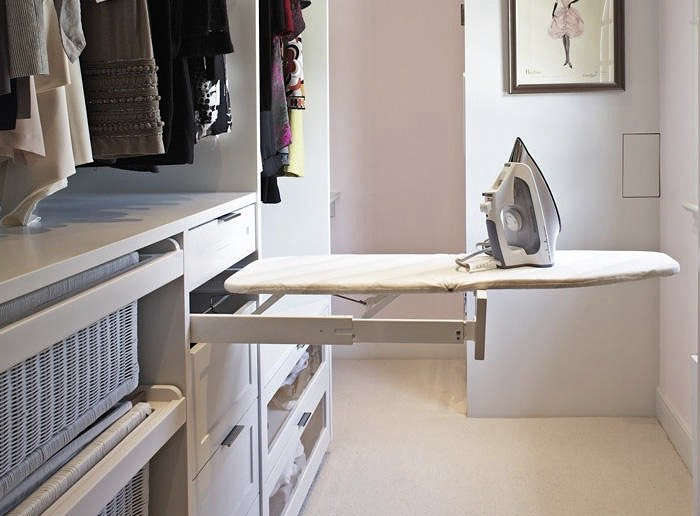
There are household objects that politely disappear when their work is done. A built-in ironing board is one of them. It unfolds when a shirt collar needs rescuing, provides a sturdy pressing surface, and then retreats into a wall or cabinet before anyone trips over its legs.
For compact laundry rooms, dressing areas, sewing studios, mudrooms, and multipurpose closets, built-in ironing boards can transform an awkward chore into a surprisingly streamlined routine. The trick is choosing the correct mechanism for your space. Some models recess between wall studs, some slide from drawers, and others rotate out of narrow cabinet openings like a very practical magic act.
This Design Sleuth guide compares six established sources for built-in ironing boards, explains their strongest applications, and covers the measurements, construction details, electrical considerations, and daily-use quirks that should influence your decision.
Research note: Product features and installation information were cross-checked using manufacturer documentation, specialty hardware suppliers, major U.S. home-improvement retailers, and established home-design publications.
Why Choose a Built-In Ironing Board?
A conventional ironing board requires two kinds of space: storage space while folded and operating space while open. Unfortunately, it is not especially talented at either job. Folded boards lean against walls, slide behind doors, attack ankles, and occasionally collapse at 2 a.m. for reasons known only to them.
A recessed or cabinet-mounted ironing board eliminates much of that clutter. It stays attached to a fixed location, opens at a predictable height, and can often share its cabinet with an iron, spray bottle, starch, lint roller, or garment hook. Design guidance for small laundry rooms commonly recommends placing a recessed board where it has enough extension clearance and convenient access to an electrical outlet.
The Main Built-In Configurations
- Recessed wall cabinets: Installed between studs, with a fold-down board hidden behind a door.
- Surface-mounted cabinets: Attached to the face of a wall when cutting a wall cavity is impractical.
- Drawer pullouts: Concealed behind a cabinet drawer front and unfolded after the drawer is extended.
- Shelf-mounted boards: Attached to a fixed closet shelf and rotated or unfolded into position.
- Tall-cabinet pullouts: Stored vertically in a narrow cabinet before sliding out and folding down.
None is universally superior. The best built-in ironing board is the one that fits your available cavity, cabinet dimensions, ironing habits, and tolerance for remodeling dust.
1. Iron-A-Way: The Full-Service Built-In Ironing Center
Iron-A-Way is one of the most recognizable names in recessed ironing centers. Its products are aimed at homeowners who want a permanent, furniture-like installation rather than a basic fold-down board.
The premium AE46 model illustrates the brand’s approach. It uses a 46-inch ventilated metal board that swivels 90 degrees in either direction, producing a 180-degree operating range with multiple locking positions. The cabinet also incorporates electrical features, hot-iron storage, a separate hot-iron rest, shelves, lighting, a cover and pad, and a built-in safety switch. It arrives assembled, although the wall opening and electrical connection still require careful preparation.
Best For
Choose Iron-A-Way for a dedicated laundry room, custom closet, primary-bedroom dressing area, or renovation where the ironing station should look and function like a permanent appliance.
What to Watch
Do not order first and measure later. Iron-A-Way offers several models with different board lengths, cabinet depths, doors, swivel mechanisms, and electrical packages. Manufacturer guidance notes that most cabinets can be recessed or surface-mounted, but completely flush installation is limited to particular configurations. Its electrical models are rated for a 120-volt, 15-amp connection with a 1,500-watt maximum, so electrical work should follow the supplied specifications and applicable local codes.
This is the feature-rich choice, but it is also the option most likely to involve a carpenter, electrician, stud finder, and at least one conversation beginning with, “What is behind this drywall?”
2. Hide-Away: A Traditional Wood-Cabinet Solution
Hide-Away ironing boards appeal to homeowners who want the station to resemble built-in cabinetry. The company offers recessed wood cabinets with raised-panel or Shaker-style doors, making them easier to coordinate with traditional, transitional, farmhouse, or cottage interiors.
The Supreme Series 420 combines a swiveling ironing board with a sleeve board, heat-shielded hot-iron storage, and an installed electrical timer and light kit. The cabinet is designed for installation between conventional studs spaced 16 inches on center. Manufacturer guidance uses a standard operating height near 36 inches but allows the installer to raise or lower the wall opening according to the user’s preference.
Best For
Hide-Away is especially attractive for visible locations where a plain utility door would feel unfinished. Consider it for a hallway near bedrooms, a well-designed laundry room, or a walk-in closet with matching painted or stained millwork.
What to Watch
Door swing matters. A beautiful cabinet is considerably less charming when its door collides with a light switch or blocks the only route through a narrow laundry room. Decide whether the door should hinge on the left or right, confirm the board’s swivel path, and mark the complete operating footprint on the floor before installation.
Also check the size of your iron. “Hot-iron storage” does not guarantee that every oversized steam-generator iron or unusually broad cordless base will fit inside the cabinet.
3. Rev-A-Shelf: The Cabinetmaker’s Pull-Out Option
Rev-A-Shelf takes a different approach. Instead of placing the ironing board inside a tall wall cabinet, several of its systems hide behind a drawer front or within closet cabinetry.
The CIB Series uses an expandable frame, fixed brackets for attaching a standard drawer front, and ball-bearing slides that extend the mechanism from the cabinet. After the unit is pulled forward, a gravity lock engages and the folded board opens into its working position.
Other Rev-A-Shelf configurations include vanity-mounted foldout boards and rotating closet boards. That variety makes the brand useful when the cabinetry is being designed around the mechanism rather than when a finished room needs a simple retrofit.
Best For
Rev-A-Shelf is a strong candidate for custom closets, sewing rooms, bathroom vanities, compact laundry cabinets, and remodels involving new base cabinetry. It is particularly convenient for quick clothing touch-ups because the board can be positioned near drawers, hanging rods, and mirrors.
What to Watch
Cabinet opening dimensions are critical. Drawer-mounted boards need enough internal width, depth, and height for both the slide mechanism and folded board. Face frames, inset doors, plumbing, drawer hardware, and countertop overhangs can reduce usable clearance.
Ask your cabinetmaker to design from the product specification sheet, not from the dimensions of a similar-looking internet photo. Cabinet hardware is not impressed by optimism.
4. Häfele Ironfix: Compact and Closet-Friendly
Häfele’s Ironfix line is designed for spaces where a full recessed cabinet would be excessive. A shelf-mounted Ironfix board attaches to a fixed closet shelf, folds into a compact package, and opens where clothes are already stored.
Specialty retailers describe the shelf-mounted version as a steel mechanism with a heat-resistant cover that installs directly on a closet shelf. It is intended for quick pressing near hanging shirts, jackets, and dresses rather than for taking over an entire laundry-room wall.
Best For
This is a smart solution for walk-in closets, wardrobe cabinets, guest suites, apartments, and dressing rooms. It also works well for people who mainly iron collars, cuffs, hems, and one outfit at a time.
What to Watch
A compact board has a compact pressing surface. That is perfectly reasonable for shirts and touch-ups, but it can become tedious when working through long curtains, tablecloths, wide trousers, or a linen duvet cover the size of a small county.
The supporting shelf must also be sturdy and securely fastened. Thin adjustable shelving held by light-duty pins may not provide the rigid base required for repeated downward pressure.
5. Household Essentials: An Accessible Recessed Cabinet
Household Essentials offers in-wall ironing cabinets through major U.S. retailers, making the category more accessible to homeowners who do not need a premium custom system.
The StowAway 18100-style cabinet uses a recessed body, a fold-down board approximately 41 inches long and 11.75 inches wide, two interior shelves, adjustable board height, and a board capable of rotating to either side. The cabinet is intended for installation between studs spaced 16 inches on center, and the exterior door can be painted to coordinate with surrounding finishes.
Best For
This option suits practical laundry-room renovations, secondary bedrooms, craft rooms, sewing areas, and budget-conscious projects where storage and swivel capability matter more than premium woodwork.
What to Watch
Retail availability can vary by finish and model number. Some listings remain online after individual stores stop stocking a product, so confirm that the exact cabinet, replacement cover, and optional accessories are currently obtainable before cutting the wall.
The cabinet also projects partially from the wall because only part of its depth is recessed. That is normal, but it should be accounted for near doors, narrow passages, and side-by-side appliances.
6. Dropout Cabinet Fixtures: The Narrow Vertical Pull-Out
Dropout Cabinet Fixtures offers a clever solution for tall, narrow cabinet spaces. Instead of folding into a drawer or wall box, the ironing board stores vertically, slides from the cabinet, and drops into its operating position.
One commonly listed configuration requires a cabinet opening at least 7 inches wide, 23 inches deep, and 63 inches high. It is available in left- or right-facing versions and requires about 56 inches of open clearance for the board to fold out.
Best For
This design is ideal for a custom laundry tower, wardrobe end panel, pantry-style utility cabinet, or narrow filler space that might otherwise become a gloomy vertical cave for lost broom handles.
What to Watch
The mechanism needs flat, accurately aligned mounting surfaces at the top and bottom of the cabinet. It also requires substantial vertical height and generous floor clearance in front of the opening.
Because left- and right-facing versions are different, determine the desired operating direction before ordering. The correct answer depends on adjacent cabinets, traffic flow, electrical outlets, and whether the user is right- or left-handed.
Built-In Ironing Board Comparison
| Source | Primary Format | Best Application | Standout Feature |
|---|---|---|---|
| Iron-A-Way | Recessed or surface-mounted center | Full laundry rooms and custom renovations | Integrated electrical and hot-iron features |
| Hide-Away | Wood recessed cabinet | Visible, design-conscious locations | Furniture-style doors and sleeve-board options |
| Rev-A-Shelf | Drawer or closet pullout | Custom cabinetry and closets | Conceals behind a standard cabinet front |
| Häfele Ironfix | Shelf-mounted folding board | Closets and quick touch-ups | Compact installation without a wall cavity |
| Household Essentials | Recessed cabinet | Value-focused laundry-room projects | Storage shelves and swiveling board |
| Dropout Cabinet Fixtures | Tall vertical pullout | Narrow custom utility cabinets | Uses a slim vertical cabinet opening |
How to Select the Right Built-In Ironing Board
Measure the Entire Operating Zone
Cabinet dimensions tell only half the story. You must also measure the board when fully extended, the door when open, and the path required for swiveling or unfolding. Use painter’s tape to outline the operating area on the floor. Then open nearby doors and appliances to identify conflicts.
Choose a Comfortable Working Height
A fixed built-in board should match the primary user. Before cutting drywall, simulate the proposed height with a countertop, table, or conventional adjustable board. Too low encourages back strain; too high makes it difficult to apply controlled pressure.
Plan for Steam and Ventilation
A ventilated metal board helps steam move through fabric instead of collecting beneath it. A breathable cover and adequate padding also improve pressing performance. Steam irons should be used according to garment-care labels, beginning with lower temperatures because an iron heats faster than it cools.
Inspect the Wall Before Cutting
Stud bays may contain electrical wiring, plumbing, blocking, ducts, or insulation. Use appropriate detection tools and inspect from both sides when possible. Exterior walls, fire-rated assemblies, and walls shared with garages may have additional code requirements.
Decide Whether You Need Built-In Power
An integrated outlet, timer, light, and safety switch can make an ironing center more convenient. However, hardwired installation adds complexity and should be completed in accordance with the manufacturer’s instructions and local electrical rules. A nearby wall outlet may be simpler for occasional users.
Confirm Replacement Parts
Ironing-board covers eventually stain, scorch, stretch, or lose padding. Before buying an unusual board shape, check whether replacement covers and pads are available. A clever mechanism becomes considerably less clever when its only compatible cover disappeared three product catalogs ago.
Experience Notes: What Daily Use Teaches You
Built-in ironing boards tend to be loved for a reason that specification sheets barely capture: they reduce the number of decisions required to iron something. With a conventional board, a person must retrieve it, carry it, unfold it, adjust it, locate the iron, find an outlet, and eventually reverse the entire operation. A built-in station removes most of that ceremony.
In everyday use, convenience often matters more than board width. A homeowner who can open a closet board in ten seconds may press a shirt before work instead of deciding that the wrinkles are “part of the fabric’s personality.” This makes compact shelf-mounted or drawer-mounted boards surprisingly effective for households that iron small amounts frequently.
Location is equally important. A technically perfect ironing center installed in the basement may see less use than a modest foldout board beside the bedroom closet. The most successful placements follow the clothing workflow: clean garments leave the washer, move to a drying or hanging area, receive any needed pressing, and then go directly into storage.
Swivel capability becomes valuable in tight rooms. A straight-opening board may block a doorway or force the user to stand against an appliance. Rotating the board even 45 degrees can improve access to both sides of a garment and keep the working area out of the main traffic path. Nevertheless, a swivel mechanism is useful only when the surrounding walls and cabinets leave room for it to move.
Storage compartments are another feature that sounds simple but changes the experience. Keeping starch, distilled water, a pressing cloth, and a lint roller in the same cabinet prevents the familiar scavenger hunt through three rooms. Shallow shelves are usually more practical than deep ones because supplies remain visible instead of migrating into a dark corner.
Hot-iron storage requires discipline. A cabinet may include heat-resistant shielding, but users should still follow the product instructions regarding temperature, cord placement, and storage. “Heat resistant” is not a magical phrase meaning “immune to every creative mistake.” The iron should sit securely without pressing against the door, cord, cover, or plastic accessories.
Board stability also becomes noticeable during real pressing. Lightweight wall-mounted boards are excellent for quick touch-ups but may flex more than premium recessed systems. People who sew, quilt, press heavy denim, or iron large batches generally appreciate a rigid frame and a longer surface. Occasional users may happily trade some rigidity for a smaller footprint and easier installation.
Finally, the door should be treated as part of the room’s design. A paintable Shaker door can blend with cabinetry, a mirror-front cabinet can serve a dressing area, and an unfinished wood door can be stained to coordinate with trim. Matching the door makes the ironing center feel intentional rather than like a utility box that wandered into the room and refused to leave.
Final Verdict
The best source for a built-in ironing board depends on how permanent, compact, decorative, and feature-rich the installation needs to be.
Iron-A-Way provides the most complete appliance-style experience. Hide-Away is compelling when traditional wood cabinetry matters. Rev-A-Shelf and Häfele excel in custom closets and compact cabinetry. Household Essentials offers a practical recessed solution through mainstream retailers, while Dropout Cabinet Fixtures turns a narrow vertical opening into useful ironing storage.
Whichever source you choose, measure the wall cavity and the open board, verify the door and swivel direction, check outlet placement, confirm replacement-cover availability, and read the installation sheet before construction begins. A properly planned built-in ironing board saves space and encourages regular use. A poorly planned one becomes an expensive cabinet door that cannot open because the washing machine is in the way.












