
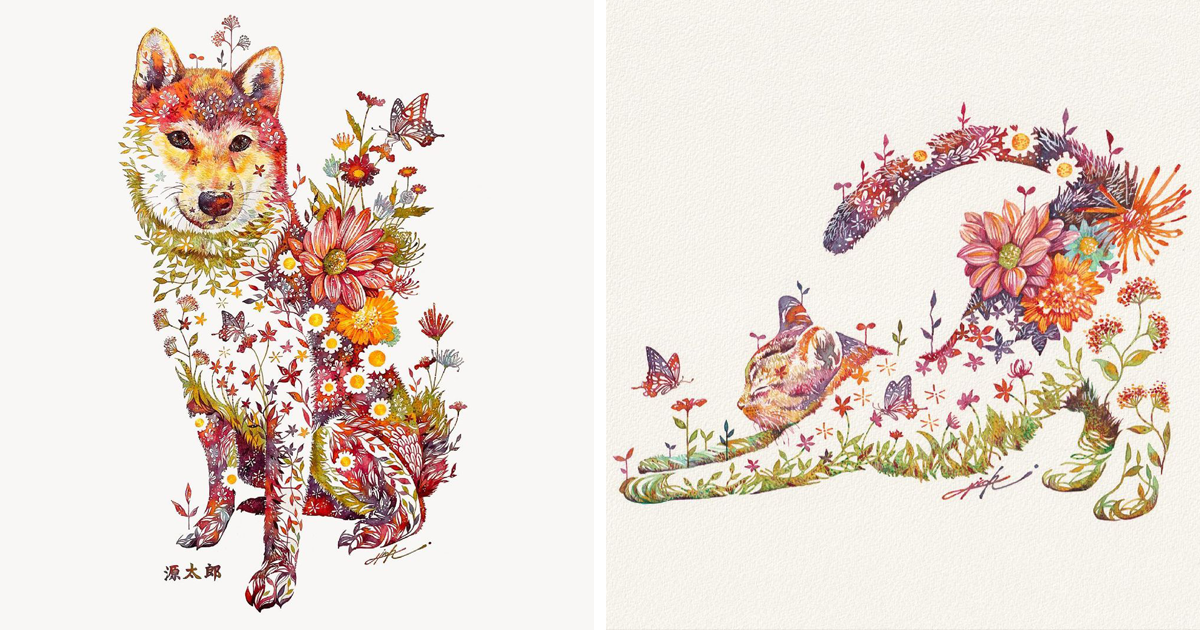
At first glance, Hiroki Takeda’s animals appear to have wandered through a botanical garden and forgotten to come out. Cats bloom with daisies. Dogs sprout leafy whiskers. Butterflies flutter around rabbits whose fur seems woven from vines, petals, and tiny stems. The effect is charming, but it is also far more technically sophisticated than “cute animal plus flowers” might suggest.
One clarification deserves to arrive before the florist: Takeda does not generally construct these creatures from physical bouquets. His “flower arrangements” are intricate watercolor compositions. Botanical motifs replace, interrupt, and reshape the animals’ fur, feathers, skin, and silhouettes. The result is a distinctive form of floral animal art in which fauna and flora seem to share the same anatomy.
The Japanese watercolor artist has become known internationally for paintings of cats, dogs, birds, rabbits, rhinoceroses, and other creatures filled with colorful plant life. Although the images spread easily online because they are immediately lovable, their staying power comes from Takeda’s control of watercolor, careful observation of animal behavior, and thoughtful interest in the beauty of living things.
Who Is Hiroki Takeda?
Hiroki Takeda is a Japan-based contemporary artist specializing in watercolor. He has said that he loved drawing from childhood and eventually reached the point where making images became his profession. His central artistic themes are straightforward but ambitious: the beauty of living creatures and the vivid possibilities of watercolor.
Takeda’s signature style developed through a combination of influences. His mother’s enthusiasm for plants helped make botanical forms familiar to him, while his experience with caricature encouraged him to observe the recognizable features and personalities of individual subjects. During his university years, he experimented with different visual approaches until animal fur and plant forms began to overlap naturally in his imagination.
He has described a moment when the fur in an animal painting reminded him of vegetation. That visual connection opened the door to his now-recognizable method: replacing conventional strokes of fur with grasses, flowers, leaves, and branching stems. What might have remained a clever experiment gradually became an entire artistic language.
These Are Watercolor Flower Arrangements, Not Bouquets
The phrase “animals using flower arrangements” can create the impression that Takeda works like a florist, placing real petals on a table to build a cat or dog. Botanical sculpture does exist, of course. Artists such as Raku Inoue have created insects and animals from actual flowers, leaves, twigs, seeds, and discarded plant material.
Takeda’s process is different. His arrangements happen on paper. A daisy may become part of a cat’s shoulder. A fern-like stroke may describe the direction of a dog’s coat. A cluster of small blossoms can create volume around a rabbit’s chest, while thin stems preserve the gesture of a tail. The flowers are not decorations placed on top of the animal. They help construct the animal itself.
That distinction matters because it reveals why his paintings feel so unified. He is not painting a realistic pet and then adding a festive floral border, as though the animal has just won a gardening contest. The botanical and zoological elements are designed together from the beginning.
How Takeda Builds an Animal from Flowers
Animal anatomy comes first
However fanciful the final image becomes, Takeda’s animals remain anatomically convincing. Their eyes align correctly, their weight appears to rest on believable limbs, and their poses reflect recognizable behavior. His cats stretch, curl, lounge, and stare with the mysterious confidence of animals that know they own the house despite contributing nothing toward the mortgage.
Takeda works from photographic references and begins with a light pencil outline. This framework allows him to preserve the proportions and personality of the subject before botanical details begin filling the form. Realistic observation gives the imaginative elements something solid to inhabit.
Flowers become fur, motion, and volume
Once the basic structure is established, Takeda gradually develops the animal with floral shapes. Large blossoms can function as visual anchors, while smaller petals create transitions between major parts of the body. Vines suggest directional movement. Repeated leaves imitate the rhythm of fur, scales, or feathers.
This is one reason his paintings reward close viewing. From across a room, viewers see a cat or dog. Move closer and the body begins to dissolve into a miniature ecosystem. The eye constantly switches between two interpretations: “That is an animal” and “That is a collection of plants.” Neither reading completely defeats the other.
The untouched paper provides light
Takeda’s handling of white space is especially important. He has explained that the white areas in his work come from the paper itself rather than white paint applied over the watercolor. Because a painted mark cannot simply be removed, he must decide carefully where to stop and which areas should remain untouched.
This approach suits watercolor, a medium prized for transparent color and luminosity. Light reflects through thin pigment layers and off the white paper, allowing petals and animal features to feel bright without becoming heavy. In Takeda’s compositions, blank areas also prevent the complex botanical patterns from turning into visual soup. Even a beautiful soup is still soup.
Why the Color Feels So Alive
Takeda frequently works with pinks, purples, oranges, greens, and blues, blending them through careful gradations. Instead of matching every animal’s natural coat color, he uses a broader botanical palette. A gray cat may acquire violet shadows. A white dog may contain pale turquoise, coral, and green. These colors are not random; they distribute attention, separate forms, and keep the paintings visually active.
Watercolor is particularly effective for this purpose because transparent washes can overlap without completely concealing earlier layers. A stem can pass through a warmer patch of color, or a petal can blend into the edge of an ear. The medium helps plant and animal forms merge without producing a hard, collage-like boundary.
Takeda also balances saturation with restraint. The most colorful areas often gather around the body’s center or a large flower, while the surrounding paper remains open. This contrast makes the paintings feel abundant but not claustrophobic. They resemble gardens with paths, rather than gardens in which every plant has declared war on its neighbor.
Why Cats and Dogs Work So Well in Floral Animal Paintings
Cats and dogs are ideal subjects because viewers already understand their body language. A raised tail, tilted head, curled paw, or sleepy posture communicates quickly. Takeda can therefore introduce dense botanical abstraction without losing the emotional clarity of the animal.
His cat paintings often emphasize elegance, flexibility, and watchfulness. Long vines echo curved tails, and scattered flowers reinforce the sense that the feline is both present and slightly untouchable. His dogs tend to project more outward energy. Botanical forms burst from their coats like visible enthusiasm, giving the impression that the dog is delighted by the entire concept of being alive.
Takeda does not limit himself to household pets. Larger animals, birds, insects, and imaginary creatures appear in his wider body of work. Yet cats and dogs remain especially shareable because they connect an unusual visual style to familiar affection. Viewers recognize the pose before they begin exploring the flowers.
Connections to Japanese Art and Nature
It would be too simple to describe Takeda’s paintings as modern versions of one specific historical school. His style is personal, contemporary, and shaped by illustration as well as fine art. Still, his close fusion of plants, animals, color, and open space participates in a much broader Japanese artistic conversation about nature.
Japanese art has repeatedly used abbreviated natural motifs, seasonal plants, animals, and bold decorative compositions. The Rinpa tradition, for example, is known for graphic treatments of nature, innovative brushwork, and striking arrangements of natural forms. East Asian flower-and-bird painting also established a long history of bringing close observation and symbolic plant life into the same composition.
Takeda’s paintings do not imitate historical screens or scrolls. Instead, they feel contemporary because the imagery is accessible, the animals are full of individual personality, and the color palettes suit modern illustration. Nevertheless, the attention to nature, rhythm, asymmetry, and negative space gives the work deeper visual roots than a passing social-media trend.
The paintings are sometimes compared loosely with ikebana because of their carefully considered botanical arrangements. Traditional ikebana emphasizes intention, balance, seasonality, asymmetry, and the expressive use of empty space. Takeda works in two dimensions and follows his own process, but a similar respect for the placement of each natural element can be felt in his compositions.
More Than Cute: The Larger Ideas in Takeda’s Art
The beauty and equality of living things
Takeda has said that representing animals with plants and flowers helps him express the beauty of life. This idea explains why his botanical motifs feel structural rather than ornamental. Plant life is not presented as scenery for a more important animal subject. The different forms of life interpenetrate and support one another.
Later exhibitions expanded that principle into visions of coexistence. In works associated with his “Ideal Life” exhibition, Takeda explored a world in which human priorities do not automatically justify the sacrifice of other living things. The floral animals may look playful, but their visual logic quietly challenges the habit of treating nature as a separate background resource.
Flowers confronting the machinery of war
Takeda has also adapted his botanical language to darker subjects. In a series of anti-war paintings, flowers and plant life interacted with guns, aircraft, tanks, soldiers, and damaged urban scenes. The contrast was intentionally uncomfortable: the same blossoms that make a cat appear enchanting became symbols of healing, memory, and resistance when placed beside weapons.
These works demonstrated that Takeda’s style could carry more emotional weight than cuteness alone. A flower can suggest fragility, but it can also suggest persistence. Plants return to abandoned structures, grow through cracks, and reclaim landscapes after human violence. Within that context, the botanical motif becomes an argument for life rather than merely a decorative signature.
From Household Pets to Fantasy Monsters
Takeda’s ability to merge anatomy with vegetation also lends itself naturally to fantasy subjects. In 2024, his work was featured in a collaboration celebrating the twentieth anniversary of the Monster Hunter game series. The project placed his detailed botanical style in conversation with fictional creatures already designed around elaborate ecosystems.
The collaboration made sense because Takeda’s method is essentially a form of biological world-building. Every vine can imply habitat. Every flower can become armor, fur, plumage, or energy. Even when the subject is imaginary, the organic detail makes it feel as though it has evolved somewhere rather than being assembled in a meeting room by people arguing over how many horns are too many horns.
Why Hiroki Takeda’s Watercolors Spread So Easily Online
Takeda’s paintings are exceptionally compatible with digital viewing. The animal silhouette is readable at thumbnail size, creating immediate recognition. The botanical detail rewards zooming, saving, and revisiting. Bright colors stand out in crowded feeds, while the emotional familiarity of cats and dogs encourages sharing.
Yet their popularity is not only a victory for the internet’s powerful cat lobby. The compositions contain a useful tension between accessibility and complexity. A viewer does not need an art-history degree to enjoy a floral kitten, but a closer look reveals sophisticated decisions about edge control, transparency, color distribution, anatomy, and negative space.
This combination is difficult to achieve. Work that is instantly readable can become forgettable, while work that is highly complex can feel inaccessible. Takeda’s botanical animal illustrations occupy the productive space between those extremes. They welcome viewers first and challenge them second.
What Artists Can Learn from Takeda’s Floral Animal Style
The most useful lesson is not to copy his flowers. It is to study how he discovered a visual connection between two subjects and then developed that connection consistently. Fur and foliage share direction, repetition, softness, and layered texture. Takeda recognized those similarities and built a style around them.
His work also shows the value of restraint. Detailed art does not require filling every inch. The untouched paper is active. It creates brightness, separates forms, and allows viewers to complete some of the image mentally. Knowing where to stop is part of the drawing.
Finally, his career demonstrates how an appealing signature technique can evolve into broader themes. Floral pets led naturally to wildlife, environmental ideas, anti-war imagery, fantasy creatures, and imagined worlds of coexistence. A recognizable style does not have to become a cage. Properly handled, it becomes a doorway.
A Viewer’s Experience: How to Spend Time with Takeda’s Floral Animals
Begin with the silhouette
The best way to experience one of Takeda’s paintings is to resist zooming in immediately. Start with the whole animal. Notice the pose before the individual flowers. Is the cat stretching, sleeping, or watching something outside the frame? Does the dog appear cautious, energetic, or proudly pleased with itself for reasons known only to dogs?
This first reading establishes the emotional character of the subject. Even when much of the body is made from plants, the gesture should remain clear. The animal’s posture acts like the melody of a song; the botanical details provide the orchestration.
Move closer and let the animal dissolve
Next, study the middle of the body or the area where fur becomes foliage. At this distance, the image starts changing categories. A colored patch that initially looked like a shoulder may reveal itself as five leaves, two small flowers, and a curling stem. An ear may be partly defined by pigment and partly by untouched paper.
This transformation is one of the pleasures of Takeda’s art. The viewer participates in assembling and disassembling the animal. Look at the flowers and the cat temporarily disappears. Look at the eyes and the cat returns. It is a gentle visual magic trick performed without smoke, mirrors, or an assistant trapped inside a suspiciously floral box.
Follow the movement of stems and butterflies
After exploring the central details, trace the directional lines. Follow vines from the body toward the tail. Notice how stems guide the eye around the composition rather than allowing it to become stuck on the largest blossom. Butterflies often serve as small visual pauses or directional signals, leading attention beyond the animal and into the surrounding white space.
These elements help the composition breathe. Without them, the floral pattern might feel contained inside the silhouette. With them, the animal appears connected to an environment extending beyond the visible page.
Notice the emotional effect of color
Consider how the palette changes the animal’s personality. Warm oranges and pinks may make a subject feel affectionate or energetic. Purples and blues can introduce quietness, mystery, or dreamlike distance. Green often performs double duty, describing vegetation while cooling the surrounding colors.
Then look for the lightest areas. Because the white paper is often preserved rather than painted over, these gaps can feel more luminous than an opaque white highlight. They keep the animal from becoming visually heavy, even when dozens of plant forms occupy its body.
End by stepping back again
Finally, return to the full image. The experience should now be different. The animal is still recognizable, but it no longer seems separate from the flowers. You have seen how each tiny botanical component contributes to its posture, texture, and expression.
This slow-looking exercise also works with reproductions, although original watercolor surfaces offer additional subtleties in pigment, paper texture, and edge variation. Whether viewed in a gallery, a book, or on a screen, Takeda’s work encourages a useful habit: enjoy the immediate charm, then stay long enough to understand how that charm was built.
Conclusion: A Garden with Paws, Whiskers, and Wings
Hiroki Takeda’s paintings succeed because they do more than place two attractive subjects together. He does not simply paint animals beside flowers. He creates animals through flowers, using watercolor transparency, botanical rhythm, careful anatomy, and untouched paper to make separate forms of life appear inseparable.
The familiar pets attract attention, but the deeper idea keeps it: nature is not a collection of isolated categories. Fur resembles grass. Veins in leaves resemble branching systems in bodies. A curled stem can carry the same energy as a raised tail. Takeda makes those connections visible without turning the experience into a biology lecture with an unusually enthusiastic slide deck.
His floral animal paintings are whimsical, technically controlled, and open to larger meanings about coexistence, fragility, healing, and respect for life. That combination explains why the images feel equally at home in an art exhibition, a watercolor discussion, or the saved-post folder of someone who originally clicked because the cat looked adorable.
Note: Despite the headline’s reference to flower arrangements, Hiroki Takeda’s best-known animal works are watercolor paintings of floral motifs rather than sculptures assembled from fresh flowers.











