
Bluetooth speakers are usually simple creatures. You connect a phone, press play, and enjoy them until the battery develops the stamina of a sleepy house cat. Once that happens, many models become expensive electronic paperweights because their enclosures are glued shut, replacement parts are unavailable, and the firmware is guarded like a secret family recipe.
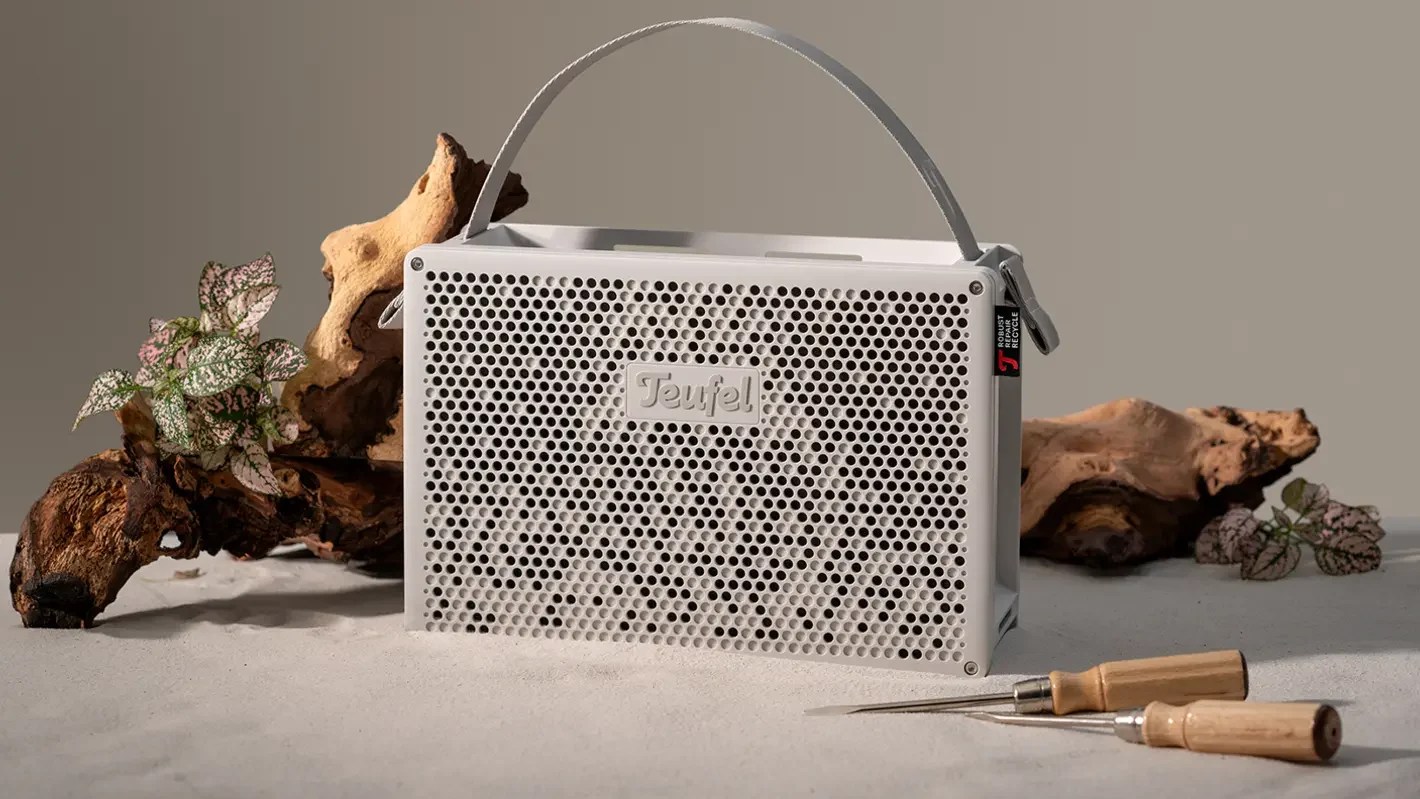
Teufel is taking a remarkably different approach with the MYND, a portable open source Bluetooth speaker designed to be repaired, modified, studied, and potentially rebuilt. Instead of merely adding another rugged wireless box to an already crowded market, the Berlin audio company has published mechanical designs, circuit information, firmware resources, repair documentation, and other technical files. The result is a commercial speaker that invites owners to look under the hood rather than politely warning them to keep their screwdrivers at a safe distance.
Meet the Teufel MYND Open Source Bluetooth Speaker
The Teufel MYND was introduced in 2025 as a portable 2.1-channel speaker focused on three ideas: strong sound, long service life, and meaningful user control. It is not an experimental development board with a tiny speaker attached as an afterthought. It is a finished consumer product with Bluetooth 5.3, app-based controls, rugged environmental protection, multiple audio inputs, and a substantial internal battery.
According to Teufel’s published specifications, the MYND measures approximately 10.2 inches wide, 7.1 inches high, and 3.9 inches deep. It weighs about 5.4 pounds, making it more substantial than a pocket speaker but still portable enough for a patio, workshop, picnic table, or weekend trip. Its enclosure is available in several playful colors, including restrained black and white options as well as brighter mint and berry finishes. Apparently, sustainability does not require everything to be painted the color of recycled oatmeal.
Inside is a 2.1 audio system built around one 90-millimeter woofer, two 20-millimeter tweeters, passive radiators, Class-D amplification, and digital signal processing. Teufel lists total output at 35 watts RMS, a frequency range of 52 Hz to 20 kHz, and a maximum sound pressure level of 95 dB at one meter. Waveguides are used to create a broader stereo presentation than listeners might expect from a single portable cabinet.
What “Open Source” Actually Means Here
Calling a product open source can mean anything from “we posted one diagram” to “here are the files required to understand and reproduce the device.” The MYND falls much closer to the second category.
The Open Source Hardware Association defines open source hardware as physical technology whose design is publicly available so people can study, modify, manufacture, and distribute it. Proper open hardware documentation should include editable source files rather than only promotional drawings or flattened documents that cannot be changed easily.
Mechanical and CAD files
Teufel has released enclosure designs in several formats, including files suitable for computer-aided design and 3D-printing workflows. Separate models cover major housing components, allowing makers to inspect dimensions, redesign exterior pieces, create mounting accessories, or experiment with replacement parts.
That does not mean an average desktop printer can produce a factory-identical enclosure before lunch. Some shapes were designed for injection molding, while seals, gaskets, acoustic surfaces, and complex overhangs can be difficult to reproduce accurately. Still, having editable geometry is far more useful than staring at a sealed plastic box and whispering encouraging words to it.
Electronic schematics and PCB layouts
The published hardware information includes circuit schematics and printed circuit board layouts in formats such as KiCad, Altium, and PDF. An independent technical examination by the Free Software Foundation Europe found enough information to study and recreate the main electronic assemblies. The investigation counted nine circuit boards containing more than 1,000 components, so building a complete MYND from scratch is technically possible but considerably more ambitious than replacing a loose cable.
The documentation is especially valuable for troubleshooting. A repair technician can follow signal paths, identify components, compare expected connections, and diagnose failures without reverse-engineering every trace. For advanced makers, the files also provide a foundation for designing replacement modules or entirely new electronic configurations.
Firmware and development tools
Teufel publishes the MYND’s main microcontroller firmware and bootloader code in a public GitHub repository under the MIT license. The repository includes source code, build scripts, hardware-support files, and instructions for compiling firmware with a supported development toolchain. This makes it possible for technically skilled users to inspect behavior, test changes, and develop alternative functions.
There is an important limitation, however. Not every line of software inside the product is fully open. Firmware associated with certain third-party components, including the Bluetooth module, digital signal processor, and USB-C controller, is distributed as proprietary binary data. Consequently, the MYND is a strong example of open hardware and partially open software, but it is not a device in which every digital instruction can be freely inspected or rewritten.
Repairability Is the Real Headline
The downloadable files are exciting for engineers, but everyday buyers may care more about a simpler question: Can the speaker be fixed when something wears out?
The MYND was designed around screws, documented fasteners, accessible modules, and reusable seals rather than an adhesive-heavy enclosure. The screws are visible, their different sizes are identified, and the opening point is marked. This reduces the amount of detective work required before a repair can even begin.
The battery is particularly important because rechargeable cells are usually among the first components to lose meaningful capacity. Teufel sells a replacement battery and provides instructions for installing it. Owners therefore do not need to discard the drivers, amplifiers, housing, and controls simply because one lithium-ion pack has aged.
Teufel also uses a battery-care charging mode that stops charging at approximately 90 percent to reduce long-term battery wear. A fast-charging option is available when speed matters more than maximizing cell longevity. It is an unusually thoughtful feature in a category where battery management often consists of a blinking red light and a vague sense of impending silence.
Repairable does not mean effortlessly repairable
The open design should not be confused with unlimited spare-part availability. Independent analysis has noted that Teufel publicly offers the battery and carrying accessories, but not necessarily every circuit board, driver, gasket, or internal component through a standard online parts catalog.
Specialized speaker drivers are another complication. Teufel developed the original drivers, and exact replacements may not be available from ordinary electronics distributors. A knowledgeable builder could adapt a similar driver, but doing so might change the frequency response, amplifier load, bass tuning, or protective DSP behavior.
In other words, the MYND makes repair dramatically more approachable, but it does not magically turn every owner into an acoustic engineer. The major improvement is that the product does not intentionally stand in the repairer’s way.
Sound and Everyday Performance
A speaker can be beautifully documented and wonderfully repairable, but none of that matters much if music sounds like it is being played through a cereal box. Fortunately, published testing indicates that the MYND’s acoustic performance is one of its stronger qualities.
Independent reviewers have described its tuning as balanced, detailed, and full-bodied, with controlled bass and a wider presentation than many similarly sized portable speakers. The 90-millimeter woofer and passive radiators provide low-frequency weight, while the separate tweeters help preserve clarity in vocals, guitars, podcasts, and higher-frequency percussion.
The speaker appears designed as an all-purpose system rather than a bass cannon built exclusively for alarming nearby lawn furniture. Its DSP adjusts output to maintain control at higher volume levels, while the Class-D amplifiers improve efficiency during battery-powered use. Eco mode extends runtime but reduces maximum volume, deep bass output, and equalizer functionality. That is a reasonable trade: physics rarely gives away 42 hours of loud bass without collecting payment somewhere.
Battery Life, Charging, and Connectivity
Teufel rates the standard battery life at approximately 39 hours at medium volume and up to 42 hours in Eco mode. Actual runtime will vary with volume, bass intensity, temperature, wireless conditions, and use of the built-in power-bank function.
The USB-C port supports charging at up to 60 watts with compatible equipment. It can also power a connected phone, although doing so naturally reduces speaker runtime. The battery has a listed capacity of 5,200 mAh at 7.3 volts.
Multiple ways to play music
Bluetooth 5.3 is the primary wireless connection, with multipoint support for keeping two source devices available. Google Fast Pair simplifies setup with compatible Android hardware. For wired listening, the MYND includes a 3.5-millimeter auxiliary input and can function as a USB audio device when connected to a computer.
Party Link allows compatible Teufel speakers to be grouped, with support for chains of up to 100 MYND or ROCKSTER GO 2 units. One hundred synchronized speakers may be excessive for a backyard cookout, but it certainly eliminates the classic complaint that the potato-salad table cannot hear the chorus.
The Teufel Go app provides equalizer controls, battery information, Eco mode management, and other settings. Crucially, the speaker can also perform its basic functions without requiring the app, reducing dependence on long-term mobile software support.
A Rugged Speaker That Can Still Be Opened
The MYND carries an IP67 rating, meaning it is designed to resist dust and temporary water immersion under the conditions covered by that rating. Achieving water resistance while preserving repair access is not trivial. Manufacturers often rely on adhesives because they are fast to apply and easy to automate during production.
Teufel instead uses mechanical fasteners and fitted rubber seals. That approach allows the enclosure to be reopened while maintaining environmental protection when correctly reassembled. Owners must still inspect seals carefully during repairs. A twisted gasket or poorly seated panel can turn “water-resistant speaker” into “surprisingly musical aquarium.”
The housing also uses plastic containing approximately 50 percent recycled material. Teufel says the product was designed so materials can be separated more easily at the end of its useful life, and the MYND has received Cradle to Cradle Certified Full Scope Bronze certification under version 4.1.
Why the MYND Matters Beyond Portable Audio
The MYND arrives as consumers, regulators, and repair advocates are questioning why so many electronic products are difficult to maintain. The Federal Trade Commission has examined repair restrictions involving unavailable parts, inaccessible documentation, proprietary tools, and software barriers. Its “Nixing the Fix” report concluded that many common arguments used to justify broad repair restrictions lacked strong supporting evidence.
Teufel’s approach offers a voluntary alternative. Rather than waiting for legislation to require service documentation or replaceable components, the company designed openness into the product from the beginning.
This approach may also have environmental benefits. The U.S. Environmental Protection Agency emphasizes that extending the useful life of electronics through reuse and repair can keep valuable products out of the waste stream. The agency’s guidance for greener electronics highlights longevity, upgradeability, recycled content, repair access, and battery replacement as desirable product attributes.
Repairing a failed battery or board does not erase the environmental cost of manufacturing a product. It does, however, spread that cost across more years of use. A speaker that remains useful for a decade is generally a better proposition than two or three sealed speakers replaced during the same period.
What Makers Can Do With an Open Source Speaker
The published MYND platform creates possibilities that extend far beyond ordinary repair. Teufel’s engineers have suggested adding a Raspberry Pi to create a network-streaming speaker, a guitar-effects system, or a phono-compatible audio device.
A technically experienced owner could design a wall bracket, bicycle mount, protective corner, equipment-rack adapter, alternative handle, or customized front grille. More advanced developers could experiment with control behavior, status indicators, input switching, power management, or communication between external hardware and the main controller.
Teufel has already demonstrated this potential through the MYNDberry project, which connects a Raspberry Pi through a custom adapter board and modified firmware. That project turns the speaker into a more flexible platform capable of running network-audio software and other services.
The real success of the open-source strategy will depend on community participation. Public files are an important beginning, but thriving hardware projects also need understandable documentation, available components, active maintainers, accepted contributions, and users willing to share their improvements.
Potential Drawbacks Buyers Should Understand
The Teufel MYND is not automatically the best Bluetooth speaker for every customer. Its 5.4-pound weight makes it less convenient than ultra-compact models. Buyers who simply need a lightweight speaker for occasional travel may prefer something smaller.
The standard Bluetooth implementation reportedly uses the SBC codec rather than offering a broad selection of premium codecs. Independent reviewers have also identified minor usability issues, including understated button labels and limitations associated with certain USB playback functions.
Regional availability may be another consideration, particularly for buyers in the United States. Teufel has historically focused heavily on direct sales in European markets, so warranty service, pricing, shipping, and replacement-part access should be checked before purchasing internationally.
Finally, open source documentation mostly benefits people willing to use it. An owner who never repairs, modifies, or studies the speaker may experience the MYND simply as a solid portable audio product. That is not a failure. Seat belts remain valuable even on journeys where nobody crashes.
A Realistic Ownership Experience With the Teufel MYND
The following practical experience is based on published specifications, repair documentation, and independent evaluations rather than a claim of personal hands-on testing.
Setting it up at home
For a typical owner, the first experience should feel pleasantly ordinary. Hold the power button, open the Bluetooth menu, select the speaker, and begin playing music. Android users with Fast Pair support may see an automatic connection prompt. The MYND does not force users to create an account or complete an elaborate app ritual before sound emerges, which is refreshing in an age when even a light bulb occasionally wants your email address.
On a kitchen counter or bookshelf, its 2.1 layout should produce a broader and more confident sound than a small cylindrical travel speaker. Acoustic music, vocals, and podcasts benefit from the separate tweeters, while the woofer and passive radiators add enough weight to drums and bass guitars to prevent the presentation from feeling thin.
Taking it outside
At roughly 5.4 pounds, the MYND is portable rather than pocketable. Carrying it from the living room to a patio is easy, and the strap attachment points are useful during a walk to a park or campsite. It is less attractive for hikers counting every ounce, unless the planned wilderness activity includes an unusually serious dance floor.
Its IP67 construction makes it appropriate for poolside use, dusty workshops, damp campsites, and surprise rain. The rubberized sealing system should inspire more confidence than an indoor speaker balanced nervously beside a garden hose. Owners should still close ports properly and avoid unnecessary underwater adventures.
Living with the battery
Long battery life changes how a portable speaker is used. With a claimed runtime approaching 39 hours at moderate volume, many households may charge the MYND only occasionally. A weekend of music, podcasts, and casual outdoor listening should not require constant attention to the battery indicator.
Battery Care Mode is particularly valuable for owners who keep the speaker connected to power for long periods. Limiting the normal charge ceiling can reduce the stress associated with holding a lithium-ion battery at maximum capacity. When a road trip or party requires every available percentage point, fast charging and a full charge can be selected instead.
Using it as a desktop speaker
The USB sound-card function makes the MYND more versatile than a wireless-only model. A laptop can send audio directly through USB-C, avoiding Bluetooth latency and preserving the computer’s analog headphone jack for other equipment. The auxiliary input also accommodates older music players, mixers, or televisions with suitable outputs.
Its single-cabinet design will not replace a well-positioned pair of stereo monitors for critical listening. However, it can provide a tidy desktop setup without separate speaker cables, an external amplifier, and the traditional search for whichever power adapter has disappeared behind the desk.
The experience several years later
The most meaningful MYND experience may occur long after the unboxing videos have stopped. Imagine that the battery eventually holds only a fraction of its original charge. With many portable speakers, that moment starts a familiar sequence: search for a repair guide, discover an adhesive-filled enclosure, complain briefly, and buy another speaker.
With the MYND, an owner can obtain a replacement battery, follow the published procedure, remove documented screws, preserve the seals, and restore useful runtime. A repair shop can consult actual schematics instead of guessing. A maker can print a damaged external component or redesign it. Even when the repair is not simple, the necessary information is available.
That changes the relationship between customer and product. The speaker becomes less like a temporary subscription to functioning hardware and more like an object that can be maintained. Owners may still decide that a particular repair is not worth the cost, but the decision belongs to them rather than being predetermined by glue, secrecy, and unavailable documentation.
Experimenting after the warranty years
Once the speaker is older, technically adventurous users may feel more comfortable experimenting with it. A Raspberry Pi conversion could add Wi-Fi streaming, internet radio, local network playback, or a custom web interface. Musicians might explore a portable practice amplifier or effects processor. Workshop users could create physical controls that are easier to operate while wearing gloves.
Most owners will never rebuild the firmware or manufacture a circuit board. That is perfectly fine. The value of openness is not that everyone must become an engineer. It is that engineers, repair businesses, educators, and curious owners are permitted to help when the need or inspiration appears.
Conclusion: A Bluetooth Speaker With a Longer-Term MYNDset
Teufel has not reinvented wireless audio. The MYND still performs the familiar job of turning a digital music stream into sound. What makes it important is the way the company has reconsidered ownership.
Published design files, accessible fasteners, a replaceable battery, open microcontroller firmware, recycled materials, and repair-oriented construction give the MYND a rare position in consumer audio. It demonstrates that water resistance, polished industrial design, strong sound, and user serviceability do not have to be mortal enemies.
The project is not perfectly open. Proprietary firmware remains inside several third-party modules, exact replacement drivers may be difficult to obtain, and not every internal assembly is readily sold as a spare part. Those limitations should be acknowledged rather than hidden beneath a cheerful layer of green marketing.
Even with those caveats, the Teufel MYND is a meaningful step toward electronics that owners can understand and maintain. It challenges other audio brands to explain why a dead battery should condemn an otherwise functional speaker. More importantly, it gives customers something increasingly unusual: a product that treats curiosity as a feature, not a warranty emergency.













