
You take a breath. It feels delightfully normal. Oxygen goes in, carbon dioxide goes out, and nobody emails you a receipt.
But what if the “normal” parthow much oxygen is even available to inhalehas been quietly shaped by something you can’t see, can’t smell,
and mostly notice only when your compass points north or your GPS throws a mini tantrum?
Earth’s magnetic field is usually filed under “cool science trivia”auroras, compass needles, and that one time your teacher said
the core is like a giant dynamo and then immediately assigned homework. Recently, though, researchers have spotlighted a weird long-term pattern:
over hundreds of millions of years, Earth’s magnetic field strength and atmospheric oxygen appear to rise and fall in sync.
Before you picture magnets coaching your lungs like a tiny personal trainer (“One more rep, alveoli!”), let’s set expectations.
This isn’t a claim that your daily oxygen level changes when the magnetic field hiccups. It’s about deep-time Earthplanetary processes,
atmospheric chemistry, space weather, and the kind of timelines that make calendars cry.
The Invisible Bubble That Makes Earth Earth
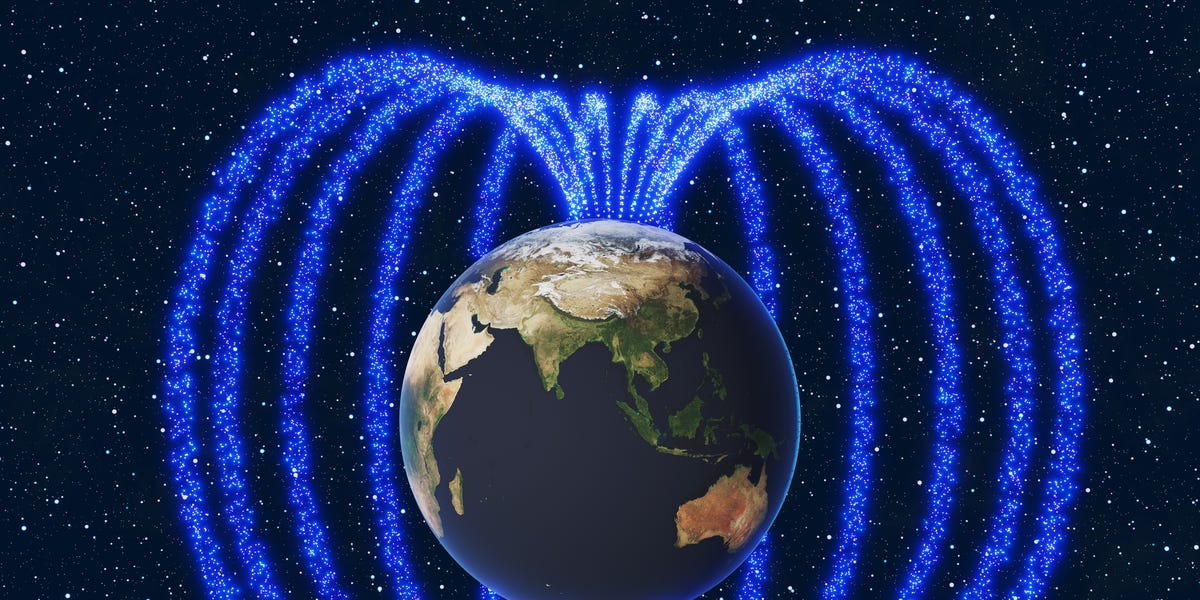
Earth’s magnetic field is generated by motion in the molten outer coreelectrically conducting fluid swirling around a solid inner core.
That motion acts like a planetary generator, producing a magnetic field that extends far into space. Where that field meets the solar wind
(a stream of charged particles flowing from the Sun), it forms a protective region called the magnetosphere.
Think of the magnetosphere as Earth’s “space umbrella,” except it’s not made of fabric and it’s not perfect. It deflects and reroutes a lot of
charged particles and energetic space weather, reducing how strongly the solar wind can chew on Earth’s upper atmosphere.
When solar activity ramps up, the magnetosphere can get jostledleading to geomagnetic storms, auroras, and disruptions to tech systems that
prefer their electrons calm and predictable.
This matters because “atmosphere” isn’t just the air at ground level. It’s a layered system extending upward into thin, charged regions where
space and air blur into one another. The top of our atmosphere is where particles can be knocked loose and lost to space over long periods,
and where energetic events can kick off chemical reactions that ripple downward.
The New Weird Clue: Oxygen and Magnetism Keep Time Together
Here’s the headline-worthy twist: a NASA-led analysis compared long-term records of Earth’s magnetic field strength (inferred from magnetic
minerals preserved in rocks) with reconstructions of atmospheric oxygen (derived from geochemical evidence in ancient materials).
Across roughly 540 million yearsback to the Cambrian periodthose two records show a striking correlation:
when one rises or falls, the other tends to follow the same pattern.
That doesn’t automatically mean the magnetic field is “turning the oxygen knob.” Correlation is not causation, and Earth is a complicated
planet with a lot of knobs. Still, the match is intriguing for two reasons:
- It’s long-term and persistent. This isn’t a short blip. It’s a relationship that appears across major chapters of life and geology.
- It hints at deep-Earth ↔ surface links. The core (where the magnetic field is generated) and the surface environment (where oxygen is produced and cycled) might be connected more than we usually imagine.
If you love tidy explanations, you may be mildly disappointed: researchers are still sorting out what the connection means.
There are multiple plausible pathways, and the truth could be “some of each” or even “a third thing influences both.”
The good news is that the mystery has a solid scientific vibe: it’s testable, it’s measurable, and it makes Earth feel like a single integrated system
rather than a stack of unrelated departments.
How Could Magnetism Influence the Air We Breathe?
Let’s break down the most credible routes by which Earth’s magnetic field could shape atmospheric oxygen and the broader air chemistrydirectly or indirectly.
Some mechanisms are well-established (especially for the upper atmosphere). Others are plausible but still debated. We’ll label them honestly.
1) Atmospheric Escape: Keeping the “Top” of the Air from Leaking Away
One big idea is simple in spirit: the magnetosphere reduces the solar wind’s ability to strip atmospheric particles into space.
Over long spans of time, even slow leakage can matter. The upper atmosphere contains ionselectrically charged atoms and moleculesespecially during
strong solar activity. Charged particles are exactly what magnetic fields can influence.
Mars is the classic cautionary tale. It lacks a strong global magnetic field today, and the solar wind can interact more directly with its upper atmosphere,
helping remove ions into space. Earth’s stronger magnetic environment changes that interactionmore deflection, more shielding, more control over where
energetic particles enter and how they move.
Now, a crucial nuance: magnetic fields aren’t the only factor controlling atmospheric survival. Venus has no Earth-like global dynamo field
and still has a thick atmosphere. Gravity, distance from the Sun, geologic outgassing, water history, and “space weather exposure” all matter.
So the magnetic field is best viewed as a major player, not the sole hero.
Still, if a stronger magnetic field reduces the loss of key atmospheric components or protects conditions that help oxygen-producing ecosystems thrive,
it could contributeindirectlyto higher oxygen levels over geological time.
2) Space Weather Chemistry: Particle Rain, Ozone, and UV Filtering
The magnetic field doesn’t just block particlesit also channels some of them. When charged particles pour into polar regions, they energize the upper atmosphere.
That’s part of what makes auroras glow. But it’s also a chemistry story.
Energetic particles and solar proton events can increase ionization in the upper atmosphere and trigger chemical pathways involving
“odd nitrogen” (NOx family) and “odd hydrogen” (HOx family). Those families can participate in ozone destruction cycles in parts of the atmosphere,
especially at high latitudes and over timescales ranging from days to months (and in some cases longer, depending on transport and season).
Why should oxygen care about ozone? Because ozone is a major UV shield. UV levels influence biological productivity,
surface chemistry, and the health of photosynthetic organisms. If magnetic-field-driven space weather patterns alter ozone and UV exposure over long time periods,
the biosphere’s oxygen production and preservation could be affectedsubtly but persistently.
Important caveat: this pathway is easier to see in modern, short-term events (like solar storms) than in deep-time oxygen trends.
But it’s one of the better-understood ways magnetism and atmospheric chemistry interact.
3) The Ionosphere: Where “Air” Starts Acting Like Electricity
Above the weather layer and stratosphere is a region where solar radiation and energetic particles ionize atmospheric gases,
creating a soup of ions and free electrons. This is the ionosphere, generally spanning roughly 80 to 600 kilometers up.
It’s the reason some radio waves bounce and why space weather forecasts are not just for astronautsthey’re for pilots, mariners,
GPS users, and anyone who enjoys their navigation system being correct.
The magnetic field shapes how charged particles move in and around the ionosphere. It helps determine where energy enters,
how currents flow, and how disturbances propagate. Most of that action stays high above us, but the ionosphere couples to lower layers through
atmospheric waves and circulation patternsone reason researchers treat Earth’s atmosphere as a connected vertical system.
4) Cosmic Rays and Clouds: A “Maybe,” Not a Mic-Drop
Galactic cosmic rays (high-energy particles from beyond the solar system) also ionize the atmosphere, and Earth’s magnetic field influences how many of them
can reach different latitudes. More shielding generally means fewer cosmic rays reaching the atmosphereespecially near the equator.
There’s an ongoing scientific conversation about whether cosmic-ray-driven ionization significantly affects cloud formation via aerosol nucleation.
Some laboratory and modeling work suggests pathways exist; other research finds the climate impact is limited or context-dependent.
What’s fair to say is that cosmic rays are a real ionization source and the magnetic field modulates thembut the downstream climate-and-oxygen consequences
remain a “watch this space” topic rather than a settled verdict.
5) The Plot Twist: A Third Driver Could Be Running the Show
Here’s the elegant alternative: oxygen levels and magnetic field strength may correlate because both respond to the same underlying Earth system changes.
One candidate is plate tectonics and continental configuration.
Moving continents change ocean circulation, nutrient delivery, erosion, burial of organic carbon, and the redox (oxidation-reduction) balance that governs oxygen.
At the same time, tectonics influence heat flow from the mantle to the coreone ingredient in how vigorously the geodynamo runs.
If Earth’s interior heat budget and surface oxygen cycles share tectonic “rhythms,” you could get a correlation even if magnetism isn’t directly adjusting oxygen.
In other words: it might be less “magnetic field controls oxygen” and more “Earth’s engine room and Earth’s living room respond to the same renovation schedule.”
Which is still wildly cooljust less like a sci-fi magnet ray and more like systems science.
Do Magnetic Reversals Mess with Our Air?
Earth’s magnetic field has flipped polarity many times. During reversals or excursions, the field can weaken and become more complex for a while.
This sparks an understandable question: did life get roasted? Did oxygen crash? Did everyone panic and install lead umbrellas?
The evidence does not support an easy story of mass extinctions caused by reversals. Reversals happen relatively frequently on geologic timescales,
and there’s no clear one-to-one link with extinction events. A weaker field could allow more energetic particles to interact with the atmosphere,
potentially increasing radiation in the upper atmosphere and affecting chemistrybut it’s not automatically an apocalypse button.
The more realistic framing is: changes in magnetic field strength can shift how Earth interacts with space weather,
which can influence upper-atmosphere chemistry and atmospheric escape rates. Over huge spans of time, those changes could contribute to broader trends,
especially when paired with other geologic and biological factors.
So… Is the Magnetic Field Controlling My Breath Right Now?
Not in the way the headline teases. The oxygen fraction in the air you breathe is very stable on human timescales.
Earth’s magnetic field changes over time, and space weather events can temporarily disturb the upper atmospherebut your day-to-day oxygen level
is not riding a magnetic roller coaster.
Where the magnetic field does show up in modern life is in the “infrastructure layer” of breathing: aviation routes, radiation exposure at high altitude,
GPS reliability, and communications. Space weather affects the ionosphere, which can affect navigation and radio systems. In extreme cases,
it can even contribute to satellite drag by heating and expanding the upper atmospherenudging orbiting objects and making mission planners earn their coffee.
The deep-time oxygen connection, meanwhile, is a long-game story: Earth as a system that might link the core’s behavior to surface habitability.
It’s less about “today’s breath” and more about why Earth stayed breathable across eras when life evolved from “ocean weirdos” to “people who argue online.”
How Scientists Try to Untangle This (Without Asking a Magnet for Answers)
If this correlation is realand the statistical results suggest it isthe next step is mechanism hunting. That usually means:
- Improving oxygen reconstructions using multiple independent proxies (not just one type of evidence).
- Refining paleomagnetic records to better estimate field strength and reduce uncertainty across time.
- Modeling atmospheric escape under different magnetic field strengths and solar conditions.
- Simulating chemistry in the upper atmosphere during particle events, then connecting that to climate and biosphere effects.
- Testing tectonic hypotheses by comparing oxygen and magnetism trends with supercontinent cycles and geochemical markers.
You’ll notice a theme: nobody is relying on a single storyline. The atmosphere is chemistry, biology, geology, and space physics in one giant, rotating experiment.
When a correlation appears across 540 million years, it’s an invitation to widen the lensnot to declare victory after one clever graph.
Bottom Line: The Weird Control Is Real-ish, Just Not Simple
The magnetic field is not a dial labeled “oxygen: more/less.” But it is part of a protective and interactive system that shapes how Earth’s atmosphere
behaves at its upper edge, how space weather energy enters, and possibly how the planet stays habitable over deep time.
The newest research adds a tantalizing clue: oxygen levels and magnetic field strength appear to track each other for hundreds of millions of years.
Whether that’s a direct influence, an indirect chain of effects, or two roommates responding to the same landlord (plate tectonics) is still being worked out.
Either way, it’s a reminder that Earth’s “breathability” isn’t just a surface feature. It may be tied to the core, the continents,
the Sun, and the invisible magnetic architecture that makes our planet more than a rock with vibes.
of Real-World “Experiences” That Connect Magnetism and the Air
Even if the magnetic field isn’t changing your oxygen percentage between breakfast and lunch, you can still experience its influence in surprising ways
especially if you live, travel, or work where the atmosphere meets space. These are the kinds of stories that make the magnetic field feel less like a textbook
diagram and more like a background character quietly steering the plot.
1) The aurora night that feels like the sky is breathing. People who’ve watched auroras in Alaska, Minnesota, or the northern plains often describe
the sky as “alive”rippling curtains of green that seem to inhale and exhale across the horizon. What you’re seeing is energy from charged particles guided by
Earth’s magnetic field into the upper atmosphere, where it excites gases that glow. You’re still breathing the same air down below, but above you the atmosphere
is being chemically and electrically “poked,” sometimes producing short-lived changes in upper-atmosphere composition.
2) The pilot’s polar reroute. On certain days, airlines adjust high-latitude routes. Why? Because solar activity can increase radiation exposure
at cruising altitude and can also disrupt the high-frequency radio communications used on polar paths. The magnetic field helps funnel energetic particles toward
the poles, which is gorgeous for auroras and inconvenient for navigation and comms. If you’ve ever had a flight take a “scenic detour” that wasn’t scenic at all,
you’ve brushed against the magnetic field’s practical footprint.
3) Ham radio operators and the “mysterious” quiet band. Radio hobbyists notice when the ionosphere is in a good mood.
Some nights signals bounce beautifully; other times the bands go oddly quiet. Since the ionosphere is shaped by solar radiation and particle activityand since
Earth’s magnetic environment controls how charged particles movespace weather becomes something you don’t just read about; you can hear it (or not hear it) in the static.
4) The satellite that suddenly feels more drag. During geomagnetic storms, Earth’s upper atmosphere can heat up and expand.
That makes the air at satellite altitudes slightly “thicker,” increasing drag and altering orbits. Mission teams track this because small changes add up,
especially for lower-orbit spacecraft. You may never notice from the ground, but the top of the atmosphere is reactingand that’s part of the same system
that, over geologic time, could influence how much atmosphere a planet keeps.
5) The South Atlantic Anomaly weirdness. There’s a region over the South Atlantic where the magnetic field is relatively weaker,
and satellites passing through can experience more energetic particle impacts. It’s a reminder that the magnetic field isn’t uniformand that “shielding”
comes in gradients, not absolutes. Again, you’re not losing oxygen in that moment, but you’re seeing how magnetic structure can shape where energy enters
Earth’s near-space environment.
Put all those experiences together and the big idea becomes easier to feel: the magnetic field doesn’t just sit there. It choreographs how Earth and the Sun
exchange energy, how the upper atmosphere behaves, and how space weather writes little notes in the chemistry overhead. Stretch that logic across deep time,
and it’s not so wild to wonder whether magnetism helped set the long-term conditions for the air we breathe today.











