
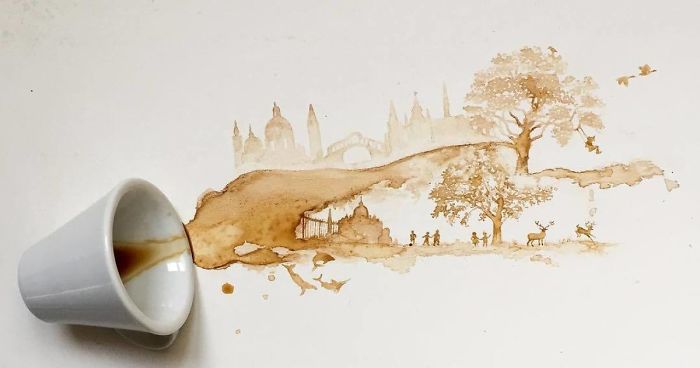
Most coffee spills have a short, tragic life. They appear. They stain. They inspire a dramatic sigh. Then they meet a paper towel and vanish like a bad decision made before breakfast. But in the hands of Italian artist Giulia Bernardelli, a spilled cup of coffee or tea becomes something entirely different: a face, a city, a sailing ship, a classic masterpiece, or a dreamy little world that seems to bloom right out of the stain.
That is the charm of Bernardelli’s work. It takes an everyday accident and turns it into a visual event. Her art feels elegant, playful, and almost impossible at first glance. You look at a coffee ring and expect mess. She looks at it and apparently sees potential, movement, character, and drama. Somewhere between the spoon, the stain, and the imagination, ordinary beverages become extraordinary images.
For readers who love creative process, coffee culture, tea rituals, or contemporary food art, Bernardelli’s work hits a sweet spot. It is beautiful enough to stop your scroll, strange enough to make you stare, and familiar enough to make you think, “Wait, I have coffee in my kitchen too.” Of course, the difference is that her spill becomes Botticelli and yours becomes laundry.
Who Is Giulia Bernardelli?
Giulia Bernardelli is an Italian artist best known for transforming spilled coffee, tea, and other edible materials into finely detailed works of art. She is often associated with the name Bernulia, the identity under which many fans discovered her online. Her rise to international attention came through images that looked both accidental and carefully composed, a combination that people on the internet have never been able to resist.
What makes Bernardelli especially interesting is that her work does not depend on grand materials or dramatic studio setups. She does not need a huge canvas, expensive oils, or a warehouse full of equipment. Her medium can be a cup of espresso, a bit of tea, a tabletop, and a tool as simple as a spoon or a small stick. That stripped-down approach gives the work a refreshing honesty. It says art does not always need to arrive wearing a tuxedo. Sometimes it enters the room dressed like breakfast.
Her visual language is rooted in observation. Bernardelli has spoken in interviews about being drawn to detail, spontaneity, and the materials already around her. That instinct shows in the final results. Even when the artwork is based on a spill, the composition feels thoughtful. The forms seem discovered rather than forced. She does not wrestle the stain into submission. She collaborates with it.
How A Coffee Spill Became A Signature Style
The origin story behind Bernardelli’s coffee art is almost suspiciously perfect. According to multiple features about her work, the whole idea began by accident when she spilled coffee while drawing. Instead of treating the stain as a disaster, she noticed its shape, picked up a spoon, and started guiding the liquid. That single moment of curiosity changed the direction of her creative life.
It is easy to see why people love this story. It feels cinematic, but it also reveals something essential about artistic thinking. Many people notice accidents. Artists notice possibilities inside accidents. Bernardelli saw tonal variation in the brown liquid, movement in the edges of the spill, and maybe even the beginning of an image hidden inside the mess. Where most of us would grab napkins, she grabbed an idea.
That origin also explains why her art feels so alive. Coffee and tea are not static materials. They spread, pool, feather, dry unevenly, and produce organic edges. Bernardelli works with those qualities instead of fighting them. The result is artwork that keeps a sense of motion. A portrait may feel as if it is emerging from vapor. A landscape may seem to have drifted into place. Even the negative space becomes part of the magic.
There is a useful lesson here for anyone interested in creativity. Bernardelli’s process reminds us that innovation is not always about inventing a new technology or chasing a trend. Sometimes it is about looking at something old, familiar, and wildly underrated, like spilled espresso, and asking one very inconvenient question: what else can this be?
Why Coffee And Tea Make Such Striking Artistic Media
Coffee and tea are not random gimmicks in Bernardelli’s work. They are visually rich materials with personalities of their own. Coffee offers warm browns, smoky gradients, sepia-like washes, and strong contrast when concentrated. Tea can create softer tones and more delicate transitions. Both can behave like watercolor while still carrying their own distinct texture and mood.
That matters because color tells emotional stories. Coffee naturally suggests warmth, memory, intimacy, and routine. Tea can feel calm, graceful, and slightly nostalgic. When Bernardelli uses these liquids as pigment, she is not just swapping paint for a clever substitute. She is borrowing the emotional baggage of the drink itself. Your brain already knows coffee. It knows the smell, the comfort, the tiny jolt of hope before a Monday meeting. Seeing that substance transformed into art creates an extra layer of pleasure.
There is also something poetically fitting about using temporary liquids to make temporary images. Bernardelli’s work belongs to a long and fascinating conversation about food art, ephemeral art, and artworks made from unconventional materials. In the broader history of art, food has appeared as symbol, subject, and medium for centuries. Contemporary artists and designers have continued to push that tradition by using edible and everyday materials in ways that challenge what we expect art to look like and how long we expect it to last.
Bernardelli’s work feels modern because it embraces impermanence. The spill exists. The image emerges. The moment is photographed. Then the physical trace is gone. In a digital age, that makes perfect sense. The original may vanish, but the image circulates. The artwork lives both as a fleeting event and as a lasting photograph. It is part performance, part painting, part visual haiku with caffeine.
The Subjects Hidden Inside The Stain
If Bernardelli only made abstract swirls, the work would still be beautiful. But part of the delight comes from how recognizable and ambitious her subjects can be. Across features on her art, viewers encounter portraits, animals, ships, architectural scenes, fantasy imagery, and reinterpretations of iconic artworks. She has recreated famous images such as the Mona Lisa, The Creation of Adam, and The Birth of Venus using spilled coffee as her medium.
That blend of classical reference and humble material gives the work its wonderful tension. On one side, you have high art, historical painting, and carefully studied composition. On the other, you have a beverage that many people are currently sloshing around in travel mugs. Bernardelli lets those two worlds collide without making the result feel gimmicky.
Her smaller scenes can be just as effective. A profile may appear in a crescent of tea. A ship may seem to sail out of a splash. An urban skyline can rise from what looks like a simple stain. Bernardelli understands that the viewer’s imagination is part of the composition. She gives us enough to recognize the form, while the natural edges of the spill keep the image suggestive and open.
This is where her work becomes more than a novelty. The best pieces are not impressive just because they were made from coffee. They are impressive because they are well designed. The line work, balance, silhouette, and use of empty space all matter. The spill may start the conversation, but composition finishes it.
Why The Internet Fell In Love With Her Work
Bernardelli’s art was practically designed to thrive online, though not in a cynical way. It photographs beautifully, delivers instant surprise, and rewards a second look. At first glance, you see a spill. At second glance, you see a face. At third glance, you start questioning your own life choices because your coffee has never done anything this productive.
Social media loves transformation, especially when it involves familiar objects becoming something better than expected. Bernardelli’s coffee and tea art offers exactly that kind of visual reveal. The everyday becomes extraordinary. The kitchen becomes a studio. A minor accident becomes a finished image. Viewers get both beauty and a tiny shock of recognition.
There is another reason the work spreads so easily: it feels accessible without being easy. People can understand the raw materials immediately, which makes the art feel close to home. But the actual skill involved is obvious. The shading, control, timing, and eye for form are not accidental. Bernardelli makes a complicated process look effortless, which is one of the oldest and most reliable ways to impress human beings.
What Makes Bernardelli’s Art More Than A Trend
Trendy art often burns bright and disappears fast. Bernardelli’s work has held attention because it taps into deeper themes than novelty. One of them is attention itself. Her art asks us to slow down and see what is already around us. Another is transformation. She shows that value can emerge from the overlooked, the messy, and the temporary.
There is also a quiet environmental elegance in her choice of materials. Coffee, tea, fruit skins, and other humble ingredients connect her art to everyday life and to natural color in a way that feels grounded rather than overly polished. The work does not deny mess. It organizes it. That may be one reason it feels strangely comforting.
And then there is the emotional tone. Bernardelli’s pieces often carry a sense of wonder. Even when the subject is familiar, the material makes it feel rediscovered. Her art invites viewers to believe that beauty might be hiding in ordinary rituals, on kitchen tables, in afternoon light, beside a half-finished cup. That is a generous message, and generous messages tend to linger.
Experiences Inspired By Coffee And Tea Art
What It Feels Like To See A Spill Become A Story
One of the most fascinating experiences related to Giulia Bernardelli’s work is the shift in perception it creates. After spending time with her art, you do not look at coffee or tea in quite the same way. A splash on a saucer stops being just a splash. A ring on a napkin starts to look suspiciously like the beginning of a landscape. The world does not actually change, of course, but your attention does, and that is often where art does its best work.
There is something almost meditative about watching a liquid spread and then imagining what it could become. Bernardelli’s art invites that mode of seeing. It encourages people to pause before cleaning up, before dismissing the accidental, before labeling a moment as useless. In everyday life, we are trained to fix mess quickly. Her work suggests that, every now and then, a mess deserves a second opinion.
For coffee lovers, the experience is especially rich. Coffee is already wrapped in ritual. There is the aroma, the heat of the mug, the morning quiet, the café conversation, the tiny personal ceremony of the first sip. Bernardelli adds a visual layer to that experience. Suddenly the drink is not only tasted and smelled. It is seen differently. It becomes pigment, mood, and movement. That transformation can make even a routine cup feel slightly more magical, which is a strong return on investment for something that usually costs less than lunch.
For artists and hobbyists, her work can trigger a more practical experience: the urge to experiment. Not necessarily to imitate her masterpiece-for-masterpiece, because that way lies disappointment and a stained table, but to play a little. To notice tonal shifts in tea. To test the edge of a spoon. To discover how quickly liquid dries, where it blooms, how it darkens, and when it resists control. That hands-on curiosity is one of the healthiest side effects of encountering inventive art. It wakes up the part of the mind that wants to try things.
There is also a social experience around Bernardelli’s work. It is the kind of art people immediately want to share. Friends send it to each other with messages like, “Look what this person did with coffee,” followed by some variation of disbelief. It works across audiences because it blends sophistication with familiarity. Art lovers appreciate the composition. Casual viewers enjoy the surprise. People who have just spilled their latte feel personally challenged.
Perhaps the most lasting experience her work creates is emotional rather than technical. Bernardelli’s art can make viewers feel lighter. Not because it is shallow, but because it is imaginative without being heavy-handed. It proves that beauty does not always require rare materials, dramatic suffering, or a giant white gallery room guarded by someone who makes you nervous. Sometimes beauty arrives in a stain, hangs around long enough to become a face, and then disappears, leaving behind a photograph and a changed way of seeing. That is not a bad legacy for a cup of coffee.
Conclusion
Giulia Bernardelli’s coffee and tea art works because it combines technical skill, playful invention, and a deep respect for the accidental. She takes liquids associated with comfort and routine and turns them into elegant images that feel both spontaneous and refined. Her art sits at the crossroads of food art, ephemeral art, social media culture, and classical visual storytelling, yet it never feels overexplained. It simply works.
In a world crowded with polished content and predictable visuals, Bernardelli reminds us that originality can begin with a mistake. A spill becomes a portrait. A stain becomes a ship. A morning drink becomes a tiny masterpiece with surprising emotional range. That is why her work continues to resonate. It does not just make coffee beautiful. It makes attention beautiful.
Note: This article is formatted for web publishing, contains only clean HTML body content, and excludes citation placeholders or source-code artifacts.












