
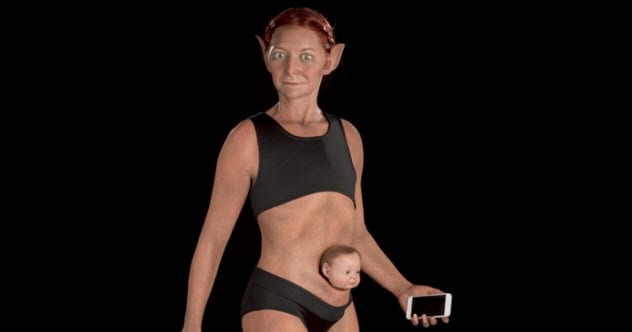
Human beings often treat our current appearance as the obvious final product of evolution. Two arms, two legs, forward-facing eyes, modest canine teeth, and a lower back that complains after one afternoon of yardworksurely nature planned it this way.
Not quite. Evolution has no blueprint, finish line, or quality-control department. Our bodies emerged through millions of years of inherited variation, environmental pressure, random genetic change, migration, and reproductive success. Change the habitat, diet, climate, predators, or mating preferences of our ancestors, and the person looking back from the mirror might be dramatically different.
The following alternate human forms are not predictions or claims that evolution inevitably produces certain features. They are science-informed thought experiments based on real adaptations found in humans, other primates, cave animals, and marine mammals. Welcome to the evolutionary fitting room. Please return all prehensile tails to the rack when finished.
How Evolution Could Have Changed the Human Body
Natural selection does not redesign an organism from scratch. It modifies inherited structures that already exist, often producing compromises rather than perfect engineering. A radically different human would therefore still carry recognizable primate foundations, but those foundations could have been stretched, shortened, strengthened, streamlined, or decorated in surprising ways.
1. Tree-Dwelling Humans With Long Arms and Grasping Feet
What we might look like
If our ancestors had remained primarily in forests instead of becoming committed ground travelers, modern humans might have longer arms, shorter legs, curved fingers, flexible shoulders, and feet capable of gripping branches. Our big toes could point away from the other toes, functioning more like thumbs.
Some early hominins combined upright walking with anatomical features useful for climbing. Later members of the human lineage developed relatively long legs, shorter arms, and body proportions suited to traveling efficiently across the ground. Reverse that transition, and the typical office worker might have the upper-body strength of a gymnast and the shoe-shopping requirements of a four-handed orangutan.
Homes would likely emphasize vertical space. Staircases might be optional, ceiling beams would double as hallways, and “open-plan living” could mean three-dimensional traffic in every direction.
2. Humans With Prehensile Tails
A built-in balance pole and extra hand
Apes, including humans, lost the external tail that many other primates retained. Research has identified genetic changes involving the developmental gene TBXT as one possible contributor to tail loss in the common ancestor of apes. In an alternate lineage, that genetic event might never have occurred.
Human tails might have remained short and useful for balance, or they could have evolved into muscular, grasping appendages. A prehensile tail could stabilize the body while climbing, hold a tool, carry a small object, or wrap around a support during sleep. Pants would need a third opening, chairs would require tail channels, and crowded elevators would become even more socially complicated.
Tails might also communicate emotion. Instead of reading a raised eyebrow or crossed arms, people could interpret curling, twitching, drooping, and enthusiastic wagging. Poker would be nearly impossible without a very disciplined tail.
3. Cold-Climate Humans With Short, Broad Bodies
Built to conserve every degree of heat
If humans had evolved for hundreds of thousands of years in intensely cold regions, we might be shorter, wider, and more heavily insulated. Compact bodies and shorter limbs reduce exposed surface area relative to body volume, helping conserve heat. Fossil humans that inhabited colder climates often had stockier proportions than populations adapted to warmer environments.
These alternate humans could have thick torsos, powerful legs, broad nasal passages, smaller ears, and more subcutaneous fat. A denser coat of body hair might also have been favored if clothing and controlled fire had not reduced the selective advantage of natural insulation.
Fashion magazines would celebrate the season’s finest shoulder fur, while barbers might offer full-back fades. On the positive side, nobody would spend half the winter asking who touched the thermostat.
4. Desert Humans With Tall Frames and Heat-Dumping Limbs
The endurance specialists of an alternate Earth
Under relentless heat, the opposite body plan could be useful. Desert-adapted humans might be tall and narrow, with long arms and legs that provide more surface area for releasing body heat. They could possess exceptionally efficient sweat glands, low levels of insulating body fat, and dark, melanin-rich skin that offers protection in environments with intense ultraviolet radiation.
Their noses might be long and narrow enough to help condition dry air before it reached the lungs. Thick, tightly curled scalp hair could shade the head while allowing air to circulate near the skin, creating a natural sun shield that never needs to be folded into a beach bag. Research into human hair evolution suggests scalp hair may have played a role in protecting and cooling the sun-exposed head.
These humans might dominate long-distance travel but find compact airline seating even more offensive than we do.
5. Semi-Aquatic Humans With Streamlined Bodies
More seal-like, but still unmistakably primate
There is no strong evidence that modern humans descended through a fully aquatic phase. However, if a branch of our ancestors had spent countless generations hunting, traveling, and escaping predators in water, natural selection could have favored a more aquatic appearance.
Marine mammals from unrelated lineages repeatedly evolved streamlined bodies, paddle-like limbs, and insulation because those traits improve movement and temperature control in water. A semi-aquatic human might therefore have a tapered torso, webbing between the fingers and toes, smaller external ears, closable nostrils, and a thick insulating fat layer.
Our legs could become shorter and more powerful for kicking, while broad hands acted like paddles. Eyes might be better protected underwater, and the body could store more oxygen in blood and muscle. Hair would probably be reduced because a smooth outline produces less drag.
Swimming lessons would be unnecessary, but finding jeans that complement a hydrodynamic torso could remain challenging.
6. Cave Humans With Pale Skin and Reduced Eyes
When vision becomes an expensive luxury
Permanent darkness can push evolution in a very different direction from ordinary nighttime living. Many cave-adapted animals lose pigmentation and experience partial or complete reduction of their eyes. Maintaining tissues that provide little benefit can waste energy, especially in habitats where food is scarce.
Humans isolated in deep caves for an immense number of generations might develop very pale skin, tiny eyes covered by protective tissue, and elongated fingers used to explore cracks and surfaces. Their ears and smell-processing anatomy could become more prominent, while facial muscles might shift toward producing or receiving subtle sound-based signals.
Instead of identifying objects by color, cave humans might distinguish them through texture, temperature, echo, and scent. Art galleries could consist of carved walls designed to be touched, and interior designers would finally be free from arguments about whether a room is painted “cloud,” “ivory,” or “slightly moodier cloud.”
7. Nocturnal Humans With Enormous Eyes
Evolution’s answer to a world without daylight
Unlike cave dwellers living in total darkness, nocturnal humans would still benefit from vision because moonlight, starlight, and twilight provide usable illumination. Nocturnal primates commonly possess enlarged eyes, large corneas, light-sensitive retinas, or reflective tissues that improve performance in dim conditions.
Our alternate faces might contain huge forward-facing eyes occupying much of the skull. Pupils could expand dramatically, while larger ears helped detect prey, predators, and coworkers quietly opening snacks across the building.
Color vision might become less precise because retinal space would favor light-sensitive rod cells. Bright midday sunlight could be painful, requiring heavy eyelids, narrow pupils, or protective skin folds. Sunglasses would not be accessories; they would be emergency equipment.
Nighttime cities built for these humans would use faint, carefully directed lighting. A modern supermarket’s fluorescent ceiling would feel like standing six feet from the sun.
8. High-Altitude Humans With Barrel-Shaped Chests
A body designed for thin air
High-altitude environments expose the body to lower oxygen pressure. Existing highland populations demonstrate that humans can adapt through several biological routes, including changes affecting breathing, circulation, blood chemistry, and oxygen use. Some Andean populations also show greater thoracic volume and broader chest morphology.
If all humans had evolved in extreme mountain environments, the average person might have a wide, deep rib cage housing unusually large lungs. Hearts could be slightly larger, blood vessels more extensive, and bodies relatively compact to reduce oxygen demands.
Wide nasal passages might warm and humidify cold mountain air. Fingers and toes could be short to limit heat loss, while powerful legs supported climbing on steep terrain. These humans might stroll up a staircase without changing their breathing, leaving lowland visitors wheezing dramatically on the second step.
The exact form would depend on the evolutionary pathway. Existing high-altitude populations already illustrate that similar environmental challenges do not always produce identical solutions.
9. Heavy-Chewing Humans With Massive Jaws and Teeth
Faces shaped by a lifetime of difficult dinners
Cooking, food processing, and tool use reduced the amount of chewing required to obtain nutrients. Modern human faces consequently have relatively small teeth and lightly built jaws compared with several earlier hominins. Even wisdom teeth are partly a legacy of ancestors whose larger jaws accommodated additional grinding surfaces.
Without cooking or cutting tools, humans dependent on tough roots, raw plants, fibrous meat, and hard seeds might retain enormous molars, projecting jaws, broad cheekbones, and thick chewing muscles. The skull could develop a ridge along the top to provide more attachment area for those muscles, similar to the crests seen in some powerful-chewing primates and extinct hominins.
Our faces would appear wider and more forward-projecting, with thick necks supporting the mechanical strain. Dental advertisements would promise “the crushing power your family deserves,” while soup would be regarded as suspiciously easy.
10. Low-Gravity Humans With Tall, Delicate Bodies
What generations in space might do to our appearance
Imagine a human population living for thousands of generations on a world with much weaker gravity. Current astronauts are not evolving during their missions, but their physical responses to microgravity offer clues about which structures become less necessary when body weight decreases.
Spaceflight reduces the loading placed on bones and muscles. Astronauts can lose bone density and lower-body muscle mass, while the spine temporarily lengthens as it is no longer compressed by Earth’s gravity.
Over evolutionary time, low-gravity humans might become extremely tall and slender, with narrow hips, thin legs, light skeletons, elongated spines, and relatively modest muscles. Their arms and fingers could grow longer for reaching and steering through three-dimensional habitats.
Heads might appear slightly larger relative to the body, especially if strong neck muscles were no longer needed for constant support. Such people could move gracefully in weak gravity yet struggle badly on Earth, where simply standing upright would feel like participating in an aggressive fitness challenge.
An Extra Possibility: Humans Shaped by Extreme Sexual Selection
Environmental survival is not the only force that changes appearance. Sexual selection favors traits that improve success in attracting or competing for mates, even when those features are costly. In another evolutionary history, humans could have developed vivid facial patches, dramatic hair crests, elaborate skin patterns, exaggerated voices, or much greater differences in appearance between sexes.
A blush might become a permanent scarlet display, healthy adults could grow iridescent shoulder hair, and dating profiles might include instructions for photographing one’s ceremonial neck fan. Fortunately, our current courtship customs are entirely sensible and never involve exaggerated displays, expensive accessories, or carefully selected profile pictures.
Experiencing a World of Differently Evolved Humans
Thinking about alternate human evolution becomes more interesting when we move beyond anatomical diagrams and imagine daily life. A different body would not merely change what people saw in a mirror. It would transform clothing, architecture, sports, medicine, etiquette, technology, and even the meaning of personal space.
Getting dressed would require different engineering
Clothing for tailed humans would need flexible openings that did not pinch the base of the tail. Aquatic people might prefer smooth garments that minimized drag, while cold-adapted humans could require less insulation but more grooming equipment. Nocturnal humans would probably treat dark glasses and hooded clothing as essential daytime protection. Shoe stores serving tree dwellers would look especially strange because grasping feet would require individually shaped toe compartments and flexible soles.
Homes would reflect the body using them
Architecture follows anatomy. Tree-adapted humans might build tall rooms with climbing poles, hanging beds, and entrances at several heights. Cave humans would favor textured navigation surfaces, curved corridors that manage echoes, and very little decorative lighting. Semi-aquatic communities could connect rooms through pools and submerged passages. Furniture for people with barrel-shaped chests would be wider, while low-gravity humans might barely use chairs at all.
Sports would become almost unrecognizable
Athletic competition would reveal the advantages and limitations of each form. Tailed gymnasts could spin around bars with astonishing control. Aquatic humans would turn swimming into the dominant international sport. Desert-adapted runners might race for hundreds of miles, while high-altitude athletes competed on mountain courses that would hospitalize an ordinary lowlander. Heavy-jawed humans could probably bite through sports equipment, although this would be discouraged by most governing organizations.
Beauty standards would follow local adaptations
People tend to turn ordinary biological variation into culture, fashion, and symbolism. A society of nocturnal humans might admire unusually large, reflective eyes. Tree dwellers could decorate their hands, feet, and tails with jewelry. Cold specialists might style dense body hair into elaborate patterns. Traits originally favored for survival could later become markers of identity, maturity, profession, or social status.
This thought experiment also shows why appearance should never be confused with worth. Evolutionary traits are responses to circumstances, not rankings on a scale from inferior to superior. Every adaptation brings costs as well as benefits. Large eyes improve low-light vision but require more skull space. Heavy insulation protects against cold but creates problems in heat. A light skeleton is useful in weak gravity and dangerous under stronger gravity.
Medicine would need a new definition of “normal”
Doctors treating these populations would study entirely different baselines. Tail injuries might require their own medical specialty. Aquatic humans could face pressure-related illnesses, while nocturnal patients might be vulnerable to retinal damage from bright light. High-altitude humans would possess blood and lung characteristics that seem unusual by present-day standards but are completely healthy in their environment.
Meeting another human form would challenge our assumptions
The most powerful experience would be realizing that intelligence, emotion, humor, and cooperation do not require one exact body plan. A pale cave human navigating by echo, a long-armed forest resident moving overhead, and a broad-chested mountain human could all create music, raise families, argue about politics, and forget where they placed their keys.
Their bodies would tell different evolutionary stories, but their lives could remain recognizably human. That may be the most useful lesson hidden inside the spectacle of webbed hands and enormous eyeballs.
Conclusion: Our Familiar Bodies Were Never Guaranteed
Humans look the way we do because our ancestors faced a particular sequence of climates, diets, habitats, diseases, movements, and social pressures. Alter that sequence and evolution might have produced gripping feet, tails, giant eyes, broad chests, streamlined torsos, or crushing jaws.
None of these forms would represent a more advanced version of humanity. Evolution does not move toward perfection. It produces bodies that reproduce successfully under specific conditions, frequently using the biological equivalent of spare parts, duct tape, and an optimistic warranty.
Our current anatomy is therefore not inevitable. It is one surviving draft among countless possibilitiesand, considering the design of the human knee and lower back, probably not the final draft anyone would have approved unanimously.











