
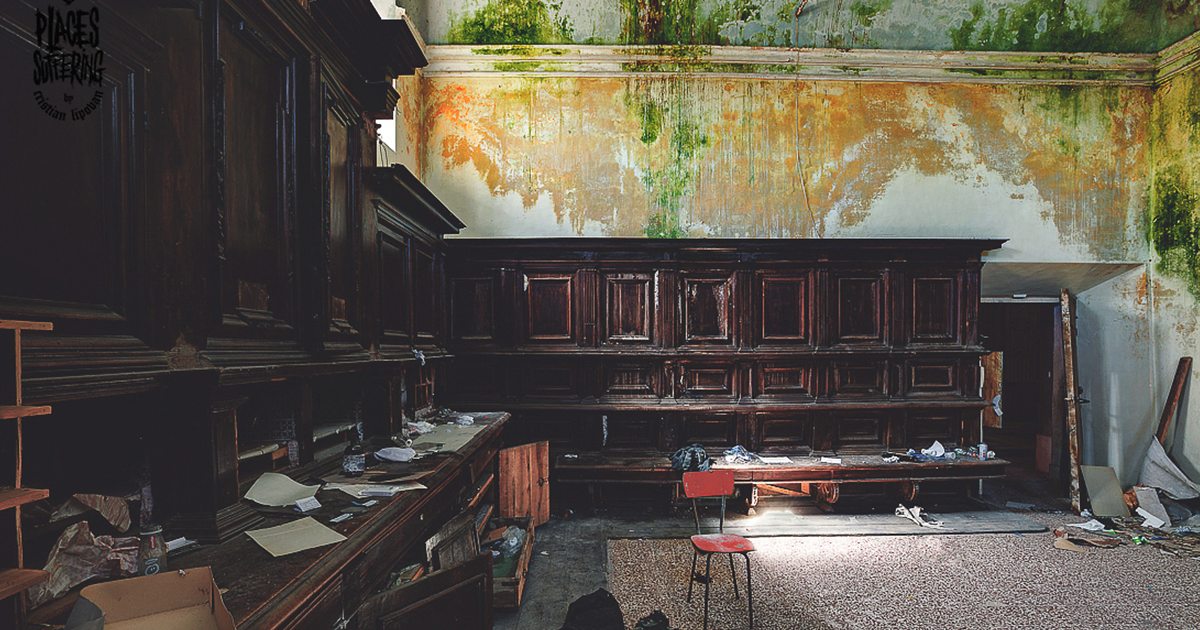
There are abandoned places that feel loud: factories with broken windows, amusement parks with weeds doing cartwheels through the bumper cars, hotels where the wallpaper looks personally offended. And then there are places like this abandoned monastery in Italyquiet, solemn, and so beautifully preserved that stepping inside feels less like trespassing into a ruin and more like arriving late to a prayer that started 500 years ago.
Hidden at the end of a forested road, surrounded by oak trees and the kind of silence that makes your camera strap sound like a marching band, this well-preserved abandoned monastery offers a rare glimpse into Italy’s layered religious, artistic, and architectural past. Built around a historic church and cloister, later expanded with educational and service buildings, the complex tells a story of faith, labor, community, decline, and unexpected survival.
This photo essay explores the atmosphere behind 27 images: the dusty corridors, the chapel light, the echoing cloister, the traces of daily life, and the strange emotional cocktail of beauty and abandonment. It is not simply a gallery of “cool ruins.” It is a walk through cultural memory, with a flashlight in one hand and goosebumps on both arms.
The Long Road To A Hidden Italian Monastery
The first thing you notice is not the building. It is the approach. The path climbs from a small Italian city toward a hilltop, gradually leaving behind traffic, conversation, and the comforting modern world of espresso machines and questionable parking decisions. The trees close in. Oak branches lean over the road. The air changes. By the time the monastery appears, it feels less discovered than revealed.
That isolation is part of why the monastery remains so unusually intact. Many abandoned religious buildings in Europe suffer from vandalism, theft, weather damage, and neglect. This place, however, is difficult to reach and easy to miss. Its remoteness acts like an unplanned security system, minus the monthly subscription and annoying password reset emails.
The complex is believed to have roots in the 15th century, when Franciscans raised the monastery around a church and cloister. Centuries later, newer structures were added, including spaces associated with education, work, service, storage, and community life. The result is not one frozen moment, but a layered architectural timeline: sacred stone, practical rooms, institutional corridors, and forest pressing in from every side.
Why Abandoned Monasteries In Italy Feel So Powerful
Italy is full of religious architecture, but abandoned monasteries hold a special emotional charge. A church can be a destination. A monastery was a world. It was a place to pray, sleep, study, copy texts, teach, cook, repair, grow food, welcome travelers, and live according to a rhythm much older than the calendar app currently judging your productivity.
Monastic buildings were designed around order. The cloister often served as the physical and spiritual center: a courtyard wrapped by covered walkways, connecting church, dormitory, refectory, classrooms, gardens, and work areas. In practical terms, it was a circulation system. In symbolic terms, it was a square of silence where sky, stone, and human routine met.
That is why an abandoned monastery can feel strangely alive. Even when no one is there, the architecture still suggests movement. A hallway points toward a chapel. A doorway opens into a courtyard. A stairwell remembers footsteps. A room still knows what it was for, even if the people are gone.
The Church: Stillness With A Roof
The church is the heart of the photo series, and it is also the place where the atmosphere becomes almost physical. The interior appears remarkably preserved compared with many abandoned sites. Light enters softly, falling across altars, arches, walls, and worn surfaces. Dust hangs in the air like very tiny, very dramatic stage actors.
What makes the church compelling is not perfection. It is the balance between survival and decay. Paint may be faded. Plaster may show age. Corners may carry the slow fingerprints of dampness. Yet the room still has dignity. The eye can understand its former purpose immediately. This was a place built for attention: to sound, to silence, to ritual, to the upward pull of architecture.
In photography, spaces like this reward patience. A rushed snapshot might show an empty church. A careful photograph can show the temperature of the air, the direction of time, and the small drama of sunlight landing exactly where it wants to land, because sunlight has always been a bit theatrical.
The Cloister: A Square Of Silence
The cloister is where the monastery’s personality becomes clearer. Cloisters are among the most recognizable features of monastic architecture: open courtyards enclosed by arcades or covered walkways. They offered protection from weather, connection between buildings, and a contemplative space where monks could walk, reflect, read, or simply be quiet without having to explain that they were “just recharging.”
In this abandoned Italian monastery, the cloister feels like a pause button. Nature has begun to return, but it has not swallowed the space entirely. The geometry remains readable. The arcades still frame views. The courtyard still gathers light. It is easy to imagine footsteps circling the perimeter, the rhythm of sandals or shoes against stone, the low murmur of work and prayer nearby.
Photographically, the cloister offers lines, repetition, shadows, and atmosphere. Every arch becomes a frame. Every column becomes a witness. The emptiness is not blank; it is structured. That is the genius of cloister photography: the subject is not only what is there, but what used to happen there.
27 Photos, 27 Moods
A good abandoned monastery photo series should not simply say, “Look, old building.” It should build a journey. The 27 images in this collection can be understood as chapters, each capturing a different emotional register of the place.
1. The Road Into The Forest
The opening image sets the mood: a road or path leading upward, the trees forming a natural corridor. It tells the viewer that this is not a roadside attraction. You have to earn the view.
2. The First Glimpse Of The Monastery
A first exterior shot establishes scale. The building appears imposing but not aggressive, more like a sleeping giant with excellent masonry.
3. The Weathered Entrance
Doors matter in abandoned photography. They are thresholds between public and private, ordinary and sacred, past and present.
4. The Nave In Soft Light
The church interior becomes the emotional centerpiece. The long axis of the nave pulls the eye forward, while the light gives the room an almost cinematic hush.
5. The Altar Area
Even when stripped of active use, an altar space carries symbolic weight. It is where the building’s purpose becomes unmistakable.
6. Faded Wall Details
Close-ups of plaster, paint, or decorative fragments remind us that preservation is often a matter of inches.
7. The Cloister Walkway
Repeating arches create rhythm. The viewer can almost hear footsteps.
8. The Courtyard
Open sky inside enclosed architecture gives the cloister its quiet magic. It is both indoors and outdoors, both protected and exposed.
9. A Corridor With Peeling Paint
This is where abandonment becomes visible. The human order remains, but nature and time have started editing the margins.
10. A Staircase
Staircases are irresistible in abandoned places. They suggest movement, mystery, and the possibility that your knees will make a weird noise halfway up.
11. The Former College Spaces
Later additions to the complex reveal how the monastery evolved beyond purely religious functions. Education and community work became part of its life.
12. The Gymnasium
A gym inside a monastic complex creates a fascinating contrast: spiritual discipline meets physical discipline. Also, probably fewer protein shakes.
13. The Chapel
Smaller devotional spaces often feel more intimate than grand churches. They hold silence differently.
14. The Typography Or Printing Area
If visible, this area hints at communication, learning, and practical labor. Monasteries were never only about retreat; they were also engines of knowledge.
15. Service Rooms
Barns, garages, storage rooms, and work areas show the everyday reality behind sacred life. Someone had to maintain the place. Angels rarely fix roofs.
16. A Long Empty Hall
Perspective does the heavy lifting here. The vanishing point becomes a visual metaphor for memory.
17. Windows Facing The Woods
The surrounding forest is not a backdrop. It is part of the monastery’s identity, a green boundary between the complex and the modern world.
18. Traces Of Furniture
A chair, cabinet, desk, or bench can be more emotional than an entire facade because it suggests the body that once used it.
19. Dust On The Floor
Dust is the unofficial archivist of abandoned places. It records absence with surprising enthusiasm.
20. The Roofline
Exterior shots of rooflines and upper walls reveal how the building negotiates with weather, gravity, and time.
21. Narrow Passages
The complex reportedly contains tight underground or lower-level passages. Even unexplored, they add mystery to the story.
22. A Door Left Open
Open doors in abandoned buildings always feel like questions. Who left? Who returned? Who decided not to lock it?
23. Religious Details
Symbols, niches, crosses, or devotional remnants help distinguish sacred abandonment from ordinary decay.
24. The Forest Taking Back The Edges
Vegetation softens the architecture and reminds viewers that abandonment is not emptiness; it is transition.
25. Light Through Broken Or Dusty Glass
This is the photographer’s jackpot: texture, atmosphere, and mood in one frame.
26. The Final Look Back
A closing exterior photo can make the monastery feel like a secret being returned to the trees.
27. The Image That Stays With You
Every powerful series has one frame that lingers. In a place like this, it might be the church interior, a silent cloister, or a small forgotten object that somehow says more than the grandest wall.
Abandonment Does Not Mean Emptiness
One reason abandoned monastery photography attracts so many viewers is that it combines beauty with unresolved questions. Why was the place left? Who decided it was no longer useful? How can something so carefully built become unnecessary? And why does it still feel meaningful after the last official activity has ended?
This Italian monastery reportedly went through gradual abandonment beginning in the 1970s before being fully closed in the 1990s. That timeline matters because the building is not an ancient ruin in the archaeological sense. It is recent enough to feel close. Some people alive today may remember its later functions. That makes the silence sharper.
The site covers a large area, with religious, educational, service, and forested zones. In other words, this was not just a pretty church on a hill. It was an ecosystem. When such a place closes, the loss is architectural, cultural, social, and emotional all at once.
The Ethics Of Photographing Abandoned Sacred Places
Abandoned photography can be beautiful, but it should never become a sport of careless invasion. Religious sites require extra respect. Even when no services are held, even when dust has moved in and the pews have moved out, these buildings can remain culturally and spiritually sensitive.
Responsible photographers follow a simple rule: take only photographs, leave only footprints, and preferably leave fewer footprints if the floor looks like it has retired from supporting people. Do not remove objects. Do not force entry. Do not publish exact locations if doing so might invite vandalism. Do not stage fake drama with props. The atmosphere is already doing plenty; it does not need a plastic skull from a Halloween store.
The best abandoned monastery photography is preservation-minded. It documents what remains, encourages appreciation, and reminds viewers that neglected heritage can disappear quickly. A photograph cannot replace restoration, but it can make people care.
Why This Monastery Still Feels Preserved
The preservation of this abandoned monastery is partly architectural and partly accidental. Strong masonry, sheltered interiors, remote location, and limited vandalism all appear to have helped. But preservation is also about atmosphere. Some places retain coherence even after closure. Their rooms still make sense. Their paths still lead somewhere. Their silence still has shape.
In the church, the preserved interior suggests continuity. In the cloister, the repeating arches maintain rhythm. In the later institutional spaces, the traces of modern use create contrast. The building does not belong to one century. It belongs to many, layered like old paint.
That layered quality is common in Italy, where religious buildings often changed function over time. Monasteries could become schools, libraries, barracks, civic buildings, cultural centers, or, in sadder cases, locked properties waiting for a plan that never quite arrives. Adaptive reuse can save heritage when done thoughtfully. Neglect can erase it. This monastery appears suspended between those outcomes.
How To Read The Atmosphere In The Photos
When viewing the 27 photos, look beyond the obvious beauty. Notice the relationships: forest and stone, light and dust, sacred design and practical additions, preservation and decay. A cracked wall is not just a texture. It is evidence of weather, time, and maintenance deferred. A quiet corridor is not just empty. It is a leftover route from one part of the community to another.
Also notice scale. Monasteries were built for repeated daily movement. Their spaces were meant to be used again and again, in cycles of prayer, work, study, meals, rest, and return. Abandonment breaks the cycle, but the architecture still remembers it. That is why the photos can feel both peaceful and sad.
The most successful images avoid turning the monastery into a haunted-house cliché. There is mystery here, yes, but not cheap horror. The mood is closer to reverence. The building is not screaming, “Boo!” It is whispering, “Please look carefully.”
What This Abandoned Monastery Teaches Us About Heritage
Italy’s cultural heritage is vast, and that is both a blessing and a burden. The country holds an extraordinary concentration of churches, monasteries, chapels, frescoes, cloisters, sculptures, and historic landscapes. Caring for all of it requires money, law, expertise, local commitment, and public imagination. When one piece falls silent, it raises a larger question: which places do we save, and how do we decide?
This monastery matters because it is not famous in the way major tourist landmarks are famous. It is not the Colosseum. It is not the Sistine Chapel. It does not have a gift shop selling refrigerator magnets shaped like saints. Yet its value is real. It represents local history, religious life, architecture, landscape, memory, and the beauty of places that never expected to become Instagram stars.
Photography can help broaden our sense of what heritage deserves attention. A well-composed image of an abandoned cloister can make viewers pause long enough to ask why such a place exists, why it closed, and what future it might still have.
Personal Experience: Walking Through A Place That Still Breathes
Exploring a well-preserved abandoned monastery in Italy is not like visiting a museum. A museum tells you where to stand, where to look, and occasionally reminds you through a stern little sign that touching 600-year-old things is frowned upon. An abandoned monastery offers no such guidance. It simply opens into silence and lets you become aware of your own presence. Every step feels louder than it should. Every door seems to have an opinion.
The strongest feeling is contrast. Outside, the forest feels alive and busy in its own quiet way: leaves moving, insects working, birds making announcements that may or may not concern you. Inside, the monastery feels still, but not dead. The rooms hold cool air. The walls hold shadows. The church holds a kind of patience that modern buildings rarely have. You get the sense that the place has survived long enough to stop being impressed by visitors.
Photographing it requires a different pace. In a city, you can chase moments. In a monastery, you wait for them. You wait for a cloud to move. You wait for your eyes to adjust. You wait for the room to explain itself. Sometimes the best frame is not the grandest one. It might be a patch of light on stone, a corridor narrowing into darkness, or a small devotional detail that survived decades of abandonment with the stubborn dignity of an old librarian.
There is also a strange feeling of responsibility. When a place is this preserved, you become very aware that your visit should not change it. You move carefully. You avoid fragile areas. You resist the urge to touch surfaces, even when the textures look like they were designed specifically to tempt photographers with poor impulse control. You understand that the real achievement is leaving the monastery exactly as you found it.
The 27 photos are not just souvenirs. They are a way of translating atmosphere into something shareable. A photograph cannot capture the temperature of the nave or the smell of dust and old plaster. It cannot fully reproduce the moment when you stand in a cloister and realize the sky has become part of the architecture. But it can suggest those things. It can invite someone else to feel a little of the stillness.
What stayed with me most was not the decay. It was the order. Even abandoned, the monastery remained organized around meaning. The church still drew the eye forward. The cloister still gathered the light. The corridors still connected one intention to another. The building had lost its community, but not its grammar.
That is why places like this matter. They remind us that architecture is more than walls. It is a record of how people believed life should be arranged. In this monastery, life was arranged around prayer, discipline, learning, work, and retreat. Later, it adapted to new uses. Then it emptied. Now it waits, not dramatically, not loudly, but with the calm endurance of stone.
Leaving was harder than arriving. On the way back through the trees, the modern world returned in pieces: road noise, phone signal, ordinary thoughts, the sudden desire for coffee. But the monastery stayed behind, holding its hilltop silence. That is the gift of photographing abandoned places at their best. You do not really capture them. They capture a part of your attention and keep it there, somewhere between wonder and responsibility.
Conclusion
The abandoned monastery in Italy is more than a beautiful forgotten building. It is a preserved atmosphere: a meeting point of sacred architecture, forested isolation, historic memory, and quiet decay. Through 27 photos, the complex becomes a visual story about what remains when human activity ends but meaning lingers.
Its church, cloister, corridors, service spaces, and surrounding woods reveal the many lives one monastery can hold. Built from faith, expanded through practical use, and later left to silence, it now stands as a reminder that cultural heritage does not need crowds to be valuable. Sometimes the most powerful places are the ones waiting at the end of a road, asking only to be seen carefully and left unharmed.












