
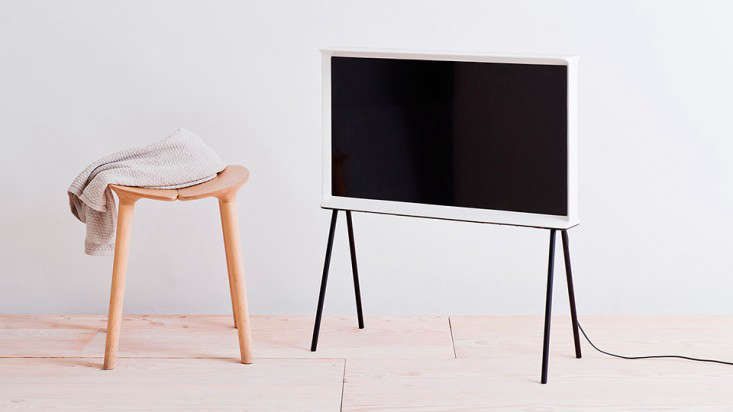
The Samsung Serif TV is what happens when a television stops pretending to be invisible and starts acting like it has a passport, a design degree, and excellent posture.
A TV That Refuses to Be Just a TV
For decades, the television industry chased one main dream: make the screen thinner, flatter, blacker, and more likely to vanish into the wall like a guilty secret. Samsung’s Serif TV took a different route. Designed in collaboration with French designers Ronan and Erwan Bouroullec, better known as the Bouroullec Brothers, The Serif treats the television not as a wall-mounted appliance but as a piece of furniture.
That single decision changes everything. Instead of a faceless black slab, The Serif has a sculptural profile inspired by the capital letter “I” in a serif typeface. From the side, it has a top and bottom ledge, giving the TV a recognizable shape and a sense of physical presence. It can stand on detachable legs, sit on a console, or become a design object in the middle of a room. In other words, it does not need to hide behind a media cabinet. It is the media cabinet’s cooler cousin.
The New Serif TV by the Bouroullec Brothers for Samsung is part of Samsung’s broader Lifestyle TV family, which also includes design-forward models like The Frame. But while The Frame wants to look like artwork, The Serif wants to feel like an object you chose with intention. It is a smart TV, a QLED display, a decorative element, and a small rebellion against the idea that technology must always look cold and anonymous.
Who Are the Bouroullec Brothers?
Ronan and Erwan Bouroullec are French designers known for furniture, objects, interiors, installations, and collaborations with major design brands such as Vitra, HAY, Kartell, Flos, and Magis. Their work often feels calm but never boring, minimal but not sterile, playful but not silly. That balance is exactly what makes their Samsung Serif TV so interesting.
Before working with Samsung, the Bouroullecs were not famous for consumer electronics. That was part of the appeal. Samsung did not simply ask another technology designer to shave a few millimeters off the bezel and call it innovation. Instead, the company invited designers who understood furniture, proportion, domestic space, and the strange emotional relationship people have with objects at home.
The result is a TV that feels less like a gadget and more like a living room companion. It has edges you notice, a back worth seeing, and a shape that welcomes placement away from the wall. For anyone who has ever stared at a giant black rectangle in the living room and thought, “Well, there goes the cozy vibe,” The Serif offers a stylish alternative.
The Design: A Capital “I” With Main Character Energy
The defining feature of Samsung The Serif TV is its I-shaped profile. Look at it from the side and the silhouette resembles a serif letterform, with thicker horizontal sections at the top and bottom. This gives the TV more depth than a typical flat-screen model, but that depth is not wasted. It creates a small shelf-like surface on top and helps the set look finished from every angle.
Most TVs are designed with one “good side”: the front. The back is often a chaos party of ports, plastic, brackets, labels, and cables having a nervous breakdown. The Serif changes that by using a cleaner rear design and a removable back panel that helps conceal connections. The goal is simple: if the TV stands in open space, it should not look like it forgot to put on pants.
Made to Stand, Not Just Hang
The Serif comes with detachable legs, allowing it to stand independently like a piece of furniture. This matters because many modern interiors are not built around a single TV wall. Open-plan apartments, studios, bedrooms, reading corners, and multipurpose rooms often need flexibility. With its floor-standing option, The Serif can float in a space rather than being glued to one architectural decision forever.
This approach also makes the TV feel more personal. Instead of asking, “Where is the wall mount?” you ask, “Where does this object belong?” That is a very different design conversation, and frankly, a more fun one.
Picture Quality: Design First, But Not Design Only
It would be easy to assume The Serif is all looks and no performance, like a beautiful chair that becomes a medieval punishment device after 20 minutes. Fortunately, Samsung did not forget that people still expect a television to be, well, a television.
Recent versions of Samsung The Serif use QLED 4K technology, bringing strong color volume, sharp resolution, and a bright, vivid image suitable for movies, streaming, sports, and casual gaming. Quantum Dot technology helps produce rich colors, while 4K resolution keeps details crisp on larger screen sizes. Depending on the model year and region, features may include HDR support, motion enhancements, smart calibration tools, and gaming-focused settings such as Auto Low Latency Mode or variable refresh rate support.
The Serif is not usually positioned as Samsung’s absolute top-tier performance TV. If your home theater goal is to recreate a cinema, frighten your neighbors with bass, and inspect every shadow detail in a moody prestige drama, Samsung’s premium OLED or Neo QLED models may be more suitable. But The Serif is not trying to win a brightness cage match. Its strength is balance: very good everyday picture quality wrapped in a design that does not murder your interior style.
Matte Display and Ambient Mode: The Anti-Black-Hole Strategy
One of the smartest updates to The Serif line is the use of a matte or anti-reflection display on newer models. This makes a real difference in bright rooms, especially where windows, lamps, or glossy surfaces would normally turn the screen into a mirror. A matte finish helps reduce glare, making the TV more comfortable for daytime viewing and more elegant when it is not actively playing content.
Then there is Ambient Mode, one of the key lifestyle features. Instead of leaving a blank black screen in your carefully decorated room, The Serif can display artful visuals, patterns, information, or decorative imagery. Some designs are inspired by the Bouroullecs’ own aesthetic language, including soft, nature-influenced patterns. It is not just a screen saver; it is a design tool.
Ambient Mode helps The Serif behave more like a home object than a dormant appliance. When the TV is off, it can still contribute to the atmosphere. That is useful for people who love technology but do not want their living room to look like the command center of a very stylish spaceship.
Smart Features and Everyday Use
Samsung The Serif is a smart TV built around Samsung’s Tizen platform. That means access to popular streaming apps, connected device controls, voice assistant features in supported markets, screen mirroring, and integration with the Samsung SmartThings ecosystem. In many versions, users can also access AirPlay support, mobile mirroring, Bluetooth audio, and Multi View, which lets the screen show two types of content at once.
Multi View is useful in real life, not just in marketing photos where everyone owns spotless furniture and apparently no charging cables. You can watch a workout video while mirroring your phone, follow a sports game while checking another source, or keep a video call or mobile feed visible alongside entertainment content. For a household where the TV is shared by more than one person, this flexibility can save arguments. Not all arguments, of course. No TV can solve who left the empty orange juice carton in the fridge.
NFC and Mobile Sound Mirroring
Some Serif models include NFC-based mobile connection features. This allows users to connect compatible smartphones more easily for music or content sharing. It is a small detail, but it supports the overall idea that The Serif is not just a screen you sit in front of. It is a connected object that participates in daily life.
Why The Serif Matters in Interior Design
The most important thing about The Serif is not its spec sheet. It is the way it changes the relationship between technology and space. Most televisions create a design problem: where do you put the giant rectangle? The Serif tries to become part of the answer.
Its white frame, sculptural body, freestanding legs, and finished back make it easier to place in rooms where a conventional TV would feel intrusive. It works especially well with Scandinavian, modern, minimalist, eclectic, Japandi, and gallery-inspired interiors. It can soften a room filled with hard surfaces, brighten a neutral space, or create a focal point without screaming for attention.
The Serif also appeals to renters and apartment dwellers. Not everyone can drill into walls, install custom wiring, or create a built-in entertainment setup. A TV that stands elegantly on its own offers freedom. Move apartments? Rearrange the room? Decide the sofa belongs where the dining table used to be because inspiration struck at 11:43 p.m.? The Serif can move with you.
The Serif vs. The Frame: Which Samsung Lifestyle TV Is Better?
Samsung The Serif and Samsung The Frame are often compared because both are Lifestyle TVs aimed at design-conscious buyers. But they solve different problems.
Choose The Frame If…
The Frame is best if you want a TV that disappears into the wall and looks like framed artwork. It is ideal for gallery walls, formal living rooms, and spaces where wall mounting is part of the design plan. Its Art Mode is the star feature, and its customizable bezels make it easy to coordinate with decor.
Choose The Serif If…
The Serif is better if you want a TV that stands as an object in the room. It is more sculptural, more furniture-like, and more flexible in placement. The Frame says, “Pretend I am art.” The Serif says, “Yes, I am a TV, but I wore a great outfit.”
Neither approach is wrong. The Frame is about camouflage. The Serif is about character. Your choice depends on whether you want the television to blend into the wall or confidently join the furniture conversation.
Pros and Cons of Samsung The Serif TV
Pros
- Distinctive Bouroullec Brothers design with a recognizable I-shaped profile
- Freestanding option with detachable legs for flexible placement
- QLED 4K picture quality suitable for everyday premium viewing
- Matte or anti-reflection display on newer versions for brighter rooms
- Ambient Mode helps reduce the “black screen” problem
- Finished back panel makes it attractive from multiple angles
- Strong fit for modern, minimalist, and design-focused interiors
Cons
- Usually more expensive than conventional TVs with similar screen size
- Not the best choice for users who prioritize maximum home theater performance
- Design may not suit traditional or ultra-dark entertainment rooms
- Wall-mounting flexibility may be limited compared with standard flat-screen TVs
- Availability, sizes, and features can vary by region and model year
Who Should Buy The New Serif TV?
The New Serif TV by the Bouroullec Brothers for Samsung is ideal for people who care about both picture quality and interior design. It is for buyers who stream movies but also own coffee-table books. It is for apartment dwellers who want flexibility, homeowners who dislike visible cables, and design fans who believe a TV should not ruin a room just because it has Wi-Fi.
It is especially appealing if your TV lives in a social space rather than a dedicated theater room. In a living room, bedroom, studio, office lounge, boutique hotel suite, or creative workspace, The Serif makes sense. It brings visual personality before the screen even turns on.
However, if your top priority is the biggest screen for the lowest price, The Serif is probably not your champion. You are paying partly for design, materials, collaboration, and lifestyle flexibility. That premium is worth it only if the shape, stand, and atmosphere matter to you. If all you want is a giant screen for game day, a more conventional Samsung QLED, OLED, or Crystal UHD model may be the more practical pick.
Experience Section: Living With The Serif TV
Using Samsung The Serif TV feels different from owning a regular television because the experience begins before you press the power button. With a normal TV, setup usually involves finding a wall, fighting with brackets, hiding cables, and silently hoping the screen is level. With The Serif, the first question is more enjoyable: where would this look best?
In a small apartment, The Serif can act almost like a room divider. Place it near a reading chair, beside a low sofa, or angled toward a dining nook, and it feels intentional rather than temporary. The detachable legs give it a light architectural presence. It stands there calmly, like it knows exactly what it is doing. Meanwhile, the rest of us are still looking for the remote.
The top ledge is one of those features that seems minor until you live with it. You should not overload it like a garage shelf, but a small decorative object, a slim book, or a tiny plant can make the TV feel integrated into the room. It brings back a nostalgic memory of older televisions as furniture, but without the bulk, dust, and mysterious humming noises of the past.
During daytime viewing, the matte screen makes the TV easier to enjoy in spaces with natural light. This is important because many stylish rooms are also bright rooms. Large windows, pale walls, glass tables, and shiny floors are beautiful until a glossy TV turns every scene into a documentary about your own reflection. The Serif handles light more gracefully, which makes casual watching feel less fussy.
At night, the experience becomes cozier. The white frame almost disappears into soft lighting, while the screen remains vivid enough for movies, shows, and streaming. It may not replace a dedicated cinema setup with blackout curtains and surround speakers, but that is not really the point. The Serif is best when entertainment is part of everyday life, not a separate ceremony requiring three remotes and emotional preparation.
Ambient Mode is surprisingly pleasant in daily use. Instead of turning the TV off and leaving a black rectangle in the room, you can let it display subtle visuals that match the mood. This works particularly well during gatherings, quiet mornings, or background music sessions. The TV becomes less demanding. It stops shouting “watch me” and starts whispering, “I live here too.”
Guests tend to notice The Serif quickly. Some people ask if it is a television. Others ask where it came from. A few may simply nod with the expression people use when they want to seem design-literate without admitting they still have a printer from 2009. Either way, The Serif starts conversations. That is rare for a TV, unless the conversation is usually about why the streaming app has logged everyone out again.
The best experience comes when the room is designed around flexibility. The Serif rewards owners who move furniture, experiment with angles, and treat the TV as part of the home rather than a fixed technical endpoint. It is not the most invisible television Samsung makes. That honor belongs more to The Frame. But The Serif is more charismatic. It gives a room a point of view, and in an era of nearly identical black screens, that alone feels refreshing.
Final Verdict: A Beautifully Opinionated TV
The Samsung Serif TV by the Bouroullec Brothers is not for everyone, and that is exactly why it works. It has a point of view. It believes a television can be furniture, a screen can have a body, and technology can be warm, domestic, and even a little poetic.
Its QLED 4K display, smart features, Ambient Mode, anti-reflection screen, and flexible stand make it practical enough for daily entertainment. But its real value lies in how it changes the visual role of the TV at home. Instead of apologizing for being in the room, The Serif participates in it.
If you want the most affordable big screen, look elsewhere. If you want a TV that doubles as a design statement, The Serif deserves serious attention. It is stylish without being fragile, functional without being dull, and unusual without trying too hard. That is a difficult trick to pull off. The Bouroullec Brothers and Samsung did it with a capital “I.”












