
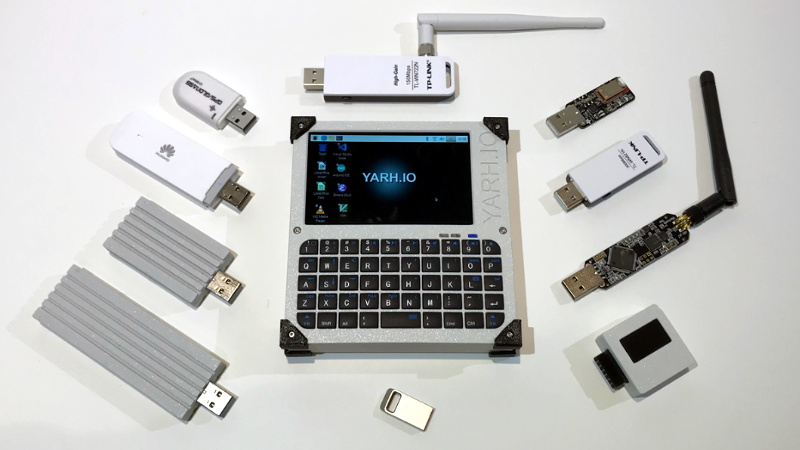
The New Micro YARH.IO, better known in the maker community as the YARH.IO M2, is not the sort of gadget you buy because your phone battery died and you need to check email in line at the grocery store. This is a pocket-sized Raspberry Pi handheld made for people who enjoy opening a terminal more than opening a social media app. It is compact, rugged, deeply hackable, and unapologetically aimed at skilled operators who know that “portable computer” can mean more than a shiny laptop with a logo on the lid.
At its heart, the YARH.IO Micro 2 is a Raspberry Pi 3B+ transformed into a handheld Linux machine. It combines a 4-inch IPS touchscreen, Bluetooth keyboard, removable battery, real-time clock module, custom power monitoring, and a 3D-printed enclosure. That sounds cute until you learn that the build may require trimming hardware, replacing USB ports, working with I2C, configuring Linux, and assembling a case that was clearly designed by someone who owns calipers and uses them with confidence.
In other words, this is not a beginner’s “my first Raspberry Pi” project. It is a serious little cyberdeck for operators, field tinkerers, Linux fans, ethical security researchers, developers, and hardware modders who want a device they can understand from screw head to shell prompt. If a sealed tablet is a microwave dinner, the Micro YARH.IO is cast-iron cooking over a campfire. More effort? Absolutely. More satisfying? Also absolutely.
What Is the Micro YARH.IO?
The Micro YARH.IO is a small handheld Linux computer based around the Raspberry Pi 3B+. It follows the same spirit as the original YARH.IO MKI, but shrinks the idea into a more compact form. The goal is simple: build a truly portable Raspberry Pi machine that includes everything needed to interact with a full operating system without carrying a monitor, keyboard, power bank, and a nest of cables that looks like a robot sneezed.
The device includes a Raspberry Pi 3B+, a Pimoroni HyperPixel 4-inch touchscreen, a miniature Bluetooth keyboard, a removable 3500mAh lithium-ion battery, a step-up power supply, a DS3231 real-time clock module, and an Arduino Pro Micro used for voltage monitoring. The enclosure is 3D printed, with rigid and flexible materials used where they make sense. Stainless steel screws and protective rubber bumpers give it a tough, field-ready personality.
The result is a handheld Raspberry Pi cyberdeck that feels more like a tool than a toy. It can run Raspberry Pi OS or Kali Linux, making it useful for coding, network testing, diagnostics, terminal work, note-taking, and general Linux experimentation. It is not trying to replace a modern laptop. It is trying to be something more specialized: a portable command station for people who know exactly why they want one.
Why It Was Designed for Skilled Operators
The phrase “designed for skilled operators” fits the YARH.IO Micro 2 because this device assumes the user is comfortable with both hardware and software. Many consumer devices are designed to hide complexity. The Micro YARH.IO does the opposite. It invites you to understand the complexity, adjust it, repair it, and occasionally argue with it until it behaves.
One of the clearest examples is the Raspberry Pi 3B+ modification. To reduce the total height and fit the board inside the compact housing, the Ethernet port is removed and the double-stack USB connectors are replaced with lower-profile single-stack USB ports. That is not a casual operation. Desoldering ports from a Raspberry Pi requires patience, proper tools, steady hands, and the humility to know when the board is getting too hot. The Micro YARH.IO does not hand out participation trophies.
Software setup also rewards experienced users. A small screen changes how you use Linux. Menus, window decorations, and desktop assumptions that feel normal on a 24-inch monitor can become ridiculous on a 4-inch display. Skilled operators are more likely to optimize the interface, remap keys, use terminal workflows, configure touch behavior, and build scripts that turn the device into a fast, purpose-built tool.
Core Hardware: Raspberry Pi 3B+ in a Handheld Body
The Raspberry Pi 3B+ gives the Micro YARH.IO a practical balance of power, availability, and energy use. Its 1.4GHz 64-bit quad-core processor, wireless networking, Bluetooth support, USB ports, GPIO header, HDMI output, and microSD storage make it flexible enough for a wide range of Linux tasks. It is not a workstation monster, but for a handheld cyberdeck, it has enough muscle to run command-line tools, lightweight editors, scripts, network utilities, and a full desktop environment when needed.
Because the Pi ecosystem is so large, the Micro YARH.IO benefits from a huge library of operating systems, drivers, tutorials, and add-on hardware. That is one of the biggest reasons Raspberry Pi remains popular in cyberdeck builds. If something breaks, there is usually a forum thread, GitHub repository, or wildly determined stranger on the internet who has already suffered through the same problem and left breadcrumbs for the rest of us.
The tradeoff is that shrinking a Raspberry Pi into a handheld case forces compromises. Heat, port placement, power draw, screen size, and internal cable routing all become important. This is where the YARH.IO design becomes interesting. It does not simply slap a Pi behind a screen and call it innovation. It reorganizes the hardware into a portable layout that gives skilled users access to a real Linux machine in a much smaller package.
The Display: Small, Sharp, and Surprisingly Serious
The YARH.IO Micro 2 uses a Pimoroni HyperPixel 4-inch display, a compact IPS screen with 800 x 480 resolution. On paper, 4 inches may sound tiny. In practice, the display is sharp enough for terminals, compact interfaces, dashboards, scripts, and quick system tasks. The high pixel density helps keep text readable, provided the user chooses fonts and scaling settings carefully.
The capacitive touch version adds another layer of usability. Touch is useful for launching apps, selecting windows, clicking buttons, or navigating when the keyboard is not ideal. However, serious users will quickly discover that touch alone is not the best way to operate a full Linux environment on a display this size. The magic comes from combining touch, keyboard shortcuts, custom keymaps, and a workflow built around efficiency.
This screen choice makes sense for the Micro YARH.IO because it preserves the compact form factor. A larger display would be easier on the eyes but would make the device less pocketable. The design walks the line between usability and portability. It is small enough to carry, but capable enough to be useful. That is the entire cyberdeck balancing act in one sentence.
The Keyboard: Tiny, Tactile, and Operator-Friendly
A handheld Linux machine needs text input. Without a real keyboard, it risks becoming a novelty screen with a battery. The Micro YARH.IO solves this with a minimalist Bluetooth keyboard mounted below the display. It is not a full-size keyboard, and nobody should pretend they are writing a novel on it unless they enjoy hand cramps as a creative lifestyle choice. But for command-line use, quick edits, SSH sessions, scripts, notes, and system control, it makes the device far more practical.
The keyboard layout can be customized, and modifier keys allow access to special functions. This matters because small keyboards require smarter interaction. Skilled operators can remap keys, build shortcuts, and tune the keyboard to match their preferred workflow. A compact keyboard becomes powerful when the operator knows how to make every key earn rent.
Bluetooth also reduces internal wiring complexity. That is a practical choice in such a small enclosure. Wired keyboards are often preferred for reliability, but in a compact handheld, every cable takes space and every connector adds mechanical risk. The Bluetooth keyboard keeps the build cleaner while still providing physical input.
Power System: Removable Battery, Real-World Flexibility
One of the smartest parts of the Micro YARH.IO design is its removable battery. The device uses a high-capacity Fenix ARB-L18-3500U lithium-ion rechargeable battery. Instead of sealing the battery inside the case, the design allows the user to swap it. That makes sense for field work, travel, or long sessions away from a wall outlet. When the battery runs low, replace it with a charged one and keep going. No dramatic low-battery panic. No ritual sacrifice to the USB-C gods.
The battery includes its own charging capability through a Micro USB connector, which simplifies charging logistics. The device also uses a step-up power supply to provide stable power for the Raspberry Pi and accessories. Power stability is not optional on Raspberry Pi projects. A weak supply can cause crashes, corrupted microSD cards, random USB behavior, and the kind of troubleshooting session that begins with confidence and ends with questioning your life choices.
The Arduino Pro Micro adds another clever layer by monitoring battery and power supply voltage. It makes those readings available over the I2C bus so the Raspberry Pi can use the information in custom applications. It also controls the power LED for battery status indication. This is the sort of feature that separates a thoughtful handheld computer from a battery taped to a board.
Real-Time Clock and Offline Readiness
The inclusion of a DS3231 real-time clock module may not sound glamorous, but it is practical. Raspberry Pi boards do not traditionally include a built-in battery-backed real-time clock. Without network access, they may not know the correct time after booting. For a desktop toy, that is mildly annoying. For a portable field device, it can create problems with logs, scripts, certificates, file timestamps, and scheduled tasks.
The DS3231 module helps the Micro YARH.IO maintain accurate time even when it is powered down. That supports offline workflows and makes the device more dependable away from Wi-Fi. Skilled operators appreciate details like this because they understand that reliability is built from many small decisions. A real-time clock is not flashy, but neither is a good pair of socks. You miss both when they are absent.
3D-Printed Enclosure: Rugged, Repairable, and Open
The Micro YARH.IO enclosure is 3D printed using PLA and flexible plastics. The rigid parts create structure, while flexible materials support protective elements such as bumpers. The case is held together with stainless steel button socket cap screws, which are suitable for repeated disassembly and reassembly. That detail matters because this device is meant to be opened, adjusted, repaired, and improved.
Many modern devices are sealed so tightly they seem personally offended by screwdrivers. The Micro YARH.IO goes in the other direction. It is built around accessibility. Components are visible, replaceable, and understandable. This open hardware philosophy gives the device its charm. It is not just a computer; it is a machine you can learn from.
The back panel includes an open battery bay with an optional cover. This keeps the battery accessible while still allowing the device to look finished. The design also includes external access to I2C connectivity, though the HyperPixel display uses the Raspberry Pi GPIO pins heavily. That limitation is worth noting. Skilled operators will plan expansions carefully instead of assuming every pin is free for spontaneous gadgetry.
Software Possibilities: Raspberry Pi OS, Kali Linux, and Custom Tools
The Micro YARH.IO can run Raspberry Pi OS, which makes it useful as a general-purpose Linux handheld. It can also run Kali Linux, which explains why the project attracts security-minded users. A compact Kali-capable device can be useful for authorized testing, network diagnostics, wireless analysis, and field troubleshooting. The important word is “authorized.” A tool is only as ethical as the person holding it, and the Micro YARH.IO should be treated as a professional instrument, not a movie prop for causing trouble.
For developers, the device can become a portable coding station. Lightweight editors, Python scripts, Git, SSH, terminal multiplexers, and local documentation all fit naturally into the workflow. For system administrators, it can serve as a pocket console for checking devices, configuring networks, reading logs, or connecting to remote machines. For hardware hackers, it can be a mobile control unit for sensors, microcontrollers, and field experiments.
The best software setup depends on the operator. Some users will prefer a minimal desktop. Others will live in the terminal. Some will build custom dashboards. Others may configure the device as a portable network toolkit. That flexibility is the point. The Micro YARH.IO is not a single-purpose appliance; it is a platform.
How It Compares With the Original YARH.IO MKI
The original YARH.IO MKI was larger and more modular. It featured a Raspberry Pi 3B+, a 5-inch touchscreen, removable keyboard and touchpad modules, and a bigger battery. It looked like a cyberdeck designed by someone who wanted everything accessible and expandable. The Micro 2 keeps the spirit but trims the footprint.
The Micro YARH.IO removes the trackpad and uses a smaller 4-inch display. It also shifts toward a tighter handheld form. This makes it easier to carry, but less spacious to operate. That is a classic design tradeoff. The MKI feels more expandable and comfortable; the Micro 2 feels more portable and focused.
For skilled operators, the smaller device may actually be more appealing. It demands a more disciplined workflow. You do not casually waste screen space on a 4-inch Linux machine. You build shortcuts, use terminal tools, reduce interface clutter, and keep tasks focused. The Micro YARH.IO rewards users who know how to work efficiently.
Who Should Consider Building One?
The Micro YARH.IO is ideal for experienced Raspberry Pi users, Linux enthusiasts, electronics hobbyists, field technicians, cybersecurity learners, amateur radio operators, hardware hackers, and cyberdeck collectors. It is also a good project for anyone who wants to learn more deeply about portable computing, power systems, 3D-printed enclosures, and embedded Linux.
It is less ideal for beginners who want a weekend project with no soldering, no configuration, and no risk. If your ideal build process is “insert battery and smile,” this may not be your machine. If your ideal build process includes a soldering station, a terminal window, a 3D printer, and at least one dramatic sigh, welcome home.
The strongest reason to build or study the Micro YARH.IO is not raw performance. A modern smartphone will outperform it in many consumer tasks. The reason is control. You can inspect the hardware, change the software, replace components, and adapt the system to your own workflow. That kind of ownership is increasingly rare in personal technology.
Practical Use Cases for the Micro YARH.IO
Portable Linux Terminal
The most obvious use is as a portable Linux terminal. It can run SSH, Git, text editors, shell scripts, package managers, and diagnostic tools. For operators who manage servers or lab systems, having a self-contained Linux handheld can be surprisingly useful.
Field Diagnostics
The device can be used for checking networks, testing hardware, reading logs, or running custom scripts in the field. Its removable battery and compact body make it easier to carry than a laptop in situations where a laptop is overkill.
Security Learning Lab
With Kali Linux or similar tools, the Micro YARH.IO can become a mobile cybersecurity learning platform. It is suitable for legal lab environments, authorized testing, and education. It is not a license to behave like a villain in a hoodie stock photo.
Hardware Control Station
Because it is based on Raspberry Pi, the device can interact with sensors, microcontrollers, serial adapters, and other electronics. It can become a compact control station for experiments, robotics, data collection, or maker projects.
Limitations You Should Understand
The Micro YARH.IO is impressive, but it is not magic. The small screen limits comfort during long sessions. The compact keyboard requires adaptation. Battery life depends on workload, display brightness, wireless usage, and connected accessories. The Raspberry Pi 3B+ is capable, but it is not a modern ultrabook. Heavy browsing, large development environments, and demanding graphical applications will reveal its limits quickly.
The build complexity is also real. Modifying a Raspberry Pi board is not something every maker should attempt on day one. Replacing ports and fitting hardware into a tight enclosure requires care. The project is open and well documented, but documentation does not remove the need for skill. It simply gives skill somewhere productive to go.
Still, these limitations are not flaws so much as boundaries. The Micro YARH.IO knows what it is. It is a compact, hackable Raspberry Pi handheld for people who value portability, openness, and hands-on control over glossy convenience.
Why the Micro YARH.IO Still Matters
The Micro YARH.IO matters because it pushes back against sealed, disposable computing. It reminds us that computers can be personal in the original sense: understandable, modifiable, repairable, and shaped by the user. In a world where many devices discourage curiosity, YARH.IO practically hands you a screwdriver and says, “Go on, learn something.”
It also shows how far off-the-shelf components and 3D printing can go. The project combines commercially available modules with custom mechanical design and thoughtful software integration. That is the modern maker movement at its best. You do not need a factory to build something meaningful. You need patience, documentation, tools, and a willingness to fail intelligently.
The Micro YARH.IO is not for everyone, and that is part of its appeal. It is for skilled operators who want a compact Linux system that can be carried, modified, repaired, and trusted. It is a device with rough edges, but those edges are honest. They are the edges of a tool, not a lifestyle accessory.
Hands-On Experience and Operator Notes
Using a device like the Micro YARH.IO changes how you think about portable computing. The first lesson is that small screens force discipline. On a laptop, it is easy to open twelve browser tabs, three chat windows, a music player, a terminal, and a document you swear you are definitely editing. On a 4-inch handheld Linux device, that chaos becomes comedy. The screen tells you, politely but firmly, to pick one task and do it well.
The second lesson is that keyboard-driven workflows become essential. A skilled operator will quickly create habits around shortcuts, terminal commands, aliases, and scripts. Instead of hunting through menus, you launch tools directly. Instead of dragging windows around, you use hotkeys. Instead of relying on a mouse, you learn to move through Linux like someone who has a train to catch. The device rewards preparation. A few well-designed scripts can turn it from a tiny computer into a pocket command center.
Battery management is another practical experience. A removable battery sounds simple, but it changes your relationship with the machine. You begin to think like a field operator: carry a spare cell, reduce brightness when possible, disable wireless when it is not needed, and avoid running heavyweight apps just because they technically launch. The Micro YARH.IO encourages efficiency. It does not beg for attention with animations and notifications. It asks, “What job are we doing?” That attitude is refreshing.
There is also a strong repair-and-modify mindset. With a typical consumer device, a problem often means warranty claims, service centers, or replacing the whole thing. With the Micro YARH.IO, a problem is more likely to become an investigation. Is the battery voltage stable? Is the Bluetooth keyboard connected? Is the screen configured correctly? Is the I2C bus reporting properly? Troubleshooting becomes part of ownership. That may sound inconvenient, but for the right user, it is exactly the point.
Another experience worth noting is the social reaction. Pulling out a Micro YARH.IO in a room full of normal laptops will attract questions. Some people will ask if it is a gaming device. Others will ask if it is a hacking tool. A few will simply stare, trying to decide whether it came from a science fiction movie or a very determined garage. The best answer is usually: it is a handheld Raspberry Pi Linux computer. That explanation is accurate, but it undersells the fun by about 40 percent.
For real work, the Micro YARH.IO shines when tasks are narrow and technical. Checking a server over SSH, editing a config file, running a Python script, testing a network, reading serial output, or controlling a hardware project all feel natural. Writing a long report, editing photos, or managing a spreadsheet would be possible only in the same way camping with a teaspoon is possible. The device is capable, but it is happiest when used for operator-style tasks.
The biggest takeaway is that the Micro YARH.IO is not trying to be convenient for everyone. It is trying to be powerful for the right person. That distinction matters. Skilled operators do not always want fewer controls. Sometimes they want better access, more transparency, and the freedom to adjust the machine until it fits their hands and habits. The Micro YARH.IO offers that freedom in a compact, rugged, wonderfully nerdy package.
Conclusion
The New Micro YARH.IO is a compact Raspberry Pi handheld built for users who prefer control over convenience. With its Raspberry Pi 3B+ core, sharp 4-inch HyperPixel display, Bluetooth keyboard, removable battery, voltage monitoring, real-time clock, and 3D-printed enclosure, it represents the best kind of maker hardware: practical, repairable, and deeply customizable.
It is not a beginner gadget, and it does not pretend to be. The build can involve soldering, hardware modification, Linux configuration, and careful assembly. But for skilled operators, that challenge is part of the reward. The Micro YARH.IO is a reminder that personal computers can still feel personal. You can open it, understand it, tune it, and make it yours.
For developers, hardware hackers, Linux users, ethical security learners, and cyberdeck fans, the Micro YARH.IO remains a fascinating example of portable open computing. It is small enough to carry, serious enough to use, and quirky enough to make every sealed tablet in the room look just a little boring.












