
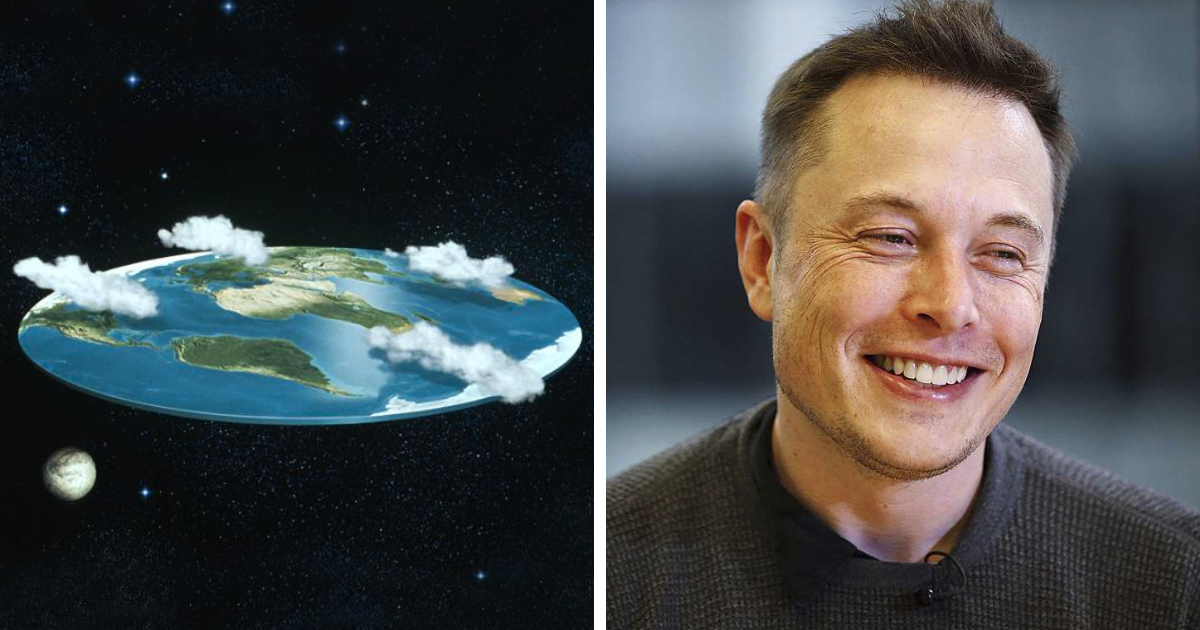
Every now and then, the internet produces a moment so perfectly strange that it feels less like a social media exchange and more like a comedy sketch written by a sleep-deprived astronomer. One of those moments arrived when Elon Musk, the SpaceX and Tesla figure known for rockets, Mars dreams, and the occasional galaxy-brained tweet, asked a simple question: why is there no Flat Mars Society?
It was a short question, but it carried enough comedic fuel to launch a small satellite. After all, if someone believes Earth is flat, should that belief apply to other planets too? Is Mars allowed to be round because it lives farther away and minds its own business? Does Jupiter need to file paperwork? The internet waited, popcorn in hand.
Then the Flat Earth Society replied with a line that instantly became legendary: Mars, unlike Earth, had been observed to be round. And there it wasthe pinnacle of irony, delivered politely, almost cheerfully, as if the universe had briefly switched into sitcom mode.
This viral moment was funny, yes, but it also became a compact lesson in science, skepticism, conspiracy thinking, social media culture, and the strange ways people decide what counts as evidence. Let’s unpack the exchange, why it hit so hard, and what it teaches us about flat Earth beliefs in the age of rockets, rovers, and very patient science teachers.
The Tweet That Launched A Thousand Facepalms
The setup was almost too good. Musk, whose company SpaceX has openly pursued the goal of making human life multiplanetary, asked why there was no organization arguing for a flat Mars. The question worked because it exposed an obvious inconsistency: if the evidence for Earth’s roundness is rejected as fake, why accept similar observations of Mars?
The Flat Earth Society’s response treated Mars as a special case. In their view, the Red Planet had been “observed” as round, while Earth somehow remained exempt from the same logic. The reply was not angry. It was not chaotic. It was polite, tidy, and scientifically upside downlike a tuxedo jacket worn with swim fins.
That is why the exchange exploded online. Musk did not write a 40-page scientific takedown. He did not bring equations, diagrams, or a globe with dramatic lighting. He simply asked a question that pushed the belief system to explain itself. The answer did the rest.
Why The Reply Was So Ironic
Irony works best when a statement accidentally defeats itself. The Flat Earth Society’s reply did exactly that. Their reasoning accepted that distant celestial bodies can be observed and understood as spherical, while denying that the same kind of observation, physics, satellite data, and historical evidence apply to Earth.
Here is the problem: Earth has been observed from space repeatedly. Its curvature is visible in photographs, satellite imagery, high-altitude observations, orbital mechanics, lunar eclipse shadows, and ordinary navigation. Scientists do not say Earth is a perfect marble, either. More precisely, Earth is closer to an oblate spheroidslightly wider at the equator than from pole to pole. In other words, not flat, not perfectly round, and definitely not a cosmic pancake.
The Mars exception is even stranger because much of what we know about Mars also comes from space agencies, telescopes, orbiters, and robotic missions. If NASA images and mission data are dismissed when they show Earth, why are they suddenly acceptable when they show Mars? That is the intellectual equivalent of refusing to trust a thermometer in your kitchen but believing it completely when it tells you the temperature in your garage.
The Science Is Not Exactly Shy
Planets tend to be round because gravity is bossy. When enough mass gathers together, gravity pulls material inward from all directions toward the center. Over time, large bodies settle into a rounded shape because that is the most stable arrangement under their own gravity.
This does not mean every object in space is a perfect sphere. Small asteroids can look like potatoes that lost a bar fight. Moons can be lumpy. Even Earth has mountains, ocean trenches, bulges, and local gravitational quirks. But planets, including Earth and Mars, are massive enough for gravity to shape them into rounded worlds.
Mars is the fourth planet from the Sun and one of the most explored objects in the solar system. NASA has sent orbiters, landers, and rovers to study its surface, atmosphere, geology, and ancient water history. The Red Planet is not a red dinner plate. It has a horizon, rotation, seasons, polar ice caps, a day length similar to Earth’s, and enough geological drama to make a documentary narrator whisper intensely for six episodes.
Why Flat Earth Claims Still Survive
So, if the evidence is overwhelming, why do flat Earth ideas continue to circulate? The answer is less about astronomy and more about psychology, identity, distrust, and online communities.
Conspiracy beliefs often offer a feeling of hidden knowledge. They tell believers: “You are not fooled like everyone else.” That can be emotionally powerful. It turns skepticism into identity and disagreement into membership. Suddenly, rejecting ordinary evidence feels like courage rather than confusion.
Social media adds rocket fuel. Algorithms reward content that sparks emotion, conflict, surprise, and outrage. A calm explanation of orbital mechanics may be accurate, but a dramatic video claiming “NASA lied to you” often travels faster because it feels like a secret door opening. The problem is that some doors lead to knowledge, and others lead to a basement where someone is arguing with a level tool.
Flat Earth communities also tend to shift the burden of proof. Any evidence for a round Earth can be dismissed as fake, edited, staged, funded, or misunderstood. When every possible correction is treated as part of the conspiracy, the belief becomes unfalsifiable. That is not healthy skepticism. It is a locked room with the key swallowed.
Elon Musk’s Question Worked Because It Was Simple
The brilliance of Musk’s question was not that it introduced new science. It introduced a comparison. If Earth is supposedly flat, why is Mars not flat too? The question forced a belief system to apply its logic consistently.
Consistency is where many conspiracy theories struggle. A theory may sound persuasive when it focuses on one narrow claim, but it begins to wobble when connected to the rest of reality. If Earth is flat, how do satellites work? Why do time zones behave as they do? Why do ships disappear hull-first over the horizon? Why do lunar eclipses show a curved shadow? Why do flights in the Southern Hemisphere make sense on a globe but become absurd on many flat Earth maps?
The Flat Earth Society’s Mars reply highlighted this problem beautifully. They accepted observation when it was aimed at Mars, but rejected stronger and more direct observation when it applied to Earth. That contradiction is why the internet laughednot merely because the answer was wrong, but because it was wrong in such a perfectly gift-wrapped way.
What This Moment Says About Internet Culture
The Musk and Flat Earth Society exchange became viral because it had all the ingredients of a perfect online moment: a famous person, a controversial group, a short question, a bizarre answer, and a punchline that needed no explanation. It was meme-ready before anyone even opened Photoshop.
But there is a deeper lesson. The internet loves dunking on bad logic, and sometimes dunking is irresistible. Still, mockery alone rarely changes minds. People who hold fringe beliefs often become more defensive when laughed at. The better approach is a mix of clarity, patience, humor, and firm evidence.
That does not mean every claim deserves endless debate. Some claims are simply false. But when communicating science, the goal is not only to win the argument. It is to make reality easier to understand than the conspiracy. Good science communication does not just say, “You are wrong.” It says, “Here is how we know, here is how you can test it, and yes, the planet remains stubbornly globe-shaped even on Mondays.”
Specific Examples That Make The Globe Hard To Ignore
1. Lunar eclipses show Earth’s curved shadow
During a lunar eclipse, Earth passes between the Sun and the Moon, casting a shadow on the lunar surface. That shadow is curved. Ancient observers noticed this long before rockets, satellites, or comment sections existed.
2. Ships vanish from the bottom up
When a ship sails away, the hull disappears before the mast. This is exactly what you expect on a curved surface. On a flat surface, the whole ship should simply shrink into the distance.
3. Time zones make sense on a rotating globe
When it is noon in New York, it is not noon in Tokyo. The pattern of daylight across the planet fits a rotating sphere illuminated by the Sun, not a flat map with a cosmic desk lamp.
4. Satellite technology works
GPS, weather forecasting, international communications, and global mapping depend on satellites orbiting Earth. These systems are not theoretical decorations. People use them daily to order food, avoid storms, and find coffee shops they will later rate three stars for “vibes.”
5. Independent observations agree
The round Earth is not supported by one agency, one country, or one photograph. It is confirmed by physics, navigation, astronomy, aviation, oceanography, geodesy, and direct observation from many independent sources.
Why Mars Was The Perfect Trapdoor
Mars made Musk’s question especially funny because Mars is central to his public vision. SpaceX has repeatedly framed Mars as a destination for future human settlement. Whether one sees that dream as inspiring, wildly ambitious, or a logistical headache wearing a spacesuit, Mars is closely associated with Musk’s brand of futurism.
By asking about a Flat Mars Society, Musk used his own favorite planet as a mirror. The Flat Earth Society then looked into that mirror and somehow saw a round Mars beside a flat Earth. The contradiction was so sharp it practically came with its own sound effect.
The moment also revealed something important about selective trust. People do not always reject evidence because it is weak. Sometimes they reject evidence because accepting it would threaten a belief, community, or worldview. Mars did not threaten the same identity in the same way, so it was easier to accept as round. Earth, however, sat at the center of the belief system, so the same standard was not applied.
The Real Lesson: Questions Can Be Stronger Than Speeches
One reason this exchange remains memorable is that it shows the power of a well-placed question. A question can expose a contradiction without requiring a lecture. It invites the audience to do the thinking themselves. That is why “Why is there no Flat Mars Society?” landed harder than a paragraph full of statistics might have.
In science education, good questions matter. They help people notice gaps in their reasoning. They turn passive disagreement into active investigation. Instead of saying, “You are wrong about Earth,” one might ask, “What evidence would change your mind?” or “Why would the same telescope be trustworthy for Mars but not for Earth?”
Sometimes the answer reveals whether the conversation is about evidence or identity. If no evidence could ever change the belief, then the debate is not scientific. It is emotional, social, or ideological. That distinction matters.
Experiences And Takeaways From The Viral Flat Mars Moment
Anyone who has spent more than 11 minutes online has probably seen a debate where facts arrive with a suitcase and immediately regret the trip. The Musk and Flat Earth Society exchange is relatable because it captures a familiar experience: someone asks a reasonable question, and the answer somehow makes the confusion stronger.
Imagine discussing this topic at a family dinner. One person brings up the tweet. Another laughs. Someone else says, “Wait, people really believe the Earth is flat?” Then a cousin opens a video titled something like “THE TRUTH THEY HID FROM YOU,” and suddenly the mashed potatoes are in danger. The conversation can spiral quickly because flat Earth arguments often feel simple on the surface. “The ground looks flat,” someone says. True. A football field also looks flat when you stand on it, but that does not mean the whole stadium is a spreadsheet.
A useful experience from conversations like this is learning not to begin with ridicule. Humor helps, but humiliation rarely does. If someone is sincerely confused, start with everyday observations. Talk about time zones, eclipses, flight paths, or why different stars are visible from different hemispheres. Use examples people can picture. Science becomes easier to accept when it feels connected to ordinary life rather than dropped from a laboratory ceiling.
Another lesson is that not every online claim deserves equal attention. Some posts are jokes. Some are bait. Some are sincere but wrong. Some are designed to keep you arguing forever because engagement is the real prize. The healthiest response is often to clarify the fact, explain the reasoning, and avoid moving into an endless debate maze where every exit is labeled “NASA conspiracy.”
The Musk moment also reminds us that irony can teach. The Flat Earth Society’s Mars reply was funny because it made selective evidence visible. People often trust information that does not challenge them and reject information that does. We all do this sometimes, even outside astronomy. We accept the weather app when it says sunny and accuse it of betrayal when rain ruins our picnic. The difference is that science gives us methods to check ourselves.
For writers, educators, parents, students, and anyone who has ever tried to explain a basic fact online without developing a twitch, this story is a useful case study. Keep the tone light. Ask sharp questions. Offer clear examples. Separate the person from the false claim. And when the internet hands you a line as ironic as “Mars is round, Earth is not,” appreciate the comedybut do not forget the lesson.
The world is complicated enough without flattening it. Evidence matters. Consistency matters. Curiosity matters. And sometimes, one simple question can reveal more than a thousand angry replies ever could.
Conclusion
Elon Musk’s brief question about a Flat Mars Society became viral because it exposed a contradiction at the heart of flat Earth thinking. The Flat Earth Society’s reply accepted that Mars is round while denying the same overwhelming evidence for Earth. That is why the moment still circulates years later: it is funny, concise, and accidentally educational.
Beyond the joke, the exchange offers a larger reminder about how misinformation works. People do not always evaluate evidence evenly. Beliefs can become tied to identity, community, and distrust. The best response combines facts, patience, humor, and questions that encourage real thinking.
Earth is not flat. Mars is not flat. The internet, however, remains a strange and bumpy landscape.












