
Note: This guide summarizes product categories and models featured in Bob Vila’s flooded-yard pump roundup. Product availability, included accessories, and specifications can change, so confirm the current manufacturer manual before buying or installing any pump.
A flooded yard can turn a normal backyard into a temporary wildlife refuge for mosquitoes, soggy socks, and one deeply offended lawn mower. A little standing water after a storm is not always a crisis. But when puddles linger, creep toward the foundation, drown plants, or make the lawn feel like a sponge cake with trust issues, it is time to move water somewhere safer.
The right pump for a flooded yard depends on much more than raw horsepower. You need to consider water depth, debris, pumping distance, elevation, available electricity, and where the water can legally and safely go. Bob Vila’s picks cover a useful range: portable utility pumps for moderate pooling, serious gas-powered transfer pumps for heavy flooding, and battery-operated options for the unpleasant moment when rain knocks out the power.
This guide explains what makes each option useful, where it fits best, and how to avoid buying a pump that looks heroic online but spends storm day wheezing beside a garden hose.
Why a Flooded Yard Needs More Than a Garden Hose
A garden hose works beautifully when water already has somewhere to go and gravity feels cooperative. Flooded yards are usually less polite. Water often gathers in a low point, a compacted patch of soil, beside a patio, around a downspout, or near the home’s foundation. In those cases, the goal is not simply to remove water; it is to lift or transfer it to a suitable drainage point.
That is where a yard drainage pump earns its keep. A submersible pump sits directly in the water and pushes it out through a discharge hose. A transfer pump typically stays on dry ground and pulls water through a suction hose before sending it away. A sump pump can be part of a more permanent drainage system, especially in yards with a predictable low spot or homes that regularly deal with groundwater near the foundation.
The most important lesson is that a pump is an emergency tool and sometimes a permanent part of a drainage plan, but it is not a cure for poor grading, clogged gutters, compacted soil, or runoff from neighboring hard surfaces. If the same section of lawn floods after every storm, the pump removes today’s headache. Better drainage design helps prevent the sequel.
At a Glance: Bob Vila’s 7 Flooded-Yard Pump Picks
| Pick | Best For | Type | Listed Capacity |
|---|---|---|---|
| Green Expert ⅓ HP Sump Pump | Versatile everyday floodwater removal | Submersible sump/utility pump | Up to 2,000 GPH |
| Milescraft 1314 DrillPump750 | Low-cost occasional pumping jobs | Drill-powered transfer pump | Up to 750 GPH |
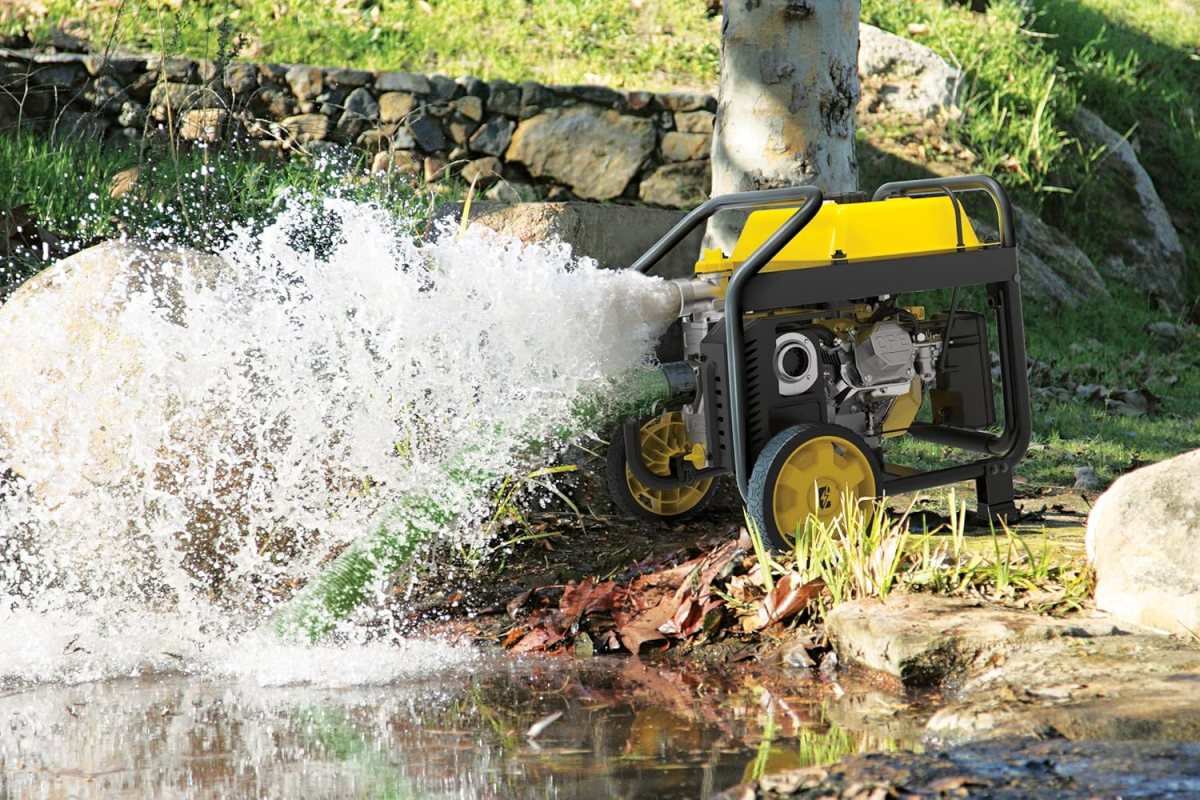
| Champion Gas-Powered Transfer Pump | Large, dirty-water flooding jobs | Gas semi-trash transfer pump | Up to 158 GPM |
| Zoeller Model 53 | Durable automatic sump applications | Submersible sump pump | Up to 2,680 GPH |
| Dekopro Submersible Utility Pump | Portable utility and cleanup work | Submersible utility pump | Up to 2,450 GPH |
| Vivosun 115V Water Transfer Pump | Small, occasional standing-water problems | Compact transfer pump | Up to 330 GPH |
| Milwaukee M18 Cordless Transfer Pump | Power outages and mobile water removal | Battery-powered transfer pump | Up to 480 GPH |
Remember that maximum flow ratings are usually measured under ideal conditions. The farther a pump must send water upward or across a long hose, the lower its real-world output can become. A pump’s “headline number” is useful, but the discharge height and hose setup decide how impressive it will be when the lawn is actually underwater.
The 7 Best Pumps for Flooded Yards
1. Green Expert ⅓ HP Sump Pump: Best Overall
The Green Expert ⅓ HP Sump Pump was Bob Vila’s overall pick because it combines portability with the flexibility to work as either a submersible pump or a more general utility pump. With a listed maximum flow rate of 2,000 gallons per hour, it is designed for homeowners who need a capable response to puddled lawns, window wells, small flooded spaces, rain barrels, and other water-removal chores.
Its appeal is versatility. Instead of buying one device only for a yard emergency, you get a pump that can also help empty a pool cover, drain a pond, or remove water after a plumbing mishap. The automatic mode can make it easier to manage ongoing pooling, while manual operation can pull water down lower than an automatic sensor typically allows.
The catch is that manual pumping requires attention. Pumps should not be left to run dry unless the manufacturer specifically says they are protected for that use. Think of dry-running a pump as making a blender perform without anything in the jar: technically dramatic, practically regrettable.
2. Milescraft 1314 DrillPump750: Best Budget Pick
The Milescraft 1314 DrillPump750 is a clever emergency tool for homeowners who already own a compatible drill and do not need to move a backyard lake before lunchtime. This compact attachment uses the drill’s motor to power the pump, making it a budget-friendly option for small-scale water transfer.
Its advertised output is up to 750 gallons per hour, though actual performance depends on the drill, hose configuration, water lift, and setup. It connects to standard garden-hose fittings, which keeps the accessory list mercifully short. For a small rain-filled low spot, an outdoor fountain cleanup, or water collected in a shallow container, that simplicity can be valuable.
However, this is not the right choice for deep standing water, dirty floodwater, or use in wet conditions with a corded drill. The pump should be secured to a board or stable surface rather than held in the air like a power-tool rodeo. It is best viewed as a handy transfer solution, not a substitute for a dedicated submersible flood pump.
3. Champion Gas-Powered Transfer Pump: Best Heavy-Duty Option
When the water volume is serious and electrical service is unavailable or unsafe to use, a gas-powered transfer pump becomes the heavy machinery of the group. Bob Vila selected the Champion gas-powered transfer pump for high-capacity work because its listed output reaches up to 158 gallons per minute, which is dramatically more water-moving power than most portable electric options.
This semi-trash-style pump is designed to handle water containing small debris, including particles up to roughly one-half inch in diameter. That matters in a muddy yard where leaves, soil, mulch, and tiny branches may be floating around like storm souvenirs. The included suction and discharge hoses also make it more ready for large jobs than a bare pump body with no practical way to move water.
Still, gas power brings responsibilities. Use it only outdoors in a well-ventilated area, follow fuel and maintenance instructions, and never assume a high-capacity pump makes floodwater safe to enter. This is the option for a big low-lying property, a large drainage ditch, or an emergency cleanup situation where a smaller pump would be trying to empty the ocean with a soup spoon.
4. Zoeller Model 53 Submersible Sump Pump: Best Submersible
The Zoeller Model 53, often known as the Mighty-Mate, is a well-known automatic sump pump built for groundwater and sump-basin applications. Bob Vila highlighted it as the best submersible choice because of its automatic float operation, corrosion-resistant materials, and durable construction.
With a listed maximum flow rate of up to 2,680 gallons per hour, the Model 53 can make sense for a permanent or semi-permanent setup in a properly designed sump pit at the lowest area of a flooding-prone yard. The float switch turns the pump on as water rises and shuts it off once the level drops, which is exactly the kind of quiet competence homeowners appreciate when rain begins at 2 a.m.
This pump is not a casual “drop it into any random muddy hole” solution. For outdoor use, the basin, discharge route, electrical connection, and frost exposure all matter. A durable sump pump can be an excellent long-term investment, but it works best as part of a planned drainage system rather than a last-minute improvisation involving a shovel, a bucket, and optimism.
5. Dekopro Submersible Utility Water Pump: Best Utility Pump
The Dekopro Submersible Utility Water Pump offers a practical middle ground for homeowners who want a portable pump that can handle several tasks beyond one flooded patch of lawn. Bob Vila listed its output at up to 2,450 gallons per hour, making it a capable choice for rainwater removal, small ponds, pool draining, irrigation chores, and emergency yard cleanup.
Its lightweight thermoplastic housing helps make it easy to carry and reposition. It also includes hose-adapter options, which can reduce the frustration of discovering that the pump outlet and your available hose belong to different universes. The removable debris screen is another useful feature for outdoor work, where leaves seem magnetically attracted to every water intake.
The main limitation is that it does not offer automatic operation. You will need to monitor it and turn it off before it runs dry. That makes it a good choice for supervised cleanup sessions, but not the ideal option for an unattended drainage basin that fills every time a thunderstorm decides to audition for a disaster movie.
6. Vivosun 115V Water Transfer Pump: Best for Small Flooding Jobs
The Vivosun 115V Water Transfer Pump is built for smaller-volume jobs. With a listed maximum capacity of 330 gallons per hour, it is not trying to outmuscle a gas-powered transfer pump. Instead, it aims to be compact, portable, and useful when you need to move a manageable amount of water from one place to another.
This type of transfer pump can be a sensible choice for a shallow puddle near a patio, water collected in a decorative pond, a rain barrel mishap, or occasional damp spots where the volume is modest. The smaller size also makes storage easier, which is nice for anyone whose garage already contains three ladders, holiday decorations, and an unidentified box labeled “miscellaneous cables.”
Because the power cord is relatively short and the flow rate is modest, planning the setup is important. Keep the electrical connection dry and protected, use only approved power arrangements, and avoid trying to make this little pump tackle debris-heavy or rapidly rising water. For a small job, it can be delightfully useful. For a major flood, it may become a very determined spectator.
7. Milwaukee M18 Cordless Transfer Pump: Best Battery-Powered Option
The Milwaukee M18 Cordless Transfer Pump solves a problem that corded pumps cannot: power outages. Storms often bring both heavy rain and electrical interruptions, which is an especially rude combination when you need to remove water. This cordless model runs on Milwaukee’s M18 battery platform and has a listed maximum capacity of up to 480 gallons per hour.
Its portable format makes it useful for moving water from shallow areas, rain barrels, utility basins, small flooded spaces, or places far from a safe electrical outlet. Features such as self-priming capability and dry-run protection can make it more convenient for emergency use than basic transfer pumps.
The trade-off is runtime. Battery-powered equipment is wonderfully mobile, but batteries are not bottomless wells of electricity. The pump is best for targeted water transfer, not for draining a large flooded yard all afternoon. Homeowners who rely on cordless tools should keep at least one charged spare battery available during severe-weather season.
How to Choose the Right Flooded-Yard Pump
Start With the Water, Not the Product Listing
Before choosing a pump, estimate how much water is present and what is floating in it. Clean rainwater with a few leaves is one thing. Muddy water full of mulch, gravel, and debris is another. A utility or sump pump may work for relatively clean water, while a semi-trash transfer pump is better suited to heavier debris.
Understand Flow Rate and Head Height
Gallons per hour and gallons per minute measure how quickly a pump can move water. But flow rate drops as the pump pushes water higher or farther. This resistance is often described as head height. A pump that moves thousands of gallons per hour at ground level may deliver much less when sending water uphill, across a long property, or through a narrow hose.
Check the manufacturer’s performance chart, not just the largest flow number on the box. A lower-capacity pump with a better match for your actual lift and hose length can outperform a larger model used in the wrong setup.
Choose a Discharge Route Before You Pump
Water needs a legal, safe destination. Never send pumped runoff toward a neighbor’s property, directly against your home, or into a location where it will immediately return to the same low spot. Local rules may limit discharge into storm drains, ditches, sewer systems, wetlands, or waterways.
For recurring water problems, a properly designed dry well, rain garden, drainage channel, French drain, or approved outlet may be more useful than repeatedly pumping the same puddle. The goal is to move water away without simply giving someone else your problem in liquid form.
Pick Automatic or Manual Operation
Automatic pumps use a float switch or sensor to turn on when water reaches a certain level. They are useful for sump pits and known low areas that regularly collect water. Manual pumps are often more flexible for one-time cleanup jobs, but they require supervision to prevent dry running and overheating.
Flooded Yard Pump Safety: The Part That Is Not Optional
Floodwater can contain contaminants, hidden sharp objects, unstable soil, and electrical hazards. Do not enter moving water or water near downed power lines. Keep children and pets away from flooded areas, and treat unknown floodwater as potentially contaminated.
For corded equipment, use a properly installed, ground-fault circuit interrupter protected outlet and follow the pump manufacturer’s electrical requirements. Do not use a damaged cord, do not place plugs or connections in standing water, and do not improvise with an extension cord that is not approved for the equipment and environment. When in doubt, stop and contact a qualified electrician or water-removal professional.
Inspect the intake before use and clear debris carefully with the power disconnected. Confirm that the discharge hose is secure and pointed toward an approved drainage area. A loose hose can turn a simple pumping job into an accidental backyard sprinkler system with extremely poor timing.
Fix the Cause After the Water Is Gone
Once the yard has dried, investigate why it flooded. Start with gutters and downspouts. A downspout that empties beside the foundation can create a pond with the confidence of a real estate developer. Extend the downspout to a suitable drainage area, inspect it for clogs, and make sure surrounding soil slopes away from the house.
Compacted clay soil, poor grading, blocked drain lines, and low sections of lawn can all trap water. Regrading may be necessary when water consistently flows toward the home. For less severe issues, a shallow swale, dry creek bed, rain garden, aeration, or raised planting bed may improve drainage and protect plants.
A pump is invaluable during an emergency. A better drainage plan makes emergencies less frequent.
Experience and Practical Lessons From Flooded-Yard Pumping
Homeowners often discover the most important lesson about flooded-yard pumps after the first major storm: the pump itself is only one piece of the system. A powerful pump can remove standing water quickly, but it cannot compensate for a discharge hose that kinks halfway across the lawn, a clogged intake buried under leaves, or a drainage outlet that sends water straight back toward the house.
One common real-world scenario starts with a low patch near a fence line. The yard looks fine most of the year, then a hard rain turns that corner into a shallow pond. A small submersible utility pump can usually handle this job well when the water is mostly clean. The user places the pump on a stable surface, runs a discharge hose toward an approved lower area, and monitors the water level. The key is patience. Moving water through a long hose takes time, and trying to rush the process by pinching, twisting, or lifting the hose often reduces flow instead of improving it.
Another frequent experience involves debris. After a storm, water rarely arrives alone. It brings grass clippings, mulch, tiny sticks, leaves, soil, and whatever mystery object was hiding beneath the patio furniture. Pumps with small intakes can clog surprisingly fast. A simple screen, a raised platform, or a clean plastic tray under the pump can help keep sediment from being pulled directly into the intake. That small preparation step can prevent repeated shutdowns and save a homeowner from crouching beside muddy water every 10 minutes.
People also tend to overestimate how much a listed flow rate tells them. A pump advertised at several thousand gallons per hour sounds unstoppable, but the numbers usually reflect ideal conditions. Add a 25-foot hose, several feet of vertical lift, a narrow discharge line, or a partially clogged intake, and output declines. This does not mean the pump is defective. It means physics has arrived, wearing work boots and carrying a clipboard.
Battery-powered pumps create another valuable lesson: convenience and capacity are different things. A cordless transfer pump can be excellent when a storm knocks out electricity or when there is no nearby outlet. It is easy to carry, quick to deploy, and much safer than trying to bring a questionable extension cord near standing water. But a battery-powered unit is generally best for targeted removal rather than a massive, long-running drainage project. Keeping batteries charged before storm season is more useful than discovering an empty battery at the exact moment the yard becomes a swamp.
For recurring flooding, homeowners often report the best results after combining a pump with a permanent improvement. Extending downspouts, reshaping a shallow low area, adding a drainage swale, or building a rain garden can reduce how often the pump is needed. The pump handles the emergency; the drainage work changes the pattern. That combination is usually more satisfying than repeatedly standing in the rain, watching a hose do its best impression of a very slow magic trick.
Final Thoughts
The best pump for a flooded yard is not automatically the biggest, loudest, or most expensive model. It is the one that matches the amount of water, debris level, discharge distance, power availability, and frequency of flooding on your property. Bob Vila’s seven picks offer useful choices for nearly every scenario, from a budget drill attachment for small transfers to a gas-powered semi-trash pump for major water removal.
For occasional puddles, a portable utility or transfer pump may be all you need. For recurring water around the foundation or a predictable low spot, consider a professionally designed sump or drainage system. Most importantly, pump water safely, direct it responsibly, and solve the drainage problem before your backyard starts charging admission for canoe rides.












