
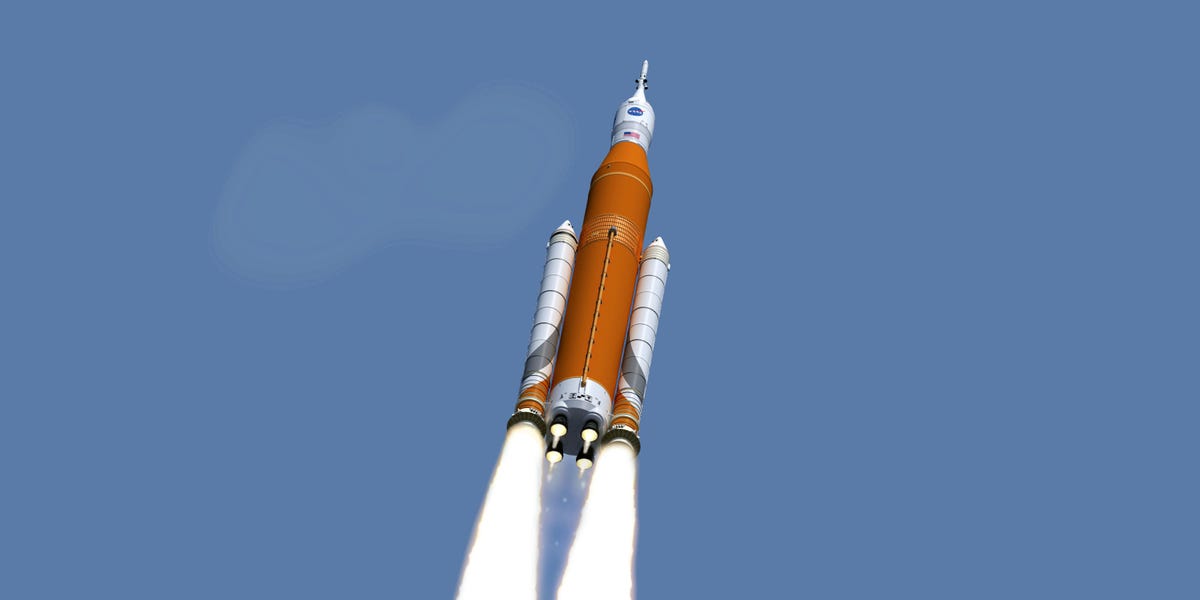
In the space world, there are “big announcements,” and then there are Big announcementsthe kind that make engineers grin, politicians squint at spreadsheets,
and space nerds suddenly remember where they left their lucky moon socks. On February 2, 2016, NASA dropped one of those Big announcements: the first flight of the
Space Launch System (SLS), its largest rocket since the Saturn V era, would carry an uncrewed Orion spacecraft and a mini-fleet of 13 CubeSats on a mission known at
the time as Exploration Mission-1 (EM-1). In other words: a giant rocket with a big-ticket passenger… and a bunch of tiny hitchhikers with serious science goals.
And while the announcement targeted a first flight in 2018, the real story (because space is never boring) became a longer, twistier journeyone that ultimately led
to Artemis I launching in 2022 and proving that this new “mega Moon rocket” could do what it was built to do: send Orion far beyond the Moon and bring it safely home.
The result is a modern space exploration tale with everything: legacy hardware, new tech, lunar ambition, and enough scheduling drama to power a streaming series.
What NASA Actually Announced in 2016 (And Why People Cared)
NASA’s 2016 press release wasn’t just “rocket news.” It was a roadmap marker. The agency said SLS’ first mission would launch Orion into a stable orbit beyond the Moon
to demonstrate the integrated performance of Orion, the SLS rocket, and ground systems before putting astronauts on board later. The headline-grabber, though, was the
bonus payload: 13 CubeSats riding along to deep spacean unusually rare opportunity for small satellites that typically get “stuck” in low-Earth orbit.
The “big rocket” part: a super heavy-lift comeback
NASA hadn’t flown a Saturn V since the Skylab era, when the final Saturn V launched America’s first space station on May 14, 1973. So when NASA talked about a rocket
in the same “super heavy-lift” conversation, it was tapping into real historyand a real capability gap. SLS was positioned as the foundation for human exploration
beyond Earth orbit: the kind of vehicle that can hurl crew hardware, cargo, and big mission energy toward the Moon (and eventually Mars).
The “tiny satellites” part: a clever science multiplier
The CubeSats were the undercard that could steal the show. NASA explained that after Orion separated from the upper stage and moved to a safe distance, the CubeSats
would deploy from dispensers on the Orion stage adapter. Each would phone home so ground stations could confirm they woke up and worked. It’s a simple idea with huge
upside: you’re already paying to light an 8.8-million-pound-thrust candleso why not use the ride to send a few dozen pounds of extra science into deep space?
Meet SLS: NASA’s Biggest Rocket Since Saturn V
How big is “big”?
In its Block 1 configuration (the one tied to the first mission), SLS stands about 322 feet tall, weighs about 5.75 million pounds
fully fueled, and produces about 8.8 million pounds of maximum thrust during launch and ascentabout 15% more than Saturn V. That’s not “big for a
rocket.” That’s “rearrange your internal organs from several miles away” big.
Shuttle DNA, Moon ambitions
One reason SLS feels like a bridge between eras is that it uses heritage technology in a modern architecture. NASA built SLS with a mix of Space Shuttle-derived
componentslike RS-25 enginesand new hardware, tying proven engineering to a new deep-space mission profile. That combination is part of the pitch: minimize reinvention
where it doesn’t buy you safety or capability, then spend innovation where it does.
NASA described the first SLS configuration for EM-1 (later Artemis I) as Block 1 with a minimum 70-metric-ton lift capability, powered by twin boosters and four RS-25
engines. Translation: it’s designed to move very large things very far, in a single launch, without needing an orbital “moving day” convoy of multiple rockets.
Orion: The Capsule Built for Deep Space (And Deep-Space Reentry)
If SLS is the muscle, Orion is the tough little travel trailer that has to keep everyone alive when the road gets weird. Orion is meant to carry astronauts farther than
they’ve gone in decades, support them during deep-space travel, and survive the toughest part: returning to Earth at deep-space speeds.
Artemis I helped prove that. NASA’s mission facts for Artemis I report a mission duration of 25 days, 10 hours, 53 minutes, a total distance traveled
of about 1.4 million miles, and an Earth re-entry speed of about 24,581 mph (Mach 32). If your car ever hits Mach 32, something has
gone deeply wrongso yes, that heat shield matters.
The 13 CubeSats: Tiny Hitchhikers With Serious Goals
Why CubeSats on a mega-rocket makes sense
CubeSats are small satellites often built faster and cheaper than traditional spacecraft. The tradeoff is limited power, propulsion, and communications. Getting them to
deep space is hard because most rideshare opportunities end in low-Earth orbit. That’s why NASA’s 2016 plan was such a big deal: SLS’ first flight created a path for
small missions to go where they almost never get to go.
Examples of the CubeSat missions NASA highlighted
NASA’s announcement broke out the initial set of CubeSats by selection pathanother reminder that this wasn’t just “grab 13 random boxes and strap them on.” These were
carefully chosen science and technology experiments:
- Skyfire (Lockheed Martin): a lunar flyby to collect infrared sensor data and improve understanding of the lunar surface.
- Lunar IceCube (Morehead State University): a low lunar orbit mission to search for water ice and other resources.
- NEA Scout: asteroid reconnaissance, including imaging and observations to understand an asteroid’s position and properties.
- BioSentinel: a deep-space radiation biology experiment using yeast to measure radiation’s effects on living organisms over long durations.
- Lunar Flashlight: a mission to look for ice deposits and identify locations where resources may be extracted from the lunar surface.
- CuSP: a “space weather station” concept to measure particles and magnetic fields, testing the practicality of a monitoring network.
- LunaH-Map: mapping hydrogen in permanently shadowed regions near the Moon’s south pole (where water ice may hide out).
NASA also described additional CubeSats to be selected through its Cube Quest Challenge, plus reserved slots for international partners. The overall vibe was clear:
the flagship rocket was going to do flagship work, but it would also open doors for smaller experiments that could punch above their weight.
From “First Flight in 2018” to Artemis I in 2022: What Changed?
Space schedules are best read with the same calm skepticism you’d use on a menu that promises a “12-minute brisket.” NASA’s 2016 plan aimed at 2018, but complex
programs like SLS and Orion face real-world friction: testing campaigns, integration challenges, hardware issues that only appear when everything is stacked, and the
simple difficulty of building a brand-new super heavy-lift system designed for human-rated missions.
By the time Artemis I finally launched on November 16, 2022, it carried the weight of that entire development story. But the payoff was meaningful: Artemis I became
the first integrated flight test of NASA’s deep-space exploration system (SLS, Orion, and ground systems), and it completed its mission successfully, splashing down on
December 11, 2022.
What the First Flight Actually Proved
The cleanest way to describe Artemis I is: “It worked, and it taught NASA a lot.” The mission demonstrated that the SLS rocket could launch Orion, that Orion could
travel well beyond the Moon, operate as intended, and return safely to Earth. NASA positioned Artemis I as the first in a series of increasingly complex missions meant
to enable human exploration at the Moon and support future missions to Mars.
Beyond the headline success, Artemis I also created a data bonanza: thermal performance, navigation, communications, reentry heating, parachute behaviorplus all the
“quiet” details that are actually the loudest part of engineering. In deep spaceflight, you don’t learn what you don’t know until you fly. Artemis I was that learning.
Why This Matters Now: Artemis II and the Next Steps
Artemis II: humans on board
NASA’s next big step is Artemis II, described as a 10-day crewed lunar flyby mission and the first time astronauts will ride SLS and Orion together in deep space.
NASA’s Artemis II page states a launch target of no later than April 2026 and a crew size of four. The mission is meant to confirm that spacecraft
systems operate as designed with humans aboard in the real deep-space environmentbecause the Moon is not the place to discover you packed the wrong charger.
Artemis III and beyond: sustainable lunar goals
Artemis is often described as “Moon to Mars,” but the Moon portion is the point. NASA’s Artemis campaign frames the lunar effort as scientific discovery, technology
advancement, and learning how to live and work on another world. That’s why ice detection matters, why south polar terrain matters, and why a long-term presence is
treated like the endgamenot just a flag-planting cameo.
Meanwhile, SLS itself is designed to evolveBlock 1 is only the start. NASA’s fact sheets describe an “evolvable” rocket family intended to grow in lift capability and
mission flexibility over time. In practical terms: bigger lunar cargo, more ambitious deep-space infrastructure, and a launch vehicle that can support a variety of human
and robotic missions.
The Big Debate: One Rocket, Many Opinions
You can’t build the biggest rocket since the 1970s without inviting debate. Supporters argue SLS provides a government-owned heavy-lift backbone for human exploration,
optimized to send Orion, crew, and large cargo toward the Moon on a single mission. Critics counter with questions about cost, cadence, and the rise of commercial heavy
lift. Both perspectives exist because the stakes are real: if Artemis succeeds, it shapes the next generation of human exploration; if it stumbles, it reshapes the
conversation about how we explore deep space.
The good news is that Artemis I moved the conversation from “Can it fly?” to “How do we fly it often, safely, and sustainably?” That’s a much better argument to have.
Conclusion: A Giant Rocket, a Smaller Solar System
NASA’s 2016 announcement about the first flight of its biggest rocket since the 1970s was a promise: the United States would rebuild true super heavy-lift capability
and use it to push human exploration beyond Earth orbit again. The path from EM-1 on paper to Artemis I in the sky took longer than plannedbecause spaceflight is hard
and rockets are allergic to optimism. But Artemis I flew, Orion came home, and the Artemis roadmap now has real flight data under its feet.
And that original 2016 detailthe idea of pairing a massive rocket with small, nimble CubeSatsstill captures the spirit of modern exploration: go big when you must,
go small when you can, and always bring extra science for the ride.
Launch-Day Experiences and Stories (Extra 500+ Words)
Not everyone gets to weld rocket parts or run a countdown console (tragic, honestly), but the first flight of a mega-rocket creates a different kind of participation:
the human experience of watching something enormous happen in real time. Whether you’re on Florida’s Space Coast or streaming from your living room, big launches have a
way of turning ordinary people into temporary mission specialistssuddenly everyone is an expert in weather rules, engine chill-down, and the emotional meaning of the
phrase “hold, hold, hold.”
What it’s like to watch a giant rocket in person
People who travel to see major launches often describe the day as a weirdly joyful mix of festival and science fair. You’ll see families with folding chairs, camera
lenses the size of small pets, and strangers making small talk like they’ve known each other for yearsbecause you’re all there for the same reason: to feel the moment
when thousands of tons of machine decide to become a loud, bright idea and leave Earth.
One of the most common surprises is the delay between seeing and feeling. Light arrives instantly, but sound doesn’t. So spectators often see the
engines flare and the rocket start to climb… and only a few seconds later the sound hits, rolling across the distance like a storm front that learned public speaking.
People talk about the rumble in the chest and the way the ground can feel alive. It’s less “I heard a rocket” and more “I accidentally befriended thunder.”
Then there’s the waitingsometimes a lot of it. Big rockets launch when the rocket, the range, and the weather agree, which is not a reliable social circle. Veteran
spectators pack snacks, sunscreen, water, and a sense of humor. Newcomers pack optimism and then learn why veterans also pack snacks.
What it’s like to watch from home (and still feel part of it)
Streaming a launch might sound less dramaticuntil you realize it can be even more intense. At home, you’re closer to the commentary, the camera angles, and the mission
control audio. Viewers get to hear the cadence of the countdown and the tiny notes of tension in a commentator’s voice when something unexpected pops up. It becomes a
shared experience across time zones: group chats light up, social feeds become a rolling mission log, and people start timing snack breaks around “built-in holds.”
A lot of families turn big launches into informal science nights: kids draw rockets, adults attempt to explain orbital mechanics with the confidence of someone who once
assembled a bookshelf without reading the instructions. It’s a rare moment when high-level engineering becomes a living-room eventone where you can pause the stream,
rewind, and go, “Wait, did you see that separation?” like you’re analyzing game footage.
What people remember most afterward
The stories that stick usually aren’t about the exact altitude at booster separation. They’re about the feeling: the brightness of the plume against a dark sky, the way
strangers cheer together, and the sudden realization that space exploration is both incredibly advanced and deeply human. The first flight of a rocket like SLS isn’t
just a technical milestone; it’s a reminder that exploring beyond Earth is still, at its core, a decision we make as a societyone launch, one mission, one careful,
hopeful step at a time.
And if you’re looking for a simple takeaway from people who’ve watched these moments (in person or online), it’s this: you don’t have to understand every subsystem to
be moved by the sight of something built by thousands of people rising into the sky. You just have to look up. The rocket does the rest.












